
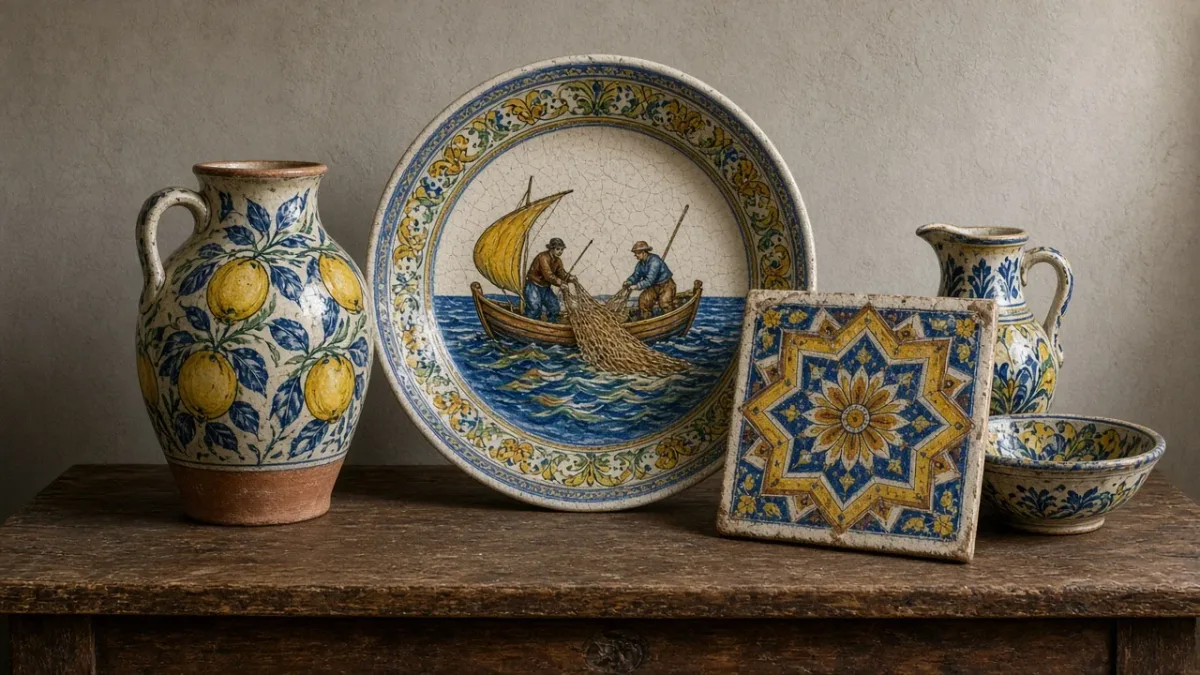
Vietri Ceramics Workshops and Marks of Campania
How collectors identify Vietri ceramics by tin glaze, workshop marks and form, from ICS fish marks to later Solimene and Pinto of Vietri sul Mare.
Vietri sul Mare stands at the western approach to the Amalfi Coast, on the Bonea torrent that once turned the mills for clay and colour. The town's tin-glazed earthenware is not a Renaissance court product. It is a Campanian workshop ware, documented from a 1558 spice-jar commission through the twentieth-century factories of Melamerson, Pinto and Solimene. Collectors who already know Urbino istoriato or Faenza berettino will find a different problem here: popular forms, a manganese-heavy palette, and factory marks that are both abundant and frequently copied.
Location, clay and the documentary record
The Abbey of the Santissima Trinità at Cava dei Tirreni, founded in 1020, received the port of Vietri from Duke Roger and treated the coastal strip as an industrial annex for tiles and vessels needed by the house. An eleventh-century name, Sergio Caccabellu, already alludes to caccabi, clay pots. The first securely dated Vietri commission tied to a named potter is the 1558 supply of spice jars by Mario de Stasio, decorated a penna di pavone (peacock feather). That motif, with the stylised palm, also appears on Orvieto ware.
Vietri was chosen over Cava for production because the Bonea could drive mills for grinding clay and pigments. In the seventeenth century Abruzzese potters from Castelli increased output of plates, tankards, saucers and salt cellars. Vietri faenzari also opened shops in Naples, in Piazza dei Cantari (from cantaro, a vessel), and a Vietri shop is recorded at Minori. The seventeenth-century table ware follows the compendiario manner: a white tin ground and a reduced drawing in turchino, yellow and orange, with green used sparingly.
The oldest ceramic object still in situ is a votive aedicule dated 1627, a Crucifixion between saints, set on a former tower at Raito. Dated votive tiles of the same class survive on walls from Marina di Vietri and Molina up to Dragonea, Albori, Benincasa and Raito. They are a dating series, not a decorative extra. Guido Donatone's La ceramica di Vietri sul Mare, dalle origini all'Ottocento (Naples, 1991) remains the standard account of this pre-industrial phase.
Eighteenth- and nineteenth-century forms
Eighteenth-century Vietri raised the quality of the palette on pharmaceutical jars. Manganese brown, used as a linear mark and as a wash, is a reliable workshop trait in this group. Landscape painting in turchino appears on the same jars. Export to Sicily is documented in this century. Late in the period the tankard with a central lobe enters the repertoire.
Floor and wall tiles, riggiole, reach their highest quality in the nineteenth century. Vietri squares measure 19 × 19 cm, a fraction smaller than the 20 cm module used in other Campanian factories. The difference is useful when a pavement has been reset or a loose tile is offered as "Neapolitan." A large Vietri floor of about 1750, with anthropomorphic leopards and scenes of the Labours of Hercules, survives in the Galleria degli Specchi of Palazzo Valguarnera-Gangi in Palermo.
Popular table ware of the same centuries uses a loud, limited range: yellow, cobalt or turchino, orange, red, copper green (verde ramina) and manganese. Typical shapes include the ogliarulo, a single-handled oil jar, and the large serving dish called caponciello or realcapone. Flower, bird, fish and rustic scenes are painted with a broad brush on a tin glaze whose brilliance depends on a tin-bearing smalto still referred to locally as "Vietri" glaze. The same tin-glaze technique underlies Faenza, Deruta and Urbino, but the drawing and the body colour differ.
By the early nineteenth century seven faenzere are recorded; by 1880 there were twelve, employing more than three hundred families. Names that persist in later factory histories include Sperandeo, Tajani and Punzi. Vincenzo Pinto (born 6 April 1870) first ran a terracotta works at Molina, then rented the early-nineteenth-century kiln on the ground floor of Palazzo Pizzicara, previously used by Michele and Gaetano Sperandeo. On 31 January 1910 he bought the tenement and factory from Giuseppe Pizzicara, as recorded by the notary Leonardo Gargano. The house on Corso Umberto I remains Ceramica Pinto.
The 1920s to 1940s: ICS, Dölker, Kowaliska, Gambone
Around 1920–1947 the town absorbed a group of northern European painters and throwers. Local writing still calls this the periodo tedesco. The term is convenient and incomplete. Poles, Swiss, Swedes and Russians worked beside Germans, and the shops remained Vietri-owned or Vietri-staffed. The Museo provinciale della ceramica at Villa Guariglia, Raito, opened on 9 May 1981 in a bequest of the diplomat Raffaele Guariglia (1970), keeps a floor of this production, together with the Di Marino, Camponi, Dölker and Kowaliska gifts.
Richard Dölker (Schömberg, 1896–Kohlgraben, 1955) arrived in 1923. The ICCD catalogue records his personal mark as a Möbius ring surmounted by a cross. He left Vietri in 1933, spent a period at Luino on Lake Maggiore, and returned to Germany in 1935. The green donkey, or ciucciariello, that later became a Vietri emblem is his. The UNESCO Amalfi Coast dossier notes that the animal follows a Sardinian type, drawn after Dölker's travel in the Barbagia, not a Campanian farm donkey. Popular dating that places the first donkey in 1922, before his arrival, should be treated as unproven.
Max Melamerson (born Moishe Melamerson, Suwałki, 17 October 1881; died Rome, 1948) took over the Della Monica maiolica works at Marina di Vietri in 1926 and founded the Industria Ceramica Salernitana (ICS) with Günther Stüdemann. A catalogued ICS alzata in the Emilia-Romagna cultural-heritage inventory carries, under the foot, the painted sequence ITALY / I.C.S. / asterisk / stylized fish / 363. That fish-and-numeral formula is the factory's working mark. Georg Trump, a friend of Dölker, is credited in later literature with designing a fish in a red circle; the documentary mark on surviving table ware is the linear fish with I.C.S. and a batch number.
Melamerson gave Dölker the artistic direction of ICS in the first months of 1927. The arrangement lasted only a short time. In 1935, after Dölker had left, Guido Gambone became head painter. Treccani's biography (Elena Longo, Dizionario Biografico degli Italiani, vol. 52, 1999) is the cleanest chronology. Gambone was born at Montella, near Avellino, on 27 June 1909. At fifteen he entered Francesco Avallone's factory. Two Avallone plates attributed to him appeared in Domus (no. 10, 1928) among pieces shown at the second Pesaro Quadriennale; Avallone also sent his painting to Monza in 1930. After a road accident in 1933 that cost him a leg, he took the ICS post in 1935. In 1936 he went to Florence with Vincenzo and Salvatore Procida and Francesco Solimene to work in Melamerson's arrangement with Cantagalli. Four polychrome pieces from that phase are in the Raito museum (Cefariello Grosso, 1994).
He returned in 1939 to the same firm, then directed by Luigi Negri and renamed Manifattura Artistica Ceramica Salernitana (MACS). Racial legislation of 1938 forced the change of name and ended Melamerson's control. In 1944 Gambone and Andrea D'Arienzo opened La Faenzarella. The shop's speckled, craquelé glaze, later called smalto Gambone, was copied by other Vietri kilns. The factory closed in 1950 when Gambone moved to Florence. The Faenzarella years, not the later Florentine stoneware, are the Vietri chapter.
Irene Kowaliska (1905–1991), Polish by birth, reached ICS in 1931. In 1932 Vincenzo Pinto gave her a studio at his Industria Ceramiche Artistiche Meridionali (ICAM). In 1937 she opened her own Vietri workshop. Her figures sit isolated on the ground, with large dark eyes; painted words such as marina, amore and fortuna appear on some pieces. Giovannino Carrano later designed the manganese façade panel on Palazzo Pinto (1977). Barbara Margarethe Thewalt-Hannasch, Lisel Oppel, the thrower Otto Piasche (also recorded as Pieschen) and Giuseppe Cassetta (at ICS from 1927 to 1942) complete the core list.
Solimene and the postwar factories
The 1954 flood wrecked Marina and Molina. Several kilns closed. Vincenzo Solimene, from a family already in the trade, had been in production at Vietri since 1947. In 1951 he asked Paolo Soleri for a new factory. The present Ceramica Artistica Solimene building, Via Madonna degli Angeli 7, opened in 1954; the cylindrical terracotta tubes of the façade date from 1954–56. Early backs are often ink-stamped C.A.S. with Vietri or Vietri Italy and a pattern number. A glazed stoneware vase sold at Bonhams Skinner in May 2025 (lot 270) was marked C.A.S. Vietri Italy 432 and dated about 1955 (height 10 in / 25.4 cm). Around 1963 the firm adopted a coloured chick as a house device. That chick is a late mark. It does not date a piece to the 1940s.
At Pinto, Raffaele Pinto replaced the wood kiln with a diesel tunnel kiln in 1959, the first industrial oven in the town. Amerigo Tot directed the shop artistically in the early 1950s. Industria Ceramica Avallone (ICA) and, from 1944, Giuseppe Cassetta's Ceramica Artistica Cassetta at Fontana Limite are the other mid-century names.
How to identify Vietri ceramics
Start with the body. Historic Vietri ware is earthenware, usually a brick-red or pink clay, not porcelain and not the buff bodies of some northern factories. The foot ring or the tile edge should show that clay. The glaze is a tin smalto: opaque, creamy, with a hard shine. Later tourist ware may use lead-rich or commercial glazes that look colder and more plastic.
Then read the palette and the drawing. Pre-1920 popular ware is dense: flowers, fish and rustics packed onto the surface in yellow, cobalt, orange, ramina and manganese. The periodo tedesco thins the field. Dölker's line is woodcut-like, reduced, with medievalising figures. Kowaliska isolates a single figure. Gambone at ICS and Faenzarella keeps Vietri motifs (including Dölker's donkey) but works the glaze for speckle and crackle. Post-1960 Solimene table ware for export is brighter, more repeatable, and often closer to hotel service than to a unique painted plate.
Forms help. An ogliarulo with a single strap handle and an unglazed foot is a Vietri domestic type. A caponciello is a large, slightly deep charger, not an Urbino piatto da pompa. A 19 × 19 cm painted tile is the Vietri riggiola module. Votive tiles with a painted date belong to a local series that begins in the 1620s. They should not be confused with later souvenir plaques that imitate the type without a parish context.
Workshop marks
| Mark or inscription | Workshop | Usual date range |
|---|---|---|
| Möbius ring with a cross | Richard Dölker, personal | 1923–1933 at Vietri |
| ITALY / I.C.S. plus stylised fish and a number | Industria Ceramica Salernitana | c. 1926–1938 |
| MACS or related painted letters | Manifattura Artistica Ceramica Salernitana | from 1938–39 |
| ICAM / Pinto / Palazzo Pinto | Vincenzo and Raffaele Pinto | from 1910; ICAM in the 1930s |
| C.A.S. / C.A.S. Vietri Italy plus a number | Ceramica Artistica Solimene | from the late 1940s |
| Coloured chick device | Solimene, after Deco 18 | from c. 1963 |
| La Faenzarella / Gambone Vietri period | Guido Gambone and Andrea D'Arienzo | 1944–1950 |
| C.A.C. / Cassetta | Ceramica Artistica Cassetta, Fontana Limite | 1944–1962 |
| Painted Vietri or Vietri sul Mare alone | Many shops; not a factory | any date after c. 1900 |
ICS is the most collected twentieth-century mark and the most forged. A fish with no I.C.S. lettering, or a fish printed rather than painted, is not sufficient. Compare the hand, the batch number and the glaze. Dölker's Möbius-and-cross is scarce; pieces offered as "Dölker" with only a painted donkey and no personal mark are workshop production in his manner, not autograph work. Solimene numbers are pattern or batch codes, not dates.
Dating and common mistakes
A piece painted with lemons, a donkey or a fisherman is not thereby "antique Vietri." Those motifs were standardised for the tourist trade after the 1950s and remain in production. Date by construction and mark, not by iconography.
Do not treat Vietri as a southern equivalent of Urbino or Deruta. The national survey of Italian maiolica places Vietri among the popular and architectural centres, closer in function to Grottaglie than to the istoriato courts. Grottaglie's capasoni and wheel-thrown storage jars are Apulian. Vietri's strength is painted tin glaze on tiles and table ware.
Unsigned nineteenth-century riggiole are dated by the 19 cm module, by wear on the walking face, and by manganese-and-yellow drawing. A mint tile with a printed outline and a glossy commercial glaze is recent. Pharmaceutical jars with manganese lining and turchino landscape belong to the eighteenth-century group described by Donatone.
Salt and marine air pit tin glaze. Pedestrian wear on riggiole should be even, not freshly ground. Restored historic pavements (the Gangi floor is an example) may include later replacements; a loose tile offered as "from Palazzo Gangi" needs a provenance the trade can test.
The reference collection is the Museo provinciale della ceramica, Torretta Belvedere, Villa Guariglia, Via Nuova Raito. The hanging is in three parts: votive tiles and stoups; everyday vessels and riggiole, including the early-eighteenth-century robba siciliana; and the 1920–47 foreign-workshop floor. Matteo Romito's museum guide (Salerno, 1994) is the printed catalogue.
FAQ
What is the difference between Vietri ceramics and other Campanian maiolica?
Vietri is a tin-glazed earthenware centre on the Bonea, with a documented tile and table-ware trade from the sixteenth century and a 19 × 19 cm riggiola. Cerreto Sannita and Ariano Irpino, both shown at Villa Guariglia, have their own clays and drawing. Naples is not a substitute attribution for a marked Vietri piece.
How do you date an ICS piece?
Look for the painted I.C.S. inscription with a stylised fish and a number, on a tin-glazed red earthenware body, in the thinned periodo tedesco drawing. The factory exists from 1926. The name changes to MACS by 1938–39. A fish mark without letters is not enough. Forgeries of this mark are common on later tourist ware.
Is the Vietri donkey a guarantee of age or of Dölker?
No. Dölker introduced the Sardinian-type donkey after his Barbagia travel. The motif was then used at ICS, Faenzarella and almost every postwar shop. Only the Möbius-and-cross personal mark, or a documented workshop piece with a secure ICS or Faenzarella back, supports a 1920s–40s date.
What does a C.A.S. mark tell you?
C.A.S. with Vietri and a number is Ceramica Artistica Solimene, from the late 1940s onward. The coloured chick is later, from about 1963. Neither mark belongs to the Melamerson years.
Where should a collector look at documented pieces?
Villa Guariglia at Raito holds the long series: votive tiles, popular vessels and ICS-period work. MIC Faenza holds Gambone's 1947 panel Repubblica italiana al lavoro and later Florentine stoneware, which is no longer Vietri production. Auction records (Cambi; Bonhams Skinner) are useful for backs.
The town continues to throw and paint. A Vietri object is dated by clay, glaze, module, workshop inscription and, where it exists, a painter's personal device. Motif alone will not do it.