
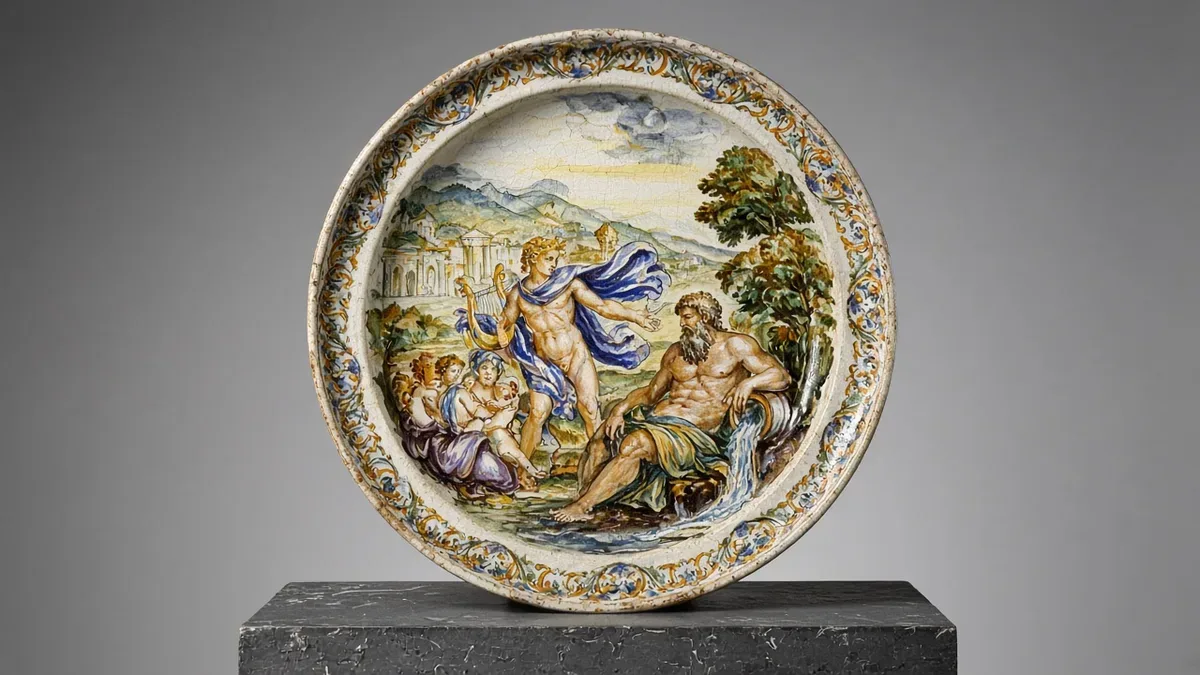
Dating Urbino Istoriato Maiolica by Marks and Construction
Dating Urbino maiolica by reverse inscriptions, workshop marks, tin-glaze body and istoriato painting. Nicola, Fontana and Patanazzi compared.
Urbino maiolica of the sixteenth century is tin-glazed earthenware painted, at its most ambitious, as a single narrative field. Collectors call that covering istoriato. Dates and workshop names sit more often on the reverse than on the face. Construction (clay colour, glaze, footring, form) then either supports the inscription or shows that the piece is later, restored, or from another Metauro centre.
The spelling maiolica is the Italian term for this tin-glazed earthenware. For the English/Italian vocabulary, see Italian majolica vs maiolica. Urbino’s istoriato is not the same system as Faenza’s berettino and bianchi, treated in Faenza maiolica identification, nor Deruta’s lustre-centred repertoire in Deruta ceramics.
Body, glaze and what the reverse can show
Urbino ware is earthenware with an opaque tin glaze used as the painting ground, then fired again. The pale clays of the Metauro valley fire to a fine buff body that does not stain through the white enamel. Cipriano Piccolpasso of Castel Durante (today Urbania), writing in the mid-1550s in Li tre libri dell’arte del vasaio, described local kiln practice in tufa-built kilns and the imported tin required for the white glaze. England was the usual source for that tin.
Look first at the unglazed or thinly glazed footring and any chip at the rim. A sixteenth-century Urbino dish typically shows a buff or light biscuit body, not a dense grey stoneware, and not the thick white of later industrial copies. The reverse of an istoriato plate is often paler and less worked than the face. Blue inscriptions, workshop formulae, dates, and literary tags belong there. A reverse that is fully istoriato, or coated in a glassy modern white with no wear at the foot, is a warning.
Common forms in the ducal decades are the broad piatto da pompa, the tondino (narrow well, wide rim), pilgrim flasks with screw or stopper necks, cisterns, and modelled inkstands. The Victoria and Albert Museum’s Fontana-workshop inkstand (acc. no. 8400-1863), tin-glazed earthenware, about 1550–60, is 38.1 cm high and painted in blue, yellow, brownish orange, copper green, manganese purple, black, and opaque white. A cartouche on the organ reads VRBINO. That city name is a place mark, not a painter’s signature.
Nicola da Urbino: painter, not Pellipario
Older catalogues still call the leading Urbino painter “Nicola Pellipario” and make him the father of Guido Durantino. Archival work published by Monsignor Franco Negroni in 1985, now standard in museum biographies, identifies the signer of Nicola da Urbino as Nicola di Gabriele Sbraghe (also Sbraga). He appears in Urbino documents from 1520 as figulus (potter). He died in the winter of 1537/38. His widow then leased the workshop to Vincenzo, son of Giorgio Andreoli of Gubbio.
Nicola was a painter as well as a shop owner. Study of his hand rests on five works that carry his name in full or as a monogram. A Bargello dish of the Martyrdom of St Cecilia, dated 1528, is inscribed on the reverse Fata in botega di guido da castello durante in Urbino 1528 and also bears Nicola’s monogram. Timothy Wilson has published another marked plate with the words Io niChola pinsitt (“I, Nicola, painted this”), which settles that the name on those pieces is the painter’s, not only the proprietor’s.
Three unsigned services are generally given to him on the strength of those marked works. The earliest group, about seventeen pieces, is the so-called Correr service, mostly in the Museo Correr, Venice, and is among the first identified Urbino istoriato, usually placed around 1520. Subjects include Orpheus and the contest of Apollo and Marsyas, painted in a cooler harmony of blue, yellow, green, and violet.
A second service was made for Isabella d’Este, marchioness of Mantua. The Metropolitan Museum of Art attributes the commission to her daughter Eleonora Gonzaga, duchess of Urbino, as a gift. Twenty-one pieces are known. Isabella’s arms are joined with those of her husband, Francesco II Gonzaga. A Lehman Collection tondino (1975.1.1019) shows the story of King Midas on the rim and, in the well, Isabella’s arms with three of her devices: a musical scroll, a candelabrum with one lit candle, and lottery tickets. Diameter 27.5 cm. The museum dates it about 1520–25. A third, slightly less tight service was made for a member of the Calini family of Brescia.
By the early to mid-1530s, including work connected with Federico Gonzaga, duke of Mantua, and the Gonzaga–Paleologo alliance arms of 1531, the drawing is often more cursive and the flesh tones rustier. Museum catalogues treat those later pieces as workshop collaboration rather than a collapse of the earlier hand.
Graphic sources matter for dating. Nicola used woodcuts from the 1497 Venetian Ovid and, later, Raphael compositions transmitted by Marcantonio Raimondi and related engravers. He also inserted severe, frontal Renaissance architecture. Those habits belong to the 1520s–30s Urbino field. They are not proof of autograph Nicola if the drawing is heavy and the glaze chalky.
Reverse inscriptions: Xanto Avelli
Francesco Xanto Avelli, from Rovigo, is the Urbino painter whose reverses are most useful to collectors because he signed, dated, and labelled so many of them. The National Gallery of Art’s biography places his first documentary mention in Urbino in 1530, in a wage dispute between interlaboratores and workshop owners (Guido Durantino and Nicola di Gabriele among the owners). His first firmly signed plate is dated 1530 and marked î Urbino, signed .f.X.A.R. He married in Urbino. After 1535 he signed more sparingly. In 1541 he initialled a piece made in the workshop of Francesco de Silvano. No later dated work is securely his.
Typical formulae expand F.X.A.R. as Francesco Xanto Avelli Rovigese. Treccani records the full line Francesco Xanto Avelli da Rovigo in Urbino pinse. Palazzo Venezia (VIVE) publishes a dish with Aesacus from Ovid, reverse: 1534. ESACO IN SMERGO NEL CASCAR CANGIOSSI. NEL LIBRO D’OVIDIO MET: F.X.A.R. IN URBINO. He tagged subjects as fabula, historia, nota, or virtù, and quoted Virgil, Ovid, Livy, Petrarch, and Ariosto. Ballardini’s Corpus della maiolica italiana logged about a hundred dated pieces from 1530–35, and about eighty more to 1542.
He was a contract painter, not a documented shop owner. A 1530s Urbino reverse that names only Xanto does not by itself name the bottega that threw and fired the dish. Palette notes from Treccani remain practical: intense polychromy, figures outlined in bistre, blue, yellow, reddish orange, copper green, purple, black, and white. He reused engraved figures across different stories, sometimes changing sex or costume. That recycling is a workshop habit, not a modern fake marker by itself.
Xanto’s istoriato was often finished with the gold and ruby lustre associated with Gubbio. Treccani states that Maestro Giorgio Andreoli’s mark is not found together with Avelli’s signature. From 1532 many lustred Xanto pieces carry a letter N linked in the literature to Vincenzo Andreoli, who later leased Nicola’s Urbino shop (1538) and became a citizen of Urbino in 1544. A Gubbio-style reverse scroll that seems to veil a blue in Urbino inscription is a known 1531–33 group, discussed by J.V.G. Mallet; it is a period feature, not a later overpaint rule.
Fontana workshop marks
Guido Durantino (Guido di Nicolò Schippe), later Guido Fontana, ran the dominant Urbino bottega from the 1520s until his death in 1576. National Gallery of Art documents place him in Urbino by 1519. In 1523 he and other potters contracted for five thousand paving tiles for Duke Francesco Maria della Rovere. In 1535 his shop had the service for Anne de Montmorency. By 1553 he used the surname Fontana.
Reverse inscriptions vary but cluster around Nel Botega di Maestro Guido durantino (and similar). Mallet’s reading, now widely followed, is that Guido was a potter-entrepreneur, not a single identifiable painter. Multiple hands appear under one shop formula. Do not treat “Fontana” on a label as an autograph of Orazio.
Orazio Fontana (c. 1510–1571) worked with his father, then opened his own shop in 1565. Around 1560 the Fontana circle developed white-ground grottesche (grotesques) derived from Roman wall ornament and from Raphael’s Vatican Logge, later also from Jacques Androuet du Cerceau’s Petites Grotesques (Orléans, 1550). Narrative medallions shrink as the white grotesque field grows. That shift dates a piece later than full-field Nicola or early Xanto istoriato, even when the subject is still Ovid.
Guidobaldo II della Rovere (duke 1538–1574) ordered a large “Spanish” credenza of Caesar subjects after drawings by Taddeo and Federico Zuccari, completed by December 1562 and packed in ten chests for Philip II. A V&A basin after a Zuccari design is associated with that gift. Vasari, in the 1568 life of Battista Franco, praised painted Urbino vases as equal to oil painting; Franco supplied drawings for services destined for Charles V and Cardinal Farnese. Those documents date high ducal patronage to the 1560s. They do not date an unsigned grottesche flask by themselves.
After Orazio’s death the Fontana manner continued under his nephew Flaminio Fontana (documented to 1591). Timothy Wilson has shown that Antonio Patanazzi and his family, relatives of the Fontana, were using the same moulds by about 1580 and into the 1590s. Antonio signed two large pharmacy amphorae for Roccavaldina (Messina) in 1580; one remains on site, one is in the Museo Internazionale delle Ceramiche, Faenza. He died on 24 May 1587.
Francesco Patanazzi produced historiated and grotesque services into the 1590s, including commissions connected with Isabella Della Rovere, Princess of Bisignano (1593; a further contract of 10 December 1599). Alfonso Patanazzi signed in full. A V&A dish (2612-1856) of Romulus receiving the Sabine women is marked on the front ALF.P.F. / VRBINI 1606 and on the reverse ALFONSO PATANAZZI FECIT VRBINI 1606. His figures are heavier and more rigid than 1560s Fontana work. That coarsening is a seventeenth-century dating clue, not a restoration flaw.
How Urbino differs from Faenza and Deruta
Faenza’s sixteenth-century sequence includes blue-tinted berettino grounds and, later, the thick white bianchi with spare compendiario drawing. Urbino istoriato of the 1520s–40s usually covers the whole face in warm polychromy on a white tin ground, with landscape and architecture treated as a continuous stage. Deruta’s collector market is dominated by gold and ruby lustre on a more limited palette; Urbino lustre, when present, is typically a Gubbio finish on an already painted Urbino dish.
A national survey of centres is in the Italian ceramics collecting guide. Use it for geography. Use the reverse of the piece in hand for the date.
Castel Durante (Urbania) supplied potters, clays, and, in Piccolpasso, the technical literature. “Durantino” in a signature means origin or training in that town, as with Guido, not a second city of manufacture if the reverse also says in Urbino.
Later copies and condition
Demand for istoriato in the nineteenth century produced revival wares that copy Urbino compositions from museum plates. Ulisse Cantagalli’s Florence factory in the 1880s–90s specialised in Renaissance maiolica reproductions studied at the Bargello and in London. Ginori, from the mid-nineteenth century under Lorenzo Ginori Lisci, ran a tin-glaze Renaissance line and even recovered lustre chemistry for exhibition wares. Honest revival pieces often carry factory marks (Cantagalli’s cockerel is the usual example). Deceptive copies omit those marks and add false blue “Urbino” tags in a rounded modern hand.
Practical tests: compare the drawing with a published source (Marcantonio print, Zuccari sheet, Ballardini corpus plate). A nineteenth-century copy may follow the print more literally than a 1530s painter who adapted it. Check the foot for even, unworn glaze and for plaster fills at the rim. UV light shows overpaint on flesh and sky, the zones restorers retouch first. Do not use Victorian English “majolica” (coloured lead glazes) as a synonym; that is a different body.
Condition notes that affect value more than romance: rim chips through the tin glaze, star cracks from an old knock, overpaint on the well, replaced footring, and lustre that sits only in the recesses. Sixteenth-century tin glaze often shows a fine, even craquelure. A dead-flat, poreless white is more typical of later industrial enamel.
FAQ
What does a genuine Urbino workshop mark look like?
Surviving workshop texts are handwritten in blue on the reverse, in sixteenth-century letter forms, often abbreviated: botega, fata in, in Urbino. Printed or stencilled marks, or a copperplate-neat “Urbino 1525” in Roman capitals, are later. Xanto’s F.X.A.R. and Alfonso Patanazzi’s 1606 formula are painter identifications. Nel Botega di Guido Durantino names a shop, not a single brush.
Can I date a piece from the subject alone?
No. Ovid, the Bible, and Raphael-school prints remain in use from Nicola through the Patanazzi. Date the decorative system: full-field istoriato (1520s–40s), istoriato with a growing grotesque frame (from about 1560), then grottesche-dominant wares into the early 1600s. Confirm with reverse text if present.
Is Gubbio lustre on an Urbino dish a contradiction?
No. Urbino painters, Xanto above all, sent or finished dishes with Gubbio-type lustre. The Met catalogues some objects as “Italian, Urbino with Gubbio luster.” The absence of Maestro Giorgio’s mark beside a Xanto signature is expected.
How should unsigned Nicola-style plates be described?
As Urbino istoriato, circa 1520–35, in the manner of Nicola da Urbino, unless a specialist catalogue has assigned the service (Correr, Isabella d’Este, Calini, Gonzaga–Paleologo). Five signed works are a small base. Over-precise autograph claims on unsigned dishes are the usual catalogue error.
The date is the agreement of clay, glaze, form, graphic source, and reverse. If those disagree, the later evidence rules.