
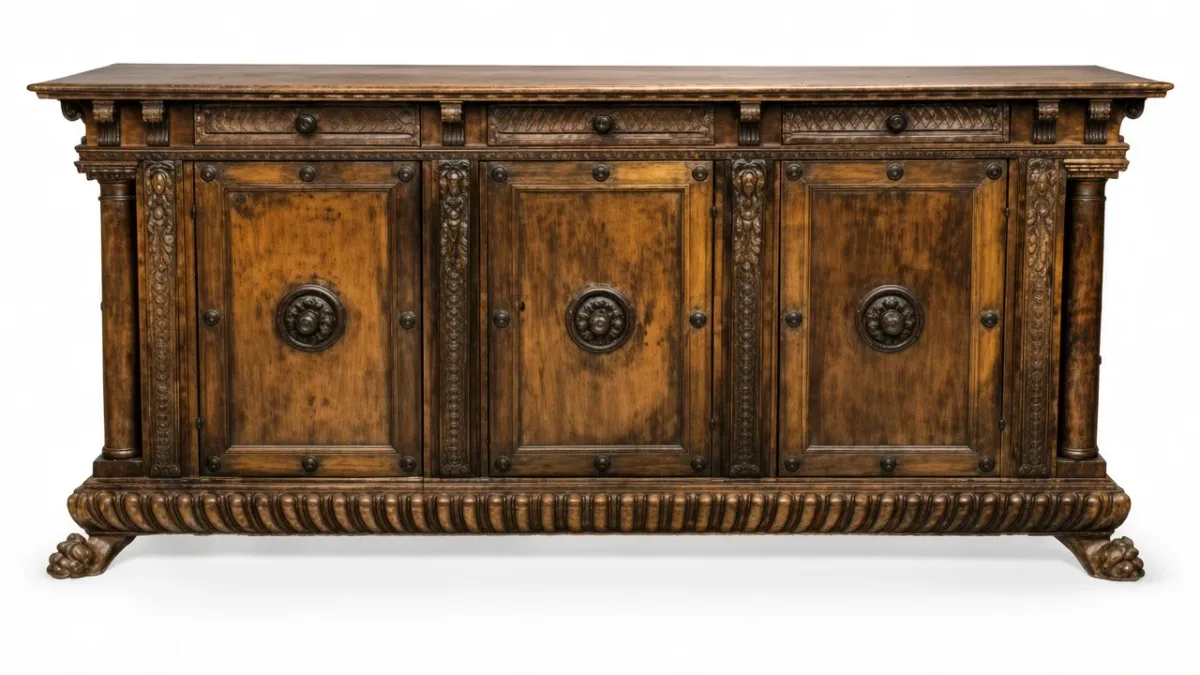
Italian Walnut Credenza Prices at Auction
Italian credenza prices at auction depend on region, walnut and later copies. Verified sale results and how to tell a period cabinet from a revival.
A credenza is a low Italian sideboard: a moulded top, a frieze of drawers, and cupboard doors below. English catalogues keep the Italian word. Dealers also use armadio for a taller cupboard and stipo for a cabinet of many small drawers. The market prices those forms as different objects. This article concerns the wall sideboard, not the Venetian trumeau and not the eighteenth-century cassettone.
Value is not a national average. A Tuscan walnut facade of the late sixteenth century, a Bolognese splayed three-door carcase, a Piedmontese eighteenth-century cupboard, and a nineteenth-century piece built from older panels occupy different bands. Most trade pieces are unsigned. Dating is by timber, joint and regional type.
What determines value
Maker and workshop come first, even when no name is present. Domestic credenze rarely carry a punch. Later signed revival carving, notably Luigi Frullini in Florence (1839–1897), is nineteenth-century work and should be priced as such. Period pieces are shop products. A published example, such as the Bolognese credenza Il Ponte sold in 2023 after Graziano Manni's 1993 illustration, carries more weight than an oral attribution to a Renaissance name.
Period follows construction. Sixteenth- and early seventeenth-century architectural walnut still leads the international rooms. Eighteenth-century four-door cupboards with later alterations sit much lower, as a 2024 Milan result shows. The catalogue phrase "and later" is a price fact.
Region is readable on the plan. Tuscany supplies the pilaster facade recorded in Florentine walnut furniture. Bologna prefers a splayed plan and a three-door front, often with pine secondaries. Piedmontese pieces of the seventeenth and eighteenth centuries run longer, with broken or scrolling friezes. Roman work is more architectural and, in the trade, often later. Venetian painted or lacquered case furniture belongs with eighteenth-century Venetian lacquer, not with walnut sideboards.
Material is specific. Show surfaces should be walnut (Juglans regia). Secondary members are typically poplar or pine that has oxidized. Even dark stain on every interior face, beech linings or plywood backs are later. The Metropolitan Museum's Tuscan credenza 26.260.10 is walnut on the show faces, 134 × 182.9 × 59.7 cm, second half of the sixteenth century. The Getty Museum's Florentine credenza 78.DA.107, about 1600–1650, measures 114.9 × 202.6 × 54.6 cm in carved walnut.
Rarity follows completeness of the original top, doors and plinth more than extra ornament. Associated tops are common. Coin slots cut into a removable top, as on the Rockefeller Bolognese example of 2018, record a later use. They do not by themselves destroy value if the carcase is coherent.
Condition is read at the joints and the unseen faces. Worm in sapwood is expected. Replaced backs, new shelves, recarved mouldings and a glass-smooth finish are not. Houses discount "supplemented parts" and "the top associated" in the description. A piece catalogued as constructed in the nineteenth century from earlier elements sold at a fraction of a period carcase.
Provenance moves the upper end. Named collections and a published catalogue entry, as on the Rockefeller example, or an exhibition history such as Aldo Geri's 1976 Milan showing of a parcel-gilt Tuscan credenza, change the room. Trade provenance through a Florence reproduction firm, the caution attached to the Victoria and Albert Museum purchase of 1904, does not.
Size is a narrow band. Domestic credenze run roughly 100–120 cm high and 150–200 cm wide. Monumental three-door examples over 250 cm wide find fewer rooms. The Dorotheum Tuscan sideboard of 2023 was 265 cm wide and still sold. Large restored pieces can stall.
Market demand today is strongest for coherent Tuscan and Bolognese walnut of the sixteenth and seventeenth centuries with restrained architectural carving. Unsigned Renaissance revival cupboards and later shop armadi sell as decorative furniture. Italian writing desks and console tables are adjacent markets, not substitutes for a credenza price.
Prices at auction
These figures are published sale results. They vary with condition, attribution and the day of sale. They are not a valuation of any private cabinet.
Christie's, London, Interiors: Including Noble & Private Collections, 10 April 2019. An Italian walnut credenza, late sixteenth century and later, probably Tuscany, 105.5 × 162.5 × 58.5 cm. Price realised GBP 7,500.
Christie's, London, 3 November 2011. An Italian walnut credenza, Tuscany, late sixteenth or seventeenth century, moulded top above two short drawers and a pair of doors flanked by detached Corinthian columns, the top associated, 103.5 × 147 × 48.5 cm. Price realised GBP 8,750. The lot essay recorded a related credenza at Christie's, London, 9 November 2006, lot 319, at £78,000 including premium.
Christie's, New York, The Collection of Peggy and David Rockefeller: English & European Furniture, Ceramics and Decorations, Part II, 10 May 2018. A north Italian walnut credenza, probably Bologna, second half of the seventeenth century, removable moulded top with two coin slots, one drawer and a central cupboard door, 89.5 × 101 × 51 cm. Price realised USD 21,250.
Dorotheum, Vienna, Furniture, Works of Art, Glass & Porcelain, 2 May 2023, lot 709. A large sideboard, so-called credenza, Italy or Tuscany, originally late sixteenth or seventeenth century, solid walnut, three doors, three drawers, claw-and-ball feet, 120 × 265 × 72 cm, top and sides with supplemented parts. Realized EUR 9,100 including premium and VAT.
Dorotheum, Vienna, Works of Art, 26 April 2018. An Italian Renaissance credenza, Bologna, originally sixteenth century, walnut and pine, splayed Bolognese three-door front, about 119 × 226 × 67 cm, losses and a heavily restored top. Realized EUR 21,250.
Il Ponte, Milan, auction 603, 23 February 2023, lot 919. A large rectangular walnut credenza, Bologna, early seventeenth century, five frieze drawers and two doors with bronze cherub-head pulls, 193 × 108 × 70 cm, published in Graziano Manni, Mobili antichi in Emilia-Romagna (1993), p. 51, fig. 85, with breaks, restorations and replacements. Awarded EUR 2,500.
Il Ponte, Milan, auction 670, 20 September 2024, lot 1149. A walnut armadio-credenza with four panelled doors and linear pilasters, eighteenth century, 121 × 175 × 56 cm, defects, alterations and restorations. Awarded EUR 700.
Christie's, London, 19 March 2020. An Italian walnut credenza constructed in the nineteenth century, incorporating earlier elements, two panelled doors on bracket feet, 122 × 114 × 46.5 cm. Price realised GBP 1,125.
The published results do not support a single range. A coherent sixteenth- or seventeenth-century Tuscan or Bolognese carcase has sold between the mid four figures in sterling or euros and the low five figures in dollars or euros. A documented or unusually architectural example can exceed that, as the 2006 Christie's lot cited above and a parcel-gilt Tuscan credenza sold at Christie's, London, 9 February 2012, for GBP 115,250, both show. An eighteenth-century cupboard with restorations, or a nineteenth-century assembly of older wood, has sold in the high hundreds or low thousands.
Authentic or later
Catalogues already name the problem. "And later," "the top associated," "constructed in the 19th century, incorporating earlier elements," and "supplemented parts" describe the object.
A period credenza is panel-in-frame. Mortise-and-tenon joints are slightly irregular. Drawer sides are solid wood, often poplar or pine, with oxidized interiors. Saw marks on unseen faces are straight or slightly scalloped from a hand plane, not identical circular machine chatter. Panel shrinkage that leaves a pale line at the frame is consistent with age.
The facade is architecture. The Victoria and Albert Museum's Florentine credenza (1375:1-1904), dated 1550–1600, is 109 × 190.5 × 52.7 cm. Fluted pilasters divide the cupboard. A gadrooned moulding sits above lion-paw feet. The frieze holds drawers. Peter Thornton, in The Italian Renaissance Interior 1400–1600, described the type's use for plate and linen. The museum bought the piece in 1904 from the Manifattura di Signa, a Florence firm better known for reproduction ceramics. Institutional ownership does not remove the need to read construction.
Later copies fail in predictable ways. Nineteenth-century revival shops reused paw feet, guilloche and pilasters on walnut of even colour, cut with machine regularity and finished with a high varnish. Secondary woods may be beech. Drawer bottoms may be plywood. Carving wraps a corner without a corresponding interior member. Unsigned work in the manner of Frullini is later Florentine taste, not cinquecento. A nineteenth-century carcase that incorporates a few older panels is exactly what Christie's sold in 2020 for GBP 1,125.
Common mistakes: treating "Italian Renaissance style" as a date; ignoring an associated top; reading lion-paw feet as proof of the sixteenth century; taking a Florence dealer label for a workshop mark; confusing a writing desk or ribalta with a credenza; pricing a restored eighteenth-century armadio as if it were a published Bolognese carcase.
Hardware is usually later. Turned wood knobs are more plausible on domestic pieces than matching sets of bright brass. New locks and recut keyholes are routine. They should be recorded, not treated as fatal on their own.
When to seek an appraisal
A professional condition report is worth commissioning before paying a period price for a credenza catalogued with restorations, an associated top, or a regional attribution that the carcase does not support. A furniture conservator or a specialist familiar with Italian walnut, not a generalist valuer, should open the doors, lift the top if it is removable, and look at the back and the drawer linings. The published auction figures above are sale results. They are not a valuation of a private piece.
FAQ
What is the difference between a credenza and an armadio?
A credenza is a low sideboard. An armadio is a taller cupboard, often with four doors. Catalogues sometimes hyphenate them when the height sits between the two. Prices follow the type, not the hyphen.
Do Italian cabinets have hallmarks?
No civic punch system comparable to silver exists for furniture. Period credenze are unsigned. Later revival carvers sometimes signed the wood. A Piedmontese chef-d'oeuvre stamp is exceptional and needs comparison with documented examples.
Why do catalogues say "and later"?
Because the top, plinth, doors or carving have been replaced, or the carcase has been rebuilt. That language is a value statement. It is the difference between the 2011 Tuscan credenza at GBP 8,750 with an associated top and the 2020 nineteenth-century construction at GBP 1,125.