
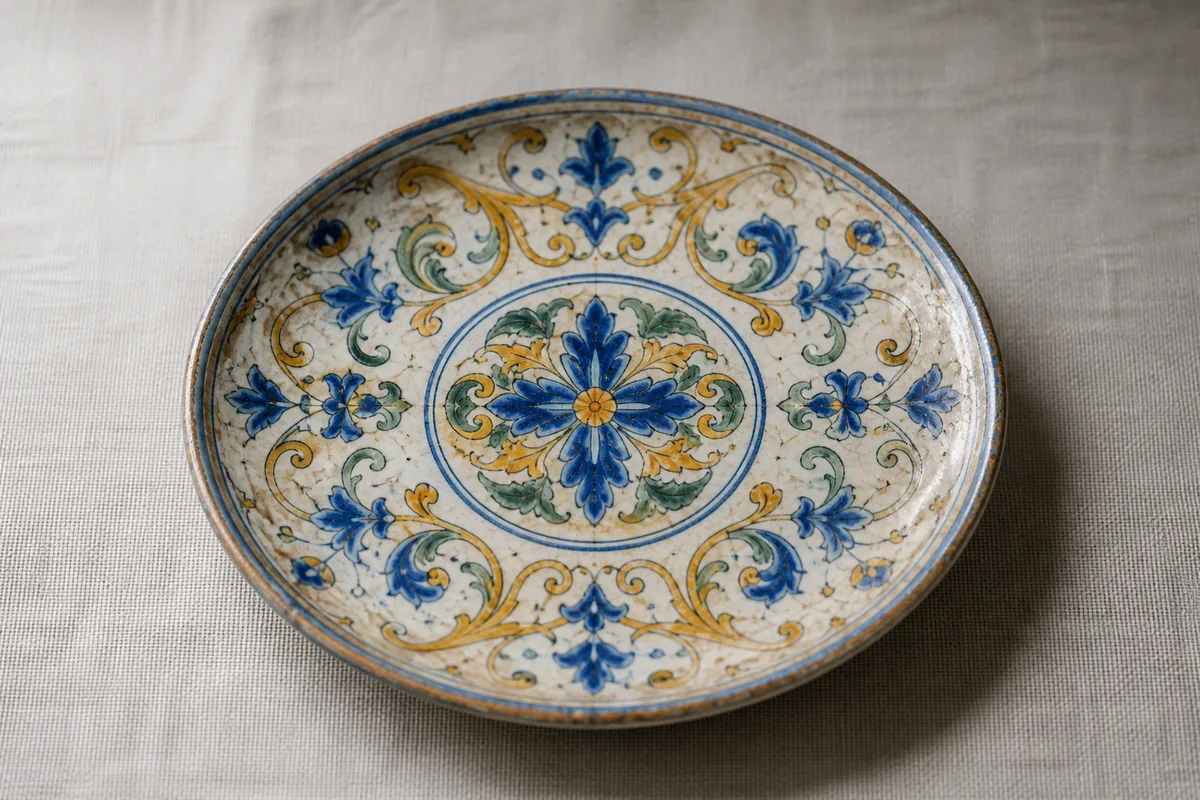
Antique Italian Ceramics: A Collector's Guide to Maiolica, Regions & Identification
Learn to identify antique Italian ceramics: maiolica technique, major regions from Deruta to Caltagirone, dating clues, and collecting tips for international buyers.
Italian ceramics occupy a singular place in the history of European decorative arts. Long before industrial porcelain factories reshaped the luxury market, Italian workshops produced tin-glazed earthenware — maiolica (also spelled majolica in English) — that traveled from Mediterranean ports to princely tables across the continent. For collectors outside Italy, the field can seem fragmented: dozens of towns, overlapping terminology, and a market where tourist ware sits beside genuine Renaissance fragments. This guide maps the essentials — materials, regions, dating clues, and practical identification — so you can approach antique Italian ceramics with confidence.
What Counts as "Italian Ceramics"?
In collecting usage, the phrase covers several distinct families of objects:
- Maiolica: tin-glazed earthenware with an opaque white surface that accepts painted decoration, then fired again. This is the core of most pre-19th-century Italian tableware and display pieces.
- Terracotta: unglazed or lightly glazed fired clay — architectural elements, sculpture, storage jars (orci), and folk pottery.
- Porcelain and soft-paste wares: later luxury production, often court-sponsored (Naples, Doccia, Venice). These are chemically and visually different from maiolica and belong to a separate collecting category. For the Neapolitan porcelain tradition, see our guide to Italian porcelain history and Capodimonte porcelain.
Maiolica dominates the antique market for "Italian pottery" because it was produced in quantity for five centuries and survives in a wide range of conditions and price points.
How Maiolica Is Made — and Why It Matters for Identification
Maiolica begins as shaped earthenware clay. After a first firing (biscotto), the piece is dipped or brushed with a tin-opacified glaze that fires to a dense white surface. Decoration in metal-oxide pigments — cobalt blue, copper green, manganese brown, antimony yellow — is applied on top of that glaze, then fixed in a third firing.
That structure explains several identification truths:
- The body is ceramic, not glass-smooth porcelain; chips reveal reddish or buff terracotta.
- Colors sit on the glaze, not beneath it as in underglaze blue-and-white porcelain.
- Genuine old pieces often show slight warping, kiln grit on the foot, or uneven glaze pooling — signs of hand manufacture.
The Italian word maiolica derives from Majorca (Italian: Maiolica), not because the island produced the ware, but because decorated Hispano-Moresque pottery reached Italy through Balearic trade routes in the late Middle Ages. Italian potters adapted the technique and, by the 15th century, transformed it into a Renaissance art form.
Major Regional Schools
Italy has never had a single "national" ceramic style. The Associazione Italiana Città della Ceramica recognizes dozens of towns with documented traditions. Collectors should learn a handful of anchor regions first.
Faenza (Emilia-Romagna)
Faenza, south of Bologna in the Emilia-Romagna region, became so identified with fine tin-glaze that European languages borrowed its name: French faïence, English faience. Renaissance workshops here developed refined istoriato panels — narrative scenes drawn from classical history and mythology — alongside elegant bianchi di Faenza (white-ground wares) in the 16th century.
The International Museum of Ceramics (MIC) in Faenza holds one of the world's largest ceramic collections and remains the best single institution for calibrating the eye. Faenza pieces tend toward painterly sophistication and controlled palettes compared with the bolder Umbrian style.
Deruta (Umbria)
Deruta, perched above the Tiber valley near Perugia in central Italy, is perhaps the most recognizable name internationally. Production is documented from the 13th century and flourished through the Renaissance. Characteristic motifs include the Raffaellesco arabesque (scrolls, fantastical creatures derived from Raphael workshop ornament) and the Ricco Deruta banded pattern combining geometric and floral registers.
Deruta remains active today; distinguishing historical pieces from modern studio production requires attention to paste, weight, foot-ring treatment, and the quality of brushwork.
Montelupo Fiorentino (Tuscany)
Montelupo, west of Florence on the Arno river, was a major export center from the 13th century. Florentine commercial networks shipped its wafers across the Mediterranean and, eventually, to northern Europe and the Americas. Museum collections in Montelupo document the town's role in standardizing forms — pharmacy jars, albarelli, plates — that appear throughout Italian and European collections.
Southern Italy: Sicily and Campania
The South developed strongly localized traditions. Caltagirone in Sicily is famous for sculptural forms and vivid polychrome, including the iconic Moor's-head vases (a subject we treat in dedicated articles). Vietri sul Mare on the Amalfi coast reinvented maiolica decoration in the early 20th century under international artisan influence. Naples and surrounding towns produced both maiolica and, from the 18th century, court porcelain — related in geography but not in material.
Other notable centers
Collectors eventually encounter Urbino (istoriato masterpieces), Castelli in Abruzzo (small-scale pictorial wares), Grottaglie in Puglia (turned forms and green-glazed tradition), and Savona in Liguria (blue-and-white tendencies). Each rewards separate study; the present guide establishes the framework.
Dating and Attribution: Practical Clues
Exact dating of unsigned Italian maiolica is specialist work, but useful first-pass indicators include:
Form. Pharmacy jars (albarelli), large storage vessels, and floor tiles belong to different periods and functions. Sixteenth-century istoriato plates differ sharply from 19th-century souvenir chargers in profile and foot design.
Decoration. Renaissance pieces draw on classical engraving sources; 19th-century revival ware often repeats the same Raffaellesco or grotesque motifs with mechanical regularity. Look for confident, variable brushstrokes versus uniform line weight.
Reverse and foot. Kiln scars, stilt marks, and the color of unglazed foot rings help distinguish age and origin. Modern tourist pieces may show crisp, white, overly uniform bases.
Marks. Many historical Italian wares were unmarked. Printed or painted marks become more common from the 19th century onward. A mark alone rarely proves age; unmarked quality can outperform marked mediocrity.
When in doubt, consult museum catalogues or auction house department notes rather than relying on a single visual impression.
Condition, Restoration, and Value
Italian maiolica is earthenware — it chips and crazes. Minor rim chips are common on authentic old tableware and may be acceptable if reflected in price. Overpainting, heavy lacquer, or invisible restoration on high-value istoriato panels can materially affect value.
Market tiers roughly follow:
- Fragmentary or provincial ware: accessible entry-level collecting.
- Documented regional Renaissance or Baroque pieces: significant auction prices when provenance is clear.
- Masterworks with publication history: museum-grade values.
Buy from reputable dealers or auction specialists who describe condition explicitly. Photographs should show edges, feet, and any hairlines transmitted through glaze.
Building a Collection Strategically
International collectors benefit from choosing a focus rather than accumulating mixed tourist pieces:
1. Regional — e.g., only Umbrian pharmacy jars or Sicilian figural wares.
2. Chronological — Renaissance tin-glaze before 1600, or 19th-century revival.
3. Functional type — plates, albarelli, tiles, or devotional plaques.
Visit major museums when possible: MIC Faenza, Deruta's regional museum, Montelupo, and the Capodimonte museum in Naples for porcelain comparisons. Handle reproduction markets in active towns (Deruta, Faenza) to train the eye on what contemporary production looks like fresh from the kiln.
Common Mistakes to Avoid
- Confusing Italian maiolica with Victorian English majolica — a 19th-century British lead-glaze tradition inspired by Italian Renaissance pottery but chemically different.
- Assuming "Deruta" on a label guarantees age; modern legal production also uses the place name.
- Treating porcelain and maiolica as interchangeable; Italian porcelain collecting follows different makers, marks, and price structures.
- Ignoring weight and paste in favor of surface decoration alone.
FAQ
What is the difference between maiolica and majolica?
Spelling varies by language and period. In Italian art-historical usage, maiolica denotes tin-glazed earthenware in the Italian tradition. English dealers sometimes use "majolica" broadly; verify whether the seller means Italian tin-glaze or Victorian lead-glaze ware.
Why is Faenza so important?
Faenza's Renaissance workshops achieved European renown; the city's name entered French and English as a generic term for fine tin-glaze. The MIC museum in Faenza is the principal reference collection.
How do I start collecting on a moderate budget?
Begin with later regional wares or small plates with honest wear, bought from sources that disclose restoration. Learn one region deeply before expanding.
Are Italian ceramics a good entry point compared with Murano glass?
They are complementary fields. Italian glass from Venice is a distinct material with its own authentication issues. Ceramic collecting offers wider geographic variety and often lower entry prices for pre-modern objects.
Can I ship antique ceramics internationally?
Yes, with proper packing and customs documentation. Declare age and material accurately; some countries restrict export of cultural property above certain thresholds — verify regulations if buying high-value istoriato pieces in Italy.
Conclusion
Antique Italian ceramics reward patient study. The vocabulary — maiolica, faïence, istoriato, albarello — reflects real technical and regional distinctions, not dealer jargon. By anchoring objects in their material structure, geographic school, and historical moment, collectors outside Italy can move beyond decorative appeal toward informed acquisition. Start with one region, compare against museum examples, and treat unsigned age claims with healthy skepticism. The field is deep enough to sustain a lifetime of learning, and broad enough to remain accessible at many price levels.