
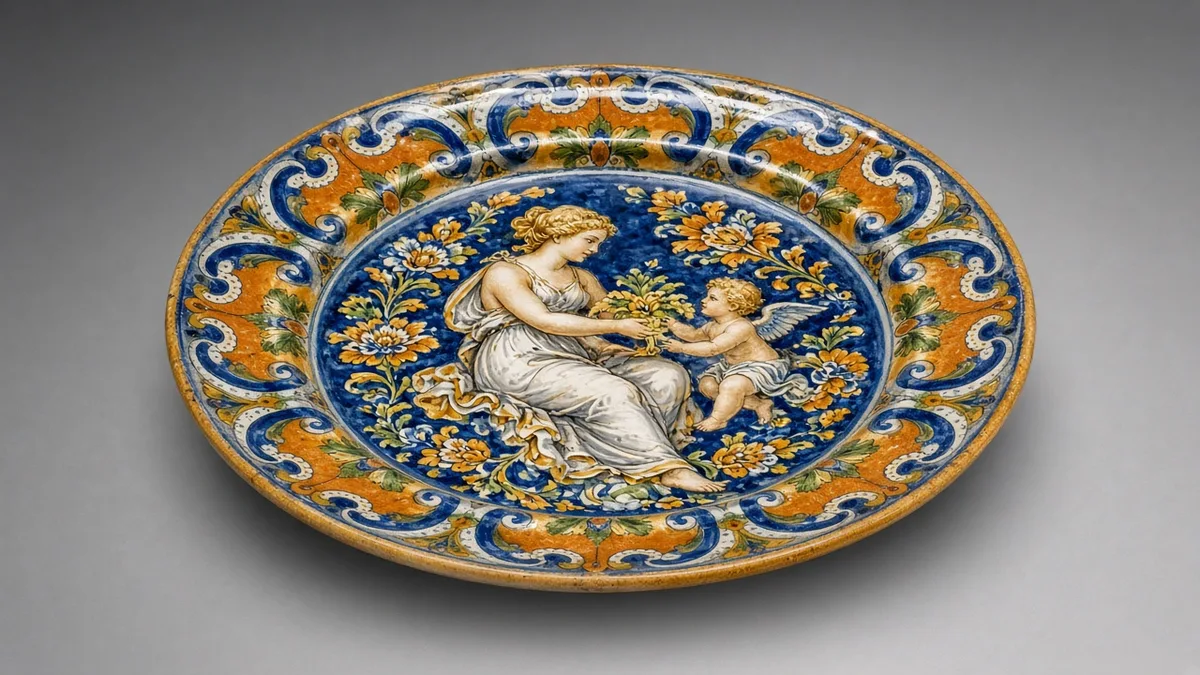
Italian Majolica vs Maiolica: Tin-Glaze Terms Explained
Majolica or maiolica? How collectors should use the terms for Italian tin-glazed earthenware, Faenza’s faïence link, and what Victorian majolica is not.
Majolica or Maiolica? What to Call Italian Tin Glaze
English-language search almost always types majolica. Italian museums and scholars write maiolica. Both can point to tin-glazed earthenware—but they do not always mean the same market category. This article separates the Italian technical term from English Victorian “majolica,” then routes you to the Italian centres already covered on this site.
Deep guides: Italian ceramics / maiolica, Faenza, Deruta.
What Italian maiolica is
In Italian usage, maiolica is earthenware coated with an opaque tin glaze that becomes the painting ground. The Museo Internazionale delle Ceramiche in Faenza (MIC) narrates local production from medieval green-and-manganese wares through Renaissance istoriato and berettino to the bianchi di Faenza, whose white tin enamel helped fix the international synonym between Faenza and French faïence.
That is the material collectors should mean when they say “Italian majolica”: tin-glazed, brush-decorated pottery from centres such as Faenza, Deruta, Urbino, Castelli, later revival workshops—not soft-paste porcelain and not lead-glazed Victorian relief ware.
Why English says majolica
English borrowed spellings through French and trade literature. In English-speaking antique markets, majolica often defaults to colourful nineteenth-century lead-glazed earthenware in high relief (English, American, Continental)—a different technology and a different collecting field. Listing an Italian Renaissance-style tin-glaze plate as “Victorian majolica” confuses buyers and algorithms alike.
Practical rule for this site’s audience:
- Prefer maiolica (or “Italian tin-glazed earthenware”) in careful catalogue notes.
- Accept Italian majolica as the common English search phrase, then immediately specify tin glaze and region.
- Reserve plain majolica without “Italian” for the Victorian relief tradition unless the object truly is that ware.
How Faenza muddies the waters—in a useful way
MIC emphasises that Faenza’s whites and export fame made the city name travel as a product noun. French faïence and English discussions of tin glaze often point back to that success. Etymology does not authenticate a dish: a modern tourist plate stamped “Faenza” is not Renaissance maiolica.
Working method for buyers
1. Ask whether the glaze is tin-opaque (chips show white enamel over buff body) or glossy lead colour on relief moulds.
2. Name a centre (Faenza, Deruta, Urbino…) only with stylistic support.
3. Use Italian mark and workshop guides already on this site rather than generic “Italian pottery marks” posters.
4. In listings, pair the keyword people search—Italian majolica—with the precise term maiolica once in the description for clarity.
FAQ
Are majolica and maiolica the same?
Sometimes in loose English; strictly, Italian maiolica is tin-glazed earthenware, while English majolica often means Victorian relief lead glaze.
Is faïence Italian?
The French word tracks Faenza’s fame; the object may be French, Delft, or Italian depending on body and marks.
Which spelling should I use for SEO?
Lead with Italian majolica in titles for English discovery, explain maiolica in the opening paragraph.
Conclusion
For Italian tin glaze, think maiolica; for English discovery, speak Italian majolica—then prove tin glaze and region. Keep Victorian majolica in its own aisle.
Material test in plain language
Tin glaze is opaque. At a chip you usually see a white or off-white layer over a darker earthenware body. Decoration sits on that white skin. Victorian majolica, by contrast, often shows coloured lead glazes puddling in moulded relief without a separate white tin ground. If you cannot see a tin ground, do not force the Italian Renaissance story.
MIC Faenza’s galleries make the sequence visible: archaic green and brown, Gothic and Renaissance ornament, berettino blue grounds, then whites with spare compendiario painting. Walk that sequence mentally when an online seller offers only one glamorous front photo.
Language for listings
A clean listing sentence reads: “Italian maiolica (tin-glazed earthenware), probably Deruta, late nineteenth-century revival.” You have used the search term people know, the technical term curators use, and a cautious origin. Avoid “rare ancient majolica” without evidence.
Cross-links on this site
Faenza, Deruta, Sicilian pigna and teste di moro articles already map regional languages. Use this terminology essay as the hub: from here, jump to the centre that matches the object. For porcelain bodies mistaken as “majolica,” switch to Ginori or Capodimonte guides instead.
What not to do
Do not date by the word Faenza alone. Do not call every blue-and-white Italian plate “Deruta.” Do not mix Victorian majolica price comps with Renaissance-style tin glaze. Do not translate Italian auction catalogue “maiolica” into “majolica” in your notes without checking technology.
Centres at a glance
If the object is tin-glazed and Italianate, next ask which centre. Faenza for berettino and whites; Deruta for lustre and later Ricco patterns; Urbino for istoriato narrative density; Castelli for Abruzzo pictorial wares; Sicilian workshops for regional colour languages already treated in pigna and teste di moro articles. Wrong centre labels are as harmful as the majolica/maiolica spelling fight.
Treccani's Italian definition of maiolica anchors catalogue English: tin-glazed painted earthenware. Keep that definition visible in your notes even when the SEO title leads with majolica.
Finally, porcelain is not maiolica. Ginori and Capodimonte guides on this site handle translucent bodies; do not file them under majolica because an online algorithm suggested the keyword.