
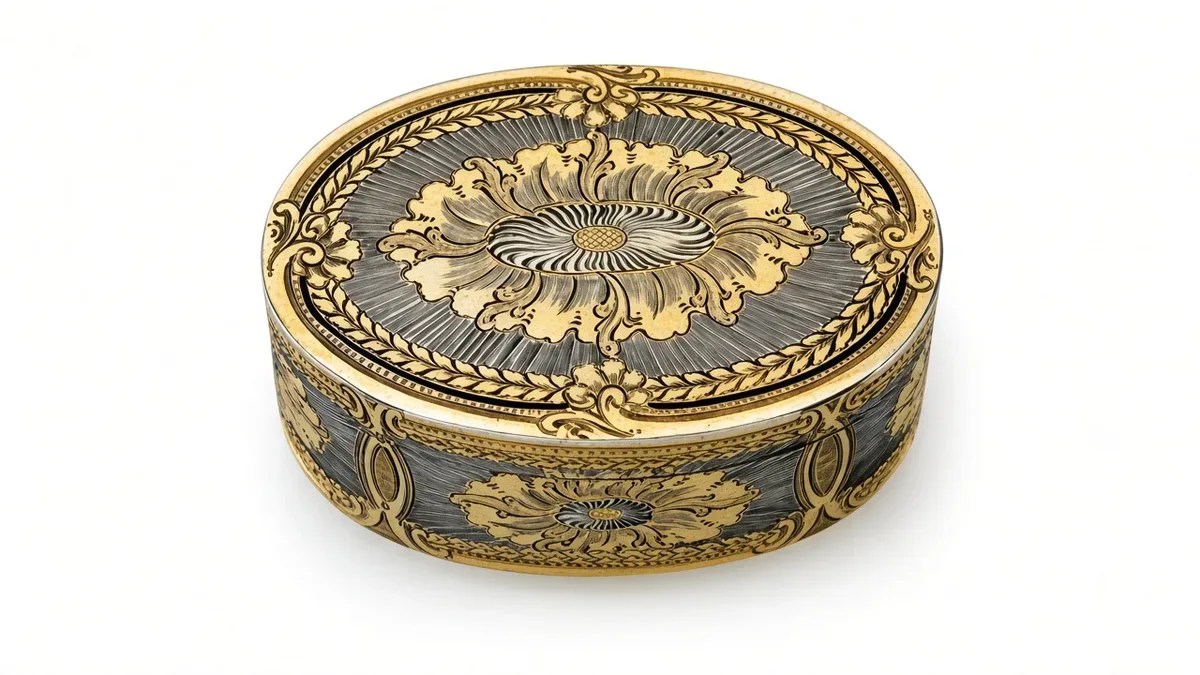
What Is an Antique Italian Silver Snuff Box Worth?
What an antique Italian silver snuff box is worth: city marks, later copies, and verified auction prices from Rome, Venice and London houses.
An Italian silver snuff box is a small hinged or lift-off container for powdered tobacco, usually 6 to 9 cm across, struck by a city assayer or a named Roman mounter. The trade name in Italian catalogues is tabacchiera. Value sits in the punch, the mount, and the lid, not in the weight of 800 silver.
Buyers confuse three different objects under one English phrase. A raised silver box from Venice or Naples is civic plate. A hardstone or tortoiseshell box with silver-gilt mounts by Luigi Mascelli of Rome is a Grand Tour souvenir. A twentieth-century 800 box with a star lozenge is later shop work. The market prices them on different scales.
What determines value
Maker and workshop come first. Luigi Mascelli (active about 1804–1825) and his son Giovanni Andrea (active about 1826–1870) are the names Christie's and the Victoria and Albert Museum attach to Roman silver-gilt and gold mounts set with micromosaic plaques. Costantino Bulgari recorded Mascelli's punch as no. 685 in Argentieri, gemmari e orafi d'Italia. An unsigned Venetian oval with a lion in moleca sells as civic silver. It does not sell as Mascelli.
Period and region are linked. A second-half-eighteenth-century Venetian box carries the Republic's assay language described in the Venetian silver hallmarks guide: the lion of St Mark in moleca and, often, the Zecca. Roman boxes of 1810–1815 sit in the Napoleonic decimal system, with the Rome assay office letter H, then in the Restauration ounce titles of the Papal States. Naples used a crowned NAP, NAPL or NA with date digits until 1808, then the Parthenope warranty for 917 and 834 thousandths. Those civic sequences are set out in the national Italian silver hallmarks guide and in the Roman papal assay note.
Material splits the field. Solid silver, often parcel-gilt, with an interior fire-gilt to resist the salt in snuff, is one market. Silver-gilt mounts on jasper, granite, lapis or red glass, the lid set with a Roman micromosaic, are another. The V&A holds both types: a lapis box by Luigi Mascelli, about 1820, with a micromosaic of Mercury charming Argus after Salvator Rosa (acc. 187-1878), and a silver-gilt circular box whose lid shows the Arch of Gallienus (acc. M.286:1-1921). The Science Museum Group has a plainer circular gilt box with a Naples mark, 62 mm across (acc. A652394). Neapolitan piqué boxes of tortoiseshell inlaid with gold or silver are a third manufacture, documented from the late sixteenth century and refined in the eighteenth. They are not silver boxes with a shell lid. Treat them as a separate category, as Neapolitan silver workshop marks sit beside, not inside, the tartarugari trade.
Rarity follows completeness and an unused interior. A fitted snuff spoon, an original gilt lining, and a lid that still seats on its bezel matter more than a few extra grams. Condition is read at the hinge and the punch. A worn thumbpiece is expected. A replaced piano hinge on a box that should have two small barrels is not. Restoration that re-gilds the exterior and leaves the punch bright while the chasing is soft will cap the price. Provenance moves the upper end: the Mascelli box sold in New York in 2016 had belonged to S. Bulgari, Rome.
Size is a narrow band. Pocket boxes of 7 to 9 cm dominate the recorded lots. Table boxes exist but are less common in Italian silver than in English provincial work. Market demand today is strongest for documented Roman micromosaic mounts and for clean eighteenth-century Venetian silver with civic punches. Later 800 boxes with a post-1968 star sell closer to decorative silver than to the Grand Tour trade.
Prices at auction
These figures are published sale results. They vary with condition, attribution and the day of sale. They are not a valuation of any private box.
Dorotheum, Vienna, Argenti, 19 May 2014, lot 63: an oval Venetian parcel-gilt silver snuff box, second half of the eighteenth century, 8.3 × 5.8 × 3.5 cm, 117 g, maker's mark and Venetian assay, rosette and leaf chasing, hinged cover, interior gilt. Realized EUR 2,000 including premium.
Christie's, New York, 21 April 2016: Luigi Mascelli, Rome, circa 1810, silver-gilt mounted hardstone box, the cover a micromosaic of a seated hound and a pair of doves tied to an anchor, red jasper sides and base, 7.8 cm, marked on the bezel. Price realised USD 20,000. Provenance: S. Bulgari, Rome.
Christie's, 14 April 2005: Giovanni Andrea Mascelli, Rome, circa 1830, silver-gilt hardstone box, the cover a micromosaic of an Italian classical building with a gold border, 8.4 cm, marked on cover and base. Price realised USD 9,600.
Christie's, 5 December 2019: Luigi Mascelli (fl. 1804–1825), Rome, circa 1810, silver-mounted granite box, the cover a micromosaic of a spaniel fighting a ginger cat on a red glass support, 85 mm. Price realised GBP 10,000. The catalogue note records that Mascelli and his son supplied the early nineteenth-century souvenir trade with boxes set with locally made micromosaic panels, a trade that overlaps the Roman micromosaic collecting record.
Bonhams, London, Fine Silver and Gold Boxes, 23 November 2011, lot 36: Luigi Mascelli, Rome, circa 1815–1825, silver-gilt and hardstone box, micromosaic of the Roman Forum with the Arch of Septimius Severus, the Column of Phocas, the Temple of Vespasian and the Temple of Saturn, 8.8 cm. Sold for £4,000 including premium.
Dorotheum, Vienna, Silver, 13 June 2017, lot 41: a Roman marble box with gilt-silver mount, maker's mark Camillo Picconi, Rome hallmark, circa 1815, 7 × 4 × 2 cm, offered with a late-eighteenth-century Roman agate vinaigrette. Realized EUR 875 including premium for the two-object lot.
Il Ponte, Milan, sale 503, 20 April 2021, lot 3: a later silver box engraved with Padua's Prato della Valle, marked Federico Buccellati orafo, 12 × 3 × 8 cm, 250 g. Hammer EUR 1,000 against an estimate of EUR 1,200–1,500. The lot shows what a named twentieth-century Milanese shop can still make of the form. It is not an eighteenth-century civic box.
Taken together, the published results support a split, not a single range. A marked eighteenth-century Venetian silver box has sold in the low thousands of euros. A documented Mascelli micromosaic mount has sold between £4,000 and USD 20,000. A later Italian 800 box, even with a famous name, can land near EUR 1,000. Unsigned later copies and mixed-country lots sit below that. Condition and a readable punch decide which band applies.
Authentic or later
Start with the punches, not the scene on the lid. Civic Italian silver is dated by city and regime, not by a Forum view. A lion in moleca and a Zecca mark belong to Venice before the French system of 1812. A crowned NAP with date digits belongs to Naples before 1808. A Roman lozenge with a Restauration title, or the Napoleonic letter H, belongs to the Papal city in the years around 1810–1820. A lone unofficial 800, without a lozenge, is typical of the voluntary national period after the law of 2 May 1872. A lozenge with fascio is 1934–1944. A lozenge without star or fascio is 1944–1968. A polygonal mark with a five-pointed star is 1968 or later. A box described as "eighteenth-century Venetian" that carries a star is a later object.
Mascelli mounts are struck on the bezel, the flange or the interior of the lid. The V&A box is marked for Luigi. Christie's 2016 box was marked on the bezel. A micromosaic lid in an unmarked modern silver frame is a reset plaque, not a Roman box of 1810.
Construction should match the date claimed. Eighteenth-century Venetian ovals are raised or seamed sheet, with a pair of small hinge barrels and a thumbpiece that has worn with the gilt. The interior is often fire-gilt; the gilt sits in the recesses of the chasing and thins on the high points. Later shop boxes show machine engine-turning that runs too evenly, a continuous piano hinge, and an interior gilt that is a bright electroplate wash. Cast copies of rococo ornament have blunt leaves and a soapy surface. Chased original work has undercutting you can feel with a fingernail.
Tool traces help. A genuine micromosaic is built of tiny glass tesserae, often on a copper or glass support, with a wax or mastic bed that yellows at the edges. Printed or painted "mosaic" under a domed glass is a later tourist lid. Hardstone sides should meet the mount in a tight rebate. Gaps filled with modern epoxy, or a granite body paired with a lid cut from a different stone, are assembly jobs.
Wear and patina should agree. Snuff corrodes ungilded interiors. A box whose outside is dull and whose inside is white and unused has been relined. Punches that sit in a bright, recently polished puddle, while the rest of the metal is oxidised, have been cleaned for sale. Do not rub a punch with plate powder.
Typical reproductions and fakes in this field are specific. Hanau and other German shops of the late nineteenth century struck pseudo-French and pseudo-Italian marks on silver boxes; Christie's has catalogued oval parcel-gilt examples as "possibly Hanau, marked with pseudo marks." French gold boxes and French silver-gilt boxes are offered as Roman when the only Italian element is a later micromosaic. Nineteenth-century micromosaic plaques, made as jewellery or as paperweights, are reset in new 800 mounts and dated "circa 1810." Twentieth-century Italian 800 boxes with engine-turned lids are described as Empire. Cast silver "Venetian" ovals with a stamped lion that is a decorative motif, not an assay punch, appear in mixed continental lots.
Common buyer mistakes follow those types. Dating a box by the building in the micromosaic (the Forum is a subject of 1800–1840, not of 1750). Taking interior gilding as proof of an eighteenth-century date (later workshops gilt interiors too). Reading "800" as an eighteenth-century fineness mark (it is a post-unification convention). Paying Mascelli money for a plaque whose mount is unmarked. Treating a Neapolitan piqué tortoiseshell box as silver because it has silver inlay. Assuming a Buccellati or other Milanese name on the base makes the box antique.
FAQ
What is an antique Italian silver snuff box worth?
A marked eighteenth-century Venetian silver box has sold at Dorotheum for EUR 2,000 including premium. Documented Mascelli micromosaic mounts have sold at Christie's and Bonhams between £4,000 and USD 20,000. Later Italian 800 boxes often sell near or below EUR 1,000. The figures are sale results, not an appraisal.
How do I tell a Roman Mascelli box from a later micromosaic lid?
Look for the maker's punch on the bezel or flange, a hardstone or glass body in a tight rebate, and tesserae set in an aged bed. An unmarked 800 frame around a plaque, or a printed scene under glass, is later work.
Do Venetian snuff boxes always show the lion of St Mark?
Surviving Republic silver is usually struck with two marks, commonly the assayer and the Zecca, both built around the lion in moleca. Five marks on one object are not recorded in the specialist literature. A decorative lion that is chased, not punched, is ornament.
Is a box marked only 800 a fake?
No. After 1872 official inspection was optional, and many genuine Italian boxes carry only an unofficial 800, sometimes with initials. It is not an eighteenth-century civic mark. Price it as later silver unless other evidence exists.
Are Neapolitan piqué boxes the same as silver snuff boxes?
No. Piqué is tortoiseshell softened and inlaid with gold, silver or mother-of-pearl. Silver mounts may be present. The object is still a shell box. Civic Neapolitan silver boxes carry NAP or Parthenope punches on the metal.
A private sale, an insurance figure or an export file needs a written opinion from a silver specialist and a condition report that photographs every punch, the hinge, the interior and the lid seating. Auction prices above are records of other objects. They do not value the box in hand.