
Castellani Jewelry and the Roman Archaeological Revival, 1814–1927
Identify authentic Castellani jewelry by the crossed-C mark, granulation and construction, with the Roman workshop history and verified auction prices.
Castellani jewelry is dated by the workshop that made it, not by an Etruscan motif. Fortunato Pio Castellani (1794–1865) opened in Rome in 1814. The British Museum records that he was twenty, the son of the goldsmith Pasquale Castellani, and that the first pieces sold as "Etruscan" appear in the firm’s archives about 1832. The archaeological revival that followed is a nineteenth-century goldsmith’s argument about Italy, not an ancient object with a modern pin.
The house worked for three generations. Alessandro (1823–1883) directed design and the trade in antiquities. Augusto (1829–1914) ran the Rome shop. Alfredo (1850–1930) closed it in 1927. The Museo Nazionale Etrusco di Villa Giulia, which holds the family collection acquired by the Italian state in 1919, gives the same terminal date. What survives on the market is a fraction of the output. Unsigned later granulation, Birmingham and Vicenza "Etruscan" gold, and tourist micromosaics in rope-twist collets now travel under the same search terms.
The shop, Caetani, and the Campana problem
The British Museum lists early addresses on Via del Corso and at 82 Piazza Poli, by the Trevi fountain. From 1869 the receiving rooms stood on Piazza di Trevi. Villa Giulia publishes early-twentieth-century photographs of those rooms: a sale gallery for modern gold, a room of ancient gold, bronzes including the reconstructed "carro Castellani" from Vulci, and a fourth room of modern jewels "di antico gusto." Seven visitors’ books survive at the museum. Travellers who already bought Roman micromosaics and other Grand Tour antiques treated the shop as a stop, not a curiosity. Print rooms and goldsmiths around the Trevi still sit on the same circuit mapped in the Rome antiques walking guide.
Michelangelo Caetani (1804–1882), Duke of Sermoneta, is the documented advisor. The Bard Graduate Center exhibition The Castellani and Italian Archaeological Jewelry (New York, then Villa Giulia and Somerset House), catalogued by Susan Weber Soros and Stefanie Walker in 2004, places his intervention in the 1830s, after the opening of the Etruscan Regolini-Galassi tomb at Cerveteri in 1836. Caetani designed. The Villa Giulia jewellery itinerary states that the raised double-C punch refers both to the family name and to him, and that from the 1850s the workshop systematically set mottos in Greek, Latin and Italian on "speaking jewels." One bracelet in that display reads NON RELINQUAM on the micromosaic face and NON RELINQUES on the gold reverse.
The Campana sale of 1860–61 is the other date that organises the firm. When the Papal States sold the collection of Giampietro Campana to France, Fortunato Pio began, Villa Giulia records, to assemble a compensatory collection of ancient gold, bronzes, vases and glass. Alessandro had privileged access to Campana objects before they left Rome. The British Museum’s Helios brooch (1978,1002.734), about 1860–70, is a wearable reduction of two Hellenistic gold masks from that collection, now in the Louvre. The hair is line-work granulation. The Campana originals were stamped sheet. The copy is not a fake antiquity. It is a signed modern jewel that declares its source.
Granulation, wire and micromosaic
Granulation is the technique the catalogues still use as a shorthand for the house. Tiny gold spheres, fused without visible solder, build pattern, outline and, on the Helios head, hair. Etruscan goldsmiths had perfected it between the ninth and fourth centuries BC. The Castellanis spent decades recovering a working method. Villa Giulia shows a gold pendant after a fifth-century BC head of Achelous from the Campana group as a test of that recovery, and a lion-and-ducks brooch after a sixth-century Etruscan fibula as a test of repoussé — sheet gold raised from the reverse, then combined with wire and grain.
Filigree and rope-twist borders are the usual frame. Applied rosettes, beaded wire and openwork discs fill the field. Stones, when present, are secondary: banded agate, lapis, carnelian, scarabs, ancient or revival cameos, and coins of Magna Graecia or Corinth set like gems. A gold necklace in the Villa Giulia tactile display uses silver coins of the fourth and third centuries BC around a Corinthian drachma of 400–375 BC, Athena and Pegasus. That is a nineteenth-century mount of ancient metal, not an ancient necklace.
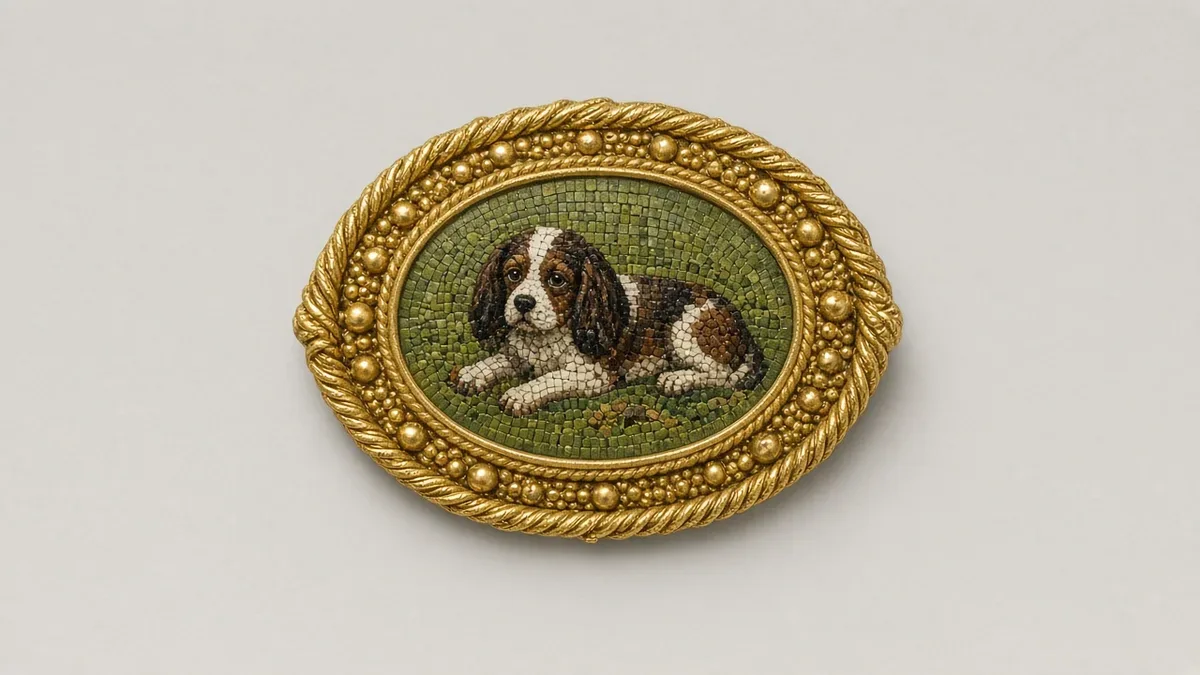
Micromosaic is the other language. Unlike granulation, it is a Roman pictorial tradition of minute glass tesserae. Castellani set early Christian and Byzantine monograms, mottos and, earlier in the firm’s life, conventional souvenir pictures — flower sprays, spaniels, doves — in archaeological gold. Christie's, cataloguing a spaniel brooch in 2006, noted that traditional animal and flower mosaics in Castellani mounts are often earlier plaques, reset for clients. The gold, not the picture, dates the jewel. Collectors who already handle Florentine pietra dura should keep the two techniques apart: hardstone inlay is cut stone; micromosaic is glass.
Naples, Melillo, London and Paris
Alessandro’s politics matter for attribution. The British Museum dates his exile from Rome to 1859–1870. In those years he opened in London and Paris and founded a goldsmiths’ school in Naples. Giacinto Melillo (1846–1915) was running that school by 1865 and the Naples workshop by 1870, when Alessandro returned to Rome. The Victoria and Albert Museum holds a plaited gold necklace of about 1870, marked GM, made by Melillo for Alessandro after a Greek original of about 330–300 BC from Melos that Alessandro sold to the British Museum in 1872 (registration 72.6.660). A related necklace is in the Villa Giulia Castellani collection.
Melillo later worked under his own name. His jewels are often unsigned; wooden fitted cases and a GM punch do more work than style. A later "Castellani" label on a delicate Neapolitan fringe necklace without the crossed C is a hypothesis, not a mark. Carlo Giuliano, who worked with Alessandro in London, is a separate English revival house and should not be used to date a Roman jewel.
The firm exhibited. Bard records displays in Florence, London and Paris in the 1860s, the 1876 Centennial Exposition in Philadelphia, and a showing at the Metropolitan Museum of Art in 1877. Geoffrey C. Munn’s Castellani and Giuliano: Revivalist Jewellers of the Nineteenth Century (Trefoil, London, 1984) remains the English handbook for marks and published comparanda.
What determines value
Value on this material is a function of workshop, not of "Etruscan style."
Maker and workshop come first. A jewel with the addorsed or interlaced Cs, preferably applied twice as on the British Museum pendant 2006,0311.1, sits in a different market from unsigned revival gold. Melillo’s GM and Giuliano’s London mark are related but not substitutes. Period and region follow: Rome, about 1850–1880, is the core; Naples under Alessandro and Melillo is the documented satellite; work after Alfredo’s closure in 1927 is another industry.
Material and technique separate the bench from the press. Fine, even granulation that reads as line, not as a sprinkled texture; hand-applied rope-twist; and micromosaic tesserae that vary slightly in size, all support a period claim. Machine-stamped "granules," identical repeats, and thin hollow sheet do not. Rarity is real: the British Museum notes that only a fraction of the firm’s jewels survive. A speaking jewel with a published Caetani motto, or a piece in an original fitted case stamped Castellani in Greek letters, is scarcer than a later reset micromosaic.
Condition and restoration move prices more than motif. Detached glass grapes on a fringe necklace, re-enamelled scrolls, a replaced pin and catch, or a micromosaic ground filled with modern grout are ordinary faults. They should be stated. Provenance — a Wartski or Bard exhibition label, a Munn illustration number, a Villa Giulia or British Museum sibling — is evidence. A leather box alone is not. Size is secondary except at the extremes: the Christie's spaniel brooch at 6.1 cm and the 2015 papal-monogram brooch at 60 mm are large enough to read as jewels, not as buttons. Market demand is concentrated on signed gold with either exceptional granulation or a distinctive micromosaic, not on generic rope-twist collets.
Prices at auction
The figures below are prices realised as published by Christie's, in the currency of the sale. They are not a valuation. Condition, mark, subject and the day’s room change the result.
Christie's, London, 6 December 2006, sold an archaeological-revival micromosaic brooch of a King Charles Spaniel on grass, by Castellani, about 1860, 6.1 cm wide, addorsed Cs, original fitted case, for GBP 26,400 against an estimate of GBP 4,000–6,000.
The same sale included a citrine cameo brooch of Zeus with a lightning bolt, ruby-set border and green enamel scrolls, about 1860, 5.5 cm high, addorsed Cs, price realised GBP 14,400 (estimate GBP 5,000–7,000); a pietra dura dove brooch on lapis with an agate pair of doves and a malachite ribbon, about 1850, 4.5 cm, addorsed Cs, GBP 3,360 (estimate GBP 2,000–3,000); and a pair of small micromosaic jewels — a brooch with the Greek acrostic Phos/Zoe, 3.0 cm, and a pendant with a Hagia Sophia lily motif, 2.6 cm, both with addorsed Cs — for GBP 6,000 (estimate GBP 2,500–3,500).
Christie's, London, 14 May 2009, sold a gold brooch with an oval flower-spray micromosaic in a pierced archaeological-revival mount, about 1860, reverse with entwined Cs, for GBP 6,875 (estimate GBP 3,000–4,000).
Christie's, London, 2 December 2015, sold a circular gold-mounted micromosaic brooch with the monogram of Pope Paschal II after the twelfth-century apse mosaic of Santa Prassede, Rome, about 1850, 60 mm, maker’s mark for Castellani, for GBP 12,500 (estimate GBP 10,000–15,000).
The published range on these lots, as realised, runs from GBP 3,360 for a small hardstone brooch to GBP 26,400 for a large signed micromosaic with case. A flower-spray reset and a papal monogram after a known Roman mosaic sit between those poles. Unsigned revival gold, later copies and damaged fringe necklaces trade below this group. Prices vary with condition and market. None of these results is an appraisal of any other jewel.
Authentic or later
The mark is the first check. Castellani used addorsed, crossed or interlaced C punches, often applied in gold on the reverse. Christie's and the British Museum both treat that punch as the workshop signature. Some genuine pieces are unmarked. Absence of the C is not proof of a fake; it is a reason to stop and compare construction. A star-and-province gold mark of 1968 or later on an "1860 Castellani" brooch is a floor. The object is modern or has a modern repair shank.
Construction tells more than motif. Period gold is built: applied wire, fused grain, a pin with a simple catch contemporary with the mount. Later tourist work is a stamped oval with a rope-twist soldered on and a modern hinge. Granules that sit in identical ranks, or that are clearly soldered with a bright fillet, are later. Micromosaic tesserae in a period plaque are tiny and slightly irregular; a printed or painted "mosaic" under glass is not a mosaic. A conventional spaniel or flower basket may be an older Roman plaque in a Castellani collet, as Christie's observed. That is still a Castellani jewel if the mount and mark are right. It is not evidence that the mosaic itself is by the workshop.
Typical reproductions are English and Italian "Etruscan" gold of the late nineteenth and twentieth centuries, unsigned, in 9-carat or thin 18-carat sheet; Vicenza and Valenza floral gold with a Liberty vocabulary sold as archaeological; and micromosaic views of St Peter’s in new rope-twist frames. Charlotte Gere recorded Augusto Castellani’s own remark that a lack of fashionable success had led some Neapolitan workmen to turn to faking. A Naples fringe without GM or the crossed C should be described as revival gold, not as Castellani.
Common mistakes: calling every granulated brooch Castellani; using a Musy, Calderoni or later Italian Art Nouveau floral as a comparison set; treating a Greek-letter case as proof when the jewel inside is later; dating by the ancient coin or scarab rather than by the mount; and reading a 1934 lozenge or a 1968 star as a period punch. The 1872 Italian assay law made state marks optional. Many period gold jewels carry only 750, the C, or nothing.
FAQ
How do I identify authentic Castellani jewelry?
Read the reverse for addorsed or interlaced Cs, then the gold. Applied granulation and hand rope-twist, a period pin, and — if present — an original fitted case are the supporting evidence. Motif is the last test, not the first.
Did the workshop only copy Etruscan gold?
No. Etruscan granulation is the famous recovery. The same benches set Greek, Roman, early Christian, Byzantine, medieval and Renaissance models, and they mounted ancient coins, scarabs and cameos. The Villa Giulia itinerary is organised by that range.
Are unsigned pieces ever by Castellani?
Yes. The British Museum and Munn both record unmarked work. Attribution then rests on construction, a published comparandum, and, where it exists, a case. "In the manner of Castellani" is the honest label when those are missing.
What is the difference between Castellani and Melillo?
Melillo trained in Alessandro’s Naples shop and ran it from 1870. Jewels he made for Castellani can carry GM, as on the V&A necklace. Independent Melillo work is a Neapolitan revival, not a Roman Castellani object.
Does a micromosaic of Rome prove the mount is Castellani?
No. Souvenir micromosaics were a Roman trade long before and after the Trevi shop. The mount, the punch and the construction date the jewel. The view dates the plaque, if it can be dated at all.
The Castellani jewel is a signed modern object that argues with antiquity. Compare the punch, the grain and the mount with the pieces published by Munn, by Weber Soros and Walker, and by Villa Giulia. If the gold, the mark and the documented comparanda do not agree, do not force the name. For a jewel offered as Castellani at a material price, or one whose mark is applied, recut or absent, a written opinion from a jewellery specialist and a condition report from an independent conservator are the next documents. They are not a sales argument. They are how this material is bought.