
Identify Grottaglie Ceramics by Workshop Forms and Marks
Identify Grottaglie ceramics by workshop marks, tin-glaze whites, rustic capasoni and historic forms from the potters' quarter at Grottaglie, Puglia.
Grottaglie, in the province of Taranto, is a working pottery town rather than a closed Renaissance court centre. The useful evidence for collectors sits in the Quartiere delle Ceramiche along the Gravina di San Giorgio: cave and tufa workshops, named vessel types, and a thin documentary trail of trade names. A national survey of centres is in the Italian ceramics collecting guide. Workshop signatures on older pieces are scarce. Identification proceeds from form, glaze system, and construction, then from the few marks that do exist.
The Italian term for the tin-glazed line is maiolica. For the English and Italian vocabulary, see Italian majolica vs maiolica. Grottaglie is not Urbino istoriato and not Faenza berettino. Its historic output is a split trade: rustic storage and kitchen wares on one side, ivory-white table and parade forms on the other.
The quarter and the written record
Local speech still calls the quarter li Camenn're (or le camenre), from the chimneys of the kilns. Unioncamere and the Camera di Commercio di Taranto describe shops that remain in caves cut from the limestone. Cosimo De Giorgi, visiting in the late nineteenth century and quoted by Giovanni Acquaviva, saw troglodyte rooms used as clay stores, settling troughs, wheel benches, and glaze mills, with drying terraces cut into the hillside. That topography is a dating clue in itself. A large capasone thrown in stacked sections, then joined, belongs to a workshop that had space and a kiln vault built for heavy ware.
The Ministero della Cultura records the Museo della Ceramica in the Castello Episcopio, opened on 22 December 1999. The castle was raised in the fourteenth century by Giacomo d'Atri, archbishop of Taranto from 1354 to 1381. The building remains property of the Diocese of Taranto, on loan to the Comune. The museum holds about 500 objects, from the eighth century BC to the present, drawn from civic holdings, private loans, and the Soprintendenza Archeologica. CoopCulture divides the display into everyday wares, archaeology, maiolica, nativity groups, and contemporary prize pieces.
Archaeology at Masseria Vicentino, in the Grottaglie countryside, produced globular ollae with geometric ornament and painted or incised paterae of the eighth to fourth centuries BC. Those finds document clay working on the site long before the medieval town. They do not date a nineteenth-century plate. Medieval continuity is clearer in slip-coated and overpainted fragments, and in the concentration of kilns outside the walls once the settlement formed in the fourteenth century.
A 1463 document of the Regia Dogana of Taranto, cited by the Associazione Italiana Città della Ceramica, records the making and sale of maiolica. Grottaglie was then a principal supplier of household ceramics to the port trade. From 1567, archival lists name potters as cretari, workers of common clay vessels. In the seventeenth century a second qualification appears: faenzari, potters of a finer, tin-glazed class named by analogy with Faenza. Fragments of that finer ware have been recovered in excavations at the castle and at the Chiesa del Carmine.
The town's official production disciplinare, approved by the Consiglio nazionale ceramico on 30 November 1999, preserves an earlier family name from the fifteenth century: Simone De Faenza and his sons Antonio and Andrea. Nicola Vacca published potters' lists for 1500–1800 in Rivista Salentina in 1936, taken from the catasto of the Palazzo Reale in Naples before the 1943 fire. Those lists are a research tool, not a punch book. Most surviving Grottaglie vessels still have to be dated without a personal mark.
Two trades: ruagnara and faenzara
Ninina Cuomo di Caprio's work on rustic Apulian pottery, and the local workshop vocabulary collected around it, distinguish two historic specialisations.
Arte ruagnara covers the useful line. Workshop speech split it further. Robba gialla is common ware given a single firing, slipped in whole or in part, then coated with a transparent lead glaze coloured by metal oxides. Robba rossa is fireproof cookware with a higher iron content. Robba verde takes its colour from copper in the glaze. Arte capasonara is the branch that made the large wine jars. Robba rustica is unglazed terracotta, once-fired, for the coarsest household uses. CoopCulture's everyday section names the principal shapes: capasone and capasone alla capuana, trimmone, capasa, vummile, cicine, pitale, cammautto, the cooking tiestu and pignata, laundry and washing forms (crasta ti cofanu, limmu, scafarea, pendriale), plant pots (crasta, casc'pò), sanitary wares, well jars, chimney pots (ciminiera), and the clay tubes (orieni) used to build kiln vaults.
A capasone (from capase, capacious) is a large ovoid storage jar for wine or oil. It was thrown in separate rings or sections and luted together. Look for the horizontal joining scars under the glaze, a thick everted rim, and a body too heavy for a decorative copy thrown in one pull. Unglazed or partly glazed lower walls are normal. Full, even, glossy coverage on a lightweight jar is a later garden ornament.
Arte faenzara (also robba bianca, robba stagnata, robba fine, opera bianca) is the twice-fired tin-glazed line. The ground is rarely a hard paper white. It tends to ivory or a faint yellow. The disciplinare forbids imported white bodies for traditional Grottaglie types and requires calcareous, ferruginous local clays. That rule is modern regulation, but it matches what the older wares show: a buff or pinkish earthenware body under the enamel, visible at the foot and in chips.
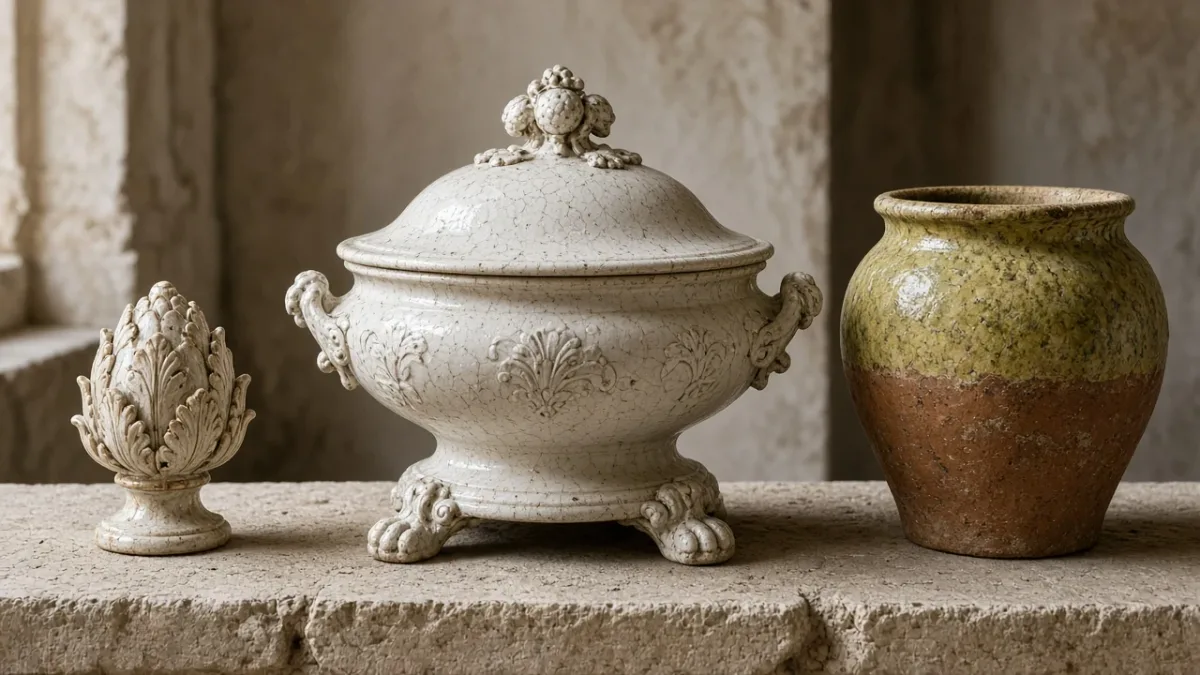
Characteristic eighteenth-century bianchi di Grottaglie include tureens on lion-paw feet, ciarle, and vucale with modelled fruit, leaves, or figures. The ciarla is the most distinctive maiolica form: a lidded jar with large ribbon handles. CoopCulture also records water and wine pitchers (sruli), apothecary albarelli, and tureen knobs modelled as human heads, pinecones, fruit, or animals. Floor and wall tiles from Grottaglie sit in the same maiolica rooms beside Salento and Campanian examples; attribution of an unsigned tile needs the body and palette, not the museum label of a mixed case.
The official colour list is short and practical: copper green (verde ramina), antique leaf green (verde frasca), cobalt (bleu cobalto, locally summartino), ochre yellow, manganese brown, and antimony gold-yellow. A dead enamel white with printed roses, or a third-fire metallic lustre on a traditional Grottaglie motif, falls outside the historic workshop range. The disciplinare bans third-fire decoration on traditional motifs, and bans decals and screenprint on traditional pieces.
Laterza, Faenza, and what Grottaglie is not
Laterza, also in the province of Taranto, ran a finer maiolica trade in the seventeenth and eighteenth centuries: tin-white grounds, turchino drawing, and, from the late seventeenth century, an istoriato laertino of cavaliers, hunts, and mythological scenes. Grottaglie borrowed glaze and some forms from that neighbour at the end of the seventeenth century. It did not become a second Laterza. Parade istoriato on a Grottaglie-weight body should be compared first with Laterza and with the northern centres treated in Faenza maiolica and Deruta ceramics, not forced into a Grottaglie attribution because the seller is in Puglia.
The faenzari name records a technical debt to Faenza, not a branch workshop of the Romagnol factories. Grottaglie bianchi suppress painted narrative. The white field and the modelled handle or foot carry the piece. That is the opposite of Urbino full-field istoriato, which is dated by reverse inscriptions rather than by modelled handles.
Named forms collectors meet
Pumo. The official disciplinare lists pumi among typical Grottaglie ornaments. The form is a closed ceramic bud set among acanthus leaves, used as a balcony, gate, or furniture finial. Related ceramic finials in other regions, such as the Sicilian pigna, have their own clay, glaze, and workshop habits; see Sicilian pigna ceramics. A Grottaglie pumo is usually tin-glazed or lead-glazed earthenware, not stoneware, and not a moulded resin souvenir.
Ciarla. Lidded jar, often with paired ribbon handles and a fruit or figure knob. Small and large sizes both occur. An eighteenth-century example should show the ivory tin glaze, modelled junctions, and a footring with kiln grit or wear.
Zuppiera. Tureen, frequently on lion feet, with a modelled lid. Wannenes sold a Grottaglie-attributed two-handled tureen with fruit handles and garland painting (lot 726, 3 March 2016, 24 × 29 cm), which is the auction type: useful for form, not a price index.
Srulo / sruli. Pitchers for water or wine. Check the handle attachment and the interior glaze. A clean, unused interior on a supposedly eighteenth-century pitcher is a warning.
Albarello. Pharmacy jar. Grottaglie made them; so did Laterza, Naples, and every major tin-glaze centre. Do not assign an albarello to Grottaglie from the waist moulding alone.
Nineteenth-century plates with repeated blue sponge-stamped rosettes are grouped in the trade as righe e stelle. The name is a collectors' label for a mid-to-late nineteenth-century decoration, not a workshop punch. Pressure and pigment load vary from stamp to stamp. That variation is workshop practice. It is not, by itself, proof of a named bottega.
A running cockerel appears in later Grottaglie painting. The disciplinare traces the motif to Messapian ceramics in the Museo di Lecce. Treat that as a local decorative claim, not as a continuous mark from antiquity.
Marks, seals, and the few signed pieces
Signed antique Grottaglie is uncommon. The clearest published example is a painted maiolica anforetta of 1867 in the Museo Internazionale delle Ceramiche, Faenza, inscribed "Alesandro Magno." Luigi Motolese (also catalogued as Mottolese), the Grottaglie potter and collector, donated it in 1940. Saverio Pansini entered it in Ceramiche pugliesi dal XVII al XX secolo (2001) as Grottaglie-area on the strength of that unusual signature. Francesco Spagnulo presented archival work at the Castello Episcopio on 28 August 2020 proposing a named Grottaglie figulo behind the inscription. The proposal is a research attribution. It is not a standard punch that other pieces can be matched to by eye.
Motolese himself (1879–1952) trained at the Regia Scuola d'Arte, worked in the Calò factory, opened a small works on Corfu in 1901, and in 1908 founded a manufactory in the former convent of the Paolotti fathers. His wares, and other late historicist pieces from the school, belong to a different market from unsigned eighteenth-century bianchi.
The school is dated in the disciplinare: founded 20 June 1884 and recognised on 15 October 1887 as the Laboratorio per il perfezionamento della Ceramica in Grottaglie. Unioncamere treats the Istituto Statale d'Arte as one of the older ceramic schools in Italy. After a century it moved into the ceramics quarter. Academic revival decoration, prize plates, and Greco-Roman reproductions begin here. They can be well made. They are not eighteenth-century bianchi.
Modern pieces that meet Law 188 of 9 July 1990 may carry the national mark for Ceramica Artistica e Tradizionale. Grottaglie is a listed zone of established tradition, together with Laterza and Cutrofiano in Puglia. The Grottaglie disciplinare requires a raw or high-fire seal giving the potter's name, initials, or sign, the letters OPM (Opus Manufactum), and the date. That seal dates a late-twentieth- or twenty-first-century workshop piece. Its absence on an older jar is expected. Its presence on a piece offered as eighteenth-century is a contradiction.
Twentieth-century shops also painted or stamped factory letters. Collectors meet CNF (Ceramiche Nicola Fasano) and other family names on table wares. Those marks identify modern or recent production. They do not authenticate a capasone or a lion-footed tureen of 1780.
Condition, copies, and what to record
Useful notes on a Grottaglie object are short. Record height, maximum diameter, weight, clay colour at the foot, glaze type (lead, tin, or mixed), whether the glaze stops short of the base, joining scars, modelled versus moulded handles, and any painted or impressed mark, including OPM. Photograph the foot, the interior, and any chip.
Condition that matters: star cracks in a thick capasone wall, replaced rims on ciarle, overpaint on the ivory field of a bianco, and resin pumi sold as ceramic. Fine, even crazing on tin glaze is common. A poreless, dead-white enamel with no wear at the foot is later. Lead-glazed rustic ware can show glaze crawl and kiln kissing; those are workshop faults, not modern damage, if the scars are under the same glaze as the rest of the pot.
Tourist copies repeat the pumo and the cockerel in bright, even colours on light white bodies. The disciplinare does not allow those white industrial bodies for traditional Grottaglie types. Compare any "antique" table service with the museum's everyday and maiolica rooms before accepting a workshop name.
FAQ
How do I tell Grottaglie rustic ware from a generic southern Italian jar?
By the combination of local form names and construction. A true capasone is large, section-thrown, and made for wine or oil. The clay is calcareous and ferruginous. Partial glaze and a heavy rim are normal. A lightweight, fully glazed garden amphora with a moulded ring foot is not that object.
Are Grottaglie bianchi the same as Faenza bianchi?
No. Faenza bianchi of the sixteenth century are a thick white enamel with spare compendiario drawing. Grottaglie bianchi are an eighteenth-century ivory tin glaze in which modelled feet, handles, and knobs do most of the work. Painted narrative is secondary.
What workshop mark should I expect on an eighteenth-century piece?
Usually none. Date the piece by form (ciarla, lion-footed tureen, vucale), clay, and glaze. Use Vacca's 1936 lists and the De Faenza family name for historical context, not as a signature to hunt for under the foot.
Does a CAT or OPM mark prove an antique?
No. The CAT system and the OPM seal belong to Law 188/1990 and the 1999 disciplinare. They identify a registered contemporary workshop working inside the Grottaglie rules.
Where can I compare documented examples?
The Museo della Ceramica in the Castello Episcopio, Largo Maria Immacolata, Grottaglie. The MIC in Faenza holds the 1867 Magno anforetta and the Apulian group published by Pansini. The Istituto's own didactic maiolica collection, at the edge of the quarter, holds later school pieces.
A Grottaglie attribution is the agreement of clay, glaze, form, and, when present, a mark that belongs to the right century. If those disagree, the later evidence rules.