
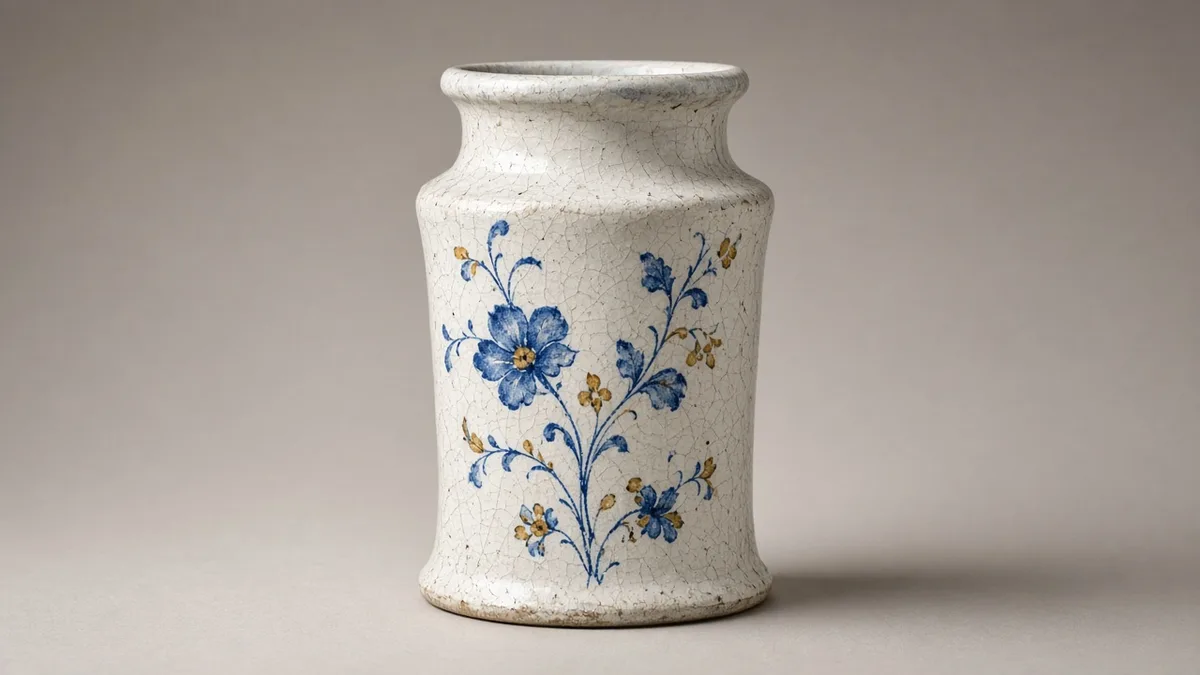
Faenza Maiolica Identification: Berettino, Bianchi and Marks
Identify Faenza maiolica by berettino glaze, bianchi di Faenza painting, VR FA and DO PI workshop marks, and later faience lookalikes.
The word faience enters French and English through Faenza, the Romagna centre that shipped tin-glazed earthenware across Europe. Collectors still use “Faenza” loosely for any white tin glaze. That habit collapses dating and workshop attribution. This guide separates Renaissance and early modern Faenza maiolica by glaze type, decorative system and the few reliable painter or bottega marks—without treating later northern European faience as Neapolitan or Deruta work by another name.
For a broader Italian maiolica frame, see our Italian ceramics collecting guide. Deruta’s repertoire is a useful contrast in colour density and lustre practice: Deruta maiolica. Sicilian pine-cone ceramics belong to a different regional tradition—see Sicilian pigna.
Body, glaze and what “maiolica” means here
Faenza maiolica is earthenware coated with an opaque tin glaze, then painted and fired again. The opaque white (or tinted) surface is the painting ground. Lead-glazed terracotta with a thin wash is not the same material, even when the shape looks similar.
The Museo Internazionale delle Ceramiche in Faenza (MIC) frames the local sequence from medieval green-and-manganese “archaic” wares through Gothic and Renaissance ornament into the sixteenth-century systems collectors meet most often: dense polychrome istoriato and a berettino (grey-blue) ground, then the bianchi di Faenza—thick white glaze with spare compendiario painting.
Berettino and “sopra azzurro”
Early sixteenth-century Faenza workshops made heavy use of blue-tinted grounds. Berettino refers to a grey-blue tin glaze used as the field for grotesques, armorials and narrative scenes. Related “sopra azzurro” painting builds figures on an azure enamel, using yellows that shift toward green in shadow and white heightening.
Auction and museum notes repeatedly caution that berettino borders with grotesques were long labelled “Casa Pirota” by habit. Scholarship since the late twentieth century (including Norman’s note on the so-called Casa Pirota mark) treats many such borders as products of other Faenza shops—Bergantini among them—unless an inscription or secure comparative set supports Pirota. Do not date or attribute from the colour name alone.
Bianchi di Faenza and the compendiario manner
From roughly the 1540s, Faenza shops thickened and whitened the tin glaze, leaving large areas undecorated so the vessel’s modelling reads first. Decoration shrinks to a figure, a putto, an armorial, or a thin rim wreath, brushed quickly in a limited palette—typically blue, yellow and orange. Gaetano Ballardini later named this rapid manner compendiario.
Treccani biographies of Virgilio Calamelli (Virgiliotto) and Leonardo Bettisi (Don Pino) place both masters in the mid-century “whites” movement. The style spread beyond Faenza; foreign tin-glazed wares borrowed the look and, in French, the place-name. A white dish with spare blue-yellow figures is therefore Faenza-type, not automatically Faenza-made.
Piccolpasso’s Tre libri dell’arte del vasaio (mid-sixteenth century) describes the white tin enamel practice collectors still paraphrase as “bianco faentino.” Use the treatise as technical context, not as a punch-list for marks on a specific object.
Workshops and marks worth learning
Marks on Faenza pieces are uneven. Many high-quality dishes carry none. When present, treat letters as workshop badges that may cover several hands, not as personal signatures of a single painter.
Documented examples include:
- VR FA / VR AF — associated with Virgiliotto Calamelli’s shop; appears on both earlier dense painting and on whites
- DO PI / DOPI — associated with Don Pino (Leonardo Bettisi); known on MIC and other museum holdings
- Inscribed bottega lines (rare) such as pieces stating manufacture in a named Faenza workshop with a day-month-year—these outweigh a guessed monogram
Ca’ Pirota (Pirotti) remains historically central for early Cinquecento Faenza, including sopra azzurro and later berettino output, but the casual “Pirota mark” label on blue-ground grotesque rims is no longer accepted as a default. Prefer construction, palette, and published comparanda over a single scratched cipher.
Bettisi’s shop also produced large credenze for Medici, Bavarian and ecclesiastical clients in the 1560s–70s—useful when a service language (armorials, matching forms) supports a Faenza whites attribution even without a mark.
How to read a candidate piece
1. Confirm tin glaze opacity at chips and footring; note glaze thickness and crawl.
2. Place the decorative system: archaic green/brown; dense Renaissance polychrome; berettino/sopra azzurro; or bianchi/compendiario.
3. Photograph any mark in raking light; expand abbreviations against published Faenza lists before naming a bottega.
4. Check form: albarelli, crespine, fluted fruit stands and modelled whites have Faenza parallels—compare silhouette to MIC types, not to modern tourist ware.
5. Separate Faenza from faience: Delft, French and Central European tin glaze can mimic whites decades later.
Common mistakes: calling every blue-ground Italian dish “Casa Pirota”; equating any white tin glaze with sixteenth-century Faenza; reading VR/DO letters as painter signatures without workshop context; ignoring restored rims that carry modern overpaint.
FAQ
Is every “faience” piece from Faenza?
No. The word travelled with the technology. Origin is a material and stylistic argument, not an etymology.
What is the fastest visual split between berettino and bianchi?
Berettino keeps a coloured blue-grey field under the ornament. Bianchi leave most of the surface white, with spare colour accents.
Do marks prove authenticity?
They support attribution when outline and glaze agree with known punches. Isolated letters on a soft modern body are not enough.
Where should I study reference pieces?
Start with MIC Faenza’s chronological galleries and its interactive catalogue of Faenza forms and decorations, then cross-check auction essays that cite Wilson, Ravanelli Guidotti and related corpora.
Conclusion
Faenza maiolica is dated by glaze system and workshop evidence, not by the modern word faience. Learn berettino versus bianchi, treat VR FA and DO PI as shop marks, and retire automatic Casa Pirota labels on blue grotesque borders. When the object, glaze and published comparanda agree, the Romagna origin holds; when only the name “Faenza” is doing the work, keep the catalogue note cautious.
Construction clues on albarelli and dishes
Footrings on Faenza maiolica are usually dry or thinly glazed on the contact ring; look for kiln-spur scars and sand adhesions consistent with period stacking. Wall thickness on Renaissance dishes can be surprisingly thin at the cavetto while the rim stays heavier. Later tourist “Faenza” souvenirs reverse that relationship: thick walls, glossy even glaze, and printed-looking ornament.
On albarelli, check the shoulder seam and the interior glaze line. A genuine tin glaze pools differently from a modern opaque white spray. Chips that show a pink-buff body under thick white enamel support a maiolica reading; a chalky white body throughout often signals a later industrial paste.
Nineteenth- and twentieth-century Faenza afterlives
Faenza did not stop in 1600. Nineteenth- and twentieth-century factories and studios revived Renaissance patterns, sometimes with clear factory marks documented in English mark guides (for example surveys covering Minardi, Melandri and later Faenza makers). Those pieces are collectible on their own terms. The error is selling a 1920s revival as a 1530s berettino dish. Compare mark books for modern Faenza punches with museum Renaissance types before you write a century on a label.
International demand also produced pastiches outside Italy. Northern European faience factories absorbed the whites aesthetic; painted “Italianate” putti on a soft Delft-related body are not Romagna wares. Weight, ring, and glaze micro-crackle patterns help more than a dealer’s regional adjective.