
How to Identify Italian Antique Console Tables by City and Construction
How to identify Italian antique consoles by city: Roman giltwood, Genoese rocaille, Venetian painted lacquer, and marble tops that are often later.
The Italian console is a wall table. In inventories it appears as a consolle, a tavolo da muro or a console d'applique. It was made to stand against a pier, usually under a looking glass, and it was finished on three sides. The back is often flat, the rear legs are sometimes omitted, and the marble slab, when there is one, is a separate object that can be later than the wood.
Collectors who treat “Italian giltwood console” as a single school will misread the market. Roman water-gilding, Genoese pierced rocaille, Venetian painted lacquer and Neapolitan silvered wood are different products. Identification starts from construction, then from city, then from the marble.
What to look at first
A period console is a piece of interior architecture. The Toledo Museum of Art records that its Genoese pair of about 1742–44, designed by Lorenzo de Ferrari for the Galleria Dorata of Palazzo Carrega-Cataldi, originally stood in a recess against a wall beneath a mirror. The same logic holds in Rome and Turin. Height is usually between about 84 and 96 cm, wide enough for a pier, and shallower than a centre table.
Turn the table if you can. A wall piece has an unfinished or planed back; the Galleria Corsini console restored for the Sala del Camino, dated around 1730, is described by the Gallerie Nazionali di Arte Antica as having a flat back because it was meant to sit against the wall. Four cabriole legs with a fully carved reverse usually mean a later, free-standing conversion, or a different form altogether.
The carcass is commonly poplar, pine or walnut, with lime or other carving woods for the ornament. Gilt examples are gessoed, given a bole, and laid with gold leaf. Painted Venetian tables use the same carved structure under coloured varnish. Neither surface should look sprayed. Losses at knees, feet and the inner edges of a pierced apron are normal. A perfectly even gold skin over sharp, identical scrolls is a warning.
Marble is the most frequently replaced part. Auction cataloguers record later Spanish brocatello on otherwise period Genoese bases, later surround-stretchers under Roman slabs, and later supports screwed to the underside of a top. A slab that does not follow the serpentine of the frieze, or that sits on bright new battens, is not evidence for the date of the wood.
Rome: masks, stretchers and named shops
Roman consoles of the first half of the eighteenth century keep a Baroque mass. Female masks and grotesques occupy the frieze. Legs are heavy volutes, often headed by female busts. An X-shaped stretcher with a further mask or palmette joins the feet. The type is close to Florentine models after Giovan Battista Foggini and the Uffizi drawings of Diacinto Maria Marmi, which is why catalogues still argue Rome against Florence on unsigned pieces. A Metropolitan Museum table of about 1740 (acc. 1971.1.7; 87.6 × 111.8 × 54.6 cm) carries a sarrancolin and vert-de-mer top on carved giltwood of this Roman scale.
The Corsini palace on via della Lungara is the public place to see the type in situ. The Sala del Camino console, commissioned in the circle of Cardinal Neri Maria Corsini and dated around 1730, still awaits a named carver. The museum places it among the Roman shops that worked for papal families, of which the most cited is that of Giuseppe Corsini and his wife Lucia Barbarossa. The First Gallery rococo consoles in the same palace are given to that shop. The palazzo was bought in 1736; Lucia ran the workshop after Giuseppe’s death. Female heads on the legs, lion-head volutes on the stretcher, and a flat back are the structural points, not the family name on a label.
A generation later the Roman rococo thins out. Nicola Carletti supplied Cardinal Flavio II Chigi (1711–1771) with seat furniture and tables for the new Villa Chigi on the via Salaria in 1768–70. Sotheby’s, following Alvar González-Palacios, records the gilders Angelo and Alessandro Clementi and the painter Pietro Rotati on the same commission. Oak trails, twisted-ribbon borders and polychrome carved foliage tied the tables to the villa’s frescoes. The contents were dispersed in the 1960s; Georgina Masson’s photographs, now at the American Academy in Rome, remain the proof of the original hang. An ICCD record for a related pair now at Palazzo Barberini (NCTN 00963084; about 94 × 134 × 63 cm, jasper and verde antico) dates them around 1770 and notes that they were later poorly regilded. That last observation is the practical one. Roman giltwood of this quality was water-gilded. A thick, cold, even gold over softened carving is later.
Bonhams catalogued a Roman table of about 1725 (93.5 × 161 × 75 cm) against tables in the Palazzo del Quirinale published by González-Palacios in 1996. The surround stretcher under the marble on that lot was later. Construction notes of that kind are worth more than a city attribution printed in bold.
The carving vocabulary overlaps the giltwood frames of Rome and Florence: the same shops produced looking-glass frames and table supports, and a console was often designed as the lower half of a pier composition.
Genoa: pierced aprons and Polcevera marble
Genoese consoles of the first half of the century are larger in plan and more open in the apron. Palazzo Reale, Genoa, keeps a pair in the Sala degli Arazzi (inv. 879 and 880; 94 × 162 × 83 cm), dated 1700–1730, with tops of verde di Polcevera, the local green marble. The ICCD description lists volute legs on foxtail feet, a pierced front rail with cartouches, floral trails and coquillage, and musical trophies on the stretcher. That combination (local marble, aquatic ornament, a pierced rather than a solid frieze) is the Ligurian test.
Lorenzo de Ferrari (1680–1744) designed the Galleria Dorata of Palazzo Carrega-Cataldi, now the Chamber of Commerce, about 1742–44. The original consoles from that gallery are in Toledo (acc. 1978.31; 87.6 × 121.9 × 50.8 cm): gilded gesso over wood, marble top, satyr and putto supports, scrolling legs. Stanford White exported the gallery’s furniture at the end of the nineteenth century. The consoles and mirrored doors now in the palace are copies. A collector who dates a “Carrega-Cataldi” table by the room as it stands today is dating the copy.
Filippo Maria Mongiardino, a Genoese carver, worked from de Ferrari’s designs. A table attributed to him, sold in 2017, had a Spanish brocatello top, later supports under the slab, replaced garlands and a later gilding. Those condition facts are typical of the Genoese market, not exceptional. Related tables share a pierced apron, dragon-head scroll feet and floral swags. Enrico Colle’s Il mobile rococò in Italia (2003) remains the printed concordance.
Late-century Genoese work tightens into a neoclassical giltwood with inverted-obelisk legs, lion masks and acanthus, still often with Polcevera or other Ligurian marble. It should not be collapsed into the rococo pierced type of 1720–50.
Venice: paint, lacquer and a different object
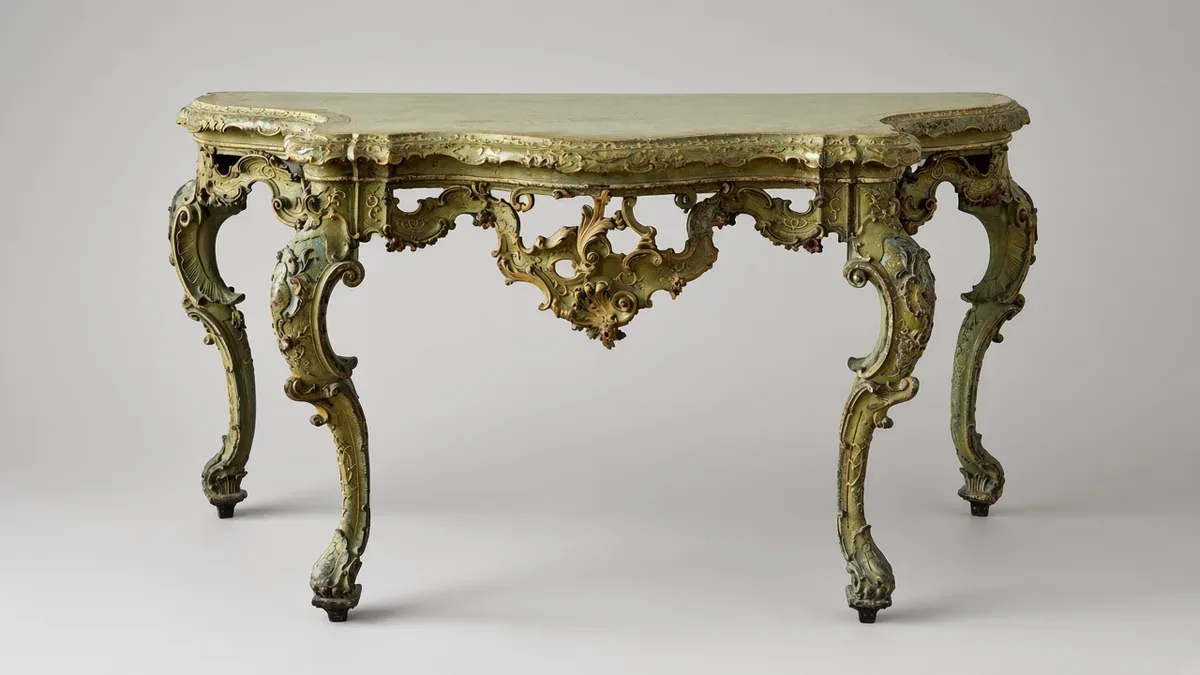
Venetian wall tables of the eighteenth century are as often painted as they are gilt. The Isabella Stewart Gardner Museum holds a pair of mid-century consoles in painted walnut and pine (F26e2.1–2; 84 × 172 × 77 cm). The original blue survives in losses; the varnish has shifted the field toward green. Cabriole legs, a hanging rococo apron of leaves, flowers and shells, and claw-like feet follow French Louis XV outlines without a French carcass. A Metropolitan pair of about 1715–25 (acc. 06.1335.2; 88.9 × 121.9 × 53.3 cm) is partly gilded and painted, with marble. Museo Correr keeps late-century examples lacquered azzurro-verde or yellow, with grey-green or grey-black marble.
This is the same painted and lacquered culture described for Venetian lacquer furniture of the eighteenth century, applied to a wall table rather than to a ribalta or a commode. Chips through coloured varnish to gesso, and gesso to wood, are the dating surface. A uniformly olive “antique green” with no losses is usually later paint.
Andrea Brustolon of Belluno (born 20 July 1662, died 25 October 1732) stands apart. His tavolo portavasi at Ca’ Rezzonico (Inv. Cl. XXII n. 340/1; carved ebony and boxwood, 200 × 167 × 80 cm, about 1700) belongs to the Fornimento Venier, a sculptural suite the museum dates between 1680 and 1706. It is a vase-stand, not a pier table. Later workshops copied the ebony figures and the branch-work chairs. Those copies are a different collecting field. They do not date a gilt or painted wall console.
Turin and Naples
Turinese giltwood consoles of the 1750s have high-hipped cabriole legs, rocaille carving and, often, a matching pier glass. A pair at Ickworth (NT 850051), with Adnet marble, is catalogued as Turin about 1755 and was almost certainly bought by the Earl Bishop while British minister there in 1755–58. Related models are in Palazzo Reale, Turin. This is not Pietro Piffetti’s work. Piffetti (1701–1777) veneered wall tables and cabinets with ivory, woods and mother-of-pearl for the royal apartments; that ebanisteria is a different technique from water-gilded carving, and it is already the subject of the marquetry literature.
Neapolitan consoles of the 1740s can be painted and silvered rather than water-gilded. The Art Institute of Chicago holds one of 1740–50 (1966.551a–b): wood painted and silvered, marble; the base measures 94 × 137.2 × 59.7 cm. Silver leaf under a varnish reads cooler than gold and wears to a grey rather than to a red bole. Later Neapolitan tables of the 1780s–90s use fluted, tapering legs and white-and-gold grounds. They should not be dated by the same tests as a Roman mask table of 1720.
Florence, walnut and the gilt exception
Florentine palace furniture of the seventeenth and eighteenth centuries is more often walnut case-work than gilt wall tables. The walnut furniture of Florence and the eighteenth-century Italian commode occupy that field. Gilt consoles with female-bust legs, pierced C-scroll friezes and giallo di Siena or breccia tops do exist, and they share drawings with Foggini’s circle. On the market they are easily confused with Roman examples of the same years. Sharper, drier carving and a Siena slab are clues, not proofs. A gilt Florentine console is not a substitute for a documented stipo or a walnut credenza.
Where a console has gilt-bronze mounts rather than carved giltwood, the problem moves to the foundry. Italian gilt bronze workshops are a separate identification, used on Piedmontese and Roman luxury furniture, not on the carved Ligurian apron.
Later gilding, later marble, later copies
The copies now standing in the Galleria Dorata are the clearest public warning. An interior can be eighteenth-century in plan and nineteenth-century in its tables.
Regilding is the commonest surface alteration. The Barberini ICCD entry calls the later gold a defect. Oil gilding and modern leaf sit on top of recut or sanded ornament. Look for gold in worm-holes that should be dark, for metallic paint in the recesses of a flower, and for a red bole that has been painted over rather than worn through.
Marble tops travel. Verde antico, brocatello, alabastro fiorito, giallo di Siena and Polcevera are all documented on Italian consoles. None of them dates the base by itself. A veneered marble sandwich with a modern plywood core is later. A top whose outline ignores the carved rail is later. Auction notes that say “the marble replaced” are doing the collector’s first job.
Nineteenth-century Genoese and Florentine revival carving repeats volutes and shells at a larger, flatter scale. Palazzo Reale, Genoa, itself holds documented 1843 consoles by Agostino Picasso, with fior di pesco marble, in a historicist taste that can be mistaken for late baroque if the inventory date is ignored.
Common mistakes
The first is to call every gilt wall table Roman. Genoese pierced aprons, Polcevera marble and aquatic feet are not Roman grotesques.
The second is to treat Brustolon’s vase-stand as the model for a pier table. It is not. Height, materials and function differ.
The third is to date by the marble. Catalogues of otherwise serious tables record later slabs as a matter of course.
The fourth is to read even, cold gold as original water-gilding. Poor later gilding is already noted on documented Roman pieces.
The fifth is to ignore the back. A console is a wall object. A fully finished reverse, new rear legs, or a base that has been opened into a four-sided table has been altered.
FAQ
How can you tell a console from a side table?
By the back and the depth. A console is built to stand against a wall, often with a flat reverse and a matching glass above. A side table is finished in the round and is usually deeper.
Did Italian workshops mark consoles?
Almost never with a punch. Attribution rests on documented palace groups (Corsini, Carrega-Cataldi, Chigi, Venier), on drawings, and on construction. Paper labels are later.
Is a replaced marble top fatal?
No. It is normal. It does mean the top cannot be used to date or to localise the base. The wood, the gilding and the carving still can.
Why do Venetian consoles look green?
On the Gardner pair the original paint is blue. Aged varnish has shifted it. Other Venetian tables were lacquered yellow, red or azzurro-verde on purpose. Distinguish a varnish colour-shift from a later green repaint by looking at losses.
Where are secure examples?
Galleria Corsini, Rome; Palazzo Reale, Genoa; Ca’ Rezzonico and Museo Correr, Venice; Palazzo Reale, Turin; the Metropolitan Museum; the Toledo Museum of Art; the Isabella Stewart Gardner Museum; the Art Institute of Chicago.