
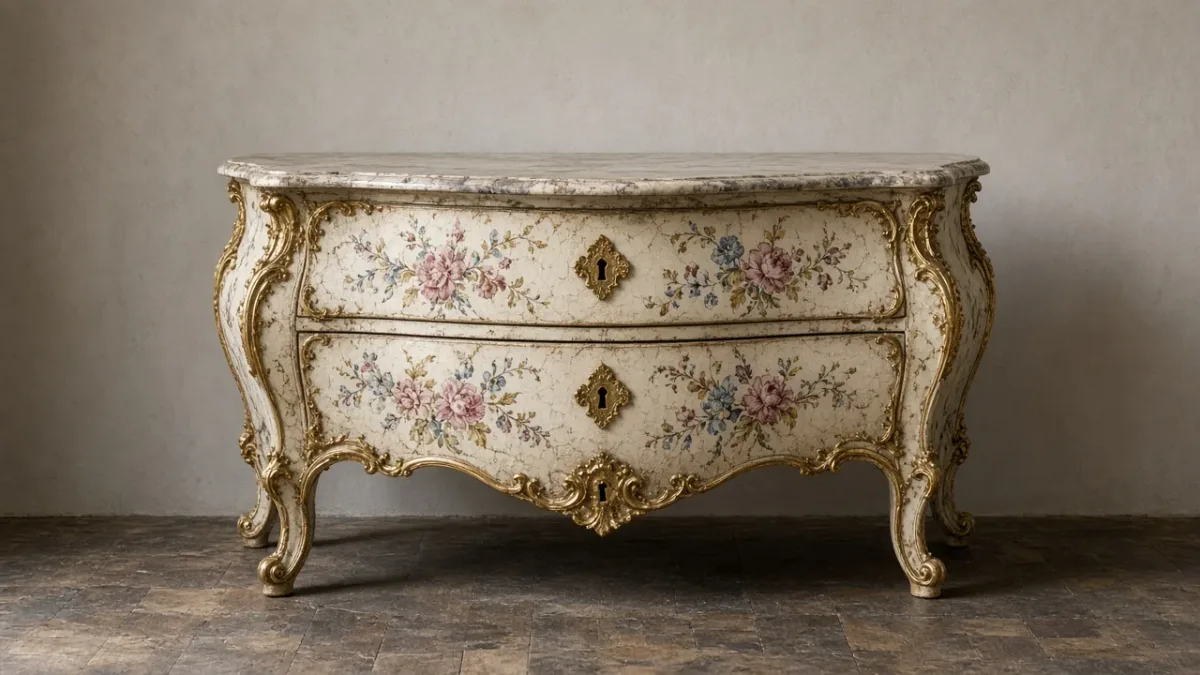
Venetian Lacquer Furniture, 1700–1800
Venetian lacquer furniture of the eighteenth century is dated by sandarac varnish, gesso grounds, and arte povera prints cut from Remondini sheets.
Venetian lacquer is a European varnish system, not Asian urushi. Workshops in the Serenissima built a softwood carcase, sealed the joints with canvas, laid a thick gesso, painted or pasted the ornament, and flooded the surface with sandarac. The finished object is lacca veneziana. Collectors still confuse it with later painted furniture and with arte povera, the paper-cut technique that used the same resin.
The distinction is physical. Oriental lacquer is the sap of Toxicodendron vernicifluum, built in many thin, hard coats. Venetian work is tempera on gypsum, locked under a spirit varnish derived from the North African sandarac tree (Tetraclinis articulata). The film is glossy and adhesive. It yellows. It crazes. It is not as hard as the Chinese or Japanese original, and it cracks as the softwood moves.
Reputation before 1700
Venice handled Levantine varnishes and painted leather long before chinoiserie became a European fashion. By the early sixteenth century the city was the principal Italian channel for a Levantine taste formed on goods from the Muslim Near East. The first Italian façon de la Chine imitations were made there, not as a sudden invention but as an extension of that trade.
Maximilien Misson, a Huguenot traveller who visited Venice in 1668, recorded the market in Nouveau voyage d'Italie: “La laque de Venise est comme on sçait en reputation.” He added that pieces existed “à toute sorte de prix.” The ornamental vocabulary of the late sixteenth century had been alla turchesca. By the early eighteenth it had shifted to chinoiserie, and that fashion held until the threshold of Neoclassicism.
The craftsmen were depentori alla cinese, members of the painters’ and decorators’ guild. In 1682 the figure painters left the Arte dei depentori; in 1691 they formed the Collegio dei pittori. Furniture decorators remained in the older corporation. The carpenters who cut the bombé carcases were marangoni. The two trades met on the same object and rarely signed it.
Workshops and output
Eighteenth-century Venice ranked with London and Paris as a centre of japanned furniture. Hans Huth, in Lacquer of the West (1971), recorded more than twenty-five lacquer specialists running workshops in 1754. By 1773 their number had nearly doubled. Sotheby’s has used those figures to place Venetian output beside English japanning and French Vernis Martin.
Names remain scarce. It was not workshop practice to stamp or sign a commode. A few exceptions are documented. Agostino Dal Bene, a depentore active in the second half of the century, exported lacquer to Germany and Spain and imported Chinese pieces, according to a report by the nobleman Gabriello Marcello. A chinoiserie ribalta with upper stage, sold at Sotheby’s London in March 1999 as lot 93, carries the painted name “Vizzo.” Giacomo Locatelli, a shop known for lacca povera, used a paper label: “Lavori di Giacomo Locatelli all’insegna del Redentore in merceria Venezia.”
The standard literature is still Giuseppe Morazzoni’s Mobili Veneziani Laccati and Mobili Veneziani del Settecento, Saul Levy’s Lacche Veneziane Settecentesche (Milan, 1967), and Clara Santini’s Lacche dei Veneziani and the three-volume Mille Mobili Veneti. Auction cataloguing still cites those plates.
Carcase and ground
The preferred woods were Alpine softwoods: spruce (abete) and Swiss stone pine (cirmolo, Pinus cembra). Both take a gouge and a plane without the resistance of walnut. Venetian marangoni built the bombé sides by the stave method used for barrels. Long, narrow boards of trapezoidal section were glued edge to edge and locked by a cross-grain fillet. The back was usually horizontal boards nailed into the thickness of the side. Drawer boxes were nailed, not dovetailed in the English manner.
A canvas strip was glued over the joints before the gesso. The cloth stopped the gypsum from cracking as the boards moved and hid openings in the softwood. Several coats of gesso, mixed from Bologna gypsum and animal glue, were then laid and scraped smooth. Venetian grounds are thicker than those on comparable lacquered furniture from Piedmont or Genoa. The difference is visible at losses: a period Venetian chip shows a substantial white or grey cake, not a film of paint on bare wood.
Colour went on in tempera. Sandarac followed in many thin, polished coats. Fresh sandarac is comparatively clear. Age gives it a yellow cast. Blues shift toward green. That optical change is a dating clue, not a defect to be “corrected” by stripping.
Hardware was restrained. Gilt-bronze handles and lock escutcheons appear; the carcase is not plated with mounts in the French manner. Drawer fronts often carry incised profiles rather than applied bronze frames.
Painted lacca and arte povera
Two surface systems ran in parallel.
Painted lacca veneziana is freehand work. Early grounds were often black or red, with gold figures in relief or on the flat, arranged as chinoiserie. Later in the century the same workshops painted flowers, birds, landscapes, and scenes of daily life on pale grounds: ivory, cream, turquoise, yellow, and a yellow-green that sandarac has often deepened. Ornament could be purely painted, built in pastiglia (gesso relief, then gilded), or carved into the wood and then lacquered. Third-quarter floral commodes on a light ground are among the most typical Venetian types. Christie's has noted that by that date the depentori often left little of the oriental model; the sprays and rocaille are a local language.
Lacca povera, also called arte povera or lacca contrafatta, substitutes cut engravings for the painted figures. The prints were coloured, glued to the prepared ground, framed with painted or printed ornament, and buried under sandarac. The method was faster and cheaper. It did not require a fully trained figure painter. Even when executed with care, the paper remains tactile: a fingertip finds a raised edge, and losses lift as sheets rather than as paint flakes. Mid-eighteenth-century bureau-cabinets at auction sometimes combine the two systems, gold chinoiserie on a red exterior and pasted landscapes on the interior drawers.
The principal print source was the Remondini firm at Bassano del Grappa. From 1729 the house issued regular catalogues. Treccani records sheets prepared specifically to be glued onto lacca povera furniture, and onto boxes and snuffboxes. Other Veneto printers supplied the same trade. English japanning manuals, above all Stalker and Parker’s A Treatise of Japanning and Varnishing (1688), also fed the painted chinoiserie vocabulary.
Arte povera in this sense is an eighteenth-century furniture term. It has no connection with the twentieth-century art movement of the same name.
Forms, 1700–1790
The cassettone, the bombé commode, is the type that carries the style most clearly. Mid-century examples use the doppia mossa: a double curve in plan and elevation, with projecting stiles, S-shaped legs, and a pronounced baccelliera (gadrooned or lobed apron) that often becomes a field for ornament. The top is shaped to the carcase and is frequently painted as faux marble. A hollow gola under the top reconciles a slightly narrower lid with a swelling body. Two long drawers are common; a slim frieze drawer appears on later pieces. A related small form is the comodino, a single-door bedside cupboard on cabriole legs.
The ribalta is a fall-front desk. The trumeau or bureau-bookcase, often of English-inspired outline, adds an upper stage of doors, sometimes glazed. Both forms took lacquer well because they offered large flat fields for chinoiserie or pasted prints. A mid-eighteenth-century red-lacquer and arte povera bureau-bookcase sold at Sotheby’s in 2017 was catalogued at 256.5 cm high and 71 cm deep, in pine, lacquer, paper, and glass. Later finials and replaced glass are typical condition notes on such pieces.
Lacquer also covered Venetian mirrors, toilet glasses, boxes, trays, and the cases of keyboard instruments. The same workshops that painted a commode could lacquer the most cut rocaille of a looking-glass frame.
Walnut and marquetry furniture of the Maggiolini type is a different construction and a different market. So are the earlier cassoni and walnut chests that dominate fifteenth- and sixteenth-century Italian rooms. A lacquered bombé commode belongs to the eighteenth-century town palace and the villa, not to the Renaissance chamber.
Museum groups in Venice and Milan
The most coherent public group is at Ca’ Rezzonico, the Museo del Settecento Veneziano. Several rooms still hold furniture from Palazzo Calbo Crotta, at the Scalzi on the Grand Canal.
The Sala Lacche Verdi shows emerald-green lacquer with gilt pastiglia chinoiserie: pagodas, willows, and floating figures on Louis XV outlines. The museum’s own caption treats the China as an imagined, Western one. The Sala del Parlatorio has yellow-green floral lacquer from the same house. The Sala Longhi has yellow lacquer with red flowers and scrolls, including a rare divano a pozzetto. Further green floral commodes and armchairs, dated around 1770, stand in the Sala Guardi.
The Sala del clavicembalo holds a harpsichord whose instrument is probably mid-seventeenth-century Urbino work, reset in the following century into a Venetian lacca povera case. A fall-front commode in the same room uses the same pasted-print technique. Those two objects are the clearest museum demonstration of arte povera available to a visitor walking the San Maurizio and Dorsoduro circuit.
Castello Sforzesco in Milan holds a painted floral cassettone of the doppia mossa type and a lacca povera bureau-cabinet published by Enrico Colle in Il Mobile Rococò in Italia (Milan, 2003). Civic museums elsewhere in Italy hold scattered examples. Period rooms remain the safest place to train the eye before buying.
Dating and later painted furniture
A period surface is a sandwich: canvas, thick gesso, paint or paper, and yellowed sandarac. Losses are stepped. The gesso reads as a cake. Painted ornament is irregular under magnification; no two flowers on a mid-century commode are mechanically identical. Lacca povera shows printed line under the colour and a paper edge.
Later painted furniture in the Venetian taste is common. Production of “Venetian painted furniture” did not stop in 1797. Nineteenth-century and later revival pieces can be honest decoration. They are not eighteenth-century lacquer. Machine-regular dovetails, circular-saw marks, plywood secondary timber, modern screws, and a thin sprayed paint-and-varnish film are later. Uniform, unoxidised drawer sides and backboards that do not match the claimed date are later. A surface that is evenly bright, without sandarac yellowing or local wear at handles and corners, is suspect.
Overpaint is the other hazard. Sandarac darkens and craze. Restorers have often recoated, filled, or entirely repainted commodes. Ultraviolet light, raking light, and, where justified, cross-section microscopy separate original tempera from later oil or acrylic. Dendrochronology is of limited use on fast-grown Alpine pine, but wood identification still matters: a “Venetian” commode in tropical hardwood or in oak is almost certainly not period lagoon work.
Condition notes on auctioned pieces are repetitive and useful. Typical remarks include later finials, replaced glass, one replaced foot, losses to a writing surface, and local inpainting. Those are expected. A perfectly even, recently polished skin is not.
What a catalogue should record
Record the wood of the carcase and of the drawer linings. Record whether joints were canvassed. Record ground colour as it now appears, and note if a blue has shifted toward green. State whether ornament is painted, pastiglia, carved, or pasted paper. If paper, say whether the prints are tactile and whether any printed inscription or Remondini-type border remains visible. Measure the doppia mossa in plan. Note hardware and whether lockplates sit in original mortises. Photograph the back, the underside, and the drawer sides.
A label such as Locatelli’s is rare and should be photographed in situ before any lining is disturbed. A painted name such as “Vizzo” should be treated as a starting point for comparison, not as a factory mark.
The market still uses the word “lacquer” for any glossy painted Italian commode. Restrict it. Lacca veneziana is a dated, layered technique. Arte povera is a subset of that technique. Later paint is later paint.
FAQ
What is the difference between Venetian lacquer and Chinese lacquer?
Chinese and Japanese lacquer are urushi, a biological sap polymerised in humid air. Venetian lacquer is European paint on gesso, varnished with sandarac. The Venetian film is softer, thicker in preparation, and more prone to craze as the pine carcase moves.
How can arte povera be told from painted lacca?
Arte povera uses cut, coloured prints glued to the ground. The paper edge can be felt and, at losses, lifts as a sheet. Painted lacca is continuous brushwork. Both may share the same sandarac coat and the same bombé carcase.
Why are so few pieces signed?
Furniture decorators in the Arte dei depentori did not, as a rule, sign. Documented names (Dal Bene, Vizzo, Locatelli) are exceptions. Attribution is usually by construction, ground, and comparison with published groups, not by a punch.
Did Venice only produce chinoiserie?
No. Chinoiserie on red or black grounds is early-to-mid century. From the mid-century onward, floral sprays on pale turquoise, yellow, ivory, or green grounds are equally characteristic. Ca’ Rezzonico’s Calbo Crotta rooms show both languages in one house.
Are nineteenth-century Venetian painted commodes fakes?
Most are revival furniture, made for a tourist and decorator market that wanted the eighteenth-century look. They are later objects. They become deceptive only when sold as period lacca veneziana. Construction and the thickness of the ground usually settle the date.