
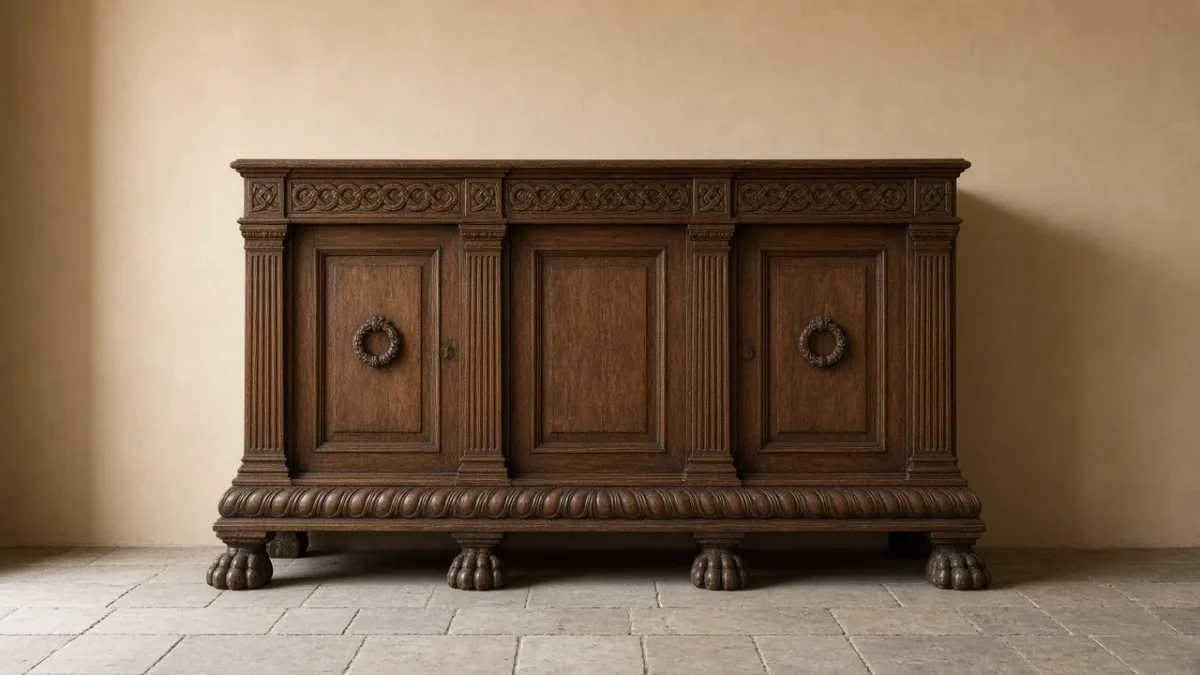
Florentine Antique Furniture of Renaissance and Grand-Ducal Workshops
Florentine antique furniture in walnut: credenze, lettucci and Grand-Ducal stipi, distinguished from later nineteenth-century revival carving.
Florentine furniture is a walnut architecture. The visible timber is noce. Secondary members are often poplar. The facade is read as a palazzo front: pilasters, an entablature of drawers, cupboard doors as bays. That language belongs to the legnaiolo shops of the late fifteenth and sixteenth centuries. It is not a later national style, and it is not the lacquered or pictorial furniture of other Italian centres.
Most period pieces carry no maker's punch. Dating is by wood, joinery, and typology. Court cabinets from the Galleria dei Lavori are a separate class: ebony carcases with hardstone panels, documented in Medici commissions rather than signed on the rail.
Walnut, poplar and the legnaiolo
Walnut (Juglans regia) takes carving and a dry, even patina. Florentine shops used it for the show faces of credenze, lettucci, sgabelli, and the better cassoni. Poplar, and sometimes other pale secondary woods, filled panels, backs, and drawer linings. The Metropolitan Museum's large Tuscan credenza of about 1500–1550 (1993.354) records walnut, poplar, ebony, ebonized wood, and maple in a single carcase. That mix is typical. Ebony or ebonized stringing is an accent, not the body timber.
Construction is panel-in-frame, with mortise-and-tenon joints. Drawers, uncommon before about 1500, sit in the frieze like an entablature. Hardware on domestic pieces was often turned wood; later brass knobs are frequently replacements. Oxidation on unseen poplar, saw marks, and the fit of tenons matter more than a dealer attribution.
The best-documented Florentine woodworking family of the late Quattrocento is the Del Tasso shop. Domenico del Tasso was born in Florence in 1440 and died in 1508. His first secure payment is of 1488, when the monastery of San Pietro in Perugia paid him for intarsia sent from Florence and set by Giuliano and Antonio da Sangallo. From 1490 to 1495 he is recorded in Perugia: a lost credenza for the silver of the Palazzo dei Priori (1490–91); the cathedral choir of 1491, inscribed Opus Iuliani Maiani et Dominici Taxi Florentini MCCCCLXXXXI; the Audience Hall of the Collegio del Cambio with his sons Francesco and Marco (1491–93); and a lost screen in the same cathedral (1495). Giuliano da Maiano (1432–1490) had supplied a general design for the Perugia choir about 1486–87. His death in 1490 left execution to Domenico's shop. Treccani treats the Cambio tribunal bench as Domenico's masterpiece and warns that cassoni and sacristy fittings given to him or to his sons on stylistic analogy remain undocumented.
Marco and Francesco del Tasso later worked in Florence. The carved frame of Michelangelo's Tondo Doni has been associated with them; the attribution is still debated. For furniture, the secure evidence is the Perugia joinery, not a group of unsigned chests.
Credenza, lettuccio, sgabello
The credenza is the Florentine storage form that replaced the chest as the principal sideboard. Peter Thornton described its use in the Italian interior: plate and linen stored behind doors, display arranged on the top during dining. The name is often linked to credere, the tasting of food before service. Architectural order is the identification clue. Fluted pilasters divide the bays. A gadrooned moulding often sits above lion-paw feet. Drawer fronts take guilloche, bead-and-reel, or leaf bands.
The Victoria and Albert Museum's carved walnut credenza (1375-1904) measures 109 × 190.5 × 52.7 cm and is dated 1550–1600. Its lower cupboard has fluted pilasters, two hinged doors with wreath-ring handles, and a fixed central panel. The frieze holds three wide drawers alternating with four narrow volute-fronted drawers. The museum bought the piece in 1904 from the Manifattura di Signa, a Florence firm better known for reproduction ceramics. The label history is a reminder that even institutional purchases passed through the revival trade. Comparable credenze are at Palazzo Davanzati, in Claudio Paolini's 2002 catalogue of the Horne collection (nos. 61–63), and in the Metropolitan Museum.
The lettuccio is a day bed with a high paneled back and an overhanging cornice that could serve as a shelf. The seat is usually a hinged lid over a chest. Museo Horne exhibits a Florentine example of the late fifteenth or early sixteenth century in carved and inlaid walnut. Cushions and a mattress sat on the seat when the piece was in use; they were stored in the chest when it was not. The type is domestic, not ecclesiastical, and it is easy to confuse with a later settle if the overhanging moulding has been cut down.
The sgabello is a back stool rather than an armchair. A high example in the Metropolitan Museum (30.93.2), attributed to the workshop of Giuliano da Maiano (1432–1490) and Benedetto da Maiano (1442–1497) and dated about 1489–91, is walnut, maple, ebony, ebonized wood, and fruitwood, with traces of gilding and red paint. It stands 147.3 cm high on a 42.5 × 41.9 cm plan. Few trade pieces will match that sculptural ambition. Ordinary Florentine stools are lower, with a carved or inlaid back splat and a triangular or octagonal seat. Painted remnants on edges and mouldings are worth recording; they are often cleaned away.
Painted cassoni remain the most published Florentine furniture type. They are not the whole shop output. A credenza or lettuccio in walnut is the more typical survival in the trade, and the more often confused with nineteenth-century revival work.
Grand-Ducal stipi
In 1588 Ferdinando I de' Medici founded a court manufactory for hardstone work in the eastern, short arm of the Uffizi, the Galleria dei Lavori. The Opificio delle Pietre Dure, the present institute, records that foundation and the later Lorraine name. The manufactory furnished grand-ducal residences and diplomatic gifts. Its furniture is not a walnut credenza with a stone top added later. The carcase is usually ebony. The decoration is commesso of hardstones, gilt bronze, and, on the most elaborate cabinets, crystal and mother-of-pearl.
Giovanni Battista Foggini (Florence, 1652–1725) designed the late Medici pieces as court sculptor and architect. The Stipo dell'Elettore Palatino in the Tesoro dei Granduchi at Palazzo Pitti (OdA 1911, no. 909) was commissioned by Cosimo III in 1707 and completed in 1709. It measures 280 × 162 × 54 cm. The materials are ebony, gilt bronze, pietre dure, mother-of-pearl, and crystal. The cabinet is taller than it is wide. A chalcedony portrait of Johann Wilhelm of Neuburg, Elector Palatine, sits in the central niche, in gilt-bronze armour on military trophies. The motto Dominus virtutum nobiscum (Psalm 46:7) appears in the crest. Cosimo sent the stipo to Düsseldorf with a prie-dieu (1706; OdA 1911, no. 836) and a holy-water stoup as a gift to his daughter Anna Maria Luisa. She brought the group back to Palazzo Pitti in 1717. Under the Lorraine, some carved hardstone panels on the stipo were removed and replaced with flat mosaics.
The related prie-dieu names the workshop specialists: Adamo Suster, cabinetmaker; Pietro Motti, bronze founder and gilder; Giuseppe Antonio Torricelli, carver of three chalcedony cherub heads. Anonymous fruttisti cut the stone fruit festoons. Those names are inventory facts, not marks on the wood. Court pieces of this class almost never appear in the open trade. What does appear are later cabinets that borrow the architectural niche and paste hardstone plaques onto an ordinary carcase. The technique of Florentine pietra dura is a separate identification problem. The furniture question is whether the stone is structural to a Galleria dei Lavori design or an applied souvenir.
This court production is also distinct from Milanese Maggiolini marquetry and from eighteenth-century Venetian lacquer. Florence did not compete by painting chinoiserie on poplar. It competed by walnut architecture in the house and by hardstone architecture at court.
Nineteenth-century revival
Florence became a centre of Renaissance revival cabinetmaking in the second half of the nineteenth century. Luigi Frullini (1839–1897), son of a woodcarver, ran a shop at 8 via Santa Caterina. He exhibited in London in 1862, Paris in 1867 and 1878, Vienna in 1873, and Philadelphia in 1876. Simone Chiarugi's Botteghe di Mobilieri in Toscana 1780–1900 (Florence, 1994) remains the standard workshop account.
Frullini signed. A wall cabinet dated 1866, sold at Sotheby's in 2025, is inscribed on the border LUIGI FRULLINI FIRENZE 1866. Other pieces read L. Frullini and Firenze. The carving is deep, even, and encyclopedic: masks, scrolling foliage, putti, dolphins. English clients included Sir William Drake, whose drawing room was ordered through William Blundell Spence. A related folio stand is in the Victoria and Albert Museum. In the United States, Frullini furnished the dining room and library of William S. Wetmore's Château-sur-Mer in Newport. Those documented suites are not forgeries. They are nineteenth-century Florentine work in a Renaissance vocabulary.
The market problem is the unsigned copy. Revival shops reused paw feet, guilloche friezes, and pilaster facades. They often chose walnut of even colour, cut with machine regularity, and applied a high varnish. Secondary woods may be beech or a stained softwood rather than oxidized poplar. Drawer bottoms may be plywood or machine-planed boards. Screw holes of modern gauge, replaced backs, and carving that wraps around a corner without a corresponding interior member are routine. A piece bought in Florence around 1900 from a firm that also sold reproductions (the V&A credenza's own provenance is the caution) needs the same construction test as a piece offered today as "cinquecento."
Reference collections for the period types are Palazzo Davanzati, Museo Horne (Paolini 2002), and the Tesoro dei Granduchi for the hardstone cabinets. Florentine giltwood frames of the same centuries are a parallel woodworking trade, not a substitute identification for case furniture.
Dating a piece in the trade
Begin with the carcase, not the story. Walnut show surfaces and pale, oxidized secondary wood support a pre-industrial date. Uniform dark stain on every interior face does not.
Check the joints. Hand-cut mortises are irregular; machine tenons are clean and identical. Panel shrinkage that leaves a bead of unstained wood at the edge of a frame is consistent with age. A perfectly tight panel in old-looking walnut is often a later replacement.
Read the facade as architecture. A sixteenth-century credenza is a wall of pilasters and bays. A later pastiche often exaggerates the paw feet, multiplies masks, and carves every rail. Frullini's signed work is the high end of that later taste. Unsigned work in his manner is later still, or provincial.
Treat Del Tasso and Maiano names as literature unless a document or a museum catalogue entry is attached. Treccani's warning on undocumented cassoni applies to the trade at large.
Court stipi are identified by ebony, commesso, and a paper trail. A walnut cabinet with a few hardstone plaques is not a Galleria dei Lavori piece.
Condition is part of identification. Worm exit holes confined to sapwood, old repairs in hide glue, and losses to gilding or paint on mouldings are expected. A complete, glass-smooth "Renaissance" credenza with new velvet in the drawers is a revival object until proven otherwise.
FAQ
Did Florentine furniture workshops use hallmarks?
No civic punch system comparable to silver assay existed for furniture. Period pieces are unsigned. Frullini and a few other nineteenth-century carvers signed or dated the wood. Grand-Ducal cabinets are identified from inventories and from the hardstone and bronze work, not from a struck mark.
How do you separate a sixteenth-century credenza from a Frullini revival piece?
Look at the carving first, then the secondary wood. Period work is architectural and relatively restrained on the doors. Frullini carved densely and signed. Unsigned revival pieces often combine even machine surfaces with overworked ornament and modern fastenings.
Are pietra dura cabinets the same as walnut Florentine furniture?
They are a different product of the same city. Domestic walnut furniture comes from legnaiolo shops. Hardstone stipi come from the Galleria dei Lavori after 1588. Confusing the two leads to false dates and false prices.
Where should a collector study the types?
Palazzo Davanzati and Museo Horne for domestic walnut. Palazzo Pitti, Tesoro dei Granduchi, for Foggini's cabinets. The Metropolitan Museum and the Victoria and Albert Museum hold comparable credenze and the Maiano-attributed sgabello.
The walnut furniture of Florence is dated by timber, joint, and facade. Names without documents do not date it.