
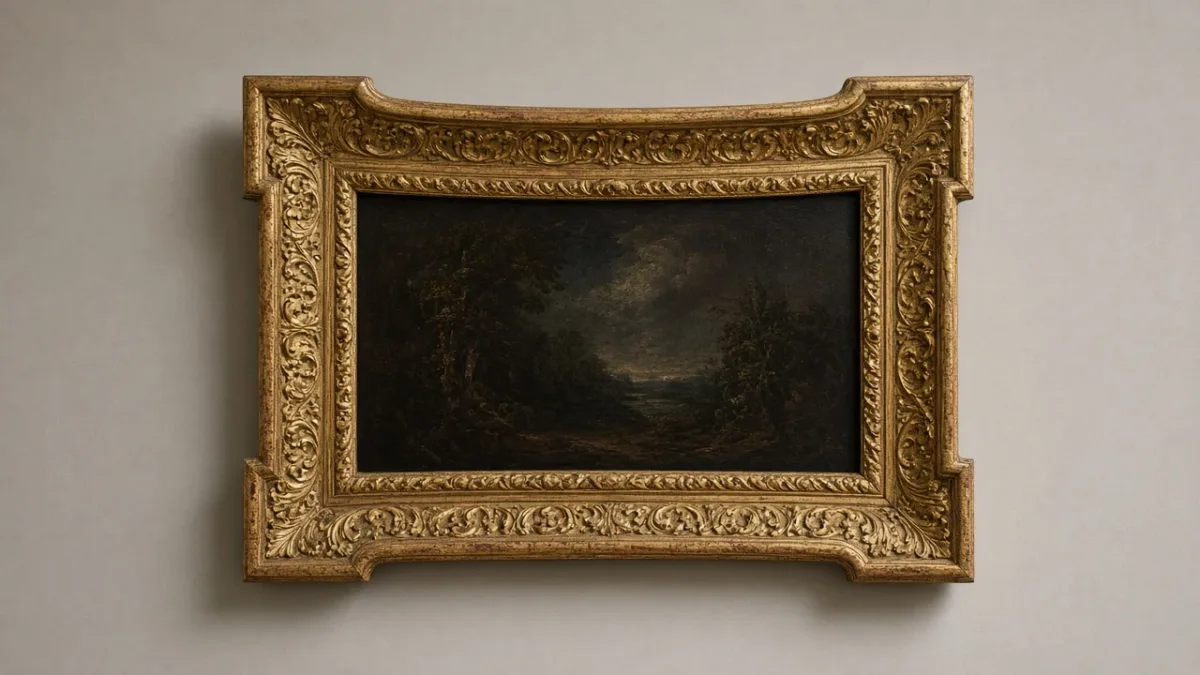
Italian Giltwood Frames of Rome and Florence
Italian giltwood frames from Rome and Florence are identified by cassetta and Maratta profiles, water gilding on bole, and later English workshop copies.
A giltwood frame is a carved wooden surround finished with gold leaf on gesso and coloured bole. In Italian workshops it is a cornice in legno dorato. The object is independent of the painting it may hold. Collectors buy empty examples. Museums catalogue them as works in their own right. The Metropolitan Museum of Art’s Robert Lehman Collection includes nearly four hundred frames, most of them Italian or French, catalogued by Timothy Newbery with measured profiles.
Italian giltwood frames are not a single national type. Rome, Florence, and Venice used different sections, woods, and finishes. English trade names attached to those types (Maratta, Sansovino, Salvator Rosa) are later conveniences. Some of those names were already current in the seventeenth century. Others were coined in the nineteenth. The same leaf-and-gesso technique is not the fire-gilding used on Italian gilt bronze. The metal object is amalgam. The wooden object is leaf.
Roman gallery frames
In seventeenth-century Rome the picture gallery took the place of the sala grande as the principal reception room. Giulio Mancini, writing Considerazioni sulla pittura between 1617 and 1621, treated the frame as both window and ornament: it gave the picture grandeur and a “majestic ornateness.” Charles de Brosses, visiting the Palazzo Borghese in 1740, recorded walls covered from top to bottom with almost no interval between canvases. In that hang a repeated moulding did more than isolate a single work. It imposed a rhythm on the room.
Dealers stocked ready-made frames. A frame could cost more than the painting it was sold to hold. Artists designed their own patterns. Frames were also changed. Giovanni Baglione’s Sacred and Profane Love (1602) is recorded in the Giustiniani collection with a black frame in 1621, a black frame with gold trim and arabesques in 1638, and a “modern Salvator Rosa frame gilded with good gold” in 1793. The painting stayed. The surround did not.
Salvator Rosa
Filippo Baldinucci and Bernardo De Dominici attributed a distinct Roman moulding to Salvator Rosa (1615–1673). The trade still calls it Salvator Rosa, Salvadoro, or Salvadorino. The section is an ogee at the sight, a cavetto, and a raised knull at the back. Examples exist as a smooth gilt run and as a run with applied acanthus at the sight, pin-and-ribbon twist, and egg-and-dart at the back edge. The type was used on paintings and, from the 1630s, on drawings framed for display. Adriano Amendola, working from Roman inventories in the Getty Provenance Index, listed five drawing-frame fashions current in the city: cassetta; Salvator Rosa; Pietro da Cortona; Bernini (berniniane); and Maratta.
In central Italy the same simple torus-and-ogee profile was often water-gilded. South of Rome, and in Naples, a cheaper finish was common: silver leaf sealed with a yellow lacquer (a mecca). The colour reads as gold at a distance. Close inspection shows a cooler metal under the varnish.
Carlo Maratta
Giovanni Pietro Bellori recorded that Carlo Maratta (1625–1713) “had introduced new models of black frames in pearwood, which imitate ebony, with exquisite gilded carving set against a fine dark background.” That is the Roman gallery frame later called Maratta or Maratti in English shops: ebonised fruitwood, gilt leaf or ribbon on the inner moulding, egg-and-dart or ribbon-and-stick on the outer edge. The dark field was meant to sit well on a crowded palazzo wall.
The name was not limited to the ebonised type. In September 1758 Richard Dalton, buying in Rome for the Prince of Wales and Sir Richard Grosvenor, described two oval frames as “truely C. Maratti frames, which are much the fashion in England.” Those examples were about seven inches broad, fully gilt, and carved on an ogee with acanthus. Dalton added that Maratta had designed the furniture and frames for the Prince Pallavicini in Rome. English collections then copied the gilt hollow for decades. The Royal Collection still houses British-made Maratta surrounds, including the eighteenth-century giltwood frame on Van Dyck’s Cupid and Psyche. A Roman original and a London copy share a name. They do not share a workshop, a wood, or a gilding campaign.
Bernini and Antonio Chiccari
Gian Lorenzo Bernini designed frames that carried heraldic devices and three bands of applied carving. The Pisan woodcarver Antonio Chiccari (1617–1675), called Il Pisano, executed several. The frame on Giovanni Battista Gaulli’s Portrait of Clement IX (1667) at Palazzo Chigi, Ariccia, lays acanthus and ribbon-twist on a red velvet ground, a papal signal. More ordinary “Bernini” or “Cortona” shop frames use the same carved bands on a gilt section, often with a cabochon knull and egg-and-dart. Quality of undercutting is the test. Applied ornament that reads as a repeated, blunt cast is later.
Florentine cassetta and Medici frames
Florentine production of the sixteenth and early seventeenth centuries is dominated by the cassetta: a box section with a flat frieze between an inner and an outer moulding. The type is older than the word collectors now use for it. Sienese engaged cassette appear on panels of the fourteenth century. The movable Tuscan picture frame of about 1550–1620 keeps the same architecture at a shallower depth.
The frieze is the field of invention. Shops punched scrolling foliage into the gilded ground (fondo bulinato). Others applied pastiglia, a gesso paste built into low relief and then gilt. Ebonised friezes with gilt corner and centre plaques are recorded in Tuscan inventories and survive in museum stores. A cassetta catalogued by the Soprintendenza at Palazzo Pitti (national catalogue 0900641695), dated 1590–1610 and attributed to a Tuscan workshop, has an ebonised fascia, gilt racemes at centres and corners, and gilt straight and reverse hollows at sight and wall edges. Auctioned Tuscan cassette of the same decades often carry water gilding in oro zecchino over dark red or brown bole. The Lehman Florentine cassetta of 1575–80 is poplar. A larger early-seventeenth-century Florentine cassetta in the same collection is pine. Poplar (pioppo) and pine are the ordinary carcass woods. Walnut is less common on fully gilt Tuscan work of this date.
The so-called Medici frame is a different Florentine object. Marilena Mosco published sixty-three original surrounds from the Galleria Palatina, the Museo degli Argenti, the Uffizi, and the Villa di Poggio a Caiano, all commissioned as paintings entered Medici collections. The Baroque examples develop Mannerist volutes from Ammannati and Buontalenti into auricular cartouches with zoomorphic detail drawn from Callot and Stefano della Bella. Archival names recovered by Mosco in the Archivio di Stato di Firenze include the carvers Antonio Mancini, Luca Boncinelli, Jacopo Sani, and Carlo Galestruzzi. Designers include Baldassarre Franceschini (Volterrano) and Giovanni Battista Foggini. Attributions have also been made to Pietro da Cortona and Ciro Ferri. From 1663 the Dutch carver Vittorio Crosten worked for Cosimo III. Two flower paintings by Bartolomeo Bimbi, inventoried in 1700 at the Villa di Castello, retain Crosten garland frames whose carved blooms repeat the subject of the canvas and are gilt in more than one tone.
A Medici auricular frame is not a cassetta with extra leaves. The section dissolves. Masks, cartilaginous scrolls, and marine forms interrupt the rectangle. Later Florentine copies flatten that modelling and often replace carved wood with composition.
Venetian Sansovino frames
The National Gallery, London, states the essential caution. Frames associated with Venice and the Veneto in the second half of the sixteenth century take the name Sansovino from Jacopo Sansovino (1486–1570), architect of the Libreria Marciana. The name was not applied to the frame type until the late nineteenth century. Sansovino did not invent the pattern. The 2015 exhibition Frames in Focus: Sansovino Frames gathered thirty examples, dated about 1550–1600, of which only two held paintings.
The carving is architectural and restless: overlapping scrolls, fruit garlands, masks, broken pediments, and, on richer pieces, cherubs or herms. Many Venetian examples are not fully gilt. Arnold Wiggins records the finish lumeggiato in oro: walnut, or pine stained to resemble walnut, with gilt highlights on the volutes. Fully gilt Sansovino-style frames were also made in Florence and the Veneto. A mid-sixteenth-century Florentine example in the Lehman Collection is carved pine with dark mauve bole, thin gesso, and glazes including dragon’s blood. A Venetian example of about 1570 in the same collection is a pine back frame with lime upper mouldings, gilt over dark red-brown bole, with a blue-painted ground in the recesses.
These surrounds are not Venetian Murano-glass mirror frames. Glass and giltwood are different trades. They can hang in the same room. They do not share a construction.
Construction and gilding
Period Italian frames are carved in wood. The carcass is usually poplar, pine, lime (tiglio), or, for ebonised Roman work, pear (pero). Joints at the corners are mitred and keyed or half-lapped. Applied ornament is cut from separate billets and glued to the back frame. The reverse should show tool marks, oxidised timber, and old iron or wooden pins. Machine-planed softwood, bright screws, and a rabbet that has been recut to a smaller sight all point to later alteration or a later object.
Water gilding (doratura a guazzo) is the finish expected on a serious Italian frame. Gesso (gypsum or chalk bound in animal glue) is brushed on in many coats and scraped. Armenian bole, an iron-rich clay, is laid over the gesso. Gold leaf is applied with a water size and burnished with agate on the high points. The leaf is so thin that the bole colour shows through in the hollows and at points of wear. Italian bole on sixteenth- and seventeenth-century work is often dark red, orange, mauve, or brown. Oil gilding (doratura a missione) uses an oil size. It cannot be burnished. It is more durable in deep recesses and on architecture. Many frames combine the two: burnished water gilt on the sight and knull, matte oil gilt in the undercutting.
Composition ornament (animal glue, whiting, linseed oil, and rosin pressed in moulds) belongs to the late eighteenth and nineteenth centuries. It is the ordinary material of English and French revival frames. It is not the ordinary material of a Roman Maratta or a Florentine cassetta of 1600. Compo shrinks and cracks along the mould seams. Carved wood splits with the grain. The two failures look different under a raking light.
Italian frames almost never carry a maker’s punch of the kind used on silver. Identification is by section, wood, ornament, and gilding stratigraphy. A written attribution to a named carver is rare outside Medici and papal paperwork.
Period work and later copies
The English Maratta is the copy most often sold as Italian. British framemakers of the later eighteenth century reproduced the deep hollow and acanthus sight for Italian pictures already in the country and for new British paintings. The section can be convincing. The wood is often pine rather than pear. The gilding may be a later oil campaign over a broken original, or an original English water gilding with a different bole. Yale Center for British Art records a British Maratta of the second half of the eighteenth century with later oil and water gilding over the first leaf.
Nineteenth-century revival frames repeat cassette, Sansovino scrolls, and Medici auricular forms in composition or coarse pine. Bronze paint and Dutch metal (schlagmetal) replace gold leaf. The metal leaf oxidises toward orange-brown. Brushy bronze paint sits thick in the recesses. Genuine leaf shows overlapping square or rectangular joins.
Resizing is common and not automatically fatal. A period frame cut down for a smaller canvas will show interrupted ornament at the centres, a patched back frame, and a rabbet that does not match the original sight. A later frame built around an older painting may have a perfect modern mitre and a distressed surface applied in one campaign.
Empty frames should be judged as furniture. Compare the carving with walnut and cassone construction of the same region. A Florentine cassetta and a Tuscan cassone of 1550 share a joinery culture. They do not share a gilding culture. For prints, a Salvator Rosa or a narrow cassetta is historically plausible; a heavy Medici auricular surround on a copperplate view of Rome is usually a later marriage.
Condition
Losses concentrate at the corners and on applied leaves. Old worm in poplar is frequent; active exit holes and frass are not acceptable without treatment. Overgilding is the usual modern injury. A thick new leaf or a gold paint hides the bole and flattens the punchwork. A competent restorer isolates losses, matches bole colour, and in-gilds only the loss. Original water gilding that has worn to bole at the touch-points is preferable to a uniform regilding.
The backboard, glazing, and hanging fittings of drawing frames are part of the object when they survive. Arnold Wiggins published a Roman Salvator Rosa drawing frame of about 1725 that retains original glass and backboard from a set of seventy-two. Those fittings are evidence. They should not be discarded for modern foamcore.
FAQ
What is a Maratta frame?
In Rome it is the late-seventeenth-century gallery moulding associated with Carlo Maratta: often ebonised pearwood with gilt carved sight and outer edges, or a fully gilt ogee with acanthus. In England the same name describes a deep-hollow gilt frame copied from those Roman models.
How can water gilding be told from oil gilding?
Water gilding sits on bole and can be burnished to a compact, reflective surface. Oil gilding is matte and follows an oil size. Wear on water gilding exposes coloured clay. Wear on oil gilding exposes size or gesso without that clay film.
Are Sansovino frames Venetian?
The type is associated with Venice and the Veneto, about 1550–1600. Related carved frames were also made in Florence and Lombardy. The name Sansovino is a nineteenth-century label, not a documented workshop mark.
Do Italian giltwood frames have hallmarks?
No. Unlike silver, they are not punched with a town or maker’s mark. Dating depends on profile, wood, carving, and the gilding layers.
What separates a period frame from a later copy?
Carved wood rather than composition; period bole under genuine leaf; oxidised carcass timber; and ornament that is cut, not repeated from a mould. English Maratta copies and nineteenth-century revival cassette fail one or more of those tests.