
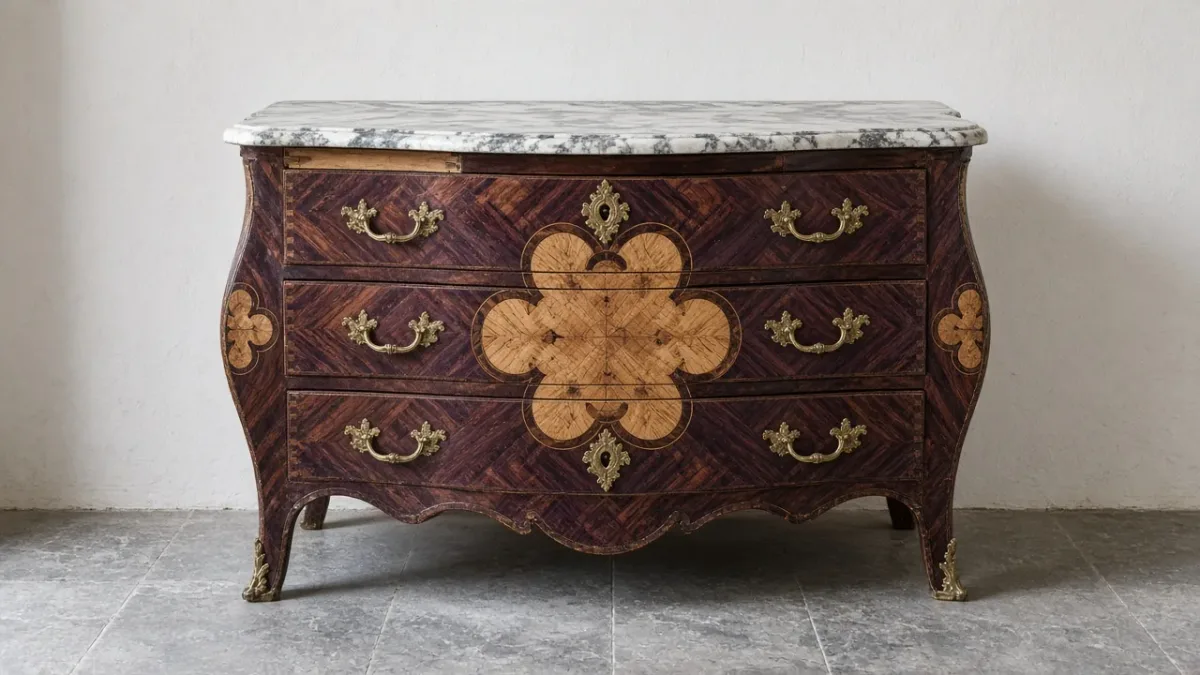
Italian Antique Commodes of the Eighteenth Century
Italian antique commodes of the 1700s differ by city. Genoa uses quadrifoglio veneer; Venice, lacquer; Turin, Piffetti mounts; Sicily, carta di Spagna.
The Italian cassettone of the eighteenth century is not a French commode with a different name. It is a chest of drawers whose outline, veneer, lacquer and mounts change by city. English catalogues still say commode. Italian inventories and museum cards say cassettone, sometimes cassettone a ribalta when a writing flap is added. The object that matters to the trade is the box: how it was built, which woods sit on which carcass, and whether the city of origin can be argued from construction rather than from a later label.
A Renaissance cassone is a marriage chest, low and lid-topped. A cassettone stands at table height, opens as stacked drawers, and belongs to a bedroom, anteroom or study. Florentine walnut case furniture of the sixteenth and seventeenth centuries is the older relative. The eighteenth-century type is a different problem: bombé or serpentine façades, marble or faux-marble tops, and regional systems of veneer and lacquer that do not travel as a single “Italian style.”
What the form is
A typical cassettone of the 1740s to 1790s stands about 85 to 95 cm high and 120 to 140 cm wide. Two or three long drawers are common. Genoese examples often run two short drawers over three long ones, the fronts treated as a single field sans traverse, without a visible rail between drawers. Venetian pieces of the same decades may have only two bombé drawers, carved wooden handles, and a grey marble slab on a shaped top. A comodino or tavolino da notte is the smaller night-table version of the same grammar. A cassettone a ribalta adds a fall front; a trumeau stacks a cabinet above the drawers.
Carcass woods are local and cheap: poplar, fir, Swiss pine (cirmolo), walnut for parts that show. Show surfaces are another matter. Northern shops laid rosewood, bois de violette, bois de rose, walnut burl and fruitwood. Venetian and Genoese lacquer shops painted and varnished pine or poplar. Turinese court work mixed ebony, boxwood and fruitwood, sometimes with ivory. None of these skins prove date by themselves. The lining of a drawer, the backboards, and the way veneer is cut do.
Genoa: the quadrifoglio cassettone
Genoese ebanisteria of the Settecento is the most distinctive northern type on the open market, and the least well supplied with named makers. The Republic had no court comparable to Turin or Naples. Lodovico Caumont Caimi’s monograph L’ebanisteria genovese del Settecento (Parma, 1995) still organises the field: early in the century, variegated woods combined in quatrefoil motifs under an English taste for figured timber; later, French Louis XV outlines taken up with Ligurian proportions and a local inlay.
That inlay is the quadrifoglio genovese. Palazzo Reale in Genoa keeps a cassettone of this type in the Queen’s Bedroom: Genoese work of the 1760s, veneered in rosewood, bois de rose and bois de violet, the heart-shaped or four-lobed leaf laid as a pictorial field on a serpentine carcass. The museum text treats the motif as the local answer to the French commode, not as a copy of Paris. Musei di Genova hold a related but more complex object, inventory M.G.L. 555, a cassettone a ribalta of Ligurian manufacture, about 1760, 116 × 128 × 67 cm, from the Matteo Luxoro bequest of 1945, now associated with Palazzo Tursi. The case has a waving profile and vertical bombé. The fall front opens on two tiers of small drawers, themselves bombé, with a small mirror at the centre. The façade carries the same polylobed quadrifoglio. Handles and escutcheons are gilt bronze.
Auction records match the museum type. A Genoese bois de violette cassettone published by Caumont Caimi (p. 128, ill. 74) and later sold at Christie’s has a shaped marble top, a double-serpentine front (doppia mossa), the quadrifoglio repeated on the sides, two narrower drawers over three wider ones without rails, and cabriole legs joined by a polylobed apron; 125 × 97 × 58 cm. A later, more neoclassical Genoese group uses quartered walnut, grotesque uprights and Bacchic masks. Christie’s compared one such commode (89 × 125 × 59 cm) to Caumont Caimi ill. 246 and distinguished it from Milanese Maggiolini marquetry: the Genoese inlay is bolder, less floral, and the feet are often tapering and themselves veneered.
Restorers in Genoa describe the quadrifoglio as end-grain “oyster” slices from a small-diameter branch of rosewood, bois de rose, violetto or olive, split and reversed so growth rings form the four lobes. A flat, sawn jigsaw heart is not the same cut. Veneer a few millimetres thick, continuous across a drawer front, is the construction point.
Genoa: lacquer thinner than Venice
Genoa also produced painted and lacquered cassettoni. Alvar González-Palacios, in Il Mobile in Liguria (Genoa, 1996), published a polychrome example bearing Grimaldi and Spinola crests and dated it to 1769, the year of a double marriage between those families. He called it one of the finest painted Genoese commodes then known. A related mid-century chinoiserie cassettone sold at Sotheby’s (92 × 133 × 60 cm) has a serpentine top painted as grey marble, two short and two long drawers, English-inspired pierced pulls, and riverside scenes with fishermen, travellers and monkeys.
The same catalogue note records a practical distinction. Genoese laccatori used a thinner varnish than the Venetian shops. In 1765 the French astronomer Joseph-Jérôme Lefrançois de Lalande, visiting Genoa, praised lacquer made opposite the Chiesa della Maddalena. Connoisseurs, he wrote, ranked that vernice della Maddalena with Parisian Vernis Martin. Named cabinet-makers remain scarce. Absence of a signature is normal, not a defect.
Venice: bombé carcass, marble, lacca
Venetian cassettoni of the mid-eighteenth century are easier to recognise as a group than to attribute to a bench. Ca’ Rezzonico, Museo del Settecento Veneziano, holds several documented types.
One, first half of the century, is carved and gilt wood, 88 × 121 × 63 cm, on four claw-and-ball feet, with two bombé drawers, projecting scroll handles in carved wood, a top shaped in mossa e contromossa and painted as faux marble, and comb and scroll carving on the drawer frames. Another, dated 1740–1760, is carved, gilt and lacquered, 90 × 130 × 65 cm: volute feet, pierced carved apron, two bombé drawers, carved rococo lock plates, bombé sides, a grey marble top with clipped corners, yellow lacquer ground with polychrome flowers and gilt filets. A third of the same decades, 89 × 140 × 64 cm, has a dark green lacquer ground with gilt pastiglia chinoiseries, marble top, and comb-and-volute carving on the apron.
Not every Venetian cassettone is lacquered. Ca’ Rezzonico also lists a cherry example of the second half of the century, 83 × 118 × 60 cm, two slightly bombé drawers with light-wood stringing, pendant bronze handles, walnut apron and feet. Palazzo Mocenigo holds a bombé cassettone veneered in walnut burl, 90 × 143 × 60 cm, 1740–1760, three drawers, bronze handles, undulating apron, scroll feet. Musei Civici di Padova keep a smaller Venetian piece, inv. 245: Swiss pine (cirmolo), lacquered, 87 × 108 × 52 cm, mid-eighteenth century, a single drawer, shaped legs, with a matching mirror.
The construction habit is consistent. Softwood carcass, often cirmolo or poplar; bombé sides as well as front; marble or painted marble on a shaped top; carved wooden hardware on richer lacquer pieces, bronze on plainer veneered ones. Venetian lacquer furniture of the same decades shares the yellow, green and chinoiserie grounds. Flat sides, a matching nineteenth-century handle set, and a later rectangular marble weaken the Venetian argument.
Turin: Piffetti and the court commode
Turin is the exception that has names. Pietro Piffetti (Turin, 1701–1777) was appointed ebanista reale to Carlo Emanuele III in 1731. His commodes sit at the top of the Italian market and should not be used as a template for ordinary Piedmontese chests.
The Metropolitan Museum of Art holds a commode by Piffetti, accession 2020.371, about 1760: 83.7 × 125 × 60.6 cm, marquetry of ebony, boxwood, walnut and fruitwood on a poplar (alberone) carcass, gilt-bronze mounts attributed to Francesco Ladatte (Turin, 1706–1787), iron locks. Bequest of Errol M. Rudman, 2020; Gallery 551. The measurements are confirmed. The carcass wood is named. That combination of a serpentine rococo box, precious wood mosaic, and chased Turinese bronze is the court type. Ivory, mother-of-pearl and tortoiseshell appear on other Piffetti furniture; they are not required on every commode, and their presence on a market piece is not a signature.
Palazzo Madama and the Fondazione Accorsi-Ometto in Turin hold further Piffetti case furniture, including fall-front cabinets with engraved ivory. Most objects offered as “Piffetti” are in the Piedmontese taste. Treat the name as a claim. The Met carcass (poplar, iron locks, a documented mount maker) is the standard against which claims are measured.
Milan: a related but separate problem
Giuseppe Maggiolini (Parabiago, 1738–1814) made cassettoni. They are not Genoese quadrifoglio furniture and not Venetian lacquer. Castello Sforzesco, Museo dei Mobili, keeps an early documented example, inv. Mobili 346, about 1773: still a rococo carcass, marble top, gilt-bronze theatrical masks and Chinese figures, chinoiserie medallions after drawings by the young Andrea Appiani, given to the civic collections in 1895. Maggiolini later supplied Genoa as well. A Christie's note records a marquetry commode for Marchese Domenico Serra in 1784. Influence is not identity. Genoese shops kept a sparer, larger-scale inlay; Maggiolini’s mature boxes become flat picture-fields with little bronze. The inlay itself is treated in the Maggiolini marquetry guide. For a cassettone, the first question remains the box, not the bouquet.
Sicily: carta di Spagna and polychrome lacquer
Southern cassettoni follow a different grammar. Enrico Colle’s Il mobile rococò in Italia (Milan, 2003) is the survey; specialist writing on the Sicilian Settecento, including Giusy Baffi’s account of island case furniture, places the change after the Bourbons. Carlo di Borbone became king of Naples in 1734 and of Sicily in 1735. Palermo then commissioned furniture in a Louis XV outline, often larger than French models, with rosewood, bois de violette and bois de rose laid in vein and counter-vein on fir carcasses.
Two local habits help in a sale room. On the rails between drawers (catene) a thin copper or brass moulding is often applied, called sguscio or carta di Spagna. Inlay favours the circle: a plain roundel, a rosette, a compass rose. Uprights tend to stay sharp-edged, alternating concave and convex, rather than melting into a continuous bombé as in Venice. Aprons are deep; legs are cabriole ending in scroll, block or spatulate feet. Bronze pulls often look English rather than Parisian.
Painted Sicilian cassettoni use vermilion, rose, blue and yellow grounds, gilt or silvered pastiglia, flowers, birds and butterflies. Chinoiserie is less common than in Liguria and the Veneto. A vase of flowers or fruit in a reserve on the side is a recurring motif. Tops may be wood, inset marble, or painted faux marble.
How to date a cassettone
Work from the inside out.
1. Outline and city. Double-serpentine veneer with a four-lobed heart points to Genoa. Bombé sides, carved wooden handles and a yellow or green lacquer ground point to Venice. Ivory on a dark, tightly curved carcass points to Turin. A brass strip on the drawer rails and a compass-rose roundel point to Sicily. A flat rectangular box with pictorial wood mosaic and almost no bronze is the Maggiolini problem, not this one.
2. Carcass. Poplar, fir or cirmolo is expected. Plywood, blockboard or a machine-planed back of even thickness is later. Hand-cut dovetails on drawer sides are slightly irregular. Machine-identical pins generally belong after the late nineteenth century.
3. Veneer and lacquer. Period show veneer is thin and follows the curve; it cracks along the bombé. Later “antique” veneer is often thicker, sanded through at the corners, or a printed transfer. Genoese lacquer is thinner than Venetian; both craze along joints of the carcass. Fresh, even varnish over a tired interior is a redressed surface.
4. Hardware. Original mounts leave older holes inside the drawer front. A complete matching set of sharp “Louis XV” handles on an otherwise worn chest is often a recent dressing. Venetian carved wooden pulls are part of the design, not an economy substitute for bronze.
5. Tops. Marble and faux marble were replaced constantly. Date the box, not the slab. A perfectly rectangular top on a serpentine carcass is a warning, not a proof of honesty.
Nineteenth-century Italian shops made Louis XV revival commodes for a bourgeois market. Post-war reproductions add Phillips screws, plywood and identical router-cut mouldings. Worm holes in a grid, all the same diameter and none filled with frass, are often punched. Honest wear sits at handles, feet and the front edge of the top.
If the piece is bought in Italy, cultural-heritage export rules still apply (Cultural Heritage Code, Legislative Decree 42/2004). Ivory and tortoiseshell on Piedmontese work add wildlife-law paperwork. Neither regulation is a certificate of quality.
FAQ
Is cassettone the same as a French commode?
The function is the same: a chest of drawers at table height. The construction is not. French ébénistes stamped names and used oak carcasses more often. Italian shops rarely signed, used poplar, fir or pine, and built regional outlines (Genoese quadrifoglio, Venetian bombé lacquer, Sicilian carta di Spagna) that a Paris commode does not copy.
How can I tell a Genoese cassettone from a Venetian one?
Look at the skin and the sides. Genoa is typically veneered in rosewood and bois de violette with a four-lobed heart, or painted in a thinner lacquer; sides are serpentine but the decoration is inlaid or painted as panels. Venice more often shows a fully bombé lacquered carcass in yellow or green, carved wooden handles, and a marble top with clipped corners. The Ca’ Rezzonico measurements (about 88–90 cm high, 120–140 cm wide) are a useful scale check, not a rule.
Did Maggiolini make commodes in Genoa?
He supplied at least one documented marquetry commode to Marchese Domenico Serra in 1784. A Genoese cassettone of the 1760s, with quadrifoglio and doppia mossa, remains a Genoese object. Flowers on the façade do not move it to Parabiago.
What is a cassettone a ribalta?
A chest of drawers with a fall front. The Luxoro example in Genoa (M.G.L. 555, about 1760, 116 cm high) is the type: bombé inner drawers and a small central mirror behind the flap. It is not a secretary in the French sense and not a Venetian trumeau.
Does a marble top prove an eighteenth-century date?
No. Tops were swapped. Faux-marble paint on a shaped wooden top, as on early Ca’ Rezzonico gilt cassettoni, is as period as a grey marble slab. Date the carcass, the drawer linings and the veneer or lacquer.
The cassettone is a regional object. Genoa made the quadrifoglio and a thin Maddalena varnish. Venice made bombé lacquer and marble. Turin made named court furniture. Sicily applied carta di Spagna and compass-rose inlay. Milan’s Maggiolini shop is a neighbouring chapter, not a national standard. A collector who starts with the city, then the carcass, will waste less time on later boxes dressed with old handles.