
Italian Gilt Bronze Workshops and Their Marks
Italian gilt bronze from Rome is identified by Valadier accounts, Righetti signatures, and fire-gilding, not by the hallmarks used on silver.
Dealers still use the French word ormolu for almost any yellow metal mount. In Italy the object has a different name and a different paper trail. Italian gilt bronze (bronzo dorato) is a copper alloy finished by fire-gilding. It appears as candelabra, dessert garnitures, clock cases, and the applied ornament on marble and hardstone. It is not the same trade as the small patinated bronzetto treated in the antique Italian bronze collecting guide. The alloy may be related. The finish, the workshop, and the way a name is recorded are not.
French court bronzes of the later eighteenth century are often chased to a known ciseleur and discussed as Gouthière or Thomire. Roman work of the same decades is identified from invoices, drawings, and, in one shop, a stamped Latin signature. The silver that left the same rooms can carry a town mark. The bronze usually does not. For the contrast with punched precious metal, see the Italian silver hallmarks guide.
Fire-gilding, not leaf on wood
Doratura a fuoco, also called doratura al mercurio, is an amalgam process. Gold is combined with mercury. The paste is spread on a cleaned copper alloy. Heat drives the mercury off as vapour. A thin, bonded film of gold remains and can be burnished with agate or haematite. Recesses may be left matte; high points are polished. The bond is mechanical and chemical. It is not gold leaf glued to wood, and it is not a wash of bronze paint.
The method is older than the Roman Rococo. Pliny and Vitruvius already describe mercury amalgams used on metal. It remained the ordinary way to gild bronze until the middle of the nineteenth century. Electrodeposition, patented in Britain by the Elkingtons and in France by the Comte de Ruolz in 1840–41, then offered a thinner, cheaper plate without mercury vapour. Residual mercury on X-ray fluorescence still argues for fire-gilding. A thin, even film that has worn to pink metal on the knuckles of a handle is more often later plate.
Auction English still says ormolu. The French term (or moulu, ground gold) names the amalgam, not the city. An Italian invoice of the 1770s is more likely to say metallo dorato or bronzo dorato.
The Valadier workshop: documents instead of punches
Luigi Valadier (Rome, 1726–1785) was a goldsmith, designer, and bronze founder. His father, Andrea Valadier (d. 1757), had already worked for the Borghese household. After Andrea’s death Luigi became the principal goldsmith to Prince Marcantonio Borghese (1730–1800). The shop also employed his brother Giovanni and, later, his son Giuseppe, the architect. Alvar González-Palacios, whose catalogues for the Frick Collection (2018–19) and the Galleria Borghese (2019–20) remain the standard accounts, notes that some fifty hands can be distinguished in the surviving workshop drawings and that no bronze from the shop is known to be signed.
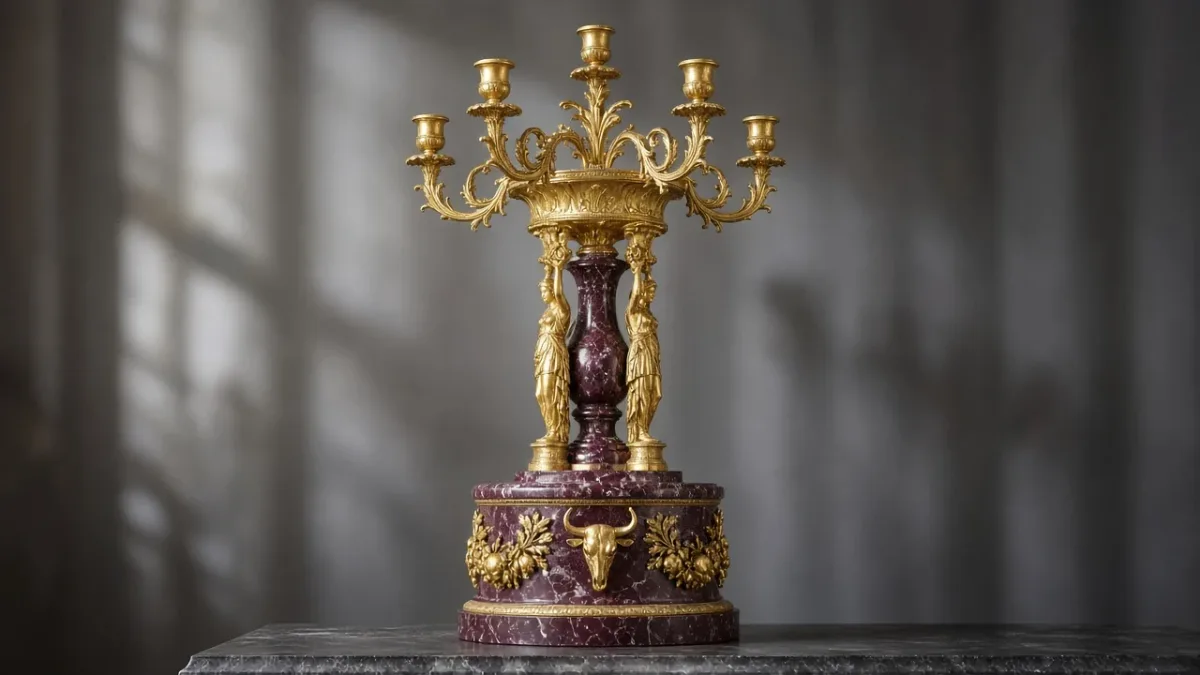
Attribution therefore rests on paper. On 6 September 1774 Valadier invoiced the Borghese for “due Candelabrij di profido tutti guarniti con dell’ornati e figure di metallo dorato.” The pair is now in the Metropolitan Museum of Art (1994.14.1, .2). Each candelabrum stands 68.6 cm high. The shafts are imperial porphyry. The figures, named on the invoice as a Venus, an Amazon, and a Muse, are fire-gilt bronze. González-Palacios identified the document in the Archivio Segreto Vaticano, Archivio Borghese, fol. 5298. The porphyry elements are sometimes given to the stone carver Lorenzo Cardelli, who worked with Valadier on mantelpieces the following year. The architect of the rooms was Antonio Asprucci. The intended setting was the Galleriola dei Cesari in Palazzo Borghese, on tables that repeated the same porphyry-and-gilt scheme.
A related pair is at Pavlovsk. González-Palacios connected it with Grand Duke Paul of Russia and Maria Feodorovna, travelling as the “Counts of the North,” in 1782. The Borghese pair remains the one fixed by a dated Roman invoice.
In 1780 the same household paid Valadier 400 scudi for gilt-bronze friezes on sixteen granite and white-marble columns (Archivio Borghese, f. 8254, c. 28). The applied ornament is a late-eighteenth-century Roman vocabulary: bucrania, paterae, fruit festoons, and ribbons. Twelve columns later left with the Borghese sculptures sold to Napoleon. Four remain in the Galleria Borghese. The bronze is not punched. The payment is.
Silver from the same shop is a different problem. A soup ladle of 1767–69, later gilt in 1784, carries Luigi Valadier’s maker’s mark and a Rome town mark of the type catalogued by Bulgari for 1767–69. That punch identifies the spoon. It does not travel onto a porphyry candelabrum made five years later. Mixed-media lamps and vases sometimes include a small silver member that does carry the mark. The gilt bronze next to it still has to be argued from the drawing and the account.
The objects themselves mix materials that Rome sold to visitors as a portable antiquity: porphyry, rosso antico, giallo antico, granite, and fire-gilt mounts. The same Grand Tour traffic produced Roman micromosaics. Valadier’s deser (table-centres) for Catherine the Great, drawn when Giuseppe was still in his teens, belong to that export luxury. They are not furniture mounts. They are architecture in miniature.
Righetti: a foundry that signed
Francesco Antonio Righetti was born in Rome on 11 June 1749 and trained in Valadier’s shop, chiefly as a modeller and founder. About 1779 he opened his own studio in via della Purificazione. In 1789 he added a foundry in vicolo S. Isidoro. The market he served was the same as Valadier’s, shifted toward serial reductions of famous statues for travellers. Chiara Teolato’s entry in the Dizionario Biografico degli Italiani is the documentary backbone: guild pressure from the Università degli orefici e argentieri in 1783, the 1788 printed list, the 1794 French catalogue addressed aux amateurs de l’Antiquité et des Beaux Arts, and the later Vatican appointments.
Unlike Valadier, Righetti signed. The usual stamp is `F. RIGHETTI. F. ROMÆ`, the F standing for fecit, almost always with a year. The earliest signed bronzetto now cited is a Dancing Faun after the Uffizi marble, dated 1783, at Wilanów. Similar casts of the same model can therefore be separated by date. From at least 1803 the signatures often add his son Luigi (born 29 February 1780). In 1805 father and son became fonditori camerali and founders to the Fabbrica di S. Pietro. They were allowed to use the Vatican foundry while still selling privately.
The 1788 list already offered, besides reductions at “un palmo oncie sette” of the Roman passetto, gilt-metal garnitures in the antique taste for desserts, writing tables, clocks, vases, urns, and obelisks. That sentence is the collector’s warrant for treating Righetti as a gilt-bronze workshop, not only as a maker of brown bronzetti. Documented gilt work includes the candelabra of 1801 that Pius VII gave to San Giorgio Maggiore in Venice, with a set of three cartegloria in gilt bronze of 1801–03, and later gilt ornaments for the sanctuary of Genazzano (1819). A Warwick vase in alabaster with applied gilt-bronze heads, catalogued by Sotheby’s as Francesco and Luigi Righetti, uses the same border vocabulary as the San Giorgio cartegloria and as a surtout now in Naples.
The large public casts, including Canova’s Napoleon as Mars the Peacemaker and the equestrian monuments begun in Naples after 1812 at San Giorgio a Cremano, are sculpture. They prove capacity, not a collecting type. Francesco died in Rome on 25 November 1819. Luigi kept a shop at Piazza di Spagna 1 by 1834 and died on 12 August 1852.
Giacomo Zoffoli’s contemporary reductions, often signed, are usually patinated rather than fire-gilt. They belong with the bronzetto market, not with mounts.
Furniture mounts: Naples, not a second Paris
Italian cabinet-makers used gilt bronze more sparingly than the Paris ébénistes. A Lombard commode of the Maggiolini circle is identified by marquetry, not by a named ciseleur. Venetian painted and lacquered cases of the same century rely on lacca and carving. The exception is Naples.
Sotheby’s has catalogued a suite of kingwood and tulipwood commodes from the Carafa household, second quarter of the eighteenth century, with gilt-bronze mounts in a French Régence manner and brèche violette tops. The claw-and-ball feet are a Neapolitan habit taken from English models. Handles, rare on northern Italian furniture, appear here. Christie's has sold related Rococo commodes, Naples circa 1750, with Bacchus-mask escutcheons and rocaille sabots, sometimes partly remounted. Seventeenth-century Neapolitan ebony and tortoiseshell cabinets also carry gilt-metal architectural mounts. Those mounts are seldom signed. The case, the wood, and the city are the evidence.
A French mount on an Italian carcass is a later marriage more often than a princely order. Screw holes that do not match, a gilt tone that is paler and more even than the rest of the piece, or a mount whose outline has been cut into an older veneer should be priced as additions. The same caution applies in reverse: an Italian gilt handle on a Parisian commode is not proof of a Roman cabinet.
How to read a piece
Work in this order. Do not start with the story on the ticket.
1. Name the object. Candelabrum or girandole; clock case; dessert urn; applied furniture mount; ecclesiastical cartagloria or altar garniture. A small Mercury on a round socle is a bronzetto. It is a different article.
2. Name the gilding. Fire-gilding sits in the chasing. It is thicker in the hollows and can show a slightly cloudy, mercury-rich tone in recesses. Electrogilding of the later nineteenth century is thinner and sheds first on the high points. A modern spray is worse: it sits on top of dirt and comes off on a cotton swab with mild solvent. Do not test that way on a claimed eighteenth-century surface.
3. Look for a foundry inscription, not a silver hallmarks set. `F. RIGHETTI. F. ROMÆ` plus a year is a workshop statement. `F. RIGHETTI ET F. ROMAE` and paired father-and-son forms appear after Luigi joined the shop. Valadier bronzes of the 1770s–80s are not expected to be signed. A freshly punched “Valadier” on the underside of a porphyry vase is a warning, not a convenience.
4. Match the stone to the bronze. Roman luxury gilt bronze of the 1770s–90s is often married to porphyry, rosso antico, granite, or alabaster. A gilt mount on a later marble copy of a Grand Tour urn may be associated. The join, the iron pin, and the wear on the underside of the bronze tell you more than the colour of the stone.
5. Read the paper if it exists. A Borghese-type object without an account, a drawing, or a long provenance is a type, not an attribution. González-Palacios published the drawings; the Pinacoteca Comunale di Faenza holds an album of Valadier workshop sheets, including gilt-bronze frames and cameo mounts. A dealer’s “circle of Valadier” is a stylistic claim. It is not a signature.
6. Separate the French comparison. A silk-suspended cartel clock in gilt bronze is usually Paris. A Roman clock of the same decades is more often a marble and gilt-bronze architectural case. The movement may still be French or Swiss. Price the case and the movement apart.
Condition, later gilding, and export
Fire-gilding is durable. It is also toxic to apply and expensive to redo. A complete, even, lemon-yellow surface on an object sold as 1774 is often a nineteenth- or twentieth-century re-gilding, sometimes electrolytic. Wear through to the red-brown alloy on edges that would have been handled is more believable than a perfect skin. Cast porosity under the gold, visible at a chip, is ordinary in sand or indirect lost-wax work. A brass-yellow body with no tin to speak of may be a later alloy, not an eighteenth-century bronze.
Do not polish gilt bronze with metal polish. The gold film is thin. A dry brush and a conservator who treats ormolu, not a furniture restorer with dip, are the right trades.
Export from Italy follows the cultural-heritage rules that apply to any documented work of art. A signed Righetti of 1788, or a piece with a Borghese or papal provenance, is not a tourist souvenir. Later, unsigned mounts of ordinary quality are treated more lightly, but the licence is still the exporter’s problem, not the buyer’s after the fact. For court silver that travelled in the same households, the Neapolitan silver workshop marks article sets out the parallel paperwork.
FAQ
Are Italian gilt bronzes hallmarked like silver?
No. Bronze was not subject to the assay offices that punched silver in Rome, Florence, Naples, or Venice. A Valadier bronze is identified from accounts and drawings. A Righetti bronze may carry `F. RIGHETTI. F. ROMÆ` and a date. A furniture mount is usually anonymous.
What is the difference between ormolu and bronzo dorato?
Ormolu is the English and French trade word for fire-gilt copper alloy. Bronzo dorato is the Italian term for the same class of object. Neither word names a city. The workshop, the chasing, and the documents do.
How can I tell fire-gilding from later electroplate?
Fire-gilding is thicker, follows the tool marks of the chasing, and often retains mercury traces under laboratory analysis. Electrogilding, commercial from the 1840s, is thinner and wears in a more even, scraped way. A modern coating sits on dirt and is softer still. Laboratory XRF is the only certain test; the eye is a first sort.
Did Valadier sign his gilt bronzes?
No signed bronze from the shop is known. Silver from the same rooms can carry Luigi Valadier’s maker’s mark and a Rome town mark. Giuseppe was paid in 1785, the year of Luigi’s death, for a Borghese clock that continues the workshop types. The name on a modern plaque is not a period signature.
Is a Righetti reduction the same as gilt bronze?
Not automatically. Many Righetti casts are patinated reductions of antique statues. The 1788 list also offered gilt garnitures, and several ecclesiastical and table objects are documented in gilt bronze. Read the surface and the inscription before you use the name as a gilding claim.
Should I buy unsigned “Roman gilt bronze” as Valadier?
Buy it as a type. Porphyry or rosso antico with competent fire-gilt bucrania is a recognisable Roman late-eighteenth-century product. The Valadier name requires a document, a drawing, or a provenance that can be checked. “Circle of” is a price category, not a biography.
What the market actually offers
The object on a London or New York table is rarely a Borghese candelabrum. It is more often a pair of gilt branches on later marble, a single signed Righetti reduction with an associated gilt base, or a Neapolitan commode whose mounts have been moved. Completeness of the iron pin, the original stone, and the gilding in the recesses matters more than a caption that says “Valadier.” The workshops that can be named are few. The method that gilded their bronze is specific. The punch that collectors expect from silver is, on this metal, the exception.