
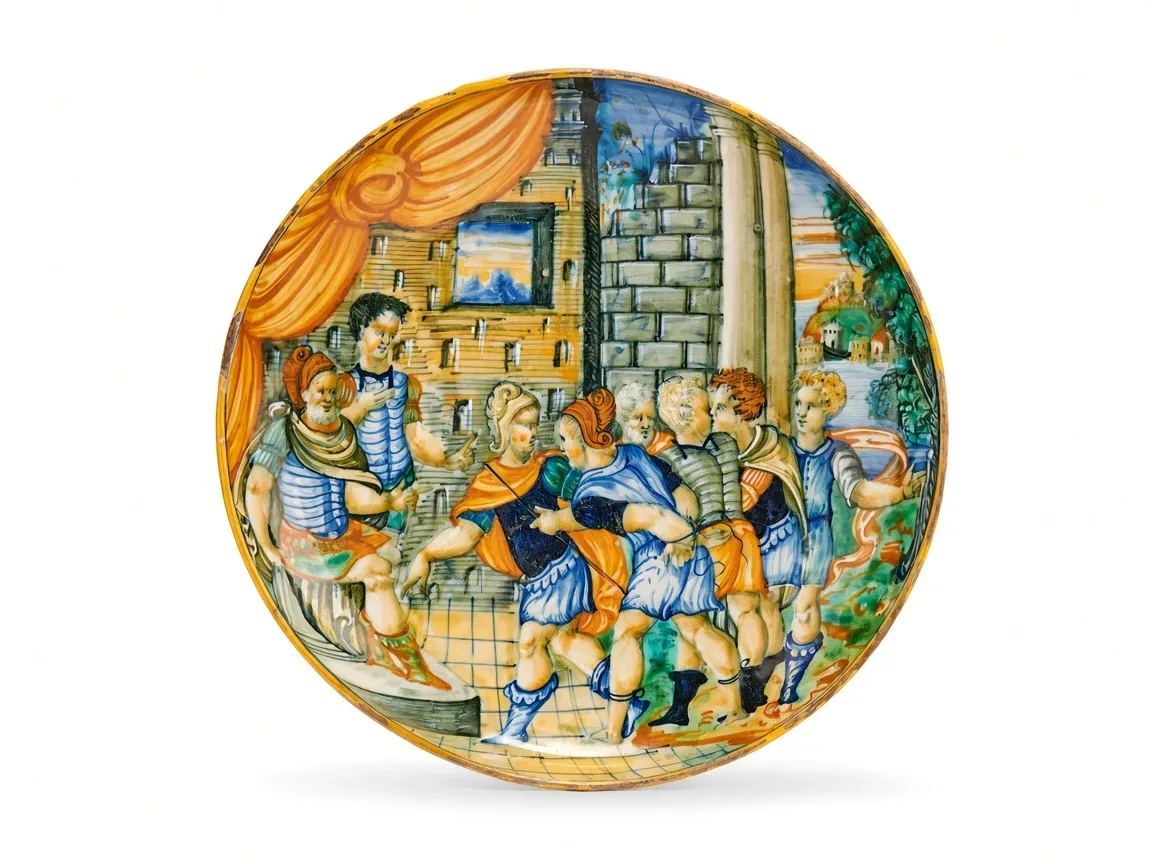
How to Identify Authentic Pesaro Maiolica by Marks and Painting
How to identify authentic Pesaro maiolica by Sforza marks, Casali e Callegari rose painting, later copies, and verified auction results today.
Pesaro maiolica is sold under two captions that do not describe the same object. One is a sixteenth-century istoriato dish painted across the well, often given to Urbino until the reverse is read. The other is an eighteenth-century plate whose off-centre rose became the city's trademark. Dealers collapse both into "Pesaro." Price and authenticity follow the split.
The clay came from the Foglia, which ran under the walls. Tin glaze and a narrative scene do not by themselves prove the town. Urbino is twenty-five kilometres inland; Casteldurante, now Urbania, sits between them. Painters moved. The question is which kiln, which decade, and whether the painting belongs to that firing.
What determines value
Maker and workshop come first when a name can be argued. For Renaissance dishes the name that moves money is Sforza di Marcantonio de' Giuliani of Casteldurante, documented from 1543 to a will of November 1580. He worked with Francesco Xanto Avelli in Urbino in the late 1530s, is recorded in Pesaro by 1548, and was associated by 1552 with the workshop of Girolamo di Lanfranco of Gabicce. Works dated 1561 to 1576 carry an "S" on the reverse as his mark. A dish with that letter, a period Italian inscription, and a landscape of the kind Johanna Lessmann catalogued in the Herzog Anton Ulrich-Museum, Brunswick, is sold as a named painter. A landscape dish given only to "Pesaro, mid-sixteenth century" is a different, cheaper lot.
The eighteenth-century factory is Casali e Callegari, formed in Pesaro on 13 August 1763 (notary Ludovichetti) by the Lodi potters Antonio Casali and Filippo Callegari, with the Sassuolo painter Pietro Lei. The firm lasted until 1816. Antonio Scacciani, called Carbone (Pesaro, 1746–1810), was its principal flower painter. A rose plate that can be tied to that shop, or to Lei's "C C Pesaro" inscriptions, is factory ware. Unmarked "alla rosa" tableware from later Pesaro and the Marche is common.
Period is the next cut. Sixteenth-century istoriato, revived under Duke Guidobaldo II Della Rovere after 1538, when the court spent more time on the Adriatic than in Urbino, is the scarce end of the market. A 1552 protective edict already speaks of vasi historiati, belli, et assai honorevoli. The seventeenth century is thin. Eighteenth-century petit-feu floral ware is what most buyers actually meet. Nineteenth-century Ignazio Callegari and later rose copies sit below both.
Region is an attribution, not a stamp on the footrim. Pesaro istoriato shares the Urbino narrative language: Ovid, Roman history, yellow rims, inscriptions on the reverse. Sforza's early work is close to Xanto, which is why tickets still read "Urbino or Pesaro." Lustre is the other regional trap. Giovanbattista Passeri, writing in the eighteenth century, gave gold-lustred dishes to Pesaro. Modern catalogues assign those wares to Deruta and Gubbio. A lustred "Pesaro" plate is usually a wrong label, not a rare local technique.
Material is tin-glazed earthenware. Renaissance painting is gran fuoco, colours that survive the glaze firing: blue, green, yellow, orange, manganese, opaque white. The eighteenth-century rose uses piccolo fuoco enamel colours over the glaze, which is why the petals can look brighter and more modelled than a sixteenth-century flower. Printed transfers, even white glaze without crazing, and porcelain bodies are later.
Rarity is a matter of inscription and type, not of a missing twin. Dated, signed Sforza dishes of about 20 cm are few. Unsigned landscape tazzas of 25–27 cm are less rare and still collected. A full Casali service with the rose is scarcer than a single soup plate. Ticchio or viticchio — the threadlike vine with chrysanthemums and peonies, a Marchigian dialect name recorded by the Musei Civici di Pesaro — is a second factory type, not a substitute for the rose.
Condition and restoration move the figure more than a catalogue date. Rim chips, glaze flakes, and restuck cracks across the well are normal on istoriato. The Christie's Sforza of 1562 that made a strong price had a broken section from 12 to 3 o'clock, associated restoration and lacquering. A dish described as "broken in several pieces and restored" sells as a document, not as a wall object. Overpaint that hides a break, or a well sanded flush and re-glazed, is a larger deduction than an honest restuck hairline.
Provenance helps when it is documentary: the Mazza collection, purchased for the Comune di Pesaro in 1857 and now in the Museo delle Ceramiche at Palazzo Toschi Mosca; a published comparison in Paride Berardi, L'antica maiolica di Pesaro dal XIV al XVII secolo (Florence: Sansoni, 1984); a Wallace Collection or British Museum number. Oral "ducal" stories do not.
Size is functional. Istoriati of 20–28 cm are the usual auction objects. The Wallace Collection plate by Sforza of Pyramus and Thisbe (C129, about 1550) is 22.1 cm. The Musei Civici Marco Curzio plate, dated 1544 on the reverse, is 23.5 cm. A charger over 35 cm is a different, heavier bet. Eighteenth-century rose trays run in the mid-20s to mid-30s of centimetres.
Market demand has held for named sixteenth-century painting and has thinned for anonymous rose plates that compete with later Marche reproductions. Collectors who already buy Urbino istoriato will look at a Pesaro reverse. Buyers decorating a table will look at the rose and at the price of a later copy.
Prices at auction
The figures below are published sale results, not estimates. Hammer or premium is given as the house printed it. Condition, attribution, and the room on the day move the number. None of these lots is a valuation of a plate in private hands.
Christie's, London, King Street, sale "Italian Ceramic Art 1400–1900," 22 April 2008, lot 17. A Pesaro circular dated armorial istoriato shallow dish, 1562, Sforza di Marcantonio. A leaping figure with a barrel at the wrist, coat of arms, mountainous landscape; reverse inscribed in blue A La Pouerta in Pedisce i Sommi in Gegni S 62, within a Vitruvian-scroll border. 8 1/8 in. (20.3 cm) diam. Section broken 12–3 o'clock, restored and lacquered, rim restorations. Price realised GBP 14,900 (estimate GBP 4,000–6,000).
Christie's, London, 24 May 2011. A Pesaro istoriato footed dish (coppa), third quarter of the sixteenth century, reverse inscribed in blue pien da le grezza anchiSe al figliolcore S, the "S" given to Sforza. Anchises running toward Aeneas, lake and distant buildings, blue line and yellow band at the rim. 10 11/16 in. (27.1 cm) diam. Broken through and discreetly restored, lacquered, rim and footrim chips. Price realised GBP 10,000 (estimate GBP 8,000–12,000).
Bonhams, London, New Bond Street, "500 Years of European Ceramics," 7 July 2022, lot 7. A Pesaro maiolica istoriato tazza, circa 1540. Sinon presented to the Trojans among ruins; yellow rim; reverse inscribed in black Sinone quando fu presentato… troiano. 26.7 cm diam. Restored section to rim. Sold for £3,825 including premium (estimate amended to £2,500–3,000).
Christie's, London, 10 July 2007. A Pesaro istoriato dish, circa 1570, circle of Sforza di Marcantonio. Cardinal's-hat form, Mars and Venus flanking Cupid on a shore with blue mountains; reverse inscribed in blue Venere e Marte. 9¼ in. (23.5 cm) diam. Cracked across and restuck, rim chips and flaking. Price realised GBP 3,840 (estimate GBP 2,500–3,500).
Christie's, Amsterdam, 5 May 2004, lot 180. A Pesaro maiolica istoriato low tazza, circa 1550. Prophet and companion in a landscape; reverse inscribed fuor della tera spauroso sollo stase david dogni speme privo. 25.3 cm diam., 6 cm high. Restored hairline and small rim chips. Price realised EUR 4,780 (estimate EUR 3,000–5,000).
Christie's, South Kensington, 25 February 2014. A Pesaro (Fabbrica Ignazio Callegari) maiolica jug, first quarter of the nineteenth century, manganese-painted N: 1: / C. mark, partially obscured. Pinched spout, bifurcated strap handle, polychrome flowers and a Greek drinking verse in a roundel. 9 1/8 in. (23.2 cm) high. Price realised GBP 1,125 (estimate GBP 1,000–2,000).
Taken together, the sales do not yield a single range for "a Pesaro plate." A dated Sforza with arms, even restored, made five figures in pounds in 2008. A circle-of-Sforza dish of similar size, cracked across, made low thousands. A nineteenth-century Callegari jug with a factory mark made just over a thousand pounds. Eighteenth-century rose basins in the Italian rooms often sit in the low hundreds of euros when condition is ordinary. Prices vary with condition and with the market; they are not a valuation.
Authentic or later
Start with the reverse. Renaissance Pesaro istoriato is commonly inscribed in Italian, in blue or manganese, with a yellow band at the rim. Sforza's "S" is a letter in that inscription, not a printed factory stamp. The Wallace Collection notes that his marked works run from 1561 to 1576. A crisp Roman "SFORZA" or "PESARO 1540" in even capitals on a dish whose well is painted in nineteenth-century taste is a warning.
The obverse is read against Urbino, not against a textbook "Pesaro style." Sforza's landscapes use lakes, distant buildings, and a yellow rim of the kind also found at Urbino. The distinction is in the hand and in the reverse, not in a unique palette. If the dealer cannot say why the dish is Pesaro rather than Urbino, you are buying a duchy object, not a town object. Comparison with Berardi and with the Museo delle Ceramiche plates — the 1544 Marco Curzio, reverse non recuso il morir / pecaltri uiua. 1544 — is the first check.
Construction of the body is earthenware under a white tin glaze. The pink of the clay often shows through on the reverse, as on Wallace C129. A porcelain body, or a glaze so opaque that no clay colour is visible anywhere, is later. Foot-rims should be wiped, slightly uneven, with kiln grit. A perfectly turned, unglazed ring from a modern chuck is not sixteenth-century.
Chasing does not apply; painting does. Gran-fuoco istoriato shows brush loading, white highlights on flesh, and trees treated as masses rather than as printed leaves. Later copies of the type flatten the faces and use a uniform outline. Restoration is visible in raking light as a change of gloss across a crack. Ultraviolet helps; so does a photograph of the reverse before any "cleaning."
The rose is a different test. Musei Civici di Pesaro describe the factory rose as round, off-centre on the well, painted in enamel colours. Later reproductions centre a generic bloom, print the petals, or paint a rose that could sit on any European faience. The ticchio vine — a thin, snaking plant with chrysanthemums and peonies — is a Pesaro type of the same factory; it is not a Faenza compendiario sketch. Marks for Casali e Callegari include painted "C C Pesaro" with a date and painter's initials (the Ashmolean example "C C Pesaro 1765 P. P. L." for Pietro Lei) and, on some pieces, "Callegari Pesaro." Ignazio Callegari in the early nineteenth century used a manganese N: 1: / C. of the kind on the Christie's jug of 2014. A printed "Pesaro" in serif type, or a paper label alone, dates the ticket, not the plate.
Typical later objects are not scarce. Marche workshops of the late nineteenth and twentieth centuries, and tourist kilns still working in the province, repeat the rose on new tin glaze. Some are honest revival. They are not Casali. Grand-tour lustred dishes sold as "Pesaro, 1500" are the Passeri error in commercial form; look instead at Deruta and Gubbio. Aftercasts in this field are after-paintings: a photograph of a published Sforza transferred onto a new dish. Compare measurements with a museum example. Even a few millimetres of shrinkage, or a scene reversed from a book plate, is enough.
Common buyer mistakes repeat. Treating every yellow-rimmed istoriato as Urbino, or every Urbino-looking dish as Pesaro because the seller prefers the rarer ticket. Believing Passeri on lustre. Reading "alla rosa" as a date. Paying Sforza money for a landscape without an inscription. Ignoring restoration across the well of a dish whose photograph was taken only from the front. Confusing tin-glazed maiolica with later painted earthenware that uses the same flower. Assuming a Casali mark cannot be copied; it can, which is why the painting of the rose and the footrim matter more than the letters.
Eighteenth-century Pesaro also had to compete with imported factory ware. The Antonibon of Nove were authorised to keep a shop in the city, a commercial fact recorded in local ceramic history and a reminder that a rose plate found in Pesaro is not automatically a Pesaro firing. For the Bassano-side factory, see the Antonibon kilns at Nove.
FAQ
How can I tell Pesaro istoriato from Urbino?
The reverse first: Italian inscription, yellow band, sometimes an "S." Then the hand, compared with published Sforza groups (Lessmann, Berardi, Thornton and Wilson in the British Museum catalogue). Palette alone will not do it. Sforza trained in the Urbino orbit.
What is the Pesaro rose?
The decoro alla rosa of Casali e Callegari: a round, usually off-centre rose in petit-feu colours on tin glaze, the emblem of eighteenth-century Pesaro maiolica in the Musei Civici. It is not a Renaissance motif.
Are Pesaro maiolica marks stamped like silver?
No. Renaissance painters signed in the inscription. The eighteenth-century factory painted letters and dates. There is no civic punch for tin glaze.
What is a Pesaro istoriato dish worth?
Named, dated Sforza dishes have made five figures in pounds at Christie's even when restored. Circle-of-Sforza and restored unsigned tazzas have made low thousands. Those results describe those lots.
A written condition report, and an opinion from a ceramics specialist who has handled Urbino and Pesaro, is warranted when the price assumes a named sixteenth-century painter or an un-restored Casali service. A conservator who photographs the reverse, maps overpaint, and measures the well is more use than a verbal date. The sales above record past auctions. They do not value the plate in front of you.