
Deruta Ceramics: Identify Umbrian Maiolica, Marks & Lustre
Identify Deruta ceramics: Umbrian maiolica from Renaissance lustre chargers to Ricco Deruta patterns, plus marks and how to date authentic pieces.
Deruta sits on a ridge above the Tiber plain, a short distance south of Perugia in Umbria. For collectors of Italian pottery, the town’s name is almost a category in itself: tin-glazed earthenware — maiolica — painted in cobalt, yellow, and copper green, often finished with a gold metallic sheen that still reads as Renaissance luxury. Modern workshops along the Via Tiberina sell dinnerware and tiles by the crate. Museum cases a few streets up hold chargers that once hung on palace walls. Telling those two worlds apart is the practical work of studying Deruta ceramics.
What Deruta maiolica actually is
Maiolica is porous earthenware given a first firing (the biscuit, or biscotto), then coated with an opaque white tin glaze that takes painted decoration in metal-oxide pigments. A second firing fuses colour and glaze. That structure is shared with Faenza, Urbino, and other Italian centres covered in our guide to antique Italian ceramics. What made Deruta distinctive was not a secret clay — Tiber-valley earthenware is reddish or buff, like most Italian pottery — but a workshop culture that specialised in large display dishes, a characteristic palette, and, from around 1500, metallic lustre.
Lustre is a third firing at lower temperature in a reducing atmosphere (a kiln starved of oxygen). Metallic salts on the glaze surface convert to a thin iridescent film, typically gold-yellow at Deruta. Ruby-red lustre, more closely associated with Gubbio and Maestro Giorgio Andreoli, appears only rarely on Deruta pieces and, on the evidence of the town’s museum collections, was largely abandoned there after the early 1520s. Cipriano Piccolpasso’s mid-sixteenth-century treatise on the potter’s art, now in the Victoria and Albert Museum, remains the best contemporary account of how unpredictable that third firing was. Workshop losses were high, which is why lustred Deruta was never a cheap bulk ware even when the kilns were busy.
Do not confuse this Italian tin-glaze with Victorian English “majolica,” a later lead-glazed tradition. And do not treat Deruta maiolica as porcelain. Court porcelain — Capodimonte, Doccia, Vezzi — belongs to a different material history; see our guide to Italian porcelain.
A documented kiln town, not a legend
Archival evidence for Deruta potters goes back to the late Middle Ages. In 1282, officials in Perugia ordered jugs and bowls (brocche and gavatelli) from a Deruta potter for the feast of Sant’Ercolano. That is a supply contract, not a foundation myth: the town was already producing utilitarian maiolica arcaica — simple thrown forms with a limited manganese-brown and copper-green palette.
Archaeology confirms the same span. Excavation of the San Salvatore kilns, beside the present museum, recovered furnace structures from the late thirteenth century through the early eighteenth; the site opened to visitors in 2013, linked to the galleries by an underground passage.
By the early sixteenth century Deruta was a specialist centre. Workshops made pharmacy jars, tiles, and tableware, but the objects that now dominate museum and auction catalogues are piatti da pompa — large display chargers, often pierced at the foot before firing so they could hang. The Metropolitan Museum’s lustered Dish with two lovers (c. 1520–50) is typical in scale, about 42 cm across, and in subject: amorous or religious scenes suited to a wealthy domestic interior.
Bella donna plates and the Perugino orbit
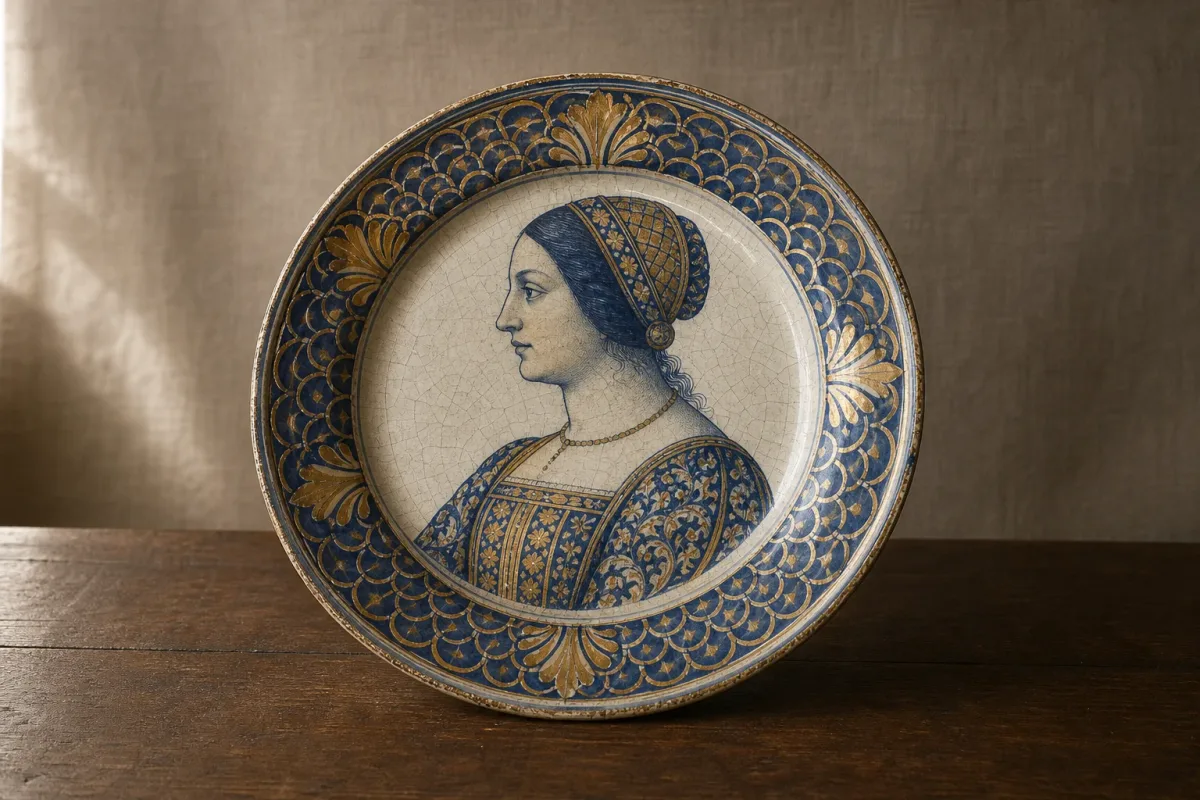
The most recognisable Renaissance Deruta type is the bella donna charger: an idealised woman in profile or three-quarter view, often with a fluttering scroll. Inscriptions praise beauty, grace, or virtue — bella, gratiosa, pulita — and sometimes name the sitter. The Victoria and Albert Museum treats these as courtship and marriage gifts rather than portraits from life. Empty scrolls on some examples suggest a buyer could have a name added. Small holes in rims or feet show they were meant to be seen on a wall.
Dated pieces are scarce. A gold-lustred charger of 1507, later in the Rothschild collection and catalogued by Christie's, carries the year and the motto VERTV E BELLEZA FALO MO BEATO — “virtue and beauty make man happy.” Giulio Busti and Franco Cocchi, in their 2004 Deruta exhibition on Umbrian ceramics in the age of Perugino, compared such profiles with the painted types of Pietro Perugino, whose workshop in nearby Perugia set the local ideal of the oval face and serene gaze.
Giacomo Mancini, called El Frate, is one of the few Deruta painters whose name attaches to surviving objects. The V&A holds a tazza of about 1550 painted with a couple and the motto Dulce est amare (“love is sweet”). Istoriato — narrative painting covering the whole surface — was never Deruta’s main export in the way it was Urbino’s, but Mancini’s workshop shows the town could work in that mode.
A related, smaller gift type is the fuseruola, a maiolica spindle whorl given as a love token, sometimes with initials and a “B” for bella. The British Museum holds a group of Deruta examples.
The 1524 pavement
Deruta’s most ambitious surviving ensemble is not a plate. In 1902, during re-flooring of the church of San Francesco, workmen uncovered a maiolica pavement dated 1524. Scholars reconstruct it as having come from a chapel of the Compagnia del Rosario e della Morte, originally in the pieve of Sant’Angelo and later moved to San Francesco. It is a geometric carpet of eight-pointed stars alternating with oblique crosses, framed by rectangular tiles. Star tiles carry prophets, muses, saints, emperors, and profile heads in landscapes that recall Perugino, Pinturicchio, and Raphael; the crosses are mostly arabesques.
The pavement covers about twelve square metres and comprises more than three hundred tiles. Attribution to Nicola Francioli, nicknamed Co (documented 1513–1565), rests on archival work by Lidia Mazzerioli and Clara Menganna and on stylistic comparison by Busti and Cocchi with signed works. A star tile is in the V&A; a fragment is in the British Museum. In 2025 the Museo Regionale della Ceramica redisplayed the surviving sections so they can be read as a single floor rather than isolated plaques.
Patterns still in production: Ricco Deruta and Raffaellesco
Collectors shopping in Deruta today meet a different vocabulary. Ricco Deruta is a dense, concentric scheme of yellow, orange, cobalt, and green — geometric panels, scrolling foliage, a central floral or wheat-sheaf medallion. Raffaellesco (Raphaelesque) fills a white ground with yellow dragons or grotesques and blue wings, a family of ornaments derived from Raphael-workshop grottesche, themselves inspired by the rediscovered decorations of Nero’s Domus Aurea. Arabesco and gallo (cockerel) patterns are also standard workshop stock.
These designs have Renaissance roots, but the versions sold as tableware are usually twentieth- or twenty-first-century. Raffaellesco in particular became a Deruta staple from the seventeenth century onward and is now the town’s most exported look. That is not a reason to dismiss it; it is a reason to date by paste, foot, and drawing, not by motif alone.
Seventeenth-century Deruta also produced the lighter, sketchier compendiario manner and continued pharmacy and floor-tile work. Production contracted in the nineteenth century. A municipal source records that by 1824 Giuseppe Grazia’s kiln was one of only three still firing in the town.
Museum, revival, and the CAT mark
Deruta’s ceramics museum is the oldest in Italy devoted to the subject. The notary Francesco Briganti founded it in 1898 as a “Museo artistico pei lavoranti in maiolica” — a teaching collection for working potters, in the spirit of London’s South Kensington Museum. Angelo Micheletti’s 1900 catalogue listed about 180 objects, then shown in the town hall. Since 1998 the museum has occupied the restored fourteenth-century convent of San Francesco. Holdings now exceed 6,000 works, including the 1962 transfer of factory samples from the Consorzio Italiano Maioliche Artistiche (CIMA) and Società Maioliche Deruta, plus the Leonardo Pecchioli and Milziade Magnini collections.
The late-nineteenth-century revival had names. A civic prize exhibition in 1872 already listed Casti, Grazia, Artegiani, and others. Alpinolo Magnini (born Deruta, 1877), trained at Perugia and at Rome’s Museo Artistico Industriale, became the key designer-teacher. He directed Società Maioliche Deruta from 1920 and served as artistic director of CIMA from 1922. In the 1890s he, Ubaldo Grazia, Enrico Pignatelli, and Micheletti worked to recover lustre recipes and Renaissance models. The Grazia family is documented among Deruta potters from the sixteenth century; Bastiano Grazia purchased a kiln in the historic centre in December 1769. That building, the Antica Fornace Grazia, is now a municipal museum. A later Grazia factory below the old town, with its own display of more than 500 sample pieces, still produces maiolica.
Italian law 188 of 9 July 1990 created the mark “ceramica artistica e tradizionale.” Deruta is one of the Umbrian towns (with Gubbio, Gualdo Tadino, and Orvieto) recognised for that protection. Authorised workshops may use the national CAT device plus a “Deruta” cartouche, an authorisation number, and a material code such as MA for maiolica. The mark certifies origin and process, not age.
Votive plaques at the Madonna del Bagno
Two kilometres toward Todi, at Casalina, the sanctuary of the Madonna del Bagno (also called Madonna dei Bagni) holds a different Deruta archive: roughly seven hundred maiolica plaques on the walls, spanning some 350 years. The cult began in 1657, after a peddler attached a ceramic fragment of the Virgin and Child to an oak; a reported healing led to a church built around the tree. Local potters supplied ex-votos showing the Madonna among oak leaves and the incident for which thanks were given — a flood of the Tiber, a fall from a horse, an epidemic, later a car crash. Most tiles are inscribed P.G.R. (per grazia ricevuta). A theft in 1980 removed more than two hundred plaques; about half were recovered. The museum in town has a related votive section. These plaques are folk documents as much as ceramics, closer in spirit to southern Italian popular devotion than to a Renaissance charger — a useful comparison with Sicilian teste di moro, another living ceramic tradition that is not Renaissance display ware.
How to identify and date Deruta ceramics
Start with the body. A chip should show terracotta, not a vitreous white porcelain paste. Weight is substantial; thin, ringing porcelain is the wrong material family.
Look at the reverse and foot. Renaissance and early-modern pieces often have a lead-glazed or partly glazed back, kiln grit, stilt marks, and an unglazed foot-ring that feels sandy. Bernard Rackham grouped some Deruta wares as “petal-back” for large orange-and-blue petal strokes on the reverse. Modern tourist plates frequently have a very white, even foot and a neatly painted “Deruta Italy.”
Brushwork is the next filter. On a sixteenth-century charger the scale pattern and profile vary in line weight; lustre sits as an iridescent film, not a flat gold paint. On a contemporary Ricco Deruta dinner plate, repeats are tighter and colours more even. Relief-moulded rims with dark recessed grounds appear on later decorative wares and are not a Renaissance diagnostic.
Marks are late. Most Cinquecento Deruta is unmarked. From the nineteenth century onward, workshop names (Grazia, Gialletti, and many others), “Handmade in Deruta,” and the CAT stamp become common. Treat marks as you would Italian silver hallmarks: useful when genuine, worthless if the object’s paste and drawing disagree.
Industrial copies exist. Authentic Deruta — old or new — is still made in the town; the problem is factory ware from elsewhere wearing Deruta patterns. Rough, unglazed feet, glaze-thickness variation, and live brushstrokes help, but they also appear on honest modern studio pieces. Age claims need the whole object, not a single clue.
Collecting: what the market actually is
There are three overlapping markets.
Renaissance lustred chargers and documented pavement tiles belong to the museum and international auction circuit. Condition, diameter, quality of drawing, and provenance (old European collections, published catalogues) drive prices. Hairlines and rim chips are expected on earthenware; heavy overpaint is not.
Nineteenth- and early-twentieth-century revival pieces — Magnini-period lustre, CIMA factory samples, signed workshop plates — sit between decorative and scholarly collecting. Factory marks and exhibition history help.
Contemporary Deruta tableware is craft, not antique. Buy it as such. It is useful for learning patterns in the hand, which is why serious buyers still walk the Via Tiberina before they bid on a 1520s charger.
Export of culturally important objects from Italy can require licences. High-value lustred or istoriato pieces should be bought through firms that handle paperwork. A tourist-shop label reading “XVI century style” is a description of decoration, not a date.
FAQ
Is all pottery marked Deruta antique?
No. Living workshops use the place name. A mark can be a modern origin stamp.
What is the difference between Deruta and Gubbio lustre?
Both used a third reducing firing. Deruta is known for gold-yellow lustre on large chargers; Gubbio, especially Andreoli, for ruby-red. The towns are close, and attributions can overlap on unsigned pieces.
What does Ricco Deruta mean?
A banded, richly coloured ornamental scheme still produced in Deruta. Motif continuity does not prove a Renaissance date.
Where should I look in person?
The Museo Regionale della Ceramica in Deruta is the reference collection. Compare also the maiolica rooms at the V&A and the Met, and the International Museum of Ceramics in Faenza for the wider Italian context.
How should I judge condition?
Earthenware chips. Honest rim wear on a four-hundred-year-old plate is normal. Recessed restoration, sprayed varnish, and replaced sections should be priced and disclosed.
Conclusion
Deruta ceramics are a town’s industry stretched across seven centuries: medieval supply contracts, Renaissance lustre, a 1524 tiled floor, Baroque votive plaques, a teaching museum founded in 1898, and factories that still throw on the same clay. Collectors who learn the difference between a piatto da pompa and a modern Ricco Deruta platter will not confuse decoration with age. The town rewards that patience — in the convent museum, in the Casalina sanctuary, and, with a colder eye, in the auction room.