
Nove Ceramics of the Antonibon Factory, 1727-1825
Nove ceramics from the Antonibon factory are dated by paste and marks: tin-glaze maiolica, hard-paste porcelain from 1762, and English-style terraglia.
Nove, in the province of Vicenza, is not Bassano. English catalogues still collapse the two names into “Nove di Bassano,” which is geographically fair and historically misleading. Bassano del Grappa, on the Brenta, had the Manardi kilns at Angarano. Nove, a few kilometres south, became the Venetian Republic’s principal ceramic factory in the eighteenth century under the Antonibon. The antique market meets both places as tin-glazed earthenware. The bodies, marks, and firing cycles are not interchangeable.
The town sits on clay, water, and milling. Those three facts explain the industry better than any later tourist label.
Place, clay, and the Serenissima
Venetian economic boards in the early eighteenth century wanted domestic substitutes for ware imported from Lodi, Faenza, and Genoa. The first organised manufactory in the district was the Manardi works at Bassano. At Rivarotta, between Angarano and Nove, Giovanni Battista Antonibon and Giovanni Maria Moretto signed a partnership in 1719 for a negozio di cristallina, using Moretto’s mills. Cristallina here is a glass-related mill product, not porcelain. It places the family on the Brenta industrial strip before the maiolica privilege.
The Museo Civico della Ceramica Giuseppe De Fabris, the town museum that occupies the former drawing school endowed by the sculptor Giuseppe De Fabris (Nove 1790-Rome 1860), dates the Antonibon firm at Nove to 1727. The Metropolitan Museum of Art uses the same year for the faience factory. Treccani’s biographical entry, written by Giovanni Mariacher in 1961, records a Senate privilegio of 1728 for fine maiolica, granted on Gian Battista’s petition, and a 1732 confirmation: twenty years’ exemption from duties and the right to open a shop in Venice. The two dates are not in conflict. One is foundation, the other is fiscal recognition.
Gian Battista died in 1738. Early production, as Mariacher summarised it, included blue-and-white maiolica in a Delft register and latesini: white-to-bluish relief wares imitating Manardi types from Angarano, with polychrome flowers. Those objects are the baseline against which later Nove ceramics are judged. They are not the fruit-shaped souvenir dishes that now fill Vicentine shop windows.
Pasquale Antonibon and grand-feu maiolica
Pasquale Antonibon, son of Gian Battista, took the factory to its commercial peak in the 1750s. The ware that concerns collectors is still maiolica: an earthenware body, dipped in a tin glaze, painted, and fired at grand feu. The white field is used as space. Decoration sits in reserves, sprays, and borders rather than covering the surface in Renaissance istoriato.
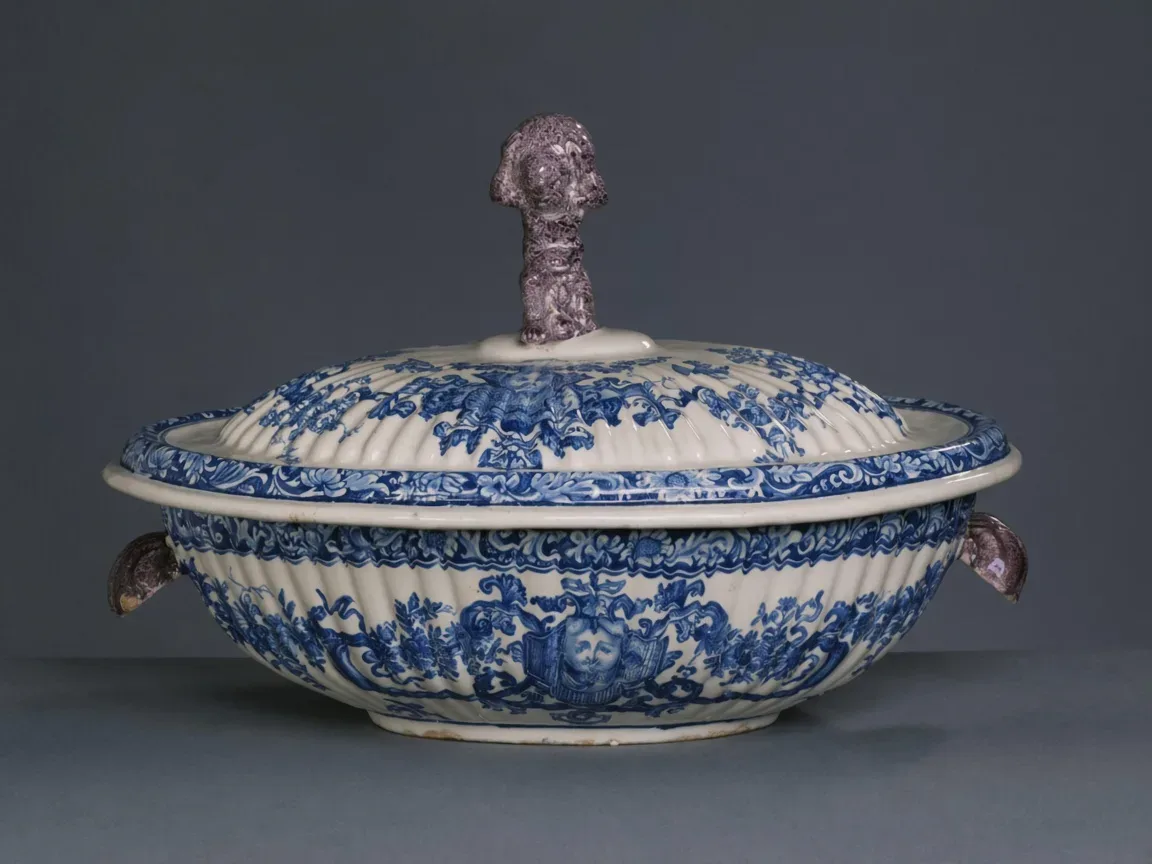
A tureen in the Victoria and Albert Museum (acc. 433&A-1869), attributed to Pasquale’s workshop and dated 1740-50, is the catalogue type. Height 25.5 cm, length 38.5 cm. The cover carries a manganese-purple finial modelled as Atlas. The bowl and lid are painted in cobalt with strapwork, foliage, and a mask. Underneath, the workshop wrote `No:ve / G:B:A:B.` The letters are the factory’s, not a painter’s signature. Bernard Rackham catalogued the piece; Giancarlo Ericani, Paola Marini, and Nadir Stringa republished it as cat. 1 in La ceramica degli Antonibon (Bassano, 1990).
Forms in this decade and the next are table service, not gallery sculpture. Christie's has sold a two-handled tray of about 1750 painted with cut fruit on a white ground (48.6 cm), the kind of still-life that Saul Levy illustrated among Lombard and Venetian eighteenth-century maioliche. Other documented shapes include lobed tureens with fruit finials, fish platters modelled as salmon, chinoiserie landscapes with a bridge (ponticello), and the floral spray known locally as tacchiolo. Handle terminals are often shells or cartoccio scrolls in manganese.
Do not date by motif alone. The same fruit and flower vocabulary was used at Lodi, in Liguria, and in later Nove tourist ware. Date by paste, glaze, and mark.
Porcelain, 1752 to 1762
Pasquale tried porcelain in 1752. Treccani names the Meissen-trained arcanist Sigismondo (Sigmund) Fischer, then Varion. Experiments are not a factory. The Museo De Fabris dates the Senate privilege for selling porcelain to 1762, the same rights previously granted to the Hewelcke works at Udine and Venice. On that chronology Nove is the fifth Italian porcelain, after Vezzi in Venice (1720-27), Doccia from 1737, the Bourbon factory at Capodimonte from 1743, and Hewelcke (1757-65). The Metropolitan Museum states that porcelain was first manufactured at Nove about 1762.
The Met’s covered bowl and stand (acc. 2007.254, about 1765) is hard-paste. Low-relief scrolling leaves, asymmetrical handles, and a finial still speak rococo. Painted reserves already admit classical architecture. That overlap is typical of Nove porcelain in its first decade: the factory did not wait for a clean neoclassical conversion.
Porcelain figures and small groups are the other documented class. They are scarce relative to the maiolica. A hard-paste body, a tighter glaze, and a different weight in the hand separate them from tin-glaze. If the object is yellow-white, relatively soft, and tin-opacified, it is not the 1760s porcelain.
Baccin, terraglia, and third fire
In 1773 Gian Battista Antonibon II ceded the maiolica side to Gian Maria Baccin. Porcelain stayed with the family, later in partnership with Francesco Parolin, who ran it from 1794 to 1802. The split matters for attribution. A marked maiolica of the 1770s-80s can be Baccin management of the Antonibon plant, not a different town.
From 1786, according to the Museo De Fabris, Baccin produced terraglia ad uso inglese: a white-firing earthenware body bulked with calcium and magnesium carbonates and silica. It is cheaper than porcelain and is not tin-glazed maiolica. Objects include jardinières, coasters, cup-and-saucer sets, and openwork baskets described as a spaghetto. Delft-type blue on white continues on this body as a cheaper echo of the earlier latesini.
Baccin’s technical contribution, again per the civic museum, was third firing (terzo fuoco, piccolo fuoco) on both maiolica and terraglia. The extra enamel firing allowed a violet-pink from purple of Cassius, greens, and a red that grand feu cannot hold. Sprays of roses “in the Marseille manner” and the small cut rosebuds called roselline tipo Nove belong to this palette. A plate that shows that pink on a tin glaze is later than a grand-feu cobalt-and-manganese tureen, even if both read “Nove” in a dealer’s headline.
An ICCD catalogue record for a chinoiserie plate in the De Fabris collection (inv. 263) assigns the painting to Pasquale or to the Baccin period (1774-1802) and notes purple of Cassius among the colours. The date band is stylistic. The body and the presence of that pink are the harder evidence.
Baroni, neoclassicism, and the nineteenth-century factory
In 1802 the works passed to Giovanni Baroni, who held them until 1825. Mariacher characterises Baroni maiolica as a particular white, with neoclassical forms and decoration. The Museo Gianetti in Saronno holds a set of six hard-paste cups and saucers with Roman histories, about 1802-10, from this management. They carry, unusually, an extended gold factory inscription together with the traditional asterisk, the six-pointed star that English mark books already listed as a Nove device.
From 1825 Gian Battista Antonibon III and his brother Francesco took the factory back. Production became more commercial: maiolica and terraglia for a broader market. Francesco (Bassano 1809-Nove 1883) was a history painter who worked as a ceramic decorator only until 1867. Lady Charlotte Schreiber visited in 1869 and found Francesco as proprietor; the V&A later recorded that Pasquale Antonibon of that generation specialised in “imitations of the best and earliest ware,” sold through the Venetian dealer Rietti. A tin-glazed tureen of about 1870 in the V&A (C.625-1921), painted with flowers and leaves, belongs to that revival, not to Pasquale II.
Gian Battista IV, trained at the Savona ceramic school associated with Luzzatti and Boselli, took artistic direction in 1884 and showed white, Della Robbia-type glazes at international exhibitions. Those nineteenth-century exhibition wares are another collecting field. They should not be catalogued as 1750.
Marks and how to read them
Marks on Nove ceramics are factory signs, not goldsmith-style date letters.
`No:ve` over `G:B:A:B.` The V&A tureen of 1740-50 carries this painted or inscribed workshop mark. Burton’s older English handbook records `GBAB` incised and assigns it to Giovanni Battista Antonibon. The same letters appear on pieces made after his death because the factory kept the cipher.
Six-pointed star or asterisk. A star, painted in blue, red, or gold, is the mark English literature treated as Nove’s. Museo Gianetti’s Baroni cups show it in gold beside a written formula. A lone star is not a date. It is a town-and-factory claim that later workshops also used.
`Fabbrica Baroni` / `Fabbrica Baroni / Nove`. Script marks of the 1802-25 lease. Neoclassical white grounds and Roman or Napoleonic subjects support the reading.
Painter’s names. Do not expect a consistent artist’s signature on eighteenth-century Nove maiolica. Attributions to individual decorators are a specialist literature. If a piece is signed in a twentieth-century hand, treat the signature as modern unless the body and glaze match the earlier factory.
A mark is necessary but not sufficient. Look at the foot ring for sand and glaze wipe, at the weight (porcelain vs maiolica vs terraglia), and at whether the pinks and golds are third-fire enamels.
Authentic factory ware versus later Nove
Nove still makes ceramics. The modern souvenir vocabulary (elongated fruit dishes, vegetable tureens, tourist landscapes) borrows eighteenth-century trompe-l’oeil without the factory’s paste or marks. Confusion is practical, not romantic.
Eighteenth-century naturalism, as in the Christie's fruit tray or a salmon platter, is modelled and painted as a single object: the glaze is continuous, the modelling relatively thin, the underside factory-finished. Nineteenth- and twentieth-century fruit services are often thicker, brighter, and marked with contemporary workshop names from the Nove-Bassano industrial cluster (Barettoni, Tasca, and many others listed by the local trade). Those names are real. They are not Antonibon 1750.
Revival pieces of the 1860s-80s, made in the same buildings, imitate early palettes on later bodies. Schreiber’s visit is the documentary warning. If the object looks like 1740 and weighs like 1870, believe the weight.
Albisola is a separate Ligurian industry with its own lantern, crown, fish, and thistle marks. A cobalt landscape on white is not a Nove attribution. Compare the mark and the clay colour before the scene.
Condition
Grand-feu tin glaze on an earthenware body will craze and chip at rims and foot. Restoration along the cover flange of a tureen is common; overpaint in the cobalt is more serious because it hides drawing quality. Third-fire pinks and golds wear first. Porcelain figures lose fingers and flowers; restored blossoms should be disclosed. Terraglia stains at the footring. None of this is unusual. Undisclosed fill on a mask cartouche or a replaced Atlas finial is.
FAQ
Is Nove the same as Bassano pottery?
No. Manardi production at Angarano/Bassano precedes and neighbours the Antonibon factory at Nove. Catalogues that print “Nove di Bassano” are locating the town, not naming a single kiln. Compare marks. Manardi types include the latesini that Gian Battista I imitated; they are not the Pasquale tureen with `G:B:A:B.`
When did Nove make porcelain?
Trials from 1752; a Venetian commercial privilege in 1762. Surviving hard-paste tableware and figures belong mainly to about 1762-1802, including the Parolin years. After 1802 Baroni and the returning Antonibon family continued ceramics, but the porcelain of the first generation is the scarce group.
What is the six-pointed star on the reverse?
A factory mark used at Nove, often with the Antonibon or Baroni name. It is not a date code and was copied. Read it with body and palette.
How can a fruit tureen be eighteenth-century and also a tourist object?
Naturalistic fruit and fish were factory models in the 1750s-80s. The same idea was industrialised in the twentieth century. The distinction is paste, glaze, modelling thickness, and mark, not the presence of a lemon finial.
The De Fabris museum in Nove remains the place to see the sequence in one building: seventeenth-century local ware at the top of the house, the eighteenth-century factory in the middle, and the later industrial town at ground level. A piece on the market has to fit somewhere in that sequence. If it does not, the attribution is a headline, not a date.