
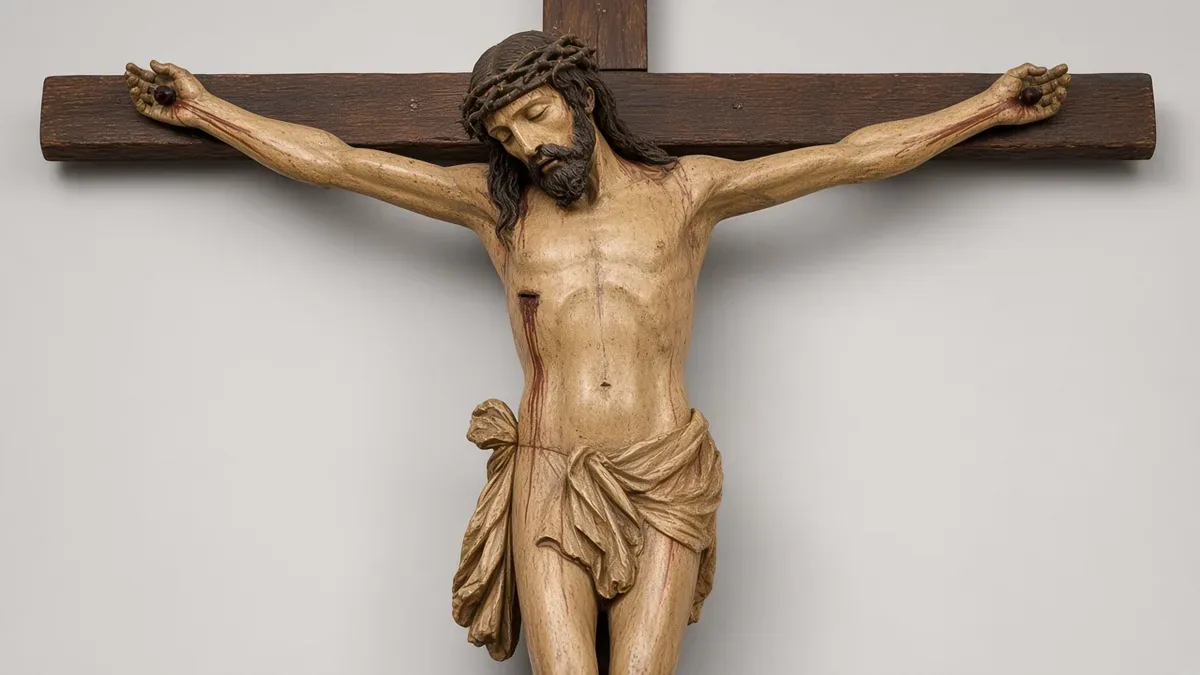
Dating Italian Antique Crucifixes by Wood, Corpus and Paint
Dating Italian antique crucifixes by wood, shoulder joints and later paint layers in Tuscan pearwood corpora and Neapolitan Baroque workshops.
A collector meeting an Italian crucifix on the market is usually looking at a corpus, the carved figure, mounted on a cross that may be later, restored, or both. Dating follows the wood, the shoulder joints, and the paint, not the silhouette alone. Tuscan pearwood figures of the early fifteenth century and Neapolitan Baroque crocifissi lignei share a liturgy and a carpentry problem. They do not share a workshop language.
What the corpus records
Italian usage distinguishes the crocifisso (figure plus cross) from the corpus or Cristo. Auction catalogues often sell the figure alone. Christie's London, on 4 December 2019, offered a polychrome wood Crucifixus Dolorosus, Sicilian or Tuscan, about 1310-1320, carved in the round, 47 cm high, 67 cm overall on a later wood cross, which sold for £125,000. The house compared the broken waist, stacked ribs, and swollen wounds with the large crucifix over the altar of the Santissimo Crocifisso in Palermo Cathedral, given in 1311 by Manfredi I Chiaramonte, count of Modica, and dated by Pavel Kalina to about 1300-10.
That Gothic type is not a Florentine Renaissance nude. Giovanni Pisano (about 1250-after 1314) set the formula around 1300: head twisted against the legs, hair falling in carved locks, polychromy used to mark wounds. The Victoria and Albert Museum holds a related ivory, acc. 212:1 to 3-1867, Tuscany, probably about 1290-1310, 15.3 × 6 × 5 cm. The arms and the legs below the knees are lost. John Pope-Hennessy published the attribution in 1965; Margrit Lisner discussed it in Holzkruzifixe in Florenz und in der Toskana (1970, p. 22). Wooden siblings stand in Siena Cathedral and in Pisa, Pistoia, Prato, and Berlin. Ivory and wood are different markets. The V&A object is a check against treating every small pale corpus as a later tourist ivory.
Scale sorts the rest. Processional and choir-screen figures run near life size. The Opera di Santa Croce gives Donatello's pearwood Crucifix as 168 × 173 cm across the arms. The Baptistery crucifix in Florence attributed to Baccio da Montelupo is 88 cm high. Christie's sold a North Italian late-fifteenth-century polychrome corpus about 165 cm high for USD 20,000 on 9 June 2010, and a painted Italian figure, probably seventeenth century, 94 cm high, for £4,375 on 24 March 2009. A later cross or varnish does not move those measurements.
Construction: trunk, fork joints, later crosses
The most useful dating evidence sits behind the figure. The Opificio delle Pietre Dure recorded Donatello's Santa Croce Christ during campaigns in 2003-2005 and 2022 (archive GR 11829, 14211). The corpus, 173 × 168 cm, comes from a single pearwood trunk. Radial splits follow the pith. The arms sit in a shoulder housing with a fork joint (incastro a forcella) and a pin. They could be lowered beside the body for Holy Week Depositio rites. Added blocks make up the front of the head, the right back, and part of the left buttock. Iron bands under the gesso at the wrists hold a correction: the hands were cut and reset. Radiography shows nails around the skull. A crown of thorns, probably rope laid on and gessoed, has been lost. The familiar cropped hair is a later state.
Two thin coats of gesso and animal glue were smoothed, not modelled. The paint is egg tempera, laid in crossed strokes until the surface reads as enamel. There is no original varnish. The cross, 482 × 187.5 cm, is two fir boards joined half-lap. A sixteenth-century cartouche is nailed at the top. The vertical member is hollowed to receive the buttocks and back. A rectangular housing at the head once held an earlier titulus. Fake wood grain is painted in egg tempera. Blood is painted at the three nail holes.
That construction is a checklist, not a Donatello signature. Later Tuscan workshops still pegged separate arms into a trunk. A frequent later alteration is to freeze those joints with gessoed linen bands. A catalogue that calls every fixed arm original has not turned the figure.
Crosses travel. Fir and spruce boards, half-lap joints, and a painted INRI scroll are often replacements. The OPD found the Santa Croce cross entirely overpainted in brown oil before the 2003 cleaning. A later cross is normal. A corpus whose back has no nail scars, no counter-profile wear, and a factory-smooth stain is the problem.
Tuscan models, 1300-1550
The early-fifteenth-century Florentine pair is the reference because the conservation record is public, not because every market piece descends from it. Donatello (Donato di Niccolò di Betto Bardi, Florence 1386-1466) carved the Santa Croce figure about 1408-1409, in the dating of the Opera, which links it to his Man of Sorrows for the Porta della Mandorla. Francesco Albertini mentioned it in 1510 in a chapel on the north aisle near the rood screen. After the Tridentine clearing of the tramezzo, Vasari saw it in 1571 on the altar now in the Bardi di Vernio chapel. The loincloth is carved from the same trunk as the body. Structural work dates to 1972-74 under Umberto Baldini and to the OPD campaigns already cited.
Filippo Brunelleschi's crucifix stands in the Gondi Chapel of Santa Maria Novella, dated about 1410-1415 by the basilica. Vasari's story of the "peasant on the cross" is first fully told in the Vite of 1550. The Santa Maria Novella catalogue notes the gap of years between the two documented works and treats the anecdote with reserve. What can be used is the geometry: the basilica describes an arm span equal to the height and a slight twist to the left. Pearwood again. The type is an ideal nude, not Donatello's heavier naturalism.
Between those two and the mid-sixteenth century, Florentine shops produced choir and convent crucifixes in series. Bartolomeo di Giovanni d'Astore Sinibaldi, called Baccio da Montelupo, was born at Montelupo Fiorentino in 1469, as he stated in the Florence estimo of May 1504. Treccani records a payment of one florin on 16 October 1496 from the Dominicans of San Marco to "the brother of fra Benedetto da Montelupo" for the wooden crucifix then over the choir door. Vasari wrote of an "infinite number" of crucifixes, "as large as life." The San Marco Christ is the documented survivor of that claim. In 1499 Baccio was paid in Florence for "uno Crocifixo di legnio" for the high altar of San Lorenzo. The Opera di Santa Maria del Fiore attributes to him the Baptistery crucifix behind the altar of the scarsella, about 1490-1510, wood and tempera, height 88 cm. An ICCD card (NCTN 00746207) lists another San Marco figure, about 80 cm, 1490-95. Hair cut from a deep parting, a closed mouth, and a quiet perizoma are the Savonarolan marks later carvers copied.
Gianluca Amato's 2013 Naples dissertation mapped Tuscan wooden crucifixes from the late thirteenth century to the first half of the sixteenth, including the Sangallo family. Giuliano's documented work begins with the crucifix once on the high altar of Santissima Annunziata, 1481-82. Antonio the Elder continued the shop into the 1530s (San Domenico at Fiesole, about 1520; Sant'Agostino at Montepulciano, 1533). Francesco held the workshop after Antonio's death in 1534, to about 1550. Pollaiolo's San Lorenzo crucifix, about 1470-80, and Brunelleschi's Gondi figure are the models those shops measured themselves against. A twisted perizoma does not make a Sangallo attribution.
The Santo Spirito crucifix attributed to the young Michelangelo is dated 1492-93 by the basilica and returned to Giuliano da Sangallo's sacristy in 2000. The attribution has been debated since the 1964 restoration display. Treat it as a published type, not as a template for unsigned trade figures.
Neapolitan and southern workshops
Southern crocifissi of the later seventeenth century are another trade. Nicola Fumo, the principal wood and stucco sculptor of his family, was born at Saragnano near Salerno in 1643 or 1645 and died in Naples on 2 July 1725. Documented work runs from 1676 to 1723, across Campania, Apulia, Calabria, and commissions sent to Spain. De Dominici (1743) placed him under Cosimo Fanzago. Gennaro Borrelli derived the flying drapery from Gaetano Patalano instead. The same debate over Fanzago's shop appears in the record of Baroque angels carved in wood and stucco in Rome and Naples.
Two dated crucifixes are usable. Eduardo Nappi published the wooden crucifix beside the entrance of Santa Maria della Provvidenza, Naples, as 1676-77. On 16 April 1695 Fumo was paid for a crucifix in the second chapel of San Nicola a Toledo, recorded by Galante and by G. B. D'Addosio. The national catalogue card NCTN 00280002 lists a Naples crucifix, wood and paint, about 175 × 150 cm, dated 1695 from those payment polizze, author "Fumo Nicola, 1645/1725." On 9 May 1715 the Banco del Salvatore paid 20 ducats (matr. 607) for a crucifix for Ragusa. A later Neapolitan corpus that shows glass eyes, separately modelled hair, and a perizoma in glued linen belongs with that century, and with the same city shops that supplied Neapolitan presepe figures, not with Baccio's San Marco type.
Ivory and coral are adjacent, not interchangeable. The Metropolitan Museum's crucifix 1982.199.1a, b, probably Italian, late sixteenth or early seventeenth century, has an ivory corpus on an ebony-and-ivory cross, 88.9 cm high with the tree. Trapani and Naples produced small luxury crucifixes in those materials for private oratories. A dealer who dates a limewood figure from an ivory comparison is mixing trades.
Paint, gesso and later skins
Original flesh on a fifteenth-century Tuscan corpus is thin. The OPD description of Donatello (two gesso coats, egg tempera, no varnish) is the laboratory version of what a raking light should show: fine craquelure, abrasion at heels, knees, and knuckles, losses along radial splits. Blood is a mixture question. On a comparable walnut figure published in an Italian conservation report, lighter drops read as lead white and cinnabar, darker ones as red lake. A thick oil skin that covers splits, worm holes, and the shoulder seam together is a later campaign.
Hair and loincloth are not always wood. Florentine shops of about 1480-1520, the circle of Giuliano and Benedetto da Maiano, the Sangallo, Chimenti and Leonardo del Tasso, and Baccio, sometimes built the perizoma in linen, glued, gessoed, and painted, and laid fabric hair over the carved skull. A restoration report on a Florentine-contado crucifix records linen hair, a gessoed canvas perizoma with smalt and gold, and arms in a different timber from the trunk, later strapped with linen. Canvas straps over a once-movable joint are a warning, not a proof of authenticity.
Gilding on a titulus or halo is often a nineteenth-century mecca or oil gilt. The same caution applies as with Roman and Florentine giltwood frames: bole colour, leaf thickness, and whether the gilt runs over a break in the carving all matter. A gold INRI on a fir cross that does not match the figure's nail spacing is a later assembly.
Common mistakes on the market
The first is to date the cross. A sixteenth-century cartouche on a fir tree, as at Santa Croce, can sit under a fifteenth-century corpus. The reverse is also common: an old figure on a twentieth-century stained board sold as a complete Renaissance crucifix.
The second is to read articulated arms as damage. Fork joints and pins are how a choir figure was used. Pegs at the shoulder, a housing cut into the trunk, and wear on the inner faces of the joint are period construction. Canvas bandages that lock the arms, or dowels set in PVA, are not.
The third is to treat a smooth, even flesh tone as quality. Laboratory cleaning of Donatello removed wax, a later varnish, and brown retouching along the splits. What remained was thin tempera and an aged dirt film that was not uniform. A figure that looks newly sprayed, with no craquelure in the recesses, is either over-restored or recent. The same test used for later terracotta casts against fired originals applies: look at the back, the joints, and the ground.
The fourth is a name. "School of Donatello," "Baccio," and "Neapolitan, seventeenth century" are catalogue shortcuts. The documented payments (San Marco, 16 October 1496; San Lorenzo, 1499; Fumo, 16 April 1695 and 9 May 1715) attach to specific churches. An unsigned corpus can be placed in a city and a half-century by wood, joint, and paint. It cannot be named from a photograph of the face.
The fifth is to ignore export and reuse. Fumo sent marble and wood to Spain. A corpus with a Spanish or Sicilian provenance can still be Neapolitan carving. Related church silver and reliquaries dated by form and seal sometimes travel with the same inventories. They do not date the wood by themselves.
FAQ
How do you tell a Tuscan fifteenth-century corpus from a Neapolitan Baroque one?
Start with the joint and the surface. A Tuscan choir figure is often a pearwood or lime trunk with forked, pegged arms and thin egg tempera over a lean gesso. A late-seventeenth-century Neapolitan crocifisso may use a more assembled carcass, a fuller gesso, glass or separately set eyes, and a perizoma that reads as cloth even when carved. Fumo's documented 1695 Naples figure is about 175 × 150 cm. Baccio's Baptistery Christ is 88 cm.
Does a later cross destroy the value of the corpus?
No. The Christie's 2019 Crucifixus Dolorosus was catalogued on a later wood cross and sold well above estimate. The OPD treated Donatello's fir cross as a historical object while recording that the present cartouche is sixteenth-century. What damages a sale is a silent marriage: a new board stained to match, new nail holes through original wrists, or a titulus whose letter forms belong to a print shop.
Were the arms meant to move?
On large convent and parish figures, yes, for the Holy Week sequence of adoration, deposition, and elevation. The OPD describes Donatello's arms swinging down beside the torso. Smaller altar corpora, and most ivory figures, were fixed. A joint filled with modern filler, or a shoulder recut to take a steel pin, is a restoration.
What woods should a buyer expect?
Pear is recorded for Donatello and, in the Santa Maria Novella tradition, for Brunelleschi. Lime (tiglio) and poplar appear in later Tuscan and central Italian shops. Walnut is used where a figure is carved more nearly in the round. Fir and spruce are common for replacement crosses. A corpus whose species does not match the cross is normal. Arms in a different species from the trunk need an explanation: period assembly, or later replacements.
Italian wooden crucifixes are dated by the same three facts a restorer writes down first: the species and joining of the carcass, the way the arms meet the trunk, and the sequence of grounds and paint. Names from Vasari and payments from San Marco or the Banco del Salvatore sit on top of that record. They do not replace it.