
Authentic vs Later Italian Terracotta: Fired Clay, Glaze and Casts
Collectors tell authentic Italian terracotta sculpture from later casts, revival glazes and painted plaster by clay body, firing and surface.
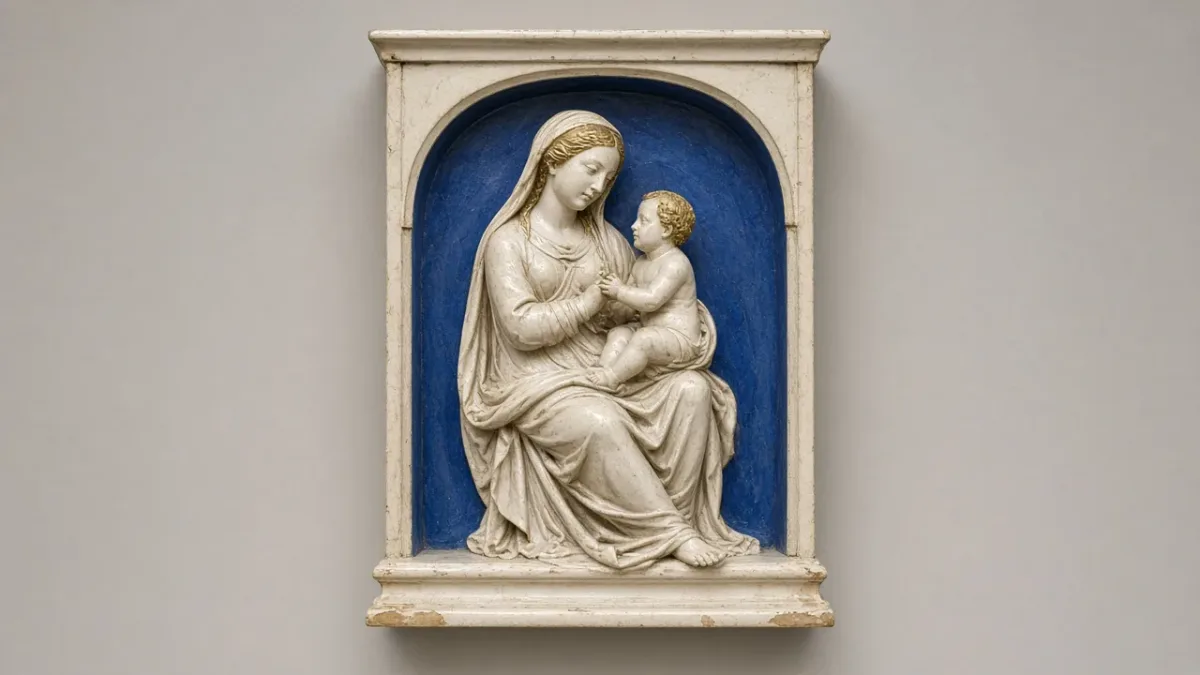
The blue-and-white Madonna on a dealer’s wall is often taken for fifteenth-century Florence. It is more often a nineteenth-century revival, a plaster painted as clay, or a garden press from an Impruneta mould. Colour does not date Italian terracotta sculpture. Clay body, kiln firing, and how the surface sits on the form do.
The collector’s range is wider than the Della Robbia tondo. It includes unglazed polychrome groups from Emilia, fired models for marble, and architectural or garden ware from the kilns south of Florence. Later casts share the iconography of the originals. The useful distinction is between a ceramic object that has been through a kiln and a surface that only looks fired.
Fired clay and what it is not
Terracotta (terra cotta, cooked earth) is earthen clay modelled or moulded, dried, and fired until it becomes a ceramic. The National Gallery of Art’s technical notes on Della Robbia sculpture describe a light, chalky river clay cleaned, sifted, and tempered with soft sand, then bisque-fired and, where glaze is used, fired a second time near 1650 °F so the glaze fuses to the body. A chip at the edge should show a biscuit fracture, not a powdery white core.
Plaster is the first substitute. It takes a piece-mould from a terracotta, a marble, or another plaster. Seams, air bubbles, and a chalky break are typical. A terracotta-coloured wash or oil paint will sit on that surface rather than vitrify with it. Stucco and gesso over wood belong to another class again: they are modelled or cast coatings, not kiln wares.
Canova’s practice, documented by the Art Institute of Chicago from the Bassano Three Graces terracotta (Musei Civici, inv. S 268, 1812) and from the plasters at Possagno, makes the sequence plain. Small clay bozzetti could be fired for durability. The full-scale clay model was cast in plaster. Bronze rèpere on the plaster then transferred measurements to Italian marble sculpture. A plaster with pointing marks is a studio tool, not a terracotta original, even when the composition is Canova’s.
Garden cement and later red-body copies occupy the lowest end of the same confusion. They copy Renaissance or neoclassical models without sharing the clay, the firing, or the toolwork.
Della Robbia glaze versus later white-and-blue
Luca di Simone della Robbia was born in Florence between July 1399 and July 1400 and died there in 1482. He enrolled in the Arte dei Maestri di Pietra e Legname on 10 September 1432 as a sculptor. The marble cantoria for Santa Maria del Fiore occupied him from the marble purchases of October 1431 until the installation of spring 1438. Glazed terracotta (terracotta invetriata) enters the documented work with the marble tabernacle for the chapel of San Luca in Sant’Egidio, now at Peretola, carved with Agnolo di Cristofano in 1441–42: polychrome maiolica inserts beside marble, not yet a fully glazed figure.
Giorgio Vasari’s 1568 life called the technique “a new, useful and most beautiful art” and the surfaces “almost eternal.” The National Gallery of Art exhibition of 2017 dated Luca’s experiments around 1440. The glazes combined ground glass with tin and lead oxides for an opaque white; cobalt and other metal compounds supplied blue, green, purple, yellow, and brown. Brush application, not dipping, produced the fields of colour. The workshop on via Guelfa used plaster moulds for popular Madonna types, then varied wet clay and glaze by hand. Serial production is therefore original workshop practice, not proof of a later fake.
Andrea della Robbia (1435–1525), Luca’s nephew, continued the shop. In the 1490s he sometimes left flesh areas in unglazed clay. His son Giovanni widened the palette and painted landscape in glaze. Another son, Girolamo, worked in France for Francis I and had to adapt foreign clays. Competition from the Buglioni workshop is recorded from about 1480; Santi Buglioni was still producing in the mid-sixteenth century.
Technical analysis supplies one dating handle that style does not. Portable PIXE and XRF work on Bargello blues, published in the Journal of Cultural Heritage in 2004, found cobalt in all the measured blues, but arsenic above detection limits only from about 1520–21. Giovanni’s Natività at the Bargello is inscribed ANO DNI MDXXI. Earlier Luca and Andrea blues, and part of the Buglioni production, fall below that threshold. The test is laboratory work, not a pocket check, but it is a reason not to date a cobalt-blue ground by eye.
Nineteenth-century Florence revived the look without reviving the workshop. Ulisse Cantagalli (1839–1901) and his brother Romeo inherited their father’s manufactory in 1878 as Manifattura Figli di Giuseppe Cantagalli. The Gardiner Museum’s account of the firm’s revival maiolica notes study at the Bargello and at South Kensington, and a crowing-cock mark playing on canta and gallo. The early-twentieth-century Album Della Robbia listed workshop copies after Bargello models taken from plasters by Oronzio Lelli. A glazed terracotta Annunciation lunette in the Museo Civico di Bracciano (160 × 270 cm) copies Andrea della Robbia’s lunette of about 1490 at the Spedale degli Innocenti; museum research places the Cantagalli version between 1878 and 1900, with a firing defect from manufacture. Montelupo produced white-on-blue devotionals in the same revival from the 1830s. The Ginori factory at Doccia supplied glazed tondi for the Innocenti loggia that replicate Andrea’s foundlings.
A cock mark, an impressed L, a redder non-calcareous body, or a glaze that pools like nineteenth-century maiolica are later. Absence of a mark is not fifteenth-century. Luca’s shop did not sign like a porcelain factory.
Unglazed and polychrome terracotta
Outside Florence the important fifteenth-century sculpture in clay is often unglazed and painted. Niccolò dell’Arca’s Compianto in Santa Maria della Vita, Bologna, is a life-size polychrome group around the dead Christ. The sculptor is documented in the city from 1462; the group is placed by the church between the 1460s and the 1490s. Guido Mazzoni of Modena modelled comparable Lamentations with casts from life and naturalistic colour. These figures were sectioned for the kiln, fired, and reassembled. They are not Della Robbia wares, and they are not Neapolitan presepe figures, which use terracotta in a later, smaller, costume-and-stoppa tradition.
Florentine sculptors used terracotta as a preparatory medium for marble. Benedetto da Maiano’s polychromed relief God the Father with Two Angels in the Detroit Institute of Arts (c.1489; 36.2 × 25.4 × 7.3 cm) is a documented model for the Annunciation altarpiece in Sant’Anna dei Lombardi, Naples, sent from Florence by September 1489. The Metropolitan Museum’s painted terracotta Virgin Annunciate (late fifteenth century; height 101.9 cm), once taken for a sketch model for that Naples altar, is now catalogued as a cast after the marble rather than a study for it. The distinction matters on the market: a fired model for a known commission is not the same object as a derivative cast, even when both are terracotta and both follow Benedetto.
Paint on unglazed clay is original more often than dealers assume, and it is also the easiest surface to renew. Look for paint in recesses that matches wear on high points, not a uniform modern skin.
Impruneta kilns and garden copies
Impruneta’s clay, often discussed as galestro, is a different body from the Della Robbia river mix. A guild of pitcher-makers and jar-makers is recorded in 1308 in the Florentine ab incarnatione calendar: artis mezzinariorum et urceorum plebatus Sancte Marie Impinete. Antonio Manetti’s life of Brunelleschi records the architect supervising roofing tiles from those kilns for the dome of Santa Maria del Fiore. The local disciplinare still distinguishes lavoro quadro (bricks and tiles formed in frames) from lavoro tondo (jars built as coils, and statues or coats of arms taken from plaster moulds). Trade in terracotta goods was liberalised in 1777.
The Antica Fornace Agresti, a two-storey brick-and-stone kiln of the early eighteenth century, preserves the layout of wood-fired chambers, loggia, and drying yard. The Comune’s 2022 inventory lists about 600 plaster and terracotta casts, tools, and machines from the late nineteenth century and the first decade of the twentieth. That archive is the practical explanation for the Renaissance putti, della Robbia garlands, and Canova reductions still sold as garden sculpture. They are fired terracotta. They are not fifteenth-century sculpture. The modern C.A.T. mark identifies clay and manufacture within the commune; it dates a living kiln, not a Renaissance workshop.
Grand Tour demand absorbed the same models in marble, bronze, and clay. Dating those objects is a matter of material and shop practice, not of subject: the Grand Tour antiques trade and the Italian bronze foundries used overlapping repertories. Terracotta is the cheapest of those three to reproduce, and the easiest to distress.
What to check on the object
Weight and sound are first filters, not proofs. Fired earthenware is lighter than a comparable marble and usually heavier than a thin plaster. A clear ceramic ring is possible on an open form and unreliable on a stuffed or restored one.
Look at breaks and the reverse. A ceramic fracture is granular and often paler than the original surface. Firing cracks follow shrinkage, not impact. Large figures may be hollow, with vents, and assembled from sections whose joints can be read inside. A plaster reverse shows mould seams, filler, and a different dust.
Glaze, where present, should be a fused skin. Crazing can be old or new; it is not a date. What matters is whether the glaze follows the modelling, including undercuts, and whether chips expose biscuit rather than gesso. Revival glazes of the Cantagalli class often sit like pottery enamel on a redder body. Fifteenth-century Robbia bodies, on the analyses summarised by the National Gallery of Art, are light and calcium-rich.
Moulding is original workshop method and later factory method. Hand variation in hair, pupils, and garland fruit, plus a glaze that is brushed rather than sprayed, still favours a Renaissance or early modern shop over a tourist press. Identical garden sets from a numbered mould board favour Impruneta or a later factory.
Polychromy should be described, not stripped. Nineteenth-century overpaint is common. So is the loss of Renaissance paint that once unified an unglazed group. Compare the object with a documented example in a museum before accepting a famous name. The Bargello, the Museo dell’Opera del Duomo, Santa Maria della Vita, and the American collections catalogued by Marquand and Pope-Hennessy remain the measuring sticks.
Condition is part of identification. Filled losses in glaze, iron staining from old mounts, and lime deposits from outdoor use are expected on architectural pieces. Uniform dirt in a regular pattern is often applied. A perfect glossy tondo with no kiln evidence and a romantic story of a villa chapel should be treated as a revival until the body is examined.
FAQ
How can I tell Della Robbia terracotta from a Cantagalli copy?
Look at the body colour at a chip, the cock mark or other factory stamps, and the character of the glaze. Cantagalli and related Florentine revivals after 1878 copied Bargello and Innocenti models, sometimes from Lelli plasters. They can be fine ceramics. They are not Luca or Andrea.
Are moulded Madonnas automatically later?
No. The fifteenth-century shop used moulds for domestic Madonnas and varied them by hand. Identical modern garden sets, and nineteenth-century neo-Robbia with factory marks, are the later class.
Is unglazed terracotta less “authentic” than glazed?
No. Emilia’s polychrome groups and Florentine sculptors’ models were routinely unglazed and painted. Glaze is a Florentine workshop speciality, not a test of authenticity for the whole peninsula.
Do firing cracks ruin the object?
Shrinkage cracks from the kiln are part of the material. They differ from later impact breaks and from plaster fractures. Record them. Do not fill them as if they were damage unless a conservator is working to a stated protocol.
Where does garden Impruneta terracotta sit on the market?
It is authentic kiln ware from a documented centre (guild 1308; tiles for Brunelleschi’s dome). It is not Renaissance figurative sculpture. Price it as architectural or garden terracotta, with or without a C.A.T. mark, not as a Della Robbia.