
How to Identify Italian Reliquaries by Form, Seal and Construction
How to identify Italian reliquaries by form, wax seals, autentiche and construction, from portable thecae to Baroque ostensori and silver busts.
A reliquary is a container made to hold and show a relic. In Italian inventories the object is a reliquiario. The relic itself is a separate thing: bone (ex ossibus), cloth (ex velo, ex veste), wood of the Cross (ex ligno S. Crucis), or ash. Collectors buy the container. Churches authenticated the contents. The two questions are not the same.
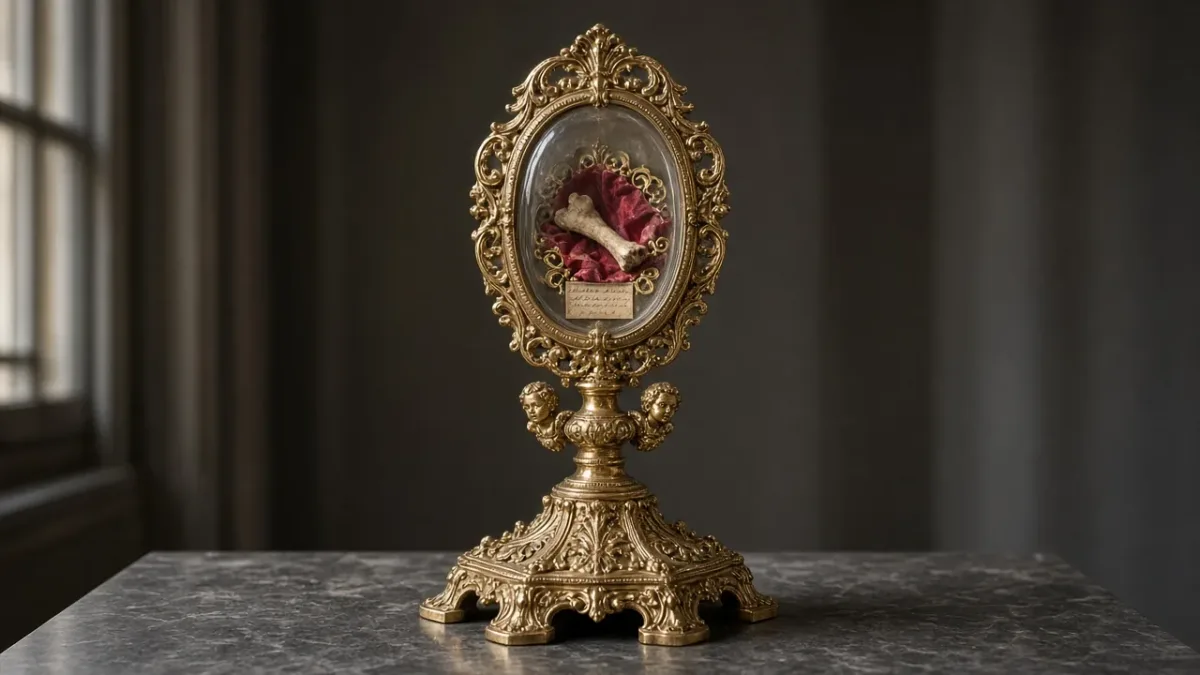
Italian shops produced several standard forms. A teca is a small glazed case, often oval or circular, meant to be worn or hung. A reliquiario a ostensorio stands on a foot, like a monstrance, and opens a window onto the relic. A reliquiario a busto or a statua is an anthropomorphic bust or full figure. A reliquiario a braccio takes the shape of a forearm and hand. A cassetta or teca a cassetta is a box with a glazed face and internal compartments. The Catalogo generale dei beni culturali uses these types as catalogue headings. They are more reliable than dealer English, which collapses most standing examples into "monstrance."
Trent and the later trade
Session XXV of the Council of Trent, held on 3 and 4 December 1563, required bishops to teach the lawful veneration of relics and forbade the recognition of new relics without episcopal investigation. Superstition and profit were to be removed from the cult. The decree did not invent the reliquary. It changed the paperwork. After Trent, a portable Italian relic that could be shown in public was expected to travel with a written autentica and a seal that closed the case.
That paper trail is the collector's first dating tool. A Roman autentica of 10 May 1810, catalogued by the Soprintendenza at Calestano (national catalogue 0800309626), is typical of the printed Vatican form. It is headed by Fr. Giuseppe Bartolomeo Menochio, Augustinian, titular Bishop of Porphyreon and Prefect of the Apostolic Sacristy. The text states that relics taken from authentic places, already documented and sealed, were placed in a theca, bound with a red silk cord, and closed with the prefect's seal in red Spanish wax (cera ispagnola). Permission is given to keep the relics, to give them to others, and to expose them for public veneration. Christie's sold a gilt-copper True Cross reliquary with a related Roman document issued in December 1772 in the name of Fr. Nicolaus Angelus Maria Landini, then Prefect of the Apostolic Sacristy, and countersigned on 22 June 1778 for the diocese of Hradec. The names of successive prefects can be checked. They date the sealing more tightly than style alone.
The Congregation for the Causes of Saints restated the principle in an instruction of 8 December 2017: relics of blesseds and saints are not to be displayed for veneration without an ecclesiastical certificate of authenticity. A broken seal is not a decorative loss. It is a broken chain of custody.
Seals, threads and the cedula
On a closed theca the reverse should show a disc of red sealing wax impressed with an episcopal or curial coat of arms. Silk threads pass through the case and into the wax. If the threads are cut or the wax is recast, the autentica no longer describes the object in the hand. A Mondovì teca a cassetta of 1664 (national catalogue 0100042402) still has two red episcopal seals between the gilt wood frame and the lid. The pastoral visit of Bishop Domenico Trucchi in 1668–69 recorded the relic of St Valerius as authenticated on 31 October 1664 by Pietro Paolo Cantatore, vicar general of the diocese. The same box holds a skull on a red velvet shelf and, in twenty lower compartments lined with red damask, bone fragments tied with gilt thread. The visitor noted that many of those names (Modestus, Modesta, Lucina, Peregrinus, Prudentius) were drawn from Roman cemeteries. Angelo Torre has treated this late-seventeenth-century arrival of Roman relics in the Mondovì valleys as a documented pastoral campaign, not as folklore.
A simpler wooden teca for a fragment attributed to Pope Clement, published from the Carthusian holdings now in the Archivio di Stato di Bologna, shows the same logic at a smaller scale: a parchment label on the bone, white textile ties, four red wax seals and yellow satin ribbons at the corners of the lid. The archive still holds folded autentiche for the church's relic altar, dated through the eighteenth century.
Inside the glass, a paper cedula names the saint and the class of relic in abbreviated Latin: Ex Oss. S. Luciae V.M., Ex ligno S. Crucis, Ex veste S. Joannis. The label should sit under the glass with the relic. A printed ticket glued to the back of an opened case is later packaging.
The setting around the relic is often paperolle: narrow strips of gilt or coloured paper rolled and glued into scrolls, leaves, and rays, sometimes with metallic thread and seed beads. Convents produced this work from the seventeenth century. It is not a hallmark of one city. Italian thecae of the eighteenth century commonly combine paperolle with a red or white silk ground. Machine-cut circular glass and a chromed brass rim belong to the late nineteenth and twentieth centuries.
Standing ostensori
The Baroque reliquiario a ostensorio is the form most often offered as an antique. A typical construction, recorded on an Umbrian example of about 1690–1710 at Orvieto (national catalogue 1000060482), is silver leaf on a wooden core, a gilt wooden foot, a knopped stem with cherubs, and a mixtilinear receptacle with an oval light. Height 85 cm, width 37 cm. The glass is inscribed in capital letters: EX OSSIBUS S. JOAN. / URBEVET. VIRGO S. BERNARDI A.G. / EX OSSI VITI M. The reverse carries a two-field seal. The cataloguer notes that metallic leaf on wood, with endless decorative variants, became the ordinary Italian model in the seventeenth and eighteenth centuries.
A Venetian workshop example of 1731–35 in the church of Santo Spirito, Dorsoduro (national catalogue 0500138260-0), is smaller: 30 cm high, circular repoussé foot with volutes and angel heads, oval light with a Marian monogram below. Christie's catalogued a late-eighteenth-century North Italian gilt-copper reliquary as a glazed rotunda on a knopped column and spreading hexagonal base, 9¼ inches high. Gilt copper and gilt bronze mounts should be judged as metalwork. Fire-gilding, chasing, and workshop punches, where they exist, follow the same regional systems described for Italian gilt bronze. They are not interchangeable with water gilding on wood.
Silver ostensori and busts take Roman papal assay marks or the town punches of other centres. An unmarked silver-gilt and rock-crystal casket can still be Venetian in construction: filigree wire drawn through a die, crystal plaques, architectural plan. Auction houses treat such pieces cautiously when punches are absent.
Busts, arms and treasury silver
Anthropomorphic reliquaries are older than Trent. Busts and statues are documented from the tenth century. Counter-Reformation Sicily and Naples multiplied them.
The Tesoro di San Gennaro in Naples still shows the essential types in one chapel. The gold-and-silver bust of the patron, dated 1305 in the Tesoro literature and commissioned under Charles II of Anjou, holds the skull bones. A silver blood reliquary of the same year is associated with Robert of Anjou. The chapel, vowed in 1527, now houses a set of fifty-three silver reliquary busts of the city's patron saints. Matteo Treglia's mitre of 1713, made to dress the bust in the May procession, is gilded silver set with 3,326 diamonds, 198 emeralds, and 168 rubies. Those figures are the museum's. They describe a treasury object, not a parish theca. Neapolitan silver hallmarks (NAP, Parthenope, and workshop punches) are the dating method for later busts and ostensori from the same city. Andrea De Blasio, active in the first half of the eighteenth century, is recorded on a reliquary now in the Museo Diocesano, Naples (national catalogue 1800028261).
In Palermo Cathedral, two wooden arm reliquaries of Saints Generosi and Rosana, attributed to the second half of the eighteenth century, were studied for conservation in 2013. Each is about 70 cm high. The wood is lime (Tilia). Base and arm are water-gilded (a guazzo) over bole; the hands are silver foil. A green glaze sits in the chased ornament. The relics are femurs, identified by inscriptions in a silver chamber. The type derives from earlier silver and gold arms. Cheaper gilt-wood versions supplied parish chapels that could not commission plate.
Gilded wooden ostensori share a gilding culture with Roman and Florentine giltwood frames: gesso, bole, leaf, and wear to the clay. They do not share a section. A reliquary stem is turned and carved as sculpture. A picture frame is a mitred moulding.
Coral, crystal and painted tabernacles
Trapani coral workshops of the seventeenth and eighteenth centuries supplied chalices, ostensori, and reliquaries in gilt copper and carved coral. The Museo Regionale Agostino Pepoli holds the reference group. Papal families collected the same work. A coral, silver, and gilt-brass reliquary with the Rospigliosi lozenges (Clement IX) has been published with a possible Roman assembly and Trapanese coral carving. Vincenzo Renda, a coral worker born in 1605 and living by mid-century in via del Pellegrino, Rome, appears in Barberini accounts of the 1640s. Coral on a reliquary is not automatically jewellery coral from Torre del Greco. The Trapani liturgical group is a different trade.
Venetian rock crystal appears on earlier caskets and on Baroque pendants. A gilt-metal pendant with a lifting crown, a shaped crystal cartouche, and the lion of St Mark is a documented seventeenth-century Venetian type. The crystal is the window. The relic is inserted when the crown is raised. Later tourist pendants repeat the lion in cast base metal with moulded glass.
A separate medieval Italian type is the Sienese gabled tabernacle whose frame is inset with glazed relic chambers. One ensemble made for the Ospedale di Santa Maria della Scala is now divided between the Cleveland Museum of Art and the Fitzwilliam Museum. Those objects are panel-painting technique, not goldsmith's work. They belong to a Trecento discussion and are rarely on the private market.
Smaller Italian thecae sometimes sit in the same domestic shrines as painted ex-voto tablets. The tablet records a vow discharged. The theca holds a relic. The two objects can share a nail hole and a coat of soot. They are catalogued separately.
Later work and opened cases
Nineteenth-century thecae are common. A Turin example of the mid-nineteenth century is dated by the seal of Archbishop Luigi Fransoni (1832–1862). Jacquard-woven pékin silk on the lining points to a date after the first quarter of that century. A circular brass theca of 1922 in the Museo del Duomo at Fidenza, with printed tickets for Teresa of Ávila and Margaret Mary Alacoque and the seal of Raffaele Maria Virili, shows the modern Vatican format at a diameter of 4.65 cm.
Opened cases are frequent in the trade. A replaced glass, a fresh silk ground, and a wax disc that does not match the threads are ordinary repairs. They do not make the metalwork modern. They do make the relic unauthenticated. Dealers sometimes sell the empty ostensory as decorative metalwork. That is an honest description if the seal is gone.
Copies and pastiches use Dutch metal, bright screws, and a relic-like splinter on new velvet. Cast "Baroque" stems with identical cherub heads in a repeated mould are later. Period chasing varies from one head to the next.
Italian cultural-heritage law treats historic church furnishings as beni culturali when they meet the age and interest tests of the Codice dei beni culturali. Export from Italy can require a licence. Canonical rules on the alienation of relics are separate from that civil process. Neither is a substitute for looking at the object.
Condition
Silver and gilt copper dent at the foot and at the knop. Wooden cores shrink and split the leaf. Glass sweats and fogs the silk. Active bronze disease or weeping iron pins need treatment. Do not soak a sealed theca. Do not lift a wax seal to see the relic. Photograph the reverse, the threads, and the autentica together. Record measurements of the whole object, not only the window.
FAQ
What is the difference between a theca and an ostensory reliquary?
A theca is a small glazed case, often pendant. An ostensory reliquary stands on a foot and presents the relic in a window, like a monstrance. Both can be Italian and both can be sealed.
Does a broken wax seal destroy the value of the metalwork?
It breaks the ecclesiastical authentication of the contents. The silver, gilt copper, or gilt wood can still be judged as plate or sculpture. The relic can no longer be described as a sealed, documented fragment.
How is a Vatican autentica dated?
By the name and office printed or written at the head, usually a bishop acting as Prefect of the Apostolic Sacristy or a postulator, and by the date line. Those officials are documented. Style of the theca is secondary.
Are San Gennaro busts available to collectors?
The fourteenth-century bust and the set of fifty-three silver patron busts belong to the Tesoro in Naples. Parish and convent busts of other saints do appear. They should be read through silver marks, wood cores, and any surviving autentica, not through the Tesoro type alone.
Can paperolle be used to date a theca?
It is supporting evidence. Hand-rolled gilt paper with irregular scrolls is consistent with seventeenth- and eighteenth-century convent work. It is not exclusive to Italy. Combine it with the seal, the glass, and the metal or wood of the case.