
Italian Baroque Angels of Rome and Naples in Wood and Stucco
Italian Baroque angels in wood and stucco, from Bernini’s Roman circle to Neapolitan giltwood altar figures of the seventeenth century, with dating clues.
Italian Baroque angels were not a single collectible type. They were fittings. In Rome they occupy parapets, altar pediments, and baldachins in marble and stucco. In Naples they were also carved in wood, then gessoed, painted, and water-gilded for churches that needed winged figures at a cost below monumental marble. The same iconography, a kneeling or hovering attendant with instruments of the Passion or with a torch, therefore appears in materials that age in completely different ways.
What comes onto the market is almost never a Bernini marble from Ponte Sant’Angelo. Dealers and auctions see parcel-gilt and fully gilt wooden angels, torch-bearing pairs, detached architectural putti, and small terracotta modelli. Later crib angels with silk clothes belong to another workshop system and should be kept apart.
Rome: Bernini’s circle and the altar angel
Gian Lorenzo Bernini (1598–1680) set the Roman type: an angel whose drapery is cut in deep, light-catching folds, the body twisted on a cloud, the hands busy with a Cross, a column, a lance, or a crown of thorns. The public programme that still governs how collectors name these figures is the decoration of Ponte Sant’Angelo under Clement IX Rospigliosi.
Bernini was made supervisor of the bridge in 1667. On 11 November that year 10,000 scudi were allocated; marble payments began on 22 September and continued into 1668. Most of the stone came from the Polvaccio quarries at Carrara and was delivered to the sculptors’ studios. The Sovrintendenza Capitolina records a fee of 700 scudi for each statue. First payments to Paolo Naldini (Angel with the Robe and Dice) and Cosimo Fancelli (Angel with the Holy Face) are dated 27 July 1668. August 1668 covers Ercole Ferrata (Cross), Antonio Giorgetti (Sponge), Girolamo Lucenti (Nails), and Domenico Guidi (Lance). Antonio Raggi, born at Vico Morcote in 1624 and dead in Rome in 1686, was paid from November 1668 for the Angel with the Column. Lazzaro Morelli (Flagelli) was paid from January 1669. Final settlement of the accounts is dated 20 July 1670.
Bernini reserved two marbles for himself: the Angel with the Crown of Thorns and the Angel with the titulus of the Cross. Clement IX refused to leave them outdoors. They remain in Sant’Andrea delle Fratte. Copies went onto the bridge, Naldini’s for the crown and Giulio Cartari’s, under Bernini, for the titulus. On 17 August 1670 Bernini and his son Paolo each received 700 scudi for the originals. Those statues are not a market category. They are the pattern book. Later giltwood angels that “look Bernini” are quoting this vocabulary at domestic or liturgical scale.
An earlier Roman pair shows how the type entered church interiors. The two adoring angels on the high-altar pediment of Sant’Agostino in Campo Marzio are dated 1626–1628 in the ICCD catalogue (NCTN 00759987). Height is given as 150 cm. The material is recorded as stucco. Mola (1663) and Filippo Baldinucci (1682) gave them to Bernini. Giovanni Battista Passeri (1772) and later Rudolf Wittkower (1955) favoured Giuliano Finelli of Carrara, in Rome from 1622, who according to the Enciclopedia Italiana also modelled putti and angels for the bronze baldachin of St Peter’s. Lione Pascoli assigned the Sant’Agostino pair to Finelli and Luigi Bernini after Gian Lorenzo’s design. Nineteenth-century restoration, cited from Monti (1868) on the ICCD card, gilded the wings and silvered the clouds. Anyone dating a “Roman Baroque stucco angel” from a photograph should remember that gold on the wings may be an Ottocento campaign, not Seicento water gilding.
A wooden counterpart sits in the Galleria Nazionale d’Arte Antica at Palazzo Barberini: a candelabrum figure of an angel with a cornucopia, catalogued as carved and painted wood, 172 cm high, second half of the seventeenth century, in the manner of Bernini (NCTN 00160974). That is the height class of an altar angel, not a mantel putto.
Naples: giltwood, bronze, and export
Neapolitan wood sculpture of the early Seicento was long read as popular craft. Pierluigi Leone de Castris, in Il legno degli angeli (2022), reconstructed it as a documented urban trade. Aniello Stellato is recorded from 1593 to 1648, working for Jesuits and Theatines and sending sacred figures through the Kingdom of Naples, to Rome, the Marche, and Spain. De Castris notes that a guardian angel from this milieu could cost as much as a good altarpiece, and that the better shops exported as far as the Spanish Indies. Stellato’s signed and dated Madonna della Neve of 1612 at Grottazzolina (Francesca Coltrinari, 2017) and a crucifix of about 1648 in Santi Apostoli, Naples, give the chronological brackets. Around 1619 he is credited with twelve reliquary busts for the Girolamini; those objects belong with Italian reliquaries rather than with free-standing angels, but they show the same gessoed and gilded wood.
Candle-bearing angels (angeli reggicandelabro or reggitorciera) are the Neapolitan form most often detached and sold. BeWeB records a pair associated with Diego da Careri, second quarter of the seventeenth century, in the Diocese of Naples: carved wood, stuccoed and gilded, 150 × 120 × 60 cm. Wings on such figures are commonly separate boards, nailed or hinged. A missing iron spike on the back is not damage in the ordinary sense; it is evidence of how the angel was mounted.
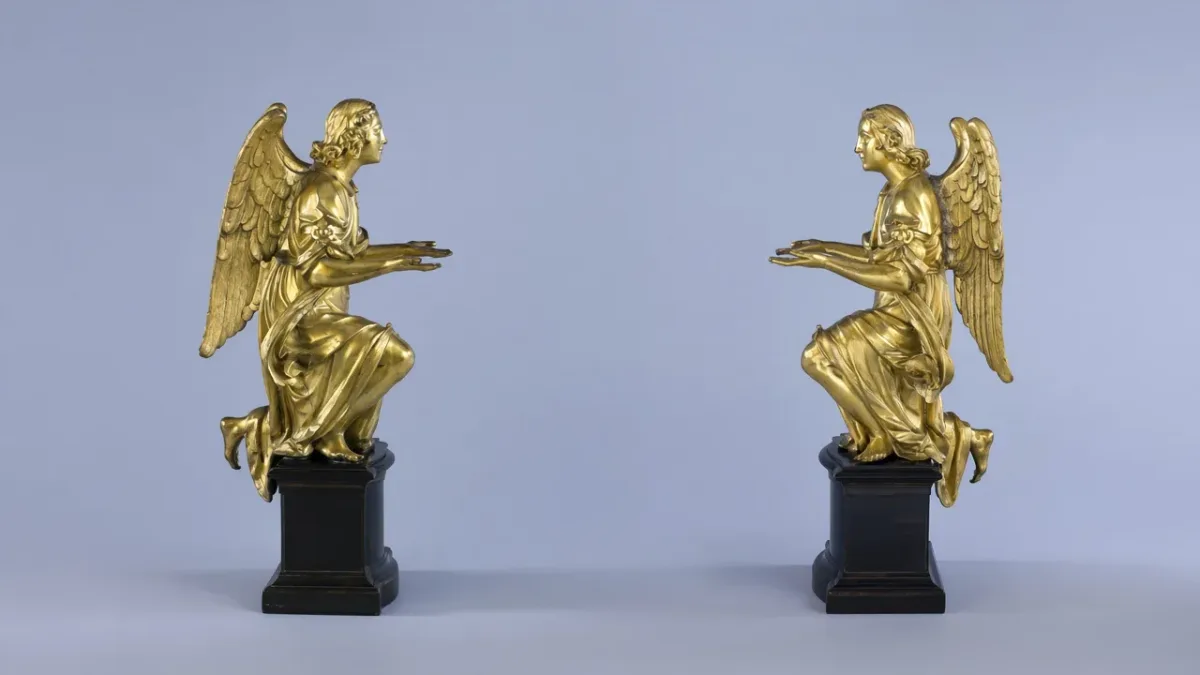
Bronze was the other Neapolitan luxury. Cosimo Fanzago (1591–1678) designed a marble tabernacle with gilded statuettes for a church in Naples. A pair of kneeling gilt-bronze angels from that campaign, dated 1640–47, is now in the Saint Louis Art Museum (inv. 117:2021.1,.2). The museum notes that the altar was finally erected without them. The oval faces, long curls, and sharply undercut drapery are the bronze equivalent of what Roman stucco was doing in the same decades. Collectors who know Italian gilt bronze workshops and their marks should still treat unsigned Neapolitan angels as workshop products unless a punch or a contract survives.
Siena, looking toward Rome, produced a related terracotta type. Giuseppe Mazzuoli (1644–1725), trained in Siena and later in Ercole Ferrata’s Roman studio, is connected with the marble ciborium angels of Sant’Agostino, Siena. Fra Carlo di Camillo Chigi contracted Francesco, Giovan Antonio, and Agostino Mazzuoli for that ciborium; Giuseppe is not named in the surviving contract, but the Metropolitan Museum catalogues two terracotta candle-bearing angels from his workshop as ricordi of about 1677–79 (1991.37a, height 41.6 cm; 1991.37b, 42.9 cm), with later remains of paint. Small terracottas of this kind are presentation or record models, not reduced church furnishings. For fired clay, shrinkage, and later casts, see authentic versus later Italian terracotta sculpture.
Wood, gesso, bole, and what later hands added
Italian giltwood angels were built, not carved from one log. Projecting wings, arms, and cloud bases are separate members, glued and dowelled, often in limewood or poplar because those timbers take a fine cut. The ground is the southern European gesso system described in conservation literature: a coarser gesso grosso under a finer gesso mate, animal glue as binder, then a clay bole, then gold leaf, burnished on the drapery and left matte in the recesses. The same layered gilding, with red bole showing in the wear, is what Roman and Florentine giltwood frames display on a flatter architecture.
Later campaigns are the rule. Devotional overpaint, bronze powder (porporina) in glue or varnish, and re-gilding on new bole will sit over losses. A uniformly bright, even gold with no bole in the high points is a warning. So is a figure whose face is porcelain-smooth while the drapery is coarse: two dates have been collapsed into one object.
Christie’s sold a carved giltwood Italian angel of the second half of the seventeenth century, 142 cm high, in Paris on 17 December 2009 (EUR 6,250). The catalogue noted that it probably came from a religious architectural setting, that it held a cord in the left hand, and that both wings and a piece of drapery were detached. That is a typical market state: the body survives, the wings travel separately or are lost. A smaller kneeling pair, 60 and 62.5 cm, catalogued as Italian, late seventeenth or early eighteenth century, appeared in London in 2006 with worming and minor restorations. Height, wing fixings, and whether the back is fully carved or left for a wall are more useful than a verbal “Bernini school.”
What is not a seventeenth-century altar angel
Eighteenth-century Neapolitan crib angels are a different construction. The Metropolitan Museum’s example attributed to Salvatore di Franco (64.164.5) is 44.1 cm high, with a polychromed terracotta head, wooden limbs and wings, a body of wire wrapped in tow, silk garments, and a silver-gilt censer. Giuseppe Sanmartino (1720–1793) and his pupils Giuseppe Gori, Angelo Viva, and Lorenzo Mosca modelled heads of this class. They belong with Neapolitan presepe figures, not with Seicento altar sculpture. A crib angel cannot be “turned into” a Baroque church angel by stripping the silk.
Nineteenth-century revival giltwood putti, often sold in pairs as wall brackets, repeat the curls and the cloud but usually have machine-regular feathers, thick later gesso, and screws rather than forged spikes. Spanish polychrome angels of the same centuries share the gesso-and-bole method and are frequently catalogued as “Spanish or Italian.” Face type, the cut of the tunic, and any remaining silver leaf on flesh (as on some Lombard putti) should be argued from the object, not from the invoice.
François Duquesnoy (1597–1643) and Alessandro Algardi (1595 or 1598–1654) produced a more classicizing Roman putto, closer to ancient children than to Bernini’s storm of drapery. Bronze reductions after Algardi models were already popular in the later seventeenth century; they are not giltwood altar angels.
FAQ
How can a giltwood angel be dated if it has no mark?
Italian Baroque angels are almost never punched. Date from construction: separate wings with iron spikes or large nails, gesso thickness, bole colour, and whether the back is finished or left for an altar. Stratigraphy of gilding, visible at losses, will often show a later porporina over an earlier leaf.
What heights are typical?
Altar and candelabrum angels in churches run from about 90 cm to well over 150 cm (the Barberini figure is 172 cm; Diego da Careri’s Naples pair is catalogued at 150 cm). Domestic or detached putti are often 35–70 cm. Terracotta ricordi sit around 40 cm, as in the Mazzuoli pair at the Met.
Are Ponte Sant’Angelo angels ever on the market?
The ten marbles remain on the bridge or, in the two Bernini originals, in Sant’Andrea delle Fratte. What is sold are later quotations in wood, stucco, or bronze, and occasional terracotta sketches related to other commissions.
How do Roman stucco angels differ from Neapolitan wood?
Roman church stucco is modelled on site or in large sections and keyed to architecture; gilding may be original or a later campaign (Sant’Agostino’s wings were gilded in the nineteenth century). Neapolitan wood angels were workshop objects, assembled, ground, and gilded at the bench, then shipped. Cracks follow glue joints. Insect attack follows the timber.
Should crib angels be catalogued with Baroque church angels?
No. Tow-and-wire bodies, terracotta heads, and silk dress are an eighteenth-century Neapolitan system. Mixing the two categories inflates dates and misstates function.