
How to Identify Neapolitan Presepe Figures of the 18th Century
How to identify eighteenth-century Neapolitan nativity scenes by terracotta heads, carved wooden limbs, glass eyes, and original silk costumes.
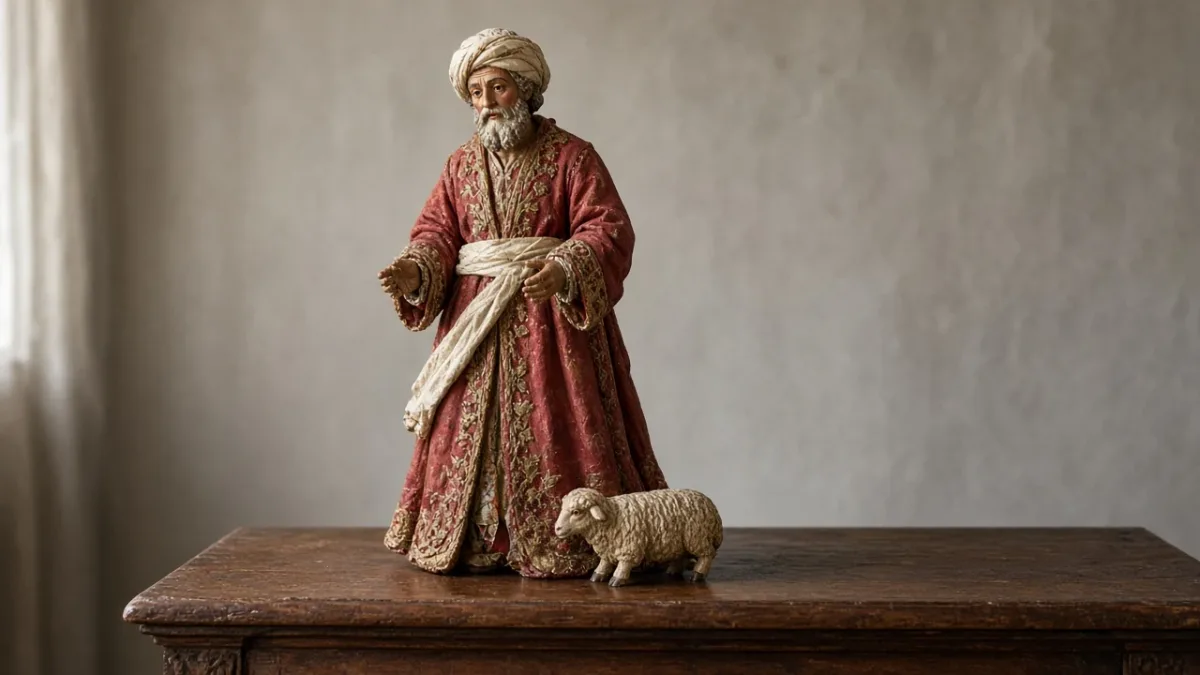
The figure on a dealer's table is rarely a complete Nativity. What survives from the eighteenth-century Neapolitan presepe is usually a single pastore: a terracotta head on a wire-and-tow body, carved wooden hands, glass eyes, and a silk jacket that may or may not be original. The Holy Family, when present, wears classical drapery and a halo. Everyone else wears the Kingdom of Naples.
This is an identification note for those fragments. The useful comparison is a documented figure in a public collection, not a shop window on Via San Gregorio Armeno. For another southern tradition of costumed, articulated figures, see the Sicilian puppets of the Opera dei Pupi. For terracotta as a collector's material more broadly, use the guide to antique Italian ceramics.
What an eighteenth-century figure is made of
A court-quality pastore is a mixed-media object, not a solid statuette. The Certosa e Museo di San Martino in Naples, the principal Italian public collection of this material, and the Catalogo generale dei beni culturali record the same construction on attributed workshop pieces: a wire armature wrapped in tow (stoppa), carved and painted wooden limbs, a polychrome terracotta head (often with the upper chest), silk costume, and glass for the eyes.
The Royal Palace of Caserta, which holds the only crib of documented royal commission, states the logic of that hybrid. Heads and extremities in terracotta could be reproduced from moulds. The mannequin of tow around wire could be bent, so the same figure could take a new pose each year. Glass was chosen for the eyes. Animals were carved in wood or modelled in terracotta. Foodstuffs were modelled in wax by specialist sculptors. Accessories used the material of the real object: leather for saddles, hats, and shoes; terracotta for jugs; ivory and mother-of-pearl with wood for musical instruments.
Principal figures in museum collections stand about 30 to 40 centimetres high. The Metropolitan Museum of Art records 12 to 15 inches (about 30 to 38 cm) for the Loretta Hines Howard group, a range chosen so that figures could recede in a perspective stage. The Bayerisches Nationalmuseum in Munich, whose Neapolitan holdings came largely with the Max Schmederer gift of 1901, catalogues the same 30–40 cm band. Smaller figures exist for distant planes. A tourist figure of 10 or 12 centimetres, in plaster or fully fired clay, is a different class of object.
Lift the costume at the wrist or neck if the owner allows it. An eighteenth-century armature shows twisted iron and compressed hemp, with wood tenons at the hands and feet. A later souvenir is often a one-piece terracotta or composition body with paint over the joints. Glass eyes that sit in the terracotta, catching light as a painted pupil does not, remain one of the more reliable first tests.
The three scenes of a complete presepe
Museum labels in Naples, New York, and Chicago agree on the iconographic programme. A complete Neapolitan crib is not a stable with ox and ass. It is a city.
The Nativity occupies the centre: Mary, Joseph, the Child, angels, shepherds, and often a ruined classical temple. That ruin is not biblical Palestine. It is the visual language of Bourbon Naples after the rediscovery of Herculaneum, and it stands for the collapse of pagan architecture before the new faith. The Annunciation to the shepherds, sometimes set in a grotto, occupies one flank. The tavern, or inn, occupies the other. The Metropolitan Museum, following St Luke, names that inn the diversorium: the place where there was no room.
The procession of the Magi is the third great block, often treated as a separate spectacle of Orientals, camels, and attendants. The Museo di San Martino's Presepe Ricciardi is cited by the Direzione regionale Musei Campania specifically for its cortege of Orientals. Genre figures fill the streets between these poles: smiths, tailors, saddlers, innkeepers, sellers of fruit, ricotta, fish, and mozzarella. Caserta's wall text lists Georgian merchants, spice sellers, camel drivers, and zampognari (bagpipers) among the court types. The sacred figures are the minority. The city is the subject.
Michele Cuciniello (1823–1889), architect and collector, gave the State about eight hundred pastori, animals, and accessories. He insisted on installing them himself. The Presepe Cuciniello opened in 1879 in the former kitchens of the Certosa di San Martino. It follows the tripartite scheme: Nativity at the centre, Annunciation to the shepherds and tavern at the sides, in an artificial grotto with lighting that runs from dawn through full day to sunset and night. That ensemble is a nineteenth-century reconstruction of eighteenth-century figures, not a frozen Bourbon palace crib. It remains the reference display against which dealers' attributions are tested.
Court workshops, not factory marks
Figures are almost never signed. Auction catalogues use "manner of" and "attributed to" because the evidence is stylistic, not punched. The same caution that applies to antique Italian bronze, where facture and type replace hallmarks, applies here.
Giuseppe Sanmartino (1720–1793), sculptor of the marble Cristo velato in the Cappella Sansevero (executed 1753 after a model by Antonio Corradini), modelled crib heads as well as church sculpture. The Catalogo dei beni culturali attributes pastori at San Martino to him; the Metropolitan Museum, more cautiously, credits some angel heads in the Howard gift to Sanmartino and to pupils Salvatore di Franco, Giuseppe Gori, and Angelo Viva on the basis of comparison with Naples and Munich. Giuseppe Gori (1732–1796) is independently documented in the national catalogue: a male figure dated 1790–1810 at San Martino is listed with materials matching the type (wire, tow, carved painted wood, silk embroidery, painted terracotta, glass).
Lorenzo Mosca (c. 1721–1789) is a different case. Italian catalogue notes describe him as the son of a crib installer, an official in the Bourbon marine secretariat who, after leaving that post in 1775, devoted himself to large installations and to modelling. He is documented at Caserta. English museum labels have sometimes placed him at the royal porcelain factory at Capodimonte as stage director of the royal crib. The Soprintendenza's published notes state that an official role as sculptor or modeller in the porcelain factory of Ferdinand IV is not, as yet, documented. Treat that Capodimonte employment as a tradition, not a fact. Porcelain heads do occur in related court work: the Belén del Príncipe in Madrid, assembled from Neapolitan figures after Charles of Bourbon became Charles III of Spain in 1759, used porcelain for some heads and arms, with Matteo Bottiglieri (1684–1757) cited for porcelain heads and Giuseppe Gori for much of the animal sculpture. That Spanish ensemble is a cousin of the Neapolitan crib, not a template for every figure on the market.
Mosca, according to period testimony assembled by later specialists, also used plaster moulds (calchi) because commissions outran hand modelling. A moulded head that has been tooled and painted can still be eighteenth-century. A moulded head with soft features, no glass, and factory-bright flesh tones is usually later.
Costume as a dating document
Charles of Bourbon (king of Naples 1734–1759) and Maria Amalia of Saxony treated the court crib as an applied-art commission. The Reggia di Caserta records that the queen chose the shepherds' garments and sewed them through the year. The display was mounted under painters, architects, and scenographers and shown from 12 December to 2 February, Candlemas, the day tradition assigns to the Magi's departure. Silks include ermisino and the embroidered silks of San Leucio, with gold and silver thread. Velvet was used for caparisons. Provincial dress from the Kingdom of the Two Sicilies was a point of pride: Procida, Torre del Greco, Terra di Lavoro, Molise, Abruzzo, Calabria.
Jewellery on those costumes is part of the object. Caserta names incannature in coral, turquoise, and hardstones, and pearl fioccagli. Coral beads and drops on a shepherd or Magus attendant are consistent with Torre del Greco coral work, not with later costume jewellery glued to a tourist figure.
Christie's and other rooms routinely note that costumes are "original" or "largely replaced." Silk splits, insect damage, and nineteenth-century restaging all produced new clothes on old bodies. A replaced costume does not make the terracotta fake. It does mean the textile cannot date the figure by itself. Conversely, a dazzling "period" silk on a plaster head is a warning, not a virtue.
The Holy Family is the exception that proves the rule. In the Art Institute of Chicago's Neapolitan crèche, Mary, Joseph, and the Child are the only figures in haloes and classical drapery. Genre figures wear contemporary Neapolitan dress. If a dealer offers an entire crowd in biblical robes, the group has been assembled for a modern taste, or it is not Neapolitan.
Later production and what collectors miss
Via San Gregorio Armeno remains the street of the presepisti. Continuity of place is not continuity of date. Nineteenth-century figures still follow the mixed-media system; Cuciniello's own shepherds run from the second half of the eighteenth century into the first half of the nineteenth. After the 1799 revolution, court ensembles were broken, stolen, or sold. Many of the figures now in Munich, New York, and Chicago left Naples in that long dispersal. Production for churches and palaces continued, including the last great Caserta installation of 1844 under cavalier Cobianchi, recorded in tempera by Salvatore Fergola.
Twentieth- and twenty-first-century shop figures are another matter. They are often smaller, fully ceramic or plaster, painted in acrylic, and sold as complete sets. Celebrity caricatures, footballers, and politicians belong to that living craft. They are not antique. A "Sanmartino" label on a figure without a comparable head in San Martino or the Bayerisches Nationalmuseum is a selling phrase.
Johann Wolfgang von Goethe, in the Italian Journey for 1787, described Neapolitans placing large cribs on flat roofs so that the Gulf and Vesuvius became the backdrop. The Bayerisches Nationalmuseum's Vesuvius crib reconstructs that idea in a case more than ten metres deep. Roof-scale scenery does not survive in the trade. Cork scogli, ruined temples in wood and cork, and miniature still-lifes of vegetables and vessels do. The 1971 Perrone bequest to San Martino (956 objects) includes scarabattoli, the glass cabinets in which families mounted the Nativity, the inn, and the Annunciation as closed pictures. A figure that still sits in an old scarabattolo with its companions is a rarer survival than a single head.
Heads circulate on their own. Terracotta faces without bodies appear in specialist shops because costumes failed or ensembles were stripped. A head can be eighteenth-century and still be a fragment. Price it as a fragment.
Condition notes
Check the terracotta at the hairline and the back of the neck for breaks and overpaint. Glass eyes may be replacements; empty sockets filled with paint are a loss. Wooden hands lose fingers. Tow bodies sag and were often restuffed. Wire rusts through at the waist. Insect damage in silk is expected; a costume with no wear at the folds is suspect if the head is claimed as 1760.
Wax food and small terracotta still-lifes crush in transit. Animals, especially sheep with applied wool, shed. Do not wash silk. Do not soak terracotta. A figure whose pose cannot be altered because the armature has been set in plaster is no longer functioning as a mannequin; that can be an old repair or a later conversion.
Export from Italy of works over the legal age and value thresholds requires the usual attestato process. A crate of "shepherds" leaving Naples without paperwork is a problem of law, not only of connoisseurship.
Where the comparisons live
Certosa e Museo di San Martino, Largo San Martino 5, Naples: Presepe Cuciniello (1879 installation), Ricciardi Orientals, Perrone scarabattoli, and earlier outliers, including a fourteenth-century wooden Virgin in childbirth and surviving fifteenth-century figures from the crib of San Giovanni a Carbonara by Pietro and Giovanni Alamanno. The museum opened to the public in 1867 after Giuseppe Fiorelli converted the suppressed charterhouse.
Reggia di Caserta, Sala ellittica: the royal crib, unique as a court commission, with Fergola's records of the 1844 arrangement.
Metropolitan Museum of Art, New York: Howard gift of 1964, more than 140 figures of the second half of the eighteenth century, shown as the Museum's Christmas tree and crèche.
Bayerisches Nationalmuseum, Munich: Schmederer gift, 1901, including the Naples street-market crib and the Vesuvius crib.
Art Institute of Chicago: a staged crèche of more than two hundred painted terracotta figures in an eighteenth-century Neapolitan setting.
None of these displays is a time capsule of a single palace night. All of them are assembled. They are still the standard.
FAQ
What does pastore mean in this market?
In Neapolitan usage a pastore is any crib figure, not only a shepherd. Dealers use the word for Magi, innkeepers, and angels as well.
Are Neapolitan nativity scenes signed?
Almost never. Names such as Sanmartino, Gori, Mosca, and Bottiglieri are attributions from pose, facial type, and comparison with museum figures. "Manner of Sanmartino" in an auction catalogue is a style note.
How can I tell an eighteenth-century figure from a San Gregorio Armeno souvenir?
Look for the mixed construction (wire, tow, wood, terracotta, glass), the 30–40 cm height of principal figures, glass eyes, and costume that can be removed. Souvenirs are commonly smaller, one-piece, brightly painted, and sold in sets.
Did the Holy Family dress like the crowd?
No. In documented ensembles the Holy Family wears classical drapery and haloes. Shepherds, traders, and Magi wear contemporary or exotic dress of the Bourbon kingdom.
Is a replaced costume a deal-breaker?
No. Textiles fail first. The terracotta head, wooden hands, and armature carry the date. Record the costume as original, partly original, or replaced, and price accordingly.
A single pastore is a sculpture, a textile, and a puppet armature. Identify each part. Then decide whether they still belong to one date.