
Dating Italian Grand Tour Antiques by Material and Workshop
Serious collectors date Italian Grand Tour antiques by workshop marks, materials and itinerary, from Roman Zoffoli bronzes to later Chiurazzi copies.
A Grand Tour antique is not a Roman marble dug from a vineyard. It is an object made in Italy, usually in Rome or Naples, for a northern European visitor who wanted a portable record of the antique. The useful dates run from the 1760s, when bronze reductions and cork models enter British inventories, to the 1830s, when the educational tour had already thinned and a cheaper tourist trade had begun. After 1870 a third layer appears: industrial lost-wax copies sold from printed catalogues. Those later bronzes are often labelled Grand Tour in the trade. They are not.
The itinerary explains the materials. A traveller spent months in Rome, then days or weeks in Naples after the Bourbon excavations at Herculaneum (from 1738) and Pompeii (from 1748). Florence and Venice supplied other goods. The objects that survive in northern houses follow that route: signed Roman bronzes after the Capitoline and Vatican statues; Neapolitan cork models of Paestum and the Vesuvian sites; plaster impronte of gems sold on the Piazza di Spagna; biscuit reductions from Giovanni Volpato’s factory near Santa Pudenziana. Roman micromosaics, copperplate vedute, Carrara marble copies, and Torre del Greco shell cameos belong to the same market. They are dated by workshop, not by a souvenir adjective.
What the market actually sold
Papal Rome already required a licence to extract antiquities. In 1802 Pius VII tightened the sale and export of ancient marble. The effect on the souvenir trade was indirect. Travellers who could no longer ship a restored torso still bought a reduction. Bartolomeo Cavaceppi (1716–1799), the principal restorer in Winckelmann’s circle, published his Raccolta di antiche Statue in 1768–1769. The plates document restored marbles and, on the frontispiece of the second volume, a small antiquarian Venus of the type he sold to visitors. In 1756 Cavaceppi was already in contact with Carlo Ginori for plaster moulds taken from Roman statues. Those moulds fed Doccia porcelain. They also show how one restorer’s studio supplied several media at once.
Dealers such as Thomas Jenkins and James Byres sat between the studio and the visitor. Francesco Righetti printed lists of bronzes. Volpato printed a French Catalogue des Statues Antiques. Antonio Chichi’s cork models were priced in Roman scudi. A Grand Tour object of the first rank is often the one that can still be matched to such a list.
Bronze reductions: Zoffoli, Righetti, Boschi
The standard Grand Tour bronze is a reduction of a famous marble, twelve to twenty inches high, on an integrally cast plinth, with a dark brown or green-brown patina and sharp cold work on hair, drapery, and attributes. The subjects repeat: the Apollo Belvedere, the Medici Venus, the Farnese Hercules, the Capitoline and Farnese Floras, Marcus Aurelius on horseback, the Furietti Centaurs.
The Furietti pair is a dating control. Giuseppe Alessandro Furietti found the two centaurs in the vaulted hall at Hadrian’s Villa in December 1736. After his death they were bought by Clement XIII for the Capitoline. A bronze that copies those figures cannot predate the find. It can, and often does, postdate it by decades.
Giacomo Zoffoli (1731–1785) and Giovanni Zoffoli (1745–1805) signed `G.ZOFFOLI.F.` on the plinth. The V&A Medici Venus (A.13-1974) carries that punch; height 34.78 cm. The museum notes that Vincenzo Pacetti (1746–1820) and other sculptors often supplied the models, so the signature is a foundry mark, not proof that either Zoffoli chased the surface. Hugh Honour published a Giovanni Zoffoli sales list of about 1795. British groups give the dates of purchase. A garniture of five bronzes at Woburn Abbey was in England by 1763. Ten reductions at Syon House were there before 1769. Sir Lawrence Dundas’s set appears in Johann Zoffany’s 1769 conversation piece. Lord Boringdon bought seven Zoffoli bronzes in Rome in 1793; they remain at Saltram. A bronze with the Zoffoli punch and a British country-house provenance of the 1760s–1790s is a period object. An unsigned reduction of the same subject is not the same thing.
Francesco Righetti (1749–1819) and his son Luigi (Aloys) dated some casts. A Laocoön group is inscribed `FR. RIGHETTI. ET. FIL. FEC. ROM 1811`. Another reads `FRANC. RIGHETTI. ET. ALOYS. FIL. ROMA. FUNDE. CAM. FEC.` The year on the plinth is a workshop date, not the date of the antique original. Righetti’s printed list, reproduced by Francis Haskell and Nicholas Penny in Taste and the Antique (1981), is the control for subjects and sizes. The same Roman bronze culture, including Righetti’s circle, is treated in the guide to Italian gilt bronze workshops and their marks.
Giuseppe Boschi (documented from a 1783 prize at the Accademia di San Luca; still listed among the Virtuosi del Pantheon in 1821) worked from Via Gregoriana. Charles Heathcote Tatham recorded his prices as lower than Righetti’s without dismissing the chasing. A bust signed `Boschi F` is the published form of the name. On 19 March 1817 Boschi contracted, through Thorvaldsen, to cast for Felix Slade a Ganymede after Thorvaldsen, a Vatican Venus, a Bacchus, seated Clio and Thalia, a Napoleon bust, and the Borghese putti, priced in Roman scudi and due by October. A Boschi bronze of a Canova or Thorvaldsen model is still a Roman Grand Tour object. It is not an antiquity.
Unsigned “Grand Tour bronzes” with sandy castings, blunt faces, and applied green chemical patina are usually later. The next section is the usual source.
Chiurazzi and the catalogue bronze
Gennaro Chiurazzi (1840–1906) opened his foundry in Naples in 1870, first opposite the Museo Nazionale, then in rooms at the Real Albergo dei Poveri. The Parco archeologico di Pompei, which in 2022 acquired about 1,650 surviving moulds and plaster copies, states the facts that matter for dating. Chiurazzi obtained the right to mould sculptures in the Museo Archeologico Nazionale di Napoli, the Vatican and Capitoline collections, the Galleria Borghese, the Uffizi, Palazzo Pitti, and the Florentine archaeological museum. Salvatore Chiurazzi’s Catalogo delle Riproduzioni di opere classiche in bronzo e in marmo of 1929 listed subjects, sizes, and finishes. The buyer chose a patina: pompeiana (green), ercolanese (dark, slightly dearer), or rinascimentale (dark, glossy, dearest).
A Chiurazzi bronze can be excellent. Lost-wax casts from museum moulds are more faithful than many eighteenth-century reductions, which idealised the antique. They are not Grand Tour souvenirs. The Grand Tour as an aristocratic educational circuit had ended a generation before 1870. A Chiurazzi stamp, a 1929 catalogue number, or a three-patina finish on a Pompeian Dancing Faun dates the object to the late kingdom or the twentieth century. The Getty Villa’s 1970s series after the Villa dei Papiri bronzes is the late end of the same mould stock.
Do not date a bronze by subject alone. The Farnese Hercules was famous from the sixteenth century, restored by Guglielmo della Porta, and moved to Naples in 1787 after work by Carlo Albacini. A Zoffoli reduction copies the Roman display. A Chiurazzi reduction copies the Naples museum piece, often in more than one size. The mark and the catalogue, not the club and the apples, give the date.
Cork models: Rosa, Altieri, Chichi, Padiglione
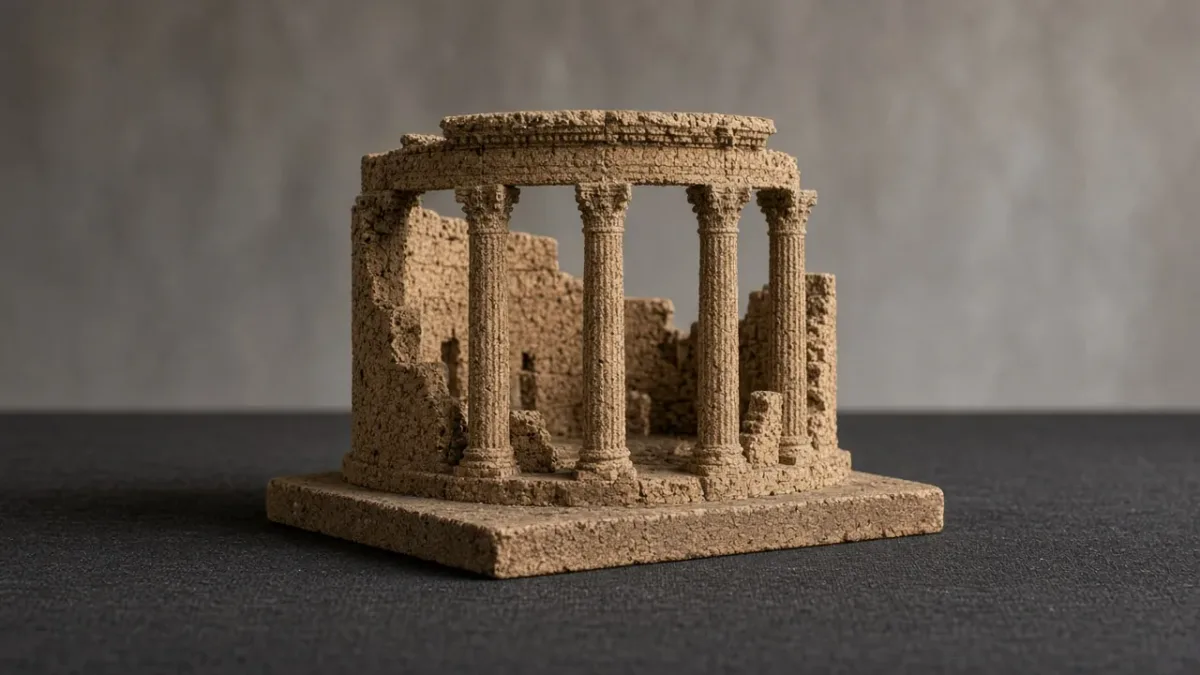
Cork (sughero) takes a weathered stone surface that plaster does not. Valentin Kockel’s Phelloplastica records Augusto Rosa (1738–1784), a Roman of Neapolitan family, calling himself the inventor of cork architectural models in the early 1770s. The earliest surviving dated model is not his. Giovanni Altieri, documented from 1767 to about 1790, made one in 1767, the year he is first attested in Rome. Antonio Chichi (1743–1816) issued a Nota de Modelli delle Antichità Romane priced in Roman scudi; Carl Christian Heinrich Rost reprinted the list at Leipzig in 1786. Domenico Padiglione and his sons, working in Naples from measured drawings of the Bourbon excavations, supplied models of Pompeii and the temples at Paestum.
The technique is consistent. Curved cork bark was pressed flat, cut, and carved. Columns, broken entablatures, and rubble are built up so that the pores read as travertine or as the limestone of Paestum. A timber base is usual. Scale is architectural, not toy-like. Cooper Hewitt dates the fashion from the mid-eighteenth century and its peak to about 1800–1830. Sir John Soane used such models as teaching substitutes for the tour. His large cork plan of Pompeii, showing the southern excavations as they stood around 1820 and attributed to Padiglione, was bought at the John Sanders sale at Christie’s in 1826. The excavation state is a date. A model that includes streets opened only in the 1860s is not an eighteenth-century Rosa.
Prices confirm the original market. Thomas Mansel Talbot paid £100 for a single Rosa Colosseum and £33 for a large set of Piranesi etchings in the early 1770s. Cork models of the first generation were furniture for a library, not luggage. Later nineteenth-century cork temples, smaller and cruder, with machine-cut columns and a tourist label, belong to a different trade. Insect attack, collapsed vaults, and replaced bases are ordinary. Record the timber, any inked scale, and whether the ruin matches a published state of the monument.
Plaster impronte and the book box
White plaster impressions of engraved gems, sold singly, in stacked wooden trays, or in boxes bound as books, are the most portable Grand Tour class. Bartolomeo Paoletti (1757–1834) and his son Pietro kept a studio at Piazza di Spagna 49. Sets carry the printed or inscribed line Si fanno in Roma da Bartolomeo Paoletti, e Pietro figlio, dimoranti di Studio in Piazza di Spagna num˚ 49. The Beazley Archive’s Paoletti impressions were made from about 1790; sales peaked in 1820–1840. By the 1840s the shop advertised more than 7,000 moulds. Count Hawks Le Grice’s 1841 Walks through the Studii of the Sculptors at Rome prints Paoletti’s own claim that the impronte in scajola convey a sculpted work better than an engraving. Catherine II of Russia and Ferdinand III of Tuscany were clients. The firm is documented at the Piazza di Spagna address until 1847 and in some form to at least 1865.
Giovanni Liberotti sold competing book-boxes of plaster cameos after gems and after sculpture in Roman, Florentine, and Neapolitan collections, with handwritten Italian lists on the inner boards. Francesco Carnesecchi is another recorded name. The casts are not ancient gems. They are teaching sets. Date them by the address, the handwriting of the index, the names of living sculptors (Canova, Thorvaldsen) in the selection, and the binding. A set that includes a mid-nineteenth-century monument is not an eighteenth-century dactyliotheca.
Condition is structural. The plaster chips. The paper labels lift. The “book” is a hinged wooden box. Do not soak or overpaint the casts. Completeness of the numbered series matters more than a single pretty Medusa.
Volpato biscuit and other white reductions
In 1785, with the approval of Pius VI, Giovanni Volpato (1735–1803) opened a hard-paste biscuit factory in via Pudenziana, near Santa Maria Maggiore. His heirs continued it until 1818. The unglazed white body was meant to read as marble. The Catalogue des Statues Antiques, Groupes et dessert de Porcellaine en biscuit, de la Fabrique Jean Volpato à Rome, sent to England by Tatham in 1795, lists statues above and below a French foot, groups, antique vases, and half-life philosopher busts. The Metropolitan Museum’s River Nile (2001.456), about 1785–95, is a reduction of the Vatican marble and the most complex group in the surviving price list. Volpato had already sold restored marble to Gustav III of Sweden in 1783–1784. The biscuit figures occupy the same mantel as a Zoffoli bronze: a library dessert, not a relic.
Biscuit chips at fingers and attributes. Later white Parian and German reductions of the same antiques are not Volpato. Compare the paste, the base profile, and, where it survives, a factory mark or a subject that appears only on the Tatham list.
Marble copies after the antique, including the Albacini restorations and the later Condotti trade associated with Benedetto Boschetti, are a separate, heavier class, treated in the existing Rome and Carrara marble guide. Soft Volterra alabaster reductions of the same statues are later still and should not be catalogued as eighteenth-century Grand Tour marble.
A working method
1. Name the prototype and the city in which the visitor saw it. A Farnese Hercules reduction bought in Rome before 1787 and one bought in Naples after the marble’s transfer are different objects.
2. Read the foundry inscription before the patina. `G.ZOFFOLI.F.`, a Righetti line with a year, or `Boschi F` is a date range. A Chiurazzi stamp or a 1929 catalogue number is another.
3. For cork, compare the ruin to a dated excavation or to Chichi’s and Padiglione’s published subjects. Weight, timber base, and pore structure separate eighteenth-century work from later tourist cork.
4. For plaster books, transcribe the inner list and the Piazza di Spagna (or Liberotti) address. Count the casts against the index.
5. Keep micromosaics, vedute, cameos, and pietra dura on their own dating systems. They share a buyer, not a workshop.
Export law is a separate question. Historic cork models, bronzes, and plaster sets can still fall under Italian beni culturali rules when they leave the country. Quality of chasing does not decide a licence.
The argument is the same as for civic silver. A punch, a printed list, an address, or an excavation state will date an Italian Grand Tour antique more tightly than the phrase “after the antique” in a dealer’s title.
FAQ
What counts as an Italian Grand Tour antique?
An object made in Italy for a visitor on the educational tour, chiefly 1760–1830: signed Roman bronze reductions, cork architectural models, plaster gem impressions, Volpato biscuit, and the related mosaic, print, marble, and cameo trades. A Chiurazzi catalogue bronze of 1870 or later is a museum reproduction, not a Grand Tour souvenir.
How do you tell a Zoffoli bronze from a later copy?
By the plinth inscription `G.ZOFFOLI.F.`, the quality of cold work, and, when it exists, an eighteenth-century provenance (Woburn, Syon, Saltram, Dundas). Unsigned reductions of the same marbles are common in the nineteenth and twentieth centuries.
Are Chiurazzi bronzes Grand Tour objects?
No. Gennaro Chiurazzi founded the Naples foundry in 1870. The 1929 catalogue and the pompeiana, ercolanese, and rinascimentale patinas belong to that firm. Collectors buy them as documented museum reproductions.
How are cork models dated?
By maker when known (Rosa, Altieri, Chichi in Rome; Padiglione in Naples), by the excavation state of the monument, and by construction. First-generation models are large, expensive, and archaeologically specific. Small crude temples with tourist labels are later.
What is a Paoletti book of impronte?
A hinged wooden box bound as a book, filled with white plaster casts of gems and sculpture, sold at Piazza di Spagna 49 by Bartolomeo and Pietro Paoletti. The inner inscription and the numbered list date the set. The casts are not ancient gems.