
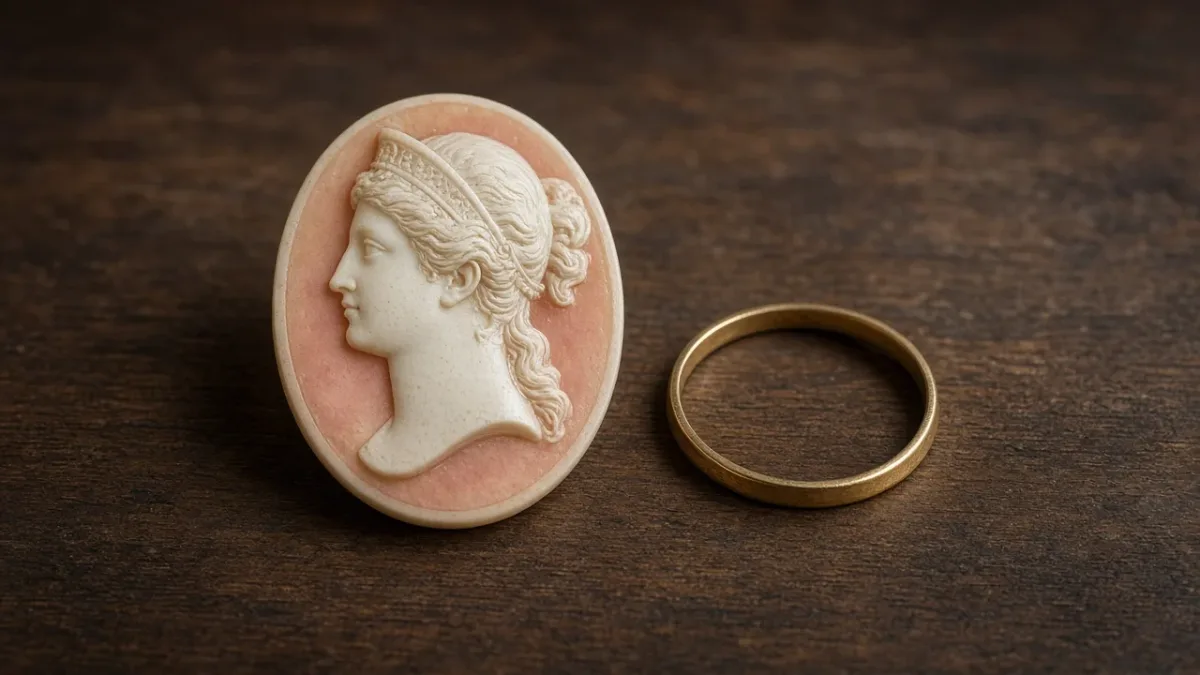
The Shell Cameos of Torre del Greco
Torre del Greco cameos are layered helmet-shell carvings. Date them by Cassis colour, burin work, gold or 800 silver mounts, and later tourist copies.
A Torresi cameo is a relief cut through the layered cup of a tropical helmet shell. The pale outer skin becomes the figure. The darker inner layer becomes the ground. That is the local glyptic, not the sardonyx and agate work of Roman hardstone shops. Collectors who treat the two as one market misread both weight and workshop.
Torre del Greco sits on the Bay of Naples, between the city and Pompeii, under Vesuvius. Its fishermen had long taken Mediterranean coral to Livorno and Genoa for finishing. Cameo cutting on shell is a nineteenth-century overlay on that maritime trade.
The Real Fabbrica and Roman engravers, 1805–1815
On 8 April 1805 Ferdinando IV of Bourbon granted the Marseilles coral merchant Paul Barthèlemy Martin (Paolo Bartolomeo Martin in Neapolitan records) a ten-year privilege to manufacture worked coral at Torre del Greco. A royal dispatch of 27 March had already authorised the factory. Martin, formerly director of the Reale Compagnia d’Africa, received duty exemption on exports and on sales inside the Kingdom. In return he was required to train local apprentices so the craft would survive the monopoly.
The plant opened in Palazzo Brancaccio. By 1807 it employed about a hundred workers at Torre del Greco. A second shop later operated at the Real Albergo dei Poveri in Naples. Joseph Bonaparte and then Joachim Murat confirmed the exclusive. The factory took the name Real Fabbrica di Coralli della Torre del Greco. It won a silver medal at the 1810 Esposizione dei Saggi delle Manifatture Nazionali and gold in 1811.
Martin’s output was not only beads. Cristina Del Mare, drawing on Giovanni Tescione and on files in the Archivio di Stato di Napoli, shows that he brought gem-engravers from Rome to cut cameos in coral for Empire jewellery. Vincenzo Jori, writing in 1894, names Michele Mancerotti, Filippo Veneziani and Giuseppe Carbone among those masters. Filippo Gagliardi followed. Several left Martin after a lawsuit on whether the liberal arts could be monopolised, and opened their own benches. Coral cameos from this circle appear on a gueridon and on a Biennais gala sword at Fontainebleau, both tied to the Murat court around 1808–1811.
Shell followed coral. Helmets of Cypraecassis rufa and Cassis madagascariensis have two workable colour layers a few millimetres thick. They could be cut faster than agate and sold to Grand Tour traffic that already bought micromosaics in Rome and souvenirs at Naples. Torresi manufacturers later recounted a surge of tropical shells in the 1870s, when African cargoes used conch as ballast and when the Sciacca coral banks briefly disrupted the red-gold trade. The 1805 factory remains the documented start of organised glyptic in the town.
Helmet shells used in the workshops
Trade names at Torre del Greco follow stone: corniola and sardonica. They describe shell, not carnelian or sardonyx.
Cypraecassis rufa (bullmouth helmet; trade Cassis rufa, conchiglia corniola). Indo-Pacific and East African fisheries. Smaller cup. Beige to flesh-coloured relief over a red to orange ground. This was the first helmet the cameists preferred for the standard female profile. The thick lip is also cut into beads and small ovals.
Cassis madagascariensis (queen helmet; trade conchiglia sardonica). Despite the Linnaean epithet, the shells used in Campania come from the western Atlantic and Caribbean. Larger cup. White relief over chestnut brown. Stronger contrast, introduced after rufa, and now the usual choice for large brooches. From the bigger specimens the cutter can take a second inner cup and a basal coronella.
Cassis cornuta (horned helmet). The largest of the three named by manufacturers. White outer layer, orange inner. Used when a big plaque is required.
The Museo Malacologico Piceno at Cupra Marittima, which keeps a section on Torresi cameos and published T. Cossignani’s 1993 monograph Cammei: gioielli dalle conchiglie, also lists Cypraea tigris, Strombus gigas and Pinctada margaritifera (mother-of-pearl). The first two helmets remain the ones that take a fine, two-colour relief. Mother-of-pearl is monochrome and iridescent. It can be worked with rotary tools in series. It does not give the stratified chiaroscuro that defines a classical Torresi cameo. Layered hardstone of the Florentine pietra dura workshops is a different technique again: inlaid stone, not a cut cup.
Cutting the cup
The usable part is the coppa, the rounded body of the shell. Workshop stages recorded at Cupra Marittima run: scoppatura (removing the cup), marking, shaping, aggarbatura (fairing the oval or round), mounting in pitch, drawing, roughing, engraving, finishing, polishing, degreasing.
Giovanni Apa’s shop, described for JCK in 2007, still used the same sequence with a wooden holding stick in place of the older pitch block. The cutter sketches on the pale face, then opens the ground with a wide burin until the dark layer appears. Finer burins model hair, eyelid and drapery. A last pass polishes the relief. The piece is washed in lukewarm soapy water to lift grease from the hand tools.
Hand work leaves slight tool tracks in the ground, uneven depth in the hair, and a back that follows the natural curve of the cup unless it has been ground flat for a closed mount. Late-twentieth-century rotary and pantograph work repeats the same profile across a batch. The Museo Malacologico notes that Chinese factories have copied the look in plastic. Plastic is even in thickness, warm to the touch, and shows no growth lines under a loupe. Shell, back-lit, is translucent at the thin edges of the ground.
The school of 1878
Demand for trained cutters produced a state school. A royal decree of 23 June 1878 founded the Scuola per la lavorazione del Corallo, on the proposal of Francesco De Sanctis, in the Carmelite convent attached to the church of the Carmine. The building had been rebuilt after the 1631 eruption and survived those of 1737 and 1794.
In 1887 it became the Regia Scuola d’Incisione sul Corallo e di Arti Decorative e Industriali. Teaching expanded from coral to cameo shells, tortoiseshell, ivory, mother-of-pearl, lava stone and hardstones. Day, evening and feast-day classes were offered so working apprentices could attend. In 1919 the Ministry of the Colonies sent eight quintals of Eritrean mother-of-pearl. In 1924 the school passed from the Ministry of Agriculture, Industry and Commerce to Public Instruction. It became an Istituto Statale d’Arte in 1968 and, in 2009, part of the Istituto d’Istruzione Superiore Francesco Degni.
The Museo del Corallo opened in that convent on 3 April 1933, under director Enrico Taverna, with support from the Banco di Napoli and public administrations. Cases hold coral, mother-of-pearl, silver, tortoiseshell, slate, so-called lava, and numerous cameos, including student and master work. The Touring Club Italiano notes school participation in exhibitions from Paris to Saint Louis and Buenos Aires between 1881 and the Second World War. The museum is the first place to compare a Torresi shell cameo with the adjacent materials the same benches used.
Firms, marks and signed shells
Most jewellery cameos are unsigned. Attribution rests on shell type, quality of the burin, and the mount.
Giovanni Ascione (1834–1908), son of the coralline owner Domenico, registered a manufactory at Torre del Greco in 1855. From 1875 the firm was allowed the arms of Vittorio Emanuele II. The Museo Ascione in Naples, on the second floor of the Galleria Umberto I, shows documents, coral, shell cameos and, from the late nineteenth century, glittocromia on shell: coloured glyptic on the cup. Liberty-period work added mother-of-pearl, ivory and tortoiseshell to coral.
Michele Scognamiglio is recorded as cutting cameos from 1857. The family factory was damaged in the 1905 Vesuvius activity and destroyed in the 1906 eruption. Gaetano Scognamiglio (1910–1999) and his brothers refounded the business in 1928 as Fratelli Scognamiglio, later CA.S.CO. (Cameo Scognamiglio Coral).
Christie’s has catalogued mid-nineteenth-century whole conch shells carved in low relief and given to Torre del Greco, including a 22 cm example inscribed Venere e Amore. A related Naples shell signed G. Stella, Napoli, with amorini and a flower-head border, documents named engravers on display pieces rather than on small brooches. Such full shells are cabinet objects. They should not be confused with the oval blanks cut from the same species for jewellery.
In 1978 manufacturers formed Assocoral (Associazione Produttori Coralli Cammei e Materie Affini). JCK in 2007 reported some 350 firms and 2,600 workers, most of them shops of three people or fewer, with about three-quarters of production exported.
Lava and limestone: the Grand Tour sideline
Naples also sold monochrome “lava” cameos as souvenirs of Vesuvius and the excavations. The Degni school taught pietra lavica. Trade pieces are grey, taupe, brown or off-white, matte, sometimes porous, with archaeological or mythological heads. Charlotte Gere and Judy Rudoe, in Jewellery in the Age of Queen Victoria, warn that many so-called lava cameos are a soft southern Italian limestone marketed under the volcanic name. A Seneca stickpin in the British Museum’s Hull Grundy collection, given as lava, proved to be limestone. Treat the term as a trade label. The material is not layered. It has none of the white-on-red or white-on-brown contrast of Cassis.
Hardstone cameos, by contrast, are cold, heavy, and sharp at the layer boundary. Roman workshops such as the Saulini produced the best Victorian hardstone, and some shell work, in that city. They are a separate school from the Torresi helmet cutters, even when both sold to the same English buyers.
How to date a Torresi shell cameo
Read the object in this order: material, cutting, mount, subject.
Material. Back-lighting should show a warm translucency at the thin ground. Growth lines run in the shell. A pin will scratch shell; it will not readily scratch sardonyx. Plastic reproductions lack growth lines and often have a mould seam or a perfectly even reverse.
Cutting. Before about 1840, English-market shell cameos tend to be small or medium, with moderate relief. After 1840, larger high-relief brooches become common. After about 1860 the largest and most crowded mythological plaques appear. Hair that is individually cut, a ground that is not mechanically flat, and a slightly convex reverse from the cup all argue for hand work. Identical batches with rotary striations argue for later workshop production, still often Torresi, but not for a mid-century Grand Tour piece.
Mount. Closed gold collets, sometimes 15 ct or 9 ct with English import or sponsor marks, point to Victorian retail. Italian 800 silver frames, including Neapolitan punches, are consistent with local jewellery of the later nineteenth and twentieth centuries. Pinchbeck and unmarked base metal appear on tourist stock of every period. A later mount does not date the shell. An English mid-Victorian mount on a two-colour helmet shell is good evidence for a nineteenth-century cutting.
Subject. The stock types are the female profile with diadem or grapes, Medusa, the Three Graces, putti, and Pompeian mythologies. Landscape and genre scenes exist. Full-face portraits and photographic likenesses are usually later, including twentieth-century commissions on sardonica. Religious subjects (Sorrowful Madonna, saints) belong to the same benches but to a different market from the Grand Tour profile.
Condition
Shell is calcium carbonate. It chips at the high points of the nose and diadem. Hairline cracks follow the growth of the cup. Old polish can round the burin ridges. Do not soak a mounted cameo. Water swells organic residues in the setting and can lift foil or pitch. Avoid ultrasonic cleaners. A dry brush and a barely damp cloth on the face are enough. Store away from direct sun. Heat and household chemicals will frost the polish.
Replacement glass or plastic inserts in old frames are common. If the relief is identical on both sides, or if the back is a smooth moulded hollow, the insert is not shell.
FAQ
Are Torre del Greco cameos the same as Italian hardstone cameos?
No. Torresi jewellery cameos are almost always helmet shell. Hardstone (sardonyx, agate, onyx) is a Roman and Idar-Oberstein speciality. Weight, coldness and a crystalline layer edge separate stone from shell.
How can a collector tell corniola shell from sardonica?
Corniola (Cypraecassis rufa) shows a cream or flesh relief on a red-orange ground and a smaller oval. Sardonica (Cassis madagascariensis) shows a white relief on brown and is often larger. Both are shell. Neither is the gemstone whose name the trade borrowed.
Do authentic pieces carry a workshop mark?
Usually not on the shell. Look at the mount: Italian 800, Neapolitan punches, or English gold marks. Signed full shells (for example G. Stella, Napoli) are display carvings, not typical brooches.
What is a lava cameo in this market?
A monochrome relief sold as Vesuvian lava, often limestone or tuff, made for Grand Tour visitors to Naples. It is not a layered helmet-shell cameo and should be priced and conserved as a different object.
Is a plastic or machine-cut cameo from the same town still a Torresi cameo?
Machine-assisted cutting has been used in Torre del Greco in the late twentieth century. Plastic copies, including Chinese mouldings, are not. The distinction that matters to a collector is hand burin work on Cassis, documented by translucency, growth lines and irregular relief.