
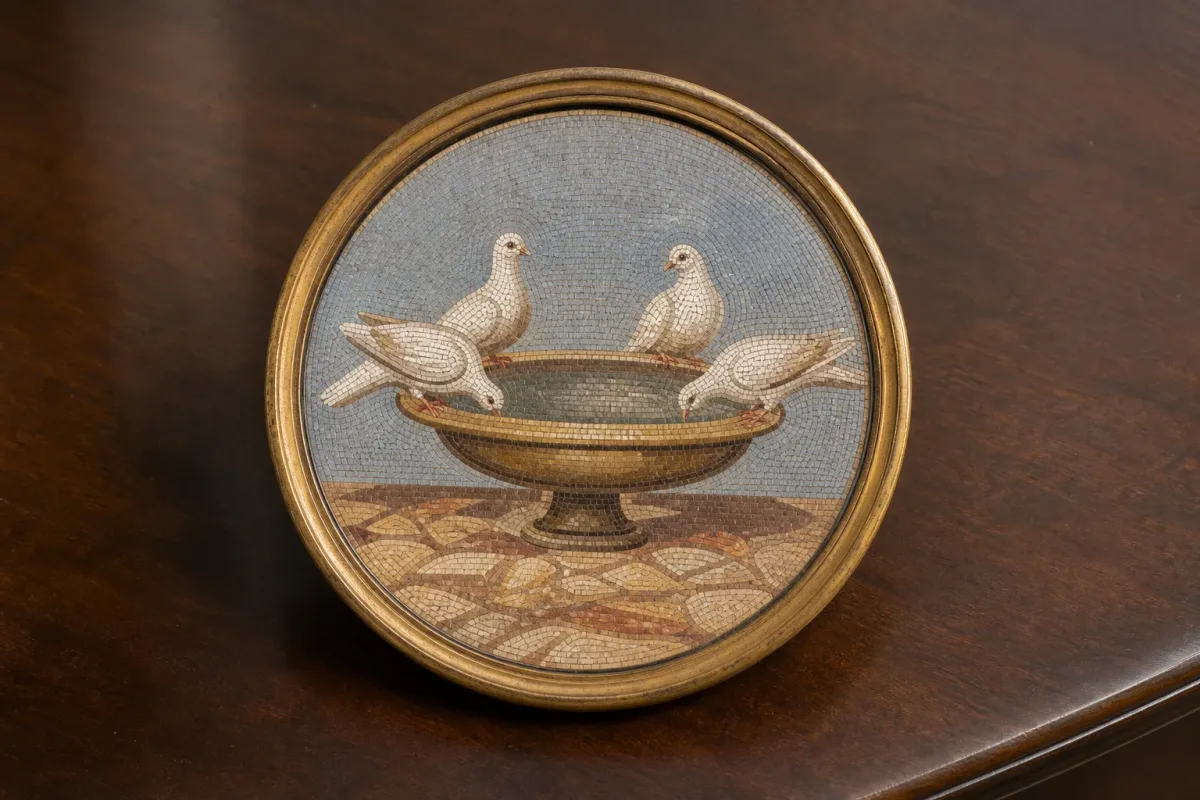
Roman Micromosaics: History, Identification & Collector's Guide
Identify antique Roman micromosaics: Vatican Studio history, tesserae technique, Grand Tour plaques, and how collectors judge quality and fakes.
English catalogues still say “Roman mosaic.” Roman workshops said mosaico minuto. Sir Arthur Gilbert, whose collection now anchors the Victoria and Albert Museum’s holdings, popularised the English word micromosaic. All three names describe the same craft: opaque glass paste spun into hair-thin rods, snipped into tesserae often smaller than a millimetre, and packed into a slow-drying mastic until the surface reads as a painting at arm’s length.
This is not Florentine pietra dura, which is cut hardstone. It is not a floor mosaic of marble cubes. It is a Roman glass technique that left the basilica and entered the tourist’s pocket — as a snuffbox lid, a circular plaque, a tabletop, or a jewel.
What a Roman micromosaic actually is
A micromosaic is assembled, not painted. The mosaicist melts coloured glass paste (smalti), draws it into rods (filati), lets the rods cool, and cuts them into minute tesserae. Those pieces are set with tweezers into a mastic bed on a copper, gold, or later stone support. Once the mastic has hardened, the joints are filled with coloured wax and the whole face is ground and polished flush.
Under a loupe the surface should still be a packed field of glass, not fused enamel or a printed picture under glaze. Early fine work uses tesserae so small that the image dissolves into colour at a foot or two; you only recover the grid when you lean in. Later tourist plaques keep the same subjects — the Colosseum, St Peter’s, four doves on a basin — but the tesserae coarsen, the sky becomes a few bands of blue, and the joints start to show at conversational distance. The plaques copy ancient subjects; the portable souvenir industry itself belongs to the last quarter of the eighteenth century and the nineteenth.
From St Peter’s to a souvenir shop
The craft’s institutional home is the Studio del Mosaico Vaticano. The Fabbrica di San Pietro’s own account begins when Pope Gregory XIII asked the painter Girolamo Muziano to decorate the dome of the Cappella Gregoriana in mosaic (1578–1580). Success there led to the mosaic cladding of Michelangelo’s great dome (1603–1612) and, from the late seventeenth century, to replacing humidity-damaged painted altarpieces with mosaic copies. Experiment with coloured smalti produced, the Studio still says, some 28,000 distinguishable shades. In 1727 Pope Benedict XIII organised the laboratory as a permanent institution under the Fabbrica, named Studio del Mosaico Vaticano.
The spun-rod method that makes micromosaic possible is older than the souvenir trade. Vatican research published by Paolo Di Buono, director of the Studio, and the historian Veronika Maria Seifert has pushed the origin of mosaico in filato back to early-seventeenth-century Rome, inside the Fabbrica itself. Marcello Provenzale and Giovanni Battista Calandra used microscopic tesserae cut from drawn enamel; a Holy Family by Calandra, found signed and dated 1622 when its frame was opened, is one of the documented early survivors. The dealer’s line that Giacomo Raffaelli “invented” spun enamel around 1775 is therefore too neat. What Raffaelli and Cesare Aguatti did, in the Vatican’s own phrasing, was rediscover and miniaturise a basilica technique so that it could decorate boxes, snuffboxes, and jewels.
That commercial turn needed an antique to copy. On 19 April 1737, excavators working for Monsignor (later Cardinal) Giuseppe Alessandro Furietti at Hadrian’s Villa in Tivoli lifted a floor mosaic of four doves drinking from a basin — the so-called Doves of Pliny, which Furietti identified with the Hellenistic mosaic by Sosos of Pergamon described in Pliny the Elder. Furietti published it as the first plate of De Musivis (Rome, 1752). After his death in 1764 the mosaic was sold to Pope Clement XIII and entered the Capitoline Museums, where it remains. Engravings of those doves, together with Piranesi’s views of Rome, gave private mosaicists a ready iconography for Grand Tour clients.
How smalti filati are made
The Vatican mosaicists still use a linseed-oil stucco whose recipe the Fabbrica says has been guarded since the cupola campaigns. Micromosaic inherits that slow bed: the miniature plaque has to stay workable for thousands of placements, then hold them through polishing.
A Politecnico di Milano study of Vatican chromatic practice divides the souvenir century into three technical phases. The first, in the last quarter of the eighteenth century, is dominated by Giacomo Raffaelli (1753–1836), whose recorded palette already ran to 872 shades from eighteen basic colours. The second is marked by Antonio Aguatti’s malmischiato: rods spun from mixed colours so that a single tessera carries a gradient. That trick, together with tesserae cut to curved outlines rather than four-sided cubes, made fur, foliage, and architecture easier to model. The third is Michelangelo Barberi’s colori a soffio (tinte di soffio), enamels drawn with a goldsmith’s blow-lamp rather than a furnace, which gave a brighter spectrum than furnace-spun rods.
Do not confuse the two Aguatti. Cesare Aguatti, active in the 1770s, is among the earliest named makers of portable mosaici minuti. Antonio Aguatti, of the next generation, is the name attached to malmischiato and to the animal and genre plaques collectors still hunt.
Supports change with date and scale. Small early plaques often sit on a metal tray; later jewellery-scale work is frequently let into black Belgian marble (noir belge). Tabletops may combine micromosaic roundels with marble inlay.
The Grand Tour market
Rome was the compulsory stop. A micromosaic was portable proof that you had been there. Peak demand runs from the 1770s through the 1870s, densest in the 1840s–1870s once middle-class tourists reached the Continent more easily.
Workshops clustered where the visitors lodged. Raffaelli’s family had supplied glass paste to the Vatican mosaicists for generations; the shop moved to Piazza San Sebastianello, at the corner of Piazza di Spagna, and later to Via del Babuino. A first public showing of micromosaics is recorded in 1775. Thomas Jenkins wrote to the 9th Earl of Exeter on 11 March 1775 enclosing a receipt from Cesare Aguatti and calling him “certainly the best workman that ever was in Mosaick.” Two signed 1774 views by Aguatti — the Colosseum and the Temple of Vesta — remain at Burghley House. A related 1774 panel in a gilt-bronze frame by Paolo Spagna, with the arms of Pope Pius VI, was catalogued by Sotheby’s from Vatican archives as an early papal diplomatic gift.
Subjects follow the tourist’s itinerary. The Doves of Pliny, the Colosseum, the Forum, St Peter’s Square, the Temple of Vesta at Tivoli, and pastoral vedute of the Campagna dominate early plaques. Spaniels, flowers, and peasant costumes follow once malmischiato made hair and petals worth attempting. After the 1830s, archaeological revival taste pulled in Pompeian motifs, Egyptianising ornament, and early Christian symbols. Plaques were mounted in Rome or exported unset to London and Paris goldsmiths.
Large work stayed on the papal and princely circuit. The Fabbrica records a table of the Shield of Achilles, given in 1826 by Pope Leo XII to Charles X of France and now at Versailles. (The Studio’s public page names Leo XIII, which cannot be right for a gift of 1826; Leo XII reigned 1823–1829.) A Napoleonic decree of 15 February 1811 placed the Vatican Studio under the French imperial crown until 1814 and set up a laboratory specifically for small mosaic.
Makers worth knowing
Giacomo Raffaelli (1753–1836). Family fornaciari, then mosaicist and entrepreneur. The Walters Art Museum holds a box with a view of Tivoli whose metal rim is engraved GIACOMO RAFFAELLI FECI IN ROMA 1804. In 1804 the Napoleonic government asked him to found a mosaic school in Milan, attached to Brera; he remained until about 1820. Napoleon commissioned a mosaic replica of Leonardo’s Last Supper, later installed in Vienna’s Minoritenkirche. Raffaelli’s 1779 Doves of Pliny in the British Museum is the canonical early souvenir treatment of Furietti’s find.
Cesare Aguatti (active 1770s). Pioneer of the portable plaque. Dated 1774 vedute are among the earliest surviving micromosaics that look like the later tourist industry rather than basilica furniture.
Antonio Aguatti (active early nineteenth century, d. c.1846). Malmischiato, animal fur, and genre. A mosaic parure of about 1805–1815 that belonged to Caroline Bonaparte is in the Museo Napoleonico, Rome. Spaniel plaques attached to his name remain a collecting cliché because the curved tesserae actually do read as hair.
Michelangelo Barberi (1787–1867). The great table man. Tsar Nicholas I ordered Il bel cielo d’Italia after his 1845 Italian journey; that table is in the Hermitage. A variant for the Earl of Kilmorey, with putti of the arts in the centre, won a Council Medal at the Great Exhibition of 1851 and is now in the Gilbert Collection at the V&A. Barberi also went to Russia in connection with an imperial mosaic studio.
Castellani and later goldsmiths. Fortunato Pio Castellani opened in Rome in 1814; his sons Alessandro and Augusto made archaeological-revival gold the international fashion. From the 1850s they had mosaicists, notably Luigi Podio (d. 1888), supply plaques for granulated gold mounts. Cesare Roccheggiani and Luigi Moglia are the other signed names that appear with some regularity. Clemente Ciuli was praised in Guattani’s Memorie Enciclopediche Romane for a monochrome Jupiter of Otricoli so fine it read as drawing; Canova included Ciuli mosaics among gifts for Napoleon’s 1804 coronation.
Most pieces, even good ones, are unsigned. A signature, when it exists, is often on the reverse of the plaque or engraved in the metal mount, not in the tesserae.
How to identify and date a piece
There is no national hallmark for micromosaic. Work through the object.
1. Material. Glass, not stone. If the “tesserae” are irregular slices of jasper, lapis, and agate fitted like a jigsaw, you are looking at Florentine pietra dura, a different Tuscan craft. If the picture is painted plaster pretending to be inlay, you are in scagliola territory. Micromosaic glass has a vitreous fracture and, in filati, a slightly elongated or cylindrical section. Directional laying — sky in horizontal rows, architecture following receding lines, fur in curves — is a good sign.
2. Scale of tesserae. Late-eighteenth- and early-nineteenth-century fine work is punishingly small. Mid-century Barberi tabletops can use slightly larger rods (the V&A notes roughly 1 × 2 mm filati on The Beautiful Sky of Italy) because the field is nearly a metre across; the drawing still holds. Cheap late souvenirs use tesserae you can count without a lens. Density at faces, lettering, and distant architecture is the quality test, not the fame of the subject.
3. Support and mount. Copper or gold trays, snuffbox lids, and jewellery collets are typical. Black Belgian marble grounds become common in jewellery-scale work after the mid-nineteenth century. A micromosaic tabletop on a carved gilt-wood or gilt-bronze base is often a Roman top and a later northern stand — the same Grand Tour habit you see with antique Italian furniture and with Maggiolini-style marquetry. Date the mosaic and the stand separately. English and French jewellers mounted Roman plaques in their own gold; the mosaic can be Roman and the hallmark London.
4. Iconography and period. Doves, Tivoli, and the Colosseum in a painterly, tightly packed style with mixed tessera shapes point to the Raffaelli–Aguatti generation. Spaniels, flowers, and night skies with malmischiato and soffio colour sit in the first half of the nineteenth century. Archaeological-revival gold with granulation around a mosaic of a lamb, a Christogram, or an Egyptianising head is Castellani-period, 1850s onward. Coarse oval Colosseums in thin gilt-metal frames are the late tourist trade.
5. Marks. Do not expect a punch. Look for engraved signatures on rims (Raffaelli’s 1804 formula is the model), inked or mosaic signatures on the reverse, retailer labels, and — on gold mounts — the usual Italian silver and gold hallmarks. Papal coats of arms on frames record a gift or a client, not automatic Vatican Studio manufacture.
6. Condition and care. The glass is stable; the mastic and the wax are not. Losses appear as tiny lacunae of dark bedding. Heat and moisture loosen tesserae. Yellowed wax makes a sky look brown and the filati stand up individually instead of reading as a painted surface — a problem the V&A has documented on Gilbert Collection tabletops. Do not steam or ultrasonically clean jewellery; dry brush only. Restoration is normal. Recut skies in modern glass and painted fills that ignore the tessera grid are the usual disappointments.
Fakes in the strict sense are less common than overdescribed tourist work. The usual inflation is to call a coarse 1880s Colosseum a “Raffaelli” or a “Vatican Studio” piece because the subject is Roman. Judge the tesserae, not the caption. Contemporary Vatican Studio mosaics are still made for sale; they are living craft, not Grand Tour antiques.
Portable mosaics sit in the same traveller’s cabinet as Torre del Greco coral: another Italian luxury Grand Tourists bought because it packed small. The techniques have nothing in common; the market psychology does. Calibrate your eye at the Gilbert Collection (V&A), the Hermitage, the Walters, the British Museum’s Raffaelli Doves, and the Capitoline original. The Studio del Mosaico Vaticano remains visitable by appointment.
FAQ
What is the difference between a Roman micromosaic and Florentine pietra dura?
Glass versus stone. Micromosaic is thousands of smalti tesserae set in mastic and polished. Pietra dura is sawn hardstone fitted edge to edge. Both were sold to Grand Tourists; both appear on tabletops; they are not the same craft.
Did Giacomo Raffaelli invent micromosaic?
He and Cesare Aguatti made the portable souvenir industry in the 1770s, using spun enamel. The Vatican Studio now documents the filato technique in Rome from the early 1600s. Credit Raffaelli as the commercial founder of mosaico minuto, not as the inventor of drawn smalti.
How can I tell a fine plaque from a tourist piece?
Tessera size, packing, and drawing. If faces, distant windows, and dove feathers hold under a loupe, you are in serious workshop territory. If the Colosseum is a few dozen rectangles of brown glass, you are in the steamer-trunk trade. Signatures help but are scarce.
Are Vatican Studio pieces marked?
Not in the way silver is hallmarked. Some ecclesiastical or diplomatic works have arms, inscriptions, or inventory numbers. Private Roman shops used the same subjects and sometimes the same mosaicists. “Vatican” in a dealer’s title is a claim, not a punch.
Roman micromosaic is a basilica technique that learned to travel. The difference between a masterpiece and a trinket is not the doves or the Colosseum — it is how small the glass is, and whether it still lies down as a picture.