
Italian Marble Sculpture in Rome and Carrara, 1750–1900
Italian marble sculpture from Rome and Carrara: Carrara stone, Canova's pointing method, Grand Tour copies, and 19th-century workshop signatures.
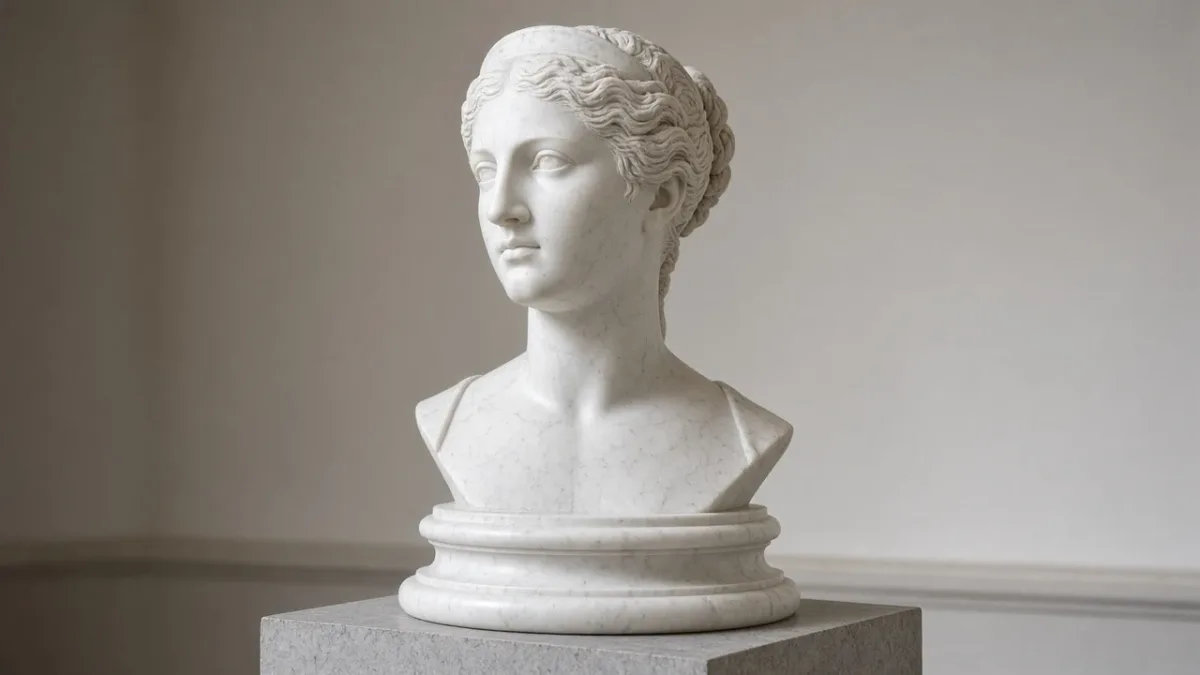
The white bust on a dealer's stand is almost never an excavated antiquity. It is more often a Roman or Florentine export of the late eighteenth or nineteenth century: Carrara marble, pointed from a plaster, finished for a northern interior. The useful questions are which quarry grade, which model, and which workshop. The same market that absorbed antique Italian bronze absorbed marble in larger volume, because the stone travelled as both original invention and licensed-looking replica.
This note covers the collector's range of Italian marble sculpture from about 1750 to 1900, the period in which Rome restored and copied the antique, Canova's studio standardised pointing, Carrara trained cutters for export, and Florence sold reductions to travellers. Earlier Renaissance marbles exist in museums; they are not the objects that circulate in quantity.
Carrara stone
The Apuan Alps above Carrara, Massa, and Pietrasanta supply the white calcite marble that European sculptors preferred after the sixteenth century. "Carrara" is a district, not a single bed. Ordinary bianco runs from pearly white to light grey, often with centimetre-scale grey spotting and veins. Statuario, the grade sought for figures, is finer in grain, more homogeneous, ivory to very pale beige, with grey veins reduced to a minimum. Grey bardiglio was used for architecture, pedestals, and contrast, not for flesh.
Petrological criteria for a sculptural white are practical: crystals fine enough that the chisel does not tear; texture even enough that there is no easy cleavage plane; few open fissures; low porosity; hardness low enough to cut, high enough to take a polish. Italian specialist literature on marmi statuari still ranks Carrara statuario with Parian and Pentelic among the historical whites, while noting that Pentelic weathers to a warmer tone and Parian is more translucent. A nineteenth-century bust with a sugar-like, highly crystalline sparkle and heavy grey clouding is more likely ordinary bianco than exhibition-grade statuario. That distinction affects price more than authenticity.
Do not confuse marble with Volterra alabaster. Alabaster is gypsum, softer, often faintly translucent at the edges, and easily scratched. Coloured stones on Grand Tour objects are a different vocabulary again: rosso antico, giallo antico, nero antico, used for vases, tazze, and architectural models rather than for life-size nudes.
The academy and the trade
The Accademia di Belle Arti di Carrara was founded by chirograph of 26 September 1769 under Maria Teresa Cybo, Duchess of Massa and Princess of Carrara. Statutes for an Accademia di San Ceccardo had been issued in April 1757 on the advice of the Carrarese sculptor Giovanni Domenico Olivieri, who had worked on the Madrid academy; that first project was never activated. The 1769 school dropped painting and opened only sculpture and architecture, with an explicit brief to support the marble industry. Giovanni Antonio Cybei directed the sculpture school; Filippo Del Medico directed architecture and designed the first purpose-built seat (works begun 1771; now the civic library). In 1781 Maria Teresa levied a tax on marble to fund the courses.
Under Elisa Bonaparte Baciocchi the academy took national rank. In 1805 it was styled Eugeniana after Eugène de Beauharnais. Lorenzo Bartolini taught sculpture. In 1810 Elisa assigned the present palazzo. She also instituted a pensionato: three years in Roman ateliers for competition winners. Canova and other visiting sculptors gave casts; the academy's gipsoteca still holds that teaching stock, including, by later exhibition catalogues, Canova's 1810 gift of the portrait of Letizia Ramolino Bonaparte as Agrippina. Alumni who then worked in Rome include Carlo Finelli, Pietro Tenerani, and Luigi Bienaimé. The point for collectors is institutional, not romantic. Carrara produced both named sculptors and anonymous sbozzatori who could point a plaster into a block at speed.
Rome: restoration, copies, and pointing
Eighteenth-century Rome ran two related businesses: the restoration of excavated sculpture and the supply of new copies. Bartolomeo Cavaceppi's studio and that of Carlo Albacini (1739–1813) were the workshops Canova frequented when he arrived from Venice. The Museo Gypsotheca Antonio Canova at Possagno records that he learned there the method of cavar punti: small bronze pegs, repères, set into a plaster model so that measurements could be transferred into the marble block with compasses, pantographs, and plumb lines.
Albacini served English patrons as restorer and copyist. Sotheby's has published the anecdote, drawn from Canova's 1780 visit, that Albacini's shop spent fourteen months pointing a colossal copy of the Borghese Lucius Verus and still needed five more. Hugh Honour reattributed the Ickworth chimneypieces, long given to Canova, to Albacini, citing a Quirinale payment of October 1813 for a related marble fireplace with free-standing groups. The lesson is documentary. High finish and a famous model do not make a Canova.
A Francesco Chiarottini drawing of March–June 1786, now in the Musei Civici di Udine, shows Canova's own studio at work on the tomb of Clement XIV: plaster and marble under a wooden pointing frame, rope drills, pantographs on a base, apprentices roughing blocks. The museum treats this campaign as the moment Canova adopted the procedure that thereafter defined his production.
Canova's sequence
Antonio Canova (Possagno, 1 November 1757 – Venice, 13 October 1822) did not carve from a sketch directly into the block. Possagno's technical account, which quotes Francesco Hayez, is consistent across the plaster collection. Invention began in drawings, then terracotta or wax bozzetti; fingerprints often survive in the clay. A full-scale clay model followed and was destroyed when the plaster forma was taken. The resulting full-scale plaster received bronze repères. The more prominent pegs were punti chiave or capi punto. Assistants pointed and rough-hewed the marble, then brought it close to finish, leaving a thin skin. Canova reserved the ultima mano: scrapers, rasps, and drills of his own devising, followed by a wax mixture that reduced the stone's glare and suggested flesh.
Johann Peter Kauffmann, nephew of Angelica Kauffman, was one of the two finishers Hayez named. The method was not a secret unique to Canova. It was the Roman copyist's method, applied to new inventions and then imitated, after 1822, by every shop that owned a plaster of the Three Graces or Cupid and Psyche. Canova's first Three Graces was commissioned by the Empress Josephine in 1812 and completed in 1816 (State Hermitage Museum). A second, for John Russell, 6th Duke of Bedford, was finished in 1817 (Victoria and Albert Museum and National Galleries of Scotland). Mid-nineteenth-century Italian marbles "after Canova" copy the Bedford type more often than they copy the antique.
Grand Tour marble in Rome
The same pointing system produced objects that never pretended to be Canova. Benedetto Boschetti's workshop at 74 Via Condotti, active from about 1820, sold marble, mosaic, and bronze to travellers whose route already included Roman micromosaics. Francesco Saverio Bonfigli's 1860 studio guide called the shop conspicuous for marble works, bronzes, candelabra, table-tops, and mosaics. Boschetti showed mosaic tables at the Great Exhibition of 1851 in London and received a medal. Signed marbles are uncommon. A rosso antico reduction of the Warwick Vase in the Toledo Museum of Art is inscribed B. Boschetti fece. Christie's notes his preference for relatively soft coloured stones, especially Numidian giallo antico and rosso antico from Cape Tenaro, and records a further award at Philadelphia in 1876. A tazza in nero and rosso antico is a souvenir of high quality, not a fragment of the Forum.
For the Roman street market in which such objects still appear, see the Rome antiques walking guide.
Florence: the export gallery
Florence sold a different product: white figure sculpture and reductions of antique and Renaissance models, aimed at the same foreign clientele, often inscribed in English. In 1822 Pietro Bazzanti took over the studio that Luigi Bozzolini had opened in 1815 in the ground-floor rooms of Palazzo Corsini, with a window on the Lungarno and the carving shop behind on Via del Parione. Bozzolini was the last of a line of ornamental sculptors employed by the Corsini since the seventeenth century. An 1823 contract for a sepulchral monument in Great Britain shows export work from the first year. The gallery's own archives were lost in the floods of 1844 and 1966; the history is recovered from guidebooks and from the few documented commissions. The Catalogo generale dei beni culturali records Pietro Bazzanti as active 1823–1861 and catalogues a sarcophagus monument at the English Cemetery in Florence.
Niccolò Bazzanti trained at the Accademia di Belle Arti under Francesco Carradori. In 1834 he was among the sculptors chosen for the series of twenty-eight Illustrious Tuscan Men for the Uffizi loggia; the marble was placed in 1842. At the National Exposition of Florence in 1861 the firm exhibited as a fine-arts trader and took a medal in sculpture. Later inscriptions on the export market read P. Bazzanti Florence or, in some English catalogues, P. Barzanti. Treat the spelling as a trade mark on a gallery object, not as proof that the named man held the chisel for every lock of hair. The Lungarno premises remain a landmark on any Florence antiques walk. Hardstone inlay from the same city is a separate technique; see Florentine pietra dura.
Cesare Lapini (1848–1893) signed and dated his own genre figures. Christie's records C. Lapini / Firenze / 1883 on La Sorpresa and Lapini / Firenze / 1890 on the group titled O Quanto T'Amo, the latter on a verde antico pedestal of the type that often travels with the sculpture. Lapini showed six works at the Esposizione Generale Italiana, Turin, in 1884. These are not Grand Tour antiquities. They are late-nineteenth-century Florentine commercial marbles, frequently of high technical finish, and they should be catalogued as such.
How to read an object
Model. Identify the prototype before the sculptor. Apollo Belvedere, Medici Venus, Capitoline Cupid and Psyche, Canova Three Graces (Bedford variant: round support behind the group), Bartolini Fiducia in Dio: each has a published plaster or marble against which reductions can be compared. "After the antique" means after a famous marble then visible in Rome or Florence, not "ancient."
Scale and pointing. Life-size or colossal work that follows a known plaster closely, with residual pinpoint depressions in hair or at the back of a socle, is workshop practice, not a defect. A reduction that distorts proportions, blurs eyelids, and leaves drill holes as open tunnels in the hair is a later, cheaper copy. Surviving plaster models with bronze repères belong in the documentation, not on the same invoice as the marble unless the provenance is studio.
Inscriptions. Look on the reverse of the base, the rim of the socle, and the back of a tree stump. Italian sculptors selling to English sitters often used Florence or Roma rather than Firenze. A date is more useful than a surname. Unsigned is the default for Boschetti-type coloured marble; unsigned is also the default for anonymous Carrara garden figures.
Stone and surface. Check the block for filled fissures, iron staining around old mounts, and a later high polish that has erased tool marks in the recesses. Canova's own practice included a waxed, non-specular skin. Many Victorian interiors wanted glare. A mirror polish on a supposed eighteenth-century piece is often a twentieth-century intervention.
Outdoor damage. Garden sculpture in Carrara bianco sugars: calcite grains loosen, faces flatten, drill work in hair becomes a crust. Do not confuse that erosion with "ancient weathering." Recut eyes and mouths on weathered figures are common and should be described.
Pedestals. A verde antico or grey bardiglio column may be original to a late-nineteenth-century Florentine group and still be later than the marble if swapped in trade. Measure both; the socket tells the story.
Condition and the market
Breaks at the neck, fingers, and attributes are structural, not cosmetic. Iron or brass pins rust and split the stone. Wax and oil darken in the pores and attract dirt; they are hard to reverse without abrasion. Museum loans and auction photographs remain the control set. A "Canova" at a fraction of autograph money is a copy after a plaster. That can still be a serious object if the marble is statuario, the pointing accurate, and the surface unrestored. It is a different object from a signed Lapini of 1890, and a different object again from a Boschetti rosso antico vase.
The trade did not end in 1900. Carrara still cuts from plasters, now also from scans. Recent reproductions can be honest studio work. They are not nineteenth-century sculpture. Look for machine-regular claw marks, identical multiples, and marble that has never been outdoors or in coal heat.
FAQ
Is most antique Italian marble sculpture from Carrara?
Most white figure sculpture made in Italy after the sixteenth century is Carrara or a related Apuan marble. Rome also used coloured stones from older decorative beds, some of them reused antique material. A Pentelic or Parian identification needs a geological argument, not a label.
What does "after Canova" mean on an invoice?
It means the composition follows a Canova model, usually via a plaster. It does not mean Canova carved the marble, and it does not mean the plaster came from Possagno. Autograph marbles are documented; mid-century copies of the Three Graces are a recognised commercial class.
How should a signature be read?
A signature locates a gallery or a sculptor, not every chisel stroke. P. Bazzanti Florence is a Lungarno trade inscription. C. Lapini / Firenze / 1890 is a personal, dated claim and is easier to test against auction comparanda. Absence of a signature is normal.
Should pointing marks be removed?
No. Residual points, drill holes that do not go through, and a slightly duller skin in the recesses are evidence of period manufacture. Filling and overpolishing destroy that evidence and rarely increase value for a specialist buyer.
The marble will not become older in a better light. It will only become clearer: quarry, plaster, workshop, and date, in that order.