
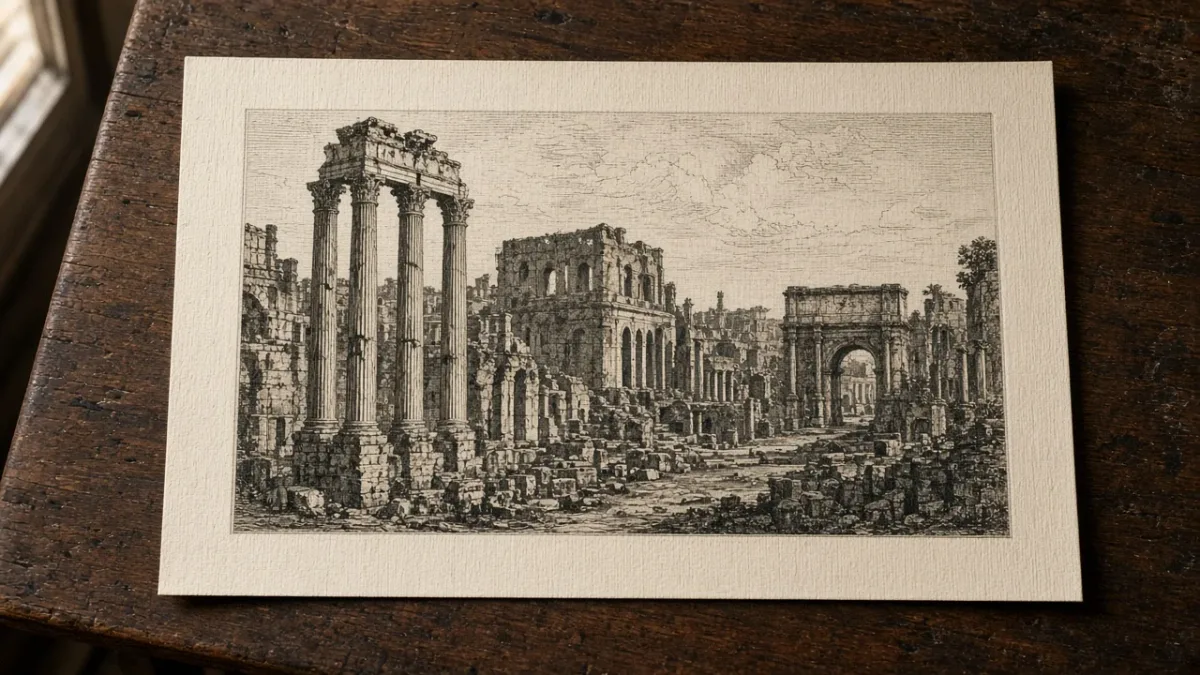
Antique Italian Engravings of Rome and Venice
Collectors identify antique Italian engravings by publisher address, plate mark and paper, from De Rossi in Rome to Remondini in Bassano del Grappa.
An antique Italian engraving is dated by the impression in hand, not by the year the copper was first cut. Plates last. A Marcantonio composition of about 1515 can survive as a sixteenth-century pull, a later recut, or a photomechanical facsimile. The collector's evidence is the address line, the paper, the plate mark, and the wear of the line.
The field is distinct from dating antique Italian maps by imprint and paper. The same Roman and Venetian shops often sold both. The objects differ. Figural and architectural plates were stock for academies, churches, and the Grand Tour. They were also stock for the street.
Rome and the reproductive plate
Marcantonio Raimondi (c. 1480 to c. 1534), trained near Bologna, is the first Italian engraver whose surviving oeuvre is largely reproductive. Giorgio Vasari gave him the only printmaker's vita in the Lives. In Rome he cut plates after Raphael, including the Judgment of Paris, a composition Raphael designed for the burin rather than as a painting. The Metropolitan Museum of Art and the British Museum hold impressions that show the hatching system he developed: parallel and cross-hatched lines that translate painted tone into metal. Michael Bury, in The Print in Italy 1550–1620, notes that before cutting the Judgment Marcantonio scored the plate with a fine abrasive and then burnished the lights. His pupils Marco Dente and Agostino Veneziano continued the method.
A reproductive print is not a second-rate painting. It is a translation. The Latin line at the foot records the division of labour. Pinxit names the painter. Delineavit names the draughtsman who copied the painting onto a working sheet. Sculpsit or incidit names the engraver. Excudit or formis names the publisher. Cum privilegio records a legal monopoly, not a date of printing.
The Stamperia alla Pace and the Calcografia Camerale
The principal Roman warehouse of plates in the seventeenth century was the Stamperia alla Pace of the De Rossi family. Giuseppe de Rossi established the shop in the early Seicento. Giovanni Giacomo de Rossi (1627–1691) ran it from 1648 and issued the Indice delle stampe intagliate in rame in 1689–90. The list is a stock catalogue. It names plates by Giovanni Battista Falda, Pietro Testa, Giovanni Benedetto Castiglione, and Giovan Francesco Grimaldi. The address, alla Pace, is as useful on a sheet as a personal name.
In 1732 Lorenzo Filippo de Rossi offered the family matrices, about 9,000 plates, for sale. English buyers were in the market. On 15 February 1738 Pope Clement XII (Lorenzo Corsini) issued a chirograph founding the Calcografia Camerale. The stated purpose, preserved in the Archivio di Stato di Roma (Camerale II, Calcografia, busta 1), was to keep "the most notable works of the old craftsmen, engraved especially on copper" from leaving Rome, and to supply models for "the studious youth of the liberal arts." Gabriella Bocconi has published the document. The first director was Giovanni Domenico Campiglia, then drawing the Capitolino sculptures for the Corsini catalogue.
The Calcografia was a state print shop. It reprinted old plates and commissioned new ones. Giovanni Volpato (Angarano di Bassano, 1735–Rome, 1803) and Raffaello Morghen (Portici, 19 June 1758–Florence, 8 April 1833) supplied reproductive plates of Raphael, Correggio, and antique sculpture. Their Principi del disegno, issued at Rome by Pagliarini in 1786, is a drawing manual cut from the Belvedere and Capitoline statues. Those matrices later entered the Camerale stock. Carlo Alberto Petrucci catalogued them for the Regia Calcografia in 1934 and again for the Calcografia Nazionale in 1953.
Giuseppe Valadier designed a purpose-built palace for the institution on via della Stamperia, constructed between August 1835 and June 1837. Shop windows at street level displayed prints for sale. Presses stood to one side. The copper store stood behind. After 1870 the shop became the Regia Calcografia; under the Republic, the Calcografia Nazionale. In 1975 it was joined to the Gabinetto Nazionale delle Stampe as the Istituto Nazionale per la Grafica, now the Istituto Centrale per la Grafica. The Calcoteca holds about 24,000 matrices. The Gabinetto holds about 114,000 historic prints. The institute's digital catalogue, Calcografica, is the first check for a Roman publisher's address.
Dealers in Rome still handle loose sheets in the print rooms mapped in the Rome antiques walking guide.
Piranesi: lifetime paper and later numbers
Giovanni Battista Piranesi (1720–1778) learned etching in Rome from Giuseppe Vasi between about 1740 and 1744. Vasi's own Delle magnificenze di Roma antica e moderna (1747–1761) is a ten-volume survey of 200 plates, organised by gates, piazze, basilicas, palaces, the Tiber, parish churches, convents, and villas. The Bibliotheca Hertziana holds the set. Piranesi's Vedute di Roma and the Carceri d'invenzione (sixteen plates, begun about 1745 and reworked in 1761) are the sheets most often offered as original Piranesi.
They are original only if the impression is. After his death his sons Francesco and Pietro continued printing in Rome (1779–1798) and then in Paris (about 1800–1807). From about 1807 many pulls are on thick wove paper. Firmin-Didot reprinted the plates in Paris in 1835–39. In 1838 Pope Gregory XVI purchased the Piranesi matrices from Firmin Didot for the Camera Apostolica. The Istituto Centrale per la Grafica records that purchase as the core of the Fondo Piranesi.
Calcografia technicians then cut inventory numbers into the corners of the copper. A Veduta that prints a small number such as 779 in the margin is a mid-nineteenth-century or later official reprint, not a lifetime sheet. Impressions issued as Regia Calcografia after 1870 often carry an embossed stamp with a crown. Arthur M. Hind's 1922 catalogue of the Prisons and Views remains the English reference for states. Andrew Robison's watermark appendix in John Wilton-Ely's complete etchings is the paper reference.
Lifetime Vedute are normally on contemporary laid paper, with plate tone in the bitten lines and, when margins survive, the price or address Piranesi used in that state. Later official pulls can be well inked. They are still later. The plate is the same object. The sheet is not.
Piranesi's Rome sat in the same Grand Tour market as Roman micromosaics. Travellers bought both. The print was cheaper and travelled flatter.
Venice, Consul Smith, and Bassano
Venetian copperplate work of the eighteenth century is often a translation of painting, not an independent veduta etched by the painter. Antonio Visentini (1688–1782) engraved the Prospectus Magni Canalis Venetiarum after Canaletto paintings in the collection of Joseph Smith, British consul in Venice. Work began about 1728. The first edition, fourteen plates, appeared in 1735 with the address In Aedibus Josephi Smith Angli. The complete set of thirty-eight plates was issued in 1742 as Urbis Venetiarum prospectus celebriores, published by Giovanni Battista Pasquali. Christie's and the Soane collection record later issues, including Teodoro Viero reprints of about 1800–1820. Smith's Canalettos were sold to George III in 1762. They remain in the Royal Collection. The prints circulated independently for another century.
Canaletto also etched. Those plates are a different series. A Canaletto engraving on the market is usually a Visentini. Read the portrait frontispiece and the letterpress titles before accepting the painter's name as the printmaker's.
Bassano del Grappa supplied a different class of sheet. Giovanni Antonio Remondini (Padua, 1634–1711) opened in Bassano in 1657. By the mid-eighteenth century the firm ran, on contemporary counts, eighteen letterpress and woodcut presses and twenty-four copper presses, with paper mills and a type foundry. Tesini pedlars from Castel Tesino carried the stock across Europe and into the Americas. Subjects were saints, seasons, games, and cheap history. Luigi Lanzi, whose Storia pittorica was first printed at Bassano by Remondini in 1795–96, called the eighteenth century the secolo del rame, the century of copper. The firm closed in 1861. The Museo della stampa Remondini, opened at Palazzo Sturm in 2007, holds the civic collection of 8,522 named engravings plus the popular stock.
Venice remains the other historic centre of the trade. Print rooms in San Maurizio and Dorsoduro still show Visentini restrikes beside later lithographs.
Paper, plate mark, and condition
Examine the sheet unframed, in raking and transmitted light.
Intaglio ink sits in the cut or bitten line and stands slightly proud of the paper. Under magnification the line is continuous. A regular dot screen is photomechanical. A plate mark, the compressed rectangle left by the copper's edge, should appear if the margins were not trimmed for a frame or an album. Absence of a plate mark does not, by itself, condemn a sheet that has been cut to the image.
Italian impressions before about 1800 are normally on laid paper. Chain lines and laid lines should be visible. Wove paper on a plate first issued in the 1750s is evidence of a later pull. A watermark dates the mould, not the printing day. Printers stored paper. Hind's warning in the British Museum catalogue of early Italian engravings still holds: the same issue tends to repeat the same papers; a mismatched mark is a reason to pause.
Hand colour on a reproductive Raphael or a Visentini view is usually later. It can be fine. Describe it as later unless the publisher's practice, as with some Remondini popular sheets, was to colour in the shop.
Condition notes that affect both dating and value include trimmed letters, backed or laid-down sheets, foxing, oxidised iron-gall inscriptions on the verso, and centre folds from atlas or album binding. A generously margined, unpressed lifetime Piranesi is uncommon. A crisp official Calcografia reprint in a modern mount is common.
Facsimiles of Marcantonio and of the Vedute are frequent. Honest ones often carry a modern caption outside the image. Dishonest ones rely on glass. Unframe the sheet.
FAQ
How do I tell a lifetime Piranesi from a Calcografia reprint?
Laid paper, early states as listed by Hind, and the absence of a later inventory number in the plate corner support a lifetime or early posthumous pull. A small etched number in the margin and, after 1870, a Regia Calcografia blindstamp identify official reprints from the same copper.
What do pinxit and sculpsit mean on an Italian print?
Pinxit names the painter of the source picture. Sculpsit (or incidit) names the engraver who cut the plate. Delineavit names the intermediary draughtsman. Excudit or formis names the publisher.
Are Remondini prints collected as fine art?
The civic collection at Bassano includes both named plates after known masters and the popular religious and genre stock sold by Tesini pedlars. Collectors treat them as separate markets. The popular sheets are documents of distribution. They are not substitute Marcantonios.
Did the Calcografia Camerale print only old plates?
No. It reprinted the De Rossi stock and commissioned new reproductive series, including Volpato's translations and, later, plates after Canova. The 1832 Camerale sales catalogue lists antiquities, modern Rome, vedute, and paintings after named masters, with prices.
How can I confirm a Roman publisher's plate?
Search the Istituto Centrale per la Grafica catalogue at calcografica.it by inventor, engraver, or editor. Petrucci's 1934 and 1953 printed catalogues remain useful for inventory numbers later cut into the copper.
The sheet is dated when address, paper, and plate wear agree. If they do not agree, the later evidence rules.