
Dating Castelli Maiolica of Abruzzo by Colour, Landscape and Marks
Date Castelli maiolica of Abruzzo by five-colour palette, istoriato landscapes, and the workshop hands of the Grue, Gentili and Fuina families.
Castelli, on the Teramo side of the Gran Sasso, sold tin-glazed earthenware at the fairs of Lanciano and Senigallia long before the village became a name on auction labels. The ware that collectors now call Castelli maiolica is dated less by a factory stamp than by a short sequence of technical and pictorial changes: a five-colour gran-fuoco palette, the revival of istoriato painting in the mid-seventeenth century, and a handful of family hands whose drawing, landscape and gold can be told apart.
Most surviving plates are unsigned. Attribution therefore starts from colour, print sources and construction, not from a punch on the reverse.
Castelli before the istoriato revival
Local clay, wood-fired kilns and a tin glaze already supported a sixteenth-century export. The Pompei workshop, whose dump has been excavated beside the village, is the documented centre of that first maturity. Orazio Pompei left a signed Madonna of 1551. The same bottega is now given the so-called Orsini-Colonna pharmacy set, a group of albarelli, bottles and two-handled jars once scattered among attributions to half the maiolica towns of Italy. The name comes from a bottle painted with a bear embracing a column and the inscription ET SARRIMO BONI AMICI, a pun on the Orsini and Colonna arms after the two Roman houses were linked by marriage. Fragments from the Pompei kiln dump, compared with the sixteenth-century tiles of San Donato, allowed the 1989 exhibition Le maioliche cinquecentesche di Castelli to fix the group at Castelli.
That early ware still looks toward Faenza: compendiario drawing, large fields of yellow, orange, green and blue, sacred figures treated as abbreviated signs rather than as history painting. Manganese brown had not yet entered the local range. The same palette covers the first maiolica ceiling of the countryside church of San Donato, later lifted and reused as paving. About two hundred of those cinquecento bricks are now in the Museo delle Ceramiche at Castelli, opened in 1984 in the former Franciscan convent on Via Salita Paradiso.
The second San Donato ceiling, made by the village confraternity of maiolicari, carries tiles dated 1615, 1616 and 1617. The Comune records more than eight hundred bricks on timber trusses; the Ministero della Cultura gives a count of 780 after the 1968 consolidation of the woodwork. Carlo Levi called the vault the Sistine Chapel of Italian maiolica. Timothy Wilson, writing from the Ashmolean, treated it as one of the most ambitious Italian maiolica campaigns at the end of the Renaissance. The programme mixes litanies and the Ave Maria with portraits, hunting animals, Solomon's knots and coats of D'Aquino, Brancaccio and di Sangro. It remains compendiario in method. The istoriato that would make Castelli distinct from Urbino and Deruta had not yet been recovered.
The five-colour palette
Castelli painting of the seventeenth and eighteenth centuries is a pentachromy. The colours that stand the full heat of the maiolica kiln are cobalt blue, antimony yellow, copper-green (ramina), manganese, and the orange that local painters still call arancio Castelli. True red is absent. If a plate shows a cardinal or purple-red flower, it is either later than the 1780s or it is not Castelli gran fuoco.
The body is a buff earthenware under an opaque tin glaze, the same maiolica technique used in the Marche and Umbria. Castelli plates of the high period often have a shallow well and a broad, nearly flat marli. Footrings, when present, are low. The reverse is commonly plain tin glaze, sometimes with three kiln-spur scars. Marks, when they exist at all, are painted in blue or, after the introduction of on-glaze firing, in mixed enamel colours.
Gold is a separate problem. Francesco Grue used third-fire gold in his last years. His son Carlo Antonio made gold heightening a regular part of the landscape plate. A dealer who treats every gilt highlight as nineteenth-century restoration will misdate the best Castelli of c. 1670–1720.
Francesco Grue and the return of istoriato
The family name was Trua, then Grua, then Grue. There was no hereditary Grue manufactory passed from father to son. What united the painters was a shared drawing and a shared kiln culture.
Francesco Angelo Grue, born at Castelli on 11 September 1618, is the documented innovator. Orphaned young, he is thought to have trained with a paternal uncle and to have looked at the work of his maternal grandfather Serafino Cappelletti. Treccani records that he chose pictorial decoration over modelling, and that this choice shaped every later Grue, who were painters on pottery rather than sculptors of form.
His early plates have hard contours and broad, hot fields of yellow and blue. From the 1650s he used engraved sources transferred by spolvero (pounced cartoons), and the palette cooled: manganese brown and copper green, then a more continuous chiaroscuro. Heroic, hunting and bucolic subjects dominate. A Sèvres plate with a battle after Antonio Tempesta, and a 1670 tile of the Madonna, Child and St Anthony of Padua after Pietro da Cortona (Paparella Treccia collection, Pescara), belong to the late, fully pictorial phase. He married three times, including into the Pompei and, through his daughter Superna, the Cappelletti. He died at Castelli on 5 October 1673.
A Metropolitan Museum plate of the 1670s (acc. 53.225.78; 2.9 × 25.2 × 25.2 cm) is given to Francesco's workshop with decoration by his son Carl Antonio. The overlap is real. Late Francesco and early Carlo Antonio share gold and landscape, and unsigned pieces of the 1670s are often argued both ways.
Carlo Antonio Grue: landscape in the well
Carlo Antonio was born at Castelli on 20 August 1655, the son of Francesco and Cecilia Nicolini. He married Ippolita di Geronimo Pompei in May 1685 and, after her death in 1692, Orsola Virgilii in 1696. The sons who painted were Francesco Antonio (1686), Anastasio (1691), Aurelio Anselmo (1699) and Liborio (1702). Isidoro took holy orders.
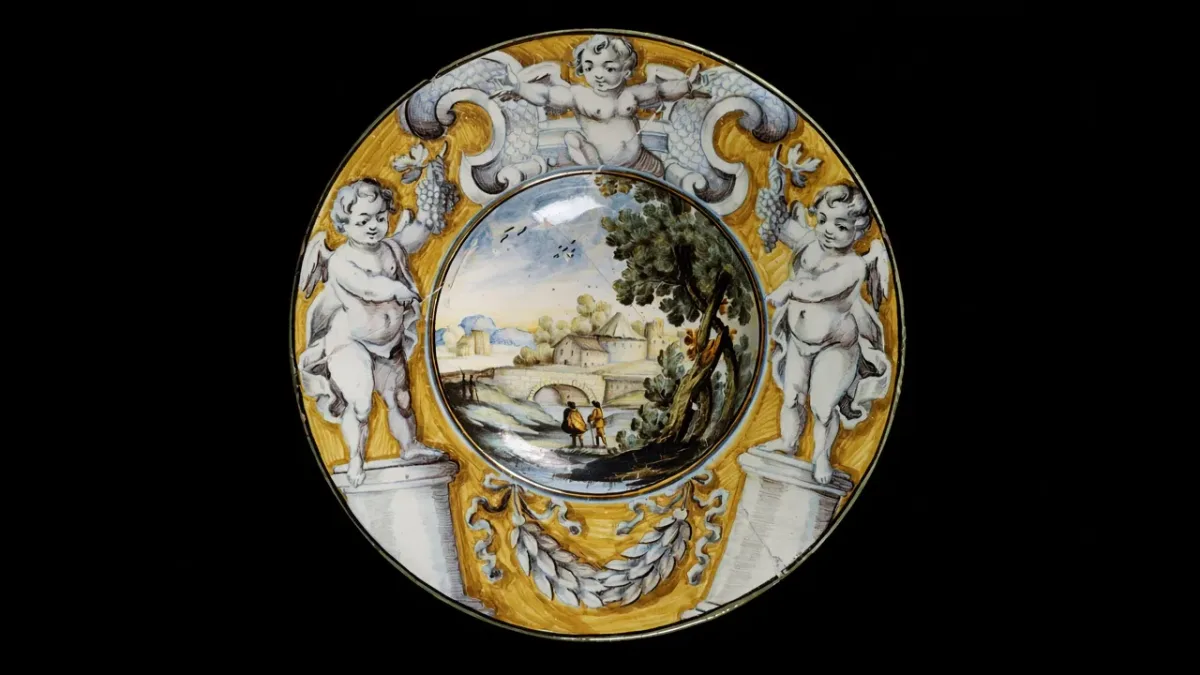
He rarely left the village. His market did not. Treccani notes cups sent to Francesco Solimena in 1695 and rim designs supplied by the Abruzzese architect-engraver Francesco Bedeschini. The typical Carlo Antonio plate puts a sacred, bucolic or landscape scene in the well and, on the marli, putti, garlands, masks or architecture on a yellow ground. The V&A plate C.250-1913 (diameter 25 cm; attributed, c. 1690–1720) is the type: two walkers approaching a bridge and farm, a yellow rim with three putti and grape bunches in reserve. The Walters plate 48.1753 (height 4.5 cm, diameter 29.5 cm; 1680–1700) adds gold to a similar pastoral and a marli of putti, a rooster, insects and leaf scrolls. A plate in the Certosa di San Martino, Naples, with a shepherdess and sleeping child in the well and children on a stippled yellow rim, is dated by Fittipaldi to the 1680s.
Prints remain the engine: the Carracci, Pietro da Cortona, Tempesta. The difference from Urbino istoriato of the 1520s–1560s is chronological and optical. Castelli drawing of this generation is smaller in the figure, wetter in the tree, and set in a landscape that occupies the whole well rather than a stage of named heroes. Dating a yellow-rim landscape plate to the late seventeenth or early eighteenth century, and not to Raphael's Urbino, is the first correction most catalogues still have to make.
Carlo Antonio trained his nephew Candeloro Cappelletti and Carmine Gentili in the same shop. He died in 1723. His sons looked for work outside Castelli. The landscape formula they inherited is what later unsigned ware imitates.
Gentili, Cappelletti and later hands
Carmine Gentili was born at Castelli on 16 July 1678. Orphaned early, he was placed by his mother Giustina Cappelletti with Carlo Antonio, her brother-in-law. He is the most identifiable of the next generation because he signed. The plaque The Triumph of Bacchus and Ariadne in the Museo di San Martino, Naples, is marked GENTILI: P. 1717, after Gérard Audran's engraving of a lost Coypel. Other documented marks are C. G. P. and C. ne G.li P. He favoured biblical and mythological istoriati, a strong yellow, and gold heightening. He sat on Castelli's public council around 1723 and died in 1763, leaving the shop to his sons Giacomo (who himself died in 1765) and Bernardino the Younger (1727–1813).
The Gentili spolveri exhibited in the Castelli museum are working documents, not souvenirs: pricked paper used to dust charcoal through onto a glaze too soft for a graphite line. Recurring subjects (Vouet's Apollo and Pan via Dorigny, Venus chastising Love, Dido) were workshop stock. An unsigned plaque of those subjects is more likely Castelli of the second quarter of the eighteenth century than a unique invention.
Nicola and Candeloro Cappelletti carried the landscape into the third quarter of the century. Harbour scenes with a radiant sun are given to Nicola; a Bonhams plaque of figures on a paved foreshore among ruins measured 25.2 × 38.3 cm excluding its giltwood frame. Covered vases with continuous landscape, masks and putti belong to the same circle, around 1775.
Francesco Antonio Saverio Grue (born 7 March 1686, died 24 August 1746) stands slightly apart. He took a degree in theology and philosophy at Urbino in October 1706 and liked to write the doctorate into his signatures. A British Museum albarello of Andromeda, dated 1717, is the first signed and dated work of his Neapolitan years; he stated in 1730 that he had lived in Naples since 1717. Pharmacy vases for the Certosa di San Martino followed in 1729, a service for the protomedico Carlo Mondelli in 1735, and, after his return to Castelli in 1736, signed jars for the Santa Casa at Loreto in 1739. Nineteenth-century biographies made him a Vicaria prisoner who taught Neapolitan maiolicari in gaol. Treccani, following Nicodemi's documents, treats the long imprisonment as unproven: dated work exists for the years in question.
Liborio Grue, born 13 October 1702, worked at Ancona, Atri, Castelli and Teramo. His interest was the figure, often after Carracci frescoes; a covered bowl in the V&A is the published example. Dates of death vary between about 1776 and about 1780. Francesco Saverio, son of Francesco Antonio, born at Castelli in 1731, painted "all'uso d'Abruzzo" for the royal maiolica factory at Caserta in 1754–55. He was dead before February 1800, when his widow applied to the Bourbon factory for a pension. His later work, including a 1755 oval of the Tower of Babel at San Martino, already looks toward porcelain scale and a lighter rococo.
Gesualdo Fuina, born at Castelli on 19 April 1755 and dead there in 1822, is the last painter a collector of antiques still meets on equal terms. With Michele De Dominicis (1781–1861) he dropped the baroque landscape. White grounds, German-style bunches of tulip, rose and anemone (fioracci), a bright green, and a purple-red laid at third fire (about 700–800 °C) from the mid-1780s change the dating test. Gold returns as a porcelain-style edge, not as Grue heightening inside a landscape. A Castelli plate with a white well and red flowers is late eighteenth century at the earliest. It is not a yellow-rim Grue.
Marks, spolveri and unsigned ware
Signed Castelli is the exception. Burton's Handbook of Marks still lists useful abbreviations, provided they are treated as painter's notes rather than factory stamps:
- C. A. G. or C. A. G. P. for Carlo Antonio Grue
- L. G. P. for Liborio Grue
- C. G. P., C. ne G.li P., GENTILI: P. with a date for Carmine Gentili
- Berardino Gent. P. for Bernardino, elder or younger according to date
- G. G. P. 1713 on a tondo by Giacomo Gentili the Elder (1668–1713)
Francesco Antonio often signed in full, sometimes with the doctoral style. Anastasio is almost without secure signatures; a tile marked AG has been proposed, not proved.
The reverse of an unsigned plate is more useful for condition than for authorship: spur marks, glaze crawls, and later overpaint show in raking light. Spolveri and print concordance date the composition. A Coypel-Audran Bacchus, a Carracci well, or a Vouet-Dorigny Dido places the piece in the Gentili-Grue print economy of c. 1680–1760. A harbour with Nicola Cappelletti's sun is mid-eighteenth century. A white ground with red fioracci is Fuina or later.
Nineteenth- and twentieth-century Castelli, including work from the Istituto d'Arte, revived the five colours and the landscape well. The drawing is usually larger, the yellow flatter, the craquelure either absent or chemically even. Comparison with a documented plate (V&A C.250-1913; Met 53.225.78; Walters 48.1753) remains the practical test.
Common mistakes
The first is to read Castelli istoriato as Urbino. Urbino history painting of the Fontana and Patanazzi shops is a century earlier, the figures larger, the palette different, the well a narrative stage. Castelli of 1660–1740 is a landscape with small staffage, a yellow or scroll-work marli, and no istoriato inscription of the Raphael-ware type.
The second is to give every unsigned yellow-rim landscape to Carlo Antonio. Candeloro Cappelletti, Carmine Gentili and later shop hands used the same formula. Gold and a wet, continuous tree mass help; they do not close the question.
The third is to treat red as part of the historic pentachromy. It is not. Red and a porcelain-white ground move the date to Fuina's generation or to a later revival.
The fourth is to trust a "Castelli" label on a pharmacy jar without looking at the Pompei-Orsini-Colonna group and at Francesco Antonio's 1717 albarello. Early Castelli drug jars and late Grue drug jars are different centuries.
FAQ
How can you date unsigned Castelli maiolica?
By palette first, then by the relationship of well to marli, then by print source. Five gran-fuoco colours without red, a landscape well and a yellow putto rim point to c. 1680–1740. White ground and purple-red flowers point to after c. 1785.
Did Castelli workshops use factory marks?
No regular factory mark. Painters sometimes signed with initials or pinxit. Most plates left the kiln unsigned.
What is the difference between Castelli and Urbino istoriato?
Urbino istoriato of the sixteenth century copies history prints at large figure scale. Castelli istoriato of the seventeenth and eighteenth centuries is a landscape art that reuses prints as small scenes inside a decorative rim.
Is gold on a Castelli plate always later?
No. Third-fire gold is documented on late Francesco Grue and is characteristic of Carlo Antonio and Carmine Gentili. Later gold rims in the porcelain taste belong with Fuina.
Where should a collector look at documented examples?
The Museo delle Ceramiche at Castelli (Pompei fragments, San Donato tiles, Gentili spolveri, Grue and Fuina rooms); San Martino, Naples; the V&A; the Metropolitan Museum; the Walters Art Museum; the Acerbo collection at Loreto Aprutino.