
How to Identify Italian Albarelli and Apothecary Jars
How to identify Italian albarelli by waisted tin-glazed form, pharmacy inscriptions and workshop marks from Montelupo, Deruta, Faenza and Savona.
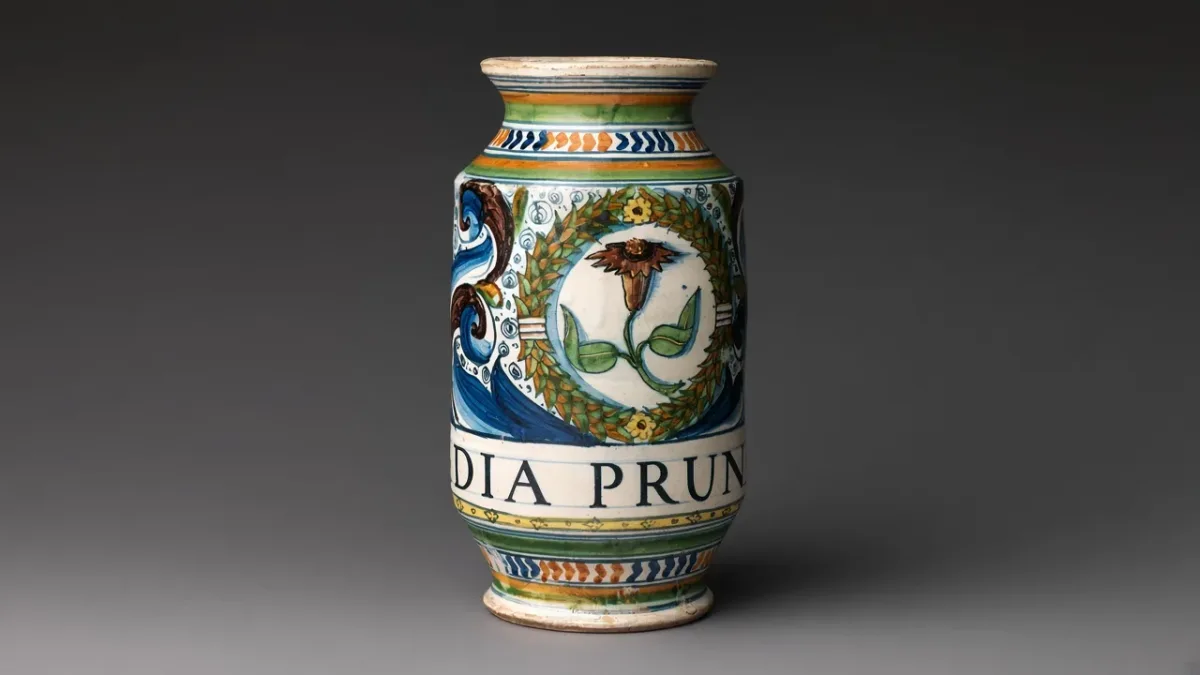
An albarello is a waisted cylindrical jar in tin-glazed earthenware, called maiolica in Italian. Pharmacies ordered them by the dozen so that dry drugs, electuaries, and ointments could stand in ranked rows. The constriction at the waist is a grip. The everted rim is a seating for parchment or paper, tied with string. Handles, when present, sit inside the vessel’s profile so that one jar does not foul the next on the shelf.
Italian usage is more precise than the English “apothecary jar.” An albarello (also alberello) is the waisted dry-goods cylinder. An orciuolo is a two-handled storage jar, often larger. A pilloliere holds pills or spices. A versatoio or boccale has a spout for liquids. Ligurian inventories use bornia, burnia, or brunia; Neapolitan shops used barattolo. Rudolf Drey, following Cipriano Piccolpasso’s Li tre libri dell’arte del vasaio, derived albarello from Arabic al-baranī. Umberto Scerrato, writing for Treccani, preferred a Latin line through alveolus or albarius, or a wooden-vessel sense tied to albero. The etymology remains open. The form is not.
Form before decoration
The type was settled in Persia, Syria, and Egypt by the late twelfth and early thirteenth centuries. Syrian blue-and-black underglaze jars reached Italy in the fourteenth century as spice and candied-fruit containers. Fifteenth- and sixteenth-century Florentine inventories call comparable imports ceramica domaschina; Piero de’ Medici’s 1463 list records “3 alberegli domaschini.” Scerrato notes that a jar now in the Museo di Capodimonte, recovered in Sicily and dated 717 AH (1317–18), belongs to that Levantine group, not to later Italian porcelain.
Hispano-Moresque lustre from Valencia supplied the luxury model between about 1300 and 1470. Tuscan potters answered with a thick white tin glaze and cobalt, often outlined in manganese. Tin oxide was costly. The Victoria and Albert Museum records that the interior of a large Florentine-area jar of about 1420–50 (acc. 2562-1856, height 36.3 cm, diameter 32.8 cm) received only a lead glaze, the tin being reserved for the visible exterior. A ladder motif is painted at the base of each small handle. The same museum’s slightly later Montelupo or Florentine albarello of 1460–90 (C.728-1909, height 25.5 cm) copies the Valencian bryony or parsley-leaf pattern in orange, blue, green, and manganese because Tuscan kilns could not yet fire true lustre.
Boccaccio already knew the word. Decameron VII, 3 is the earliest Italian literary mention usually cited. By then the jar was furniture of the spezieria.
How to read a Renaissance set
A pharmacy jar is identified first by shape, then by the painted contents label, then by hospital or family badges, and only last by a workshop mark. Many fifteenth-century pieces carry no factory stamp. The decoration is often richer on the display face than on the back.
The Metropolitan Museum’s Montelupo albarello of about 1500–10 (acc. 65.6.4, 26.2 × 14 × 14 cm) is the standard dry-goods cylinder: short neck, flanged lip, disc foot, no handles. A Deruta companion of about 1505–10 (acc. 46.85.38, height 22.2 cm) shows the same construction. Inscriptions name the contents. They are abbreviations, not titles. Gothic lettering is usual before about 1550; later Ligurian and Faentine sets move toward Roman capitals in a cartouche.
The V&A Deruta jar of about 1510 (C.2094-1910, height 21.5 cm, diameter 12 cm) is labelled Ioc Sanum, for lohoch sanum et expertum, a sweet anti-tussive licked from the spoon. The back is plainer, with stars among ribbons. After firing, someone incised the numeral 28 and other pharmacy marks under the base. A related Deruta jar in the same bequest (C.2093-1910) reads DIA CHASSIA and belongs to a set of which one piece is dated 1507. The neck constriction on both is the tie-point for a parchment cover.
Lyon’s Musée des Beaux-Arts holds a dated Deruta albarello of 1501 (inv. D 322, height 31 cm, diameter 21 cm) inscribed pinochi (pine nuts). The series, now dispersed, shares a Moorish bust with a forehead band, read as an unidentified hospital emblem, and monograms under a two-barred cross. Kiln wasters excavated at Deruta fixed the attribution.
Florence, 1431: orciuoli for Santa Maria Nuova
The best-documented Italian hospital order is not a set of albarelli. It is a delivery of two-handled orciuoli for the pharmacy of the Arcispedale Santa Maria Nuova in Florence. Hospital accounts record a large purchase in 1427 from Maso and Miniato di Domenico. A further order of about one thousand jars went in 1431 to the workshop of Giunta di Tugio in the Oltrarno. Giunta is documented from about 1430 to 1466.
Surviving jars of this group are decorated in manganese and zaffera a rilievo, a cobalt-rich blue that stands proud of the glaze. Oak leaves fill the ground. Animals, fleurs-de-lis, or busts occupy the panels. Each handle carries the hospital’s green crutch. Asterisks beneath the crutch, one to three in number, are treated as decorator or workshop marks. Excavations on Giunta’s site in 1975 and 2015 recovered relief-blue wasters and confirmed the asterisk.
Measured examples give the scale of the commission. The Fitzwilliam Museum’s jar C.75-1961 is 20 cm high and 22.5 cm across the handles, with hounds among oak leaves (about 1427–31). The Metropolitan’s Lehman jar (1975.1.1061) is 31.5 cm high and shows a crane; the museum dates it probably to 1431. Toledo 1950.224 is 30.8 cm. Cleveland 1943.54, with male and female portraits, is 20.4 cm and is dated 1431. The National Gallery of Victoria’s example measures 30.9 × 30.8 × 26.0 cm and repeats the green crutch on both handles. These are storage jars for a hospital wall, not small counter pots.
Zaffera a rilievo itself is earlier than the 1431 order. The Fitzwilliam notes archaeological evidence for the pigment in Tuscany from the last third of the fourteenth century, continuing beside Italo-Moresque painting into the 1460s. It appears on jugs, ewers, albarelli, and, more rarely, dishes, and it was taken up in Romagna, Lazio, and Umbria. A Bologna University manuscript (MS 2861, from San Salvatore) preserves recipes for a blue pigment and for relief-blue “in the Florentine manner.”
Workshop geography after 1480
Montelupo, a few kilometres down the Arno from Florence, became the volume supplier of pharmacy shapes. Fausto Berti’s excavations and his Storia della ceramica di Montelupo remain the reference for peacock-eye (occhio di penna di pavone) grounds of about 1480–95, Persian palmettes, and the alla porcellana scroll that Marco Spallanzani dates from about 1480, with an archival mention in 1494 among goods of Filippo Strozzi the Elder. Galeazzo Cora moved a number of peacock-eye pieces from a default Faenza attribution back to the Florentine hinterland after the Montelupo digs.
In 1497/98 the brothers Stefano and Piero di Filippo Schiavone left Montelupo for the Medici villa at Cafaggiolo, Barberino di Mugello. They signed SP. Piero died in 1507; Stefano in 1532. A pair of two-handled Cafaggiolo albarelli of about 1500–20, published by Sotheby’s in 2018 (each about 36 cm high), carries the initials under the handle and a Persian-palmette ground. Julia Poole linked a related spouted drug jar, painted with the same palmettes, to the hospital of Santa Maria Nuova and suggested a date near 1508.
Faenza supplied a later, cooler pharmacy look. A catalogo.beniculturali.it albarello a rocchetto of the second half of the sixteenth century is painted in turchino on berettino, the grey-blue tin glaze associated with Faenza. Onion-like swellings sit at shoulder and foot. A cartouche on the front names the drug. The interior is only lead-glazed over a brown slip. Istoriato narrative painting, the speciality of Urbino in the same decades, is uncommon on working pharmacy cylinders. It appears more often on display pieces.
Castelli, in the Abruzzo, painted portrait busts and Gothic labels on mid-sixteenth-century jars. The V&A example 1271&A-1855 (1550–75) reads Isopus humida, Rudolf Drey’s correction of Oesipus humidus, wool-fat. The lid on that piece is striped blue and yellow and probably does not belong to the jar. Mismatched covers are routine on the market.
Liguria and the later hospital wall
By the seventeenth century the dominant pharmacy colour in Liguria was blue on white. The Comune of Savona ordered a new spezieria for the Ospedale San Paolo, completed in 1666. Stella Cattaneo and Donatella Ventura, working from the hospital chapters of 1513 and 1606 and from later inventories, describe 171 surviving maiolica vessels now in the Museo della Ceramica di Savona: 34 seed flasks at 27 cm; 22 pillolieri between 17 and 30 cm; 19 truncated cones at about 27 cm for ointments and plasters; 39 spouted boccali at about 26 cm; 33 albarelli between 24 and 27 cm; 16 electuary jars between 27 and 30 cm; and 8 stagnoni or hydriae at 51–52 cm for waters. All share an “orientalising tapestry” ground in blue, a Gothic abbreviated cartouche, and a figure of St Paul with the Epistolae ad Romanos and a downward sword. The 1513 chapters still mention glass containers only. The 1606 revision called for a new pharmacy. The 1666 maiolica set answered that call. Auctioned Savona albarelli of the late seventeenth century sometimes add a stella con S factory mark under the foot.
Sicilian and Trapani jars of the same century tend toward ovoid, slightly tapered bodies and a hotter polychrome than Ligurian blue-and-white. Attribution between Sicily and Faenza is not always stable on the market. Construction, glaze fit, and the script of the cartouche are safer than a verbal origin in a sale title.
Dating without a factory stamp
Work through the object in this order.
Profile. A tight waist, short neck, and flanged lip point to a dry-goods albarello. Two strap handles and a more ovoid body point to an orciuolo. A spout means liquid. A square-section eighteenth-century jar with a fitted lid, such as the Faentine group from Santa Maria Nuova now deposited at the Museo Galileo (height about 290 mm), is a later hospital type, not a Renaissance albarello.
Glaze. Renaissance tin glaze is creamy, often with pinholes and a dry rim. Zaffera stands in relief. Berettino is grey-blue. Later Ligurian glaze is colder and more even. Nineteenth-century revival pieces can be too white, too glossy, and too evenly thrown.
Inscription. Gothic contents labels belong mainly to the fifteenth and early sixteenth centuries. Baroque cartouches with Roman or mixed lettering are later. A label that names a modern chemical, or that is painted in a nineteenth-century hand on an otherwise “Renaissance” ground, is a warning. Incised numerals under the base, as on the V&A Ioc Sanum jar, are pharmacy inventory marks made after firing. They date use, not manufacture.
Badge. A green crutch is Santa Maria Nuova. A sacred monogram in a rayed medallion, as on V&A C.728-1909, is a religious house or a pious owner, not a factory. Hospital and family arms identify the client. They do not by themselves name the kiln.
Mark. SP at Cafaggiolo is an exception among early pieces. Ligurian stella con S marks appear on later Savona wares. Most Renaissance albarelli are unsigned. A crisp painted cock on the base is the Cantagalli revival mark, not a sixteenth-century signature.
Later copies and common mistakes
Ulisse Cantagalli (1839–1901) and his brother Romeo inherited the family factory in Florence in 1878. The firm reproduced Islamic, Hispano-Moresque, and Renaissance maiolica, using pieces studied in the Bargello, the South Kensington Museum, and the British Museum. Pandolfini catalogued a two-handled Cantagalli pharmacy jar of about 1890 (24 × 25 × 15 cm) with grotesque decoration reserved on blue, lustred handles, and the factory mark in blue on the base. Such jars are revival wares. They become a problem only when the mark is ground away or when a dealer describes them as “in the Renaissance taste” without a date.
Other errors are simpler. A two-handled oak-leaf orciuolo is not an albarello. A flower arrangement in a Hispano-Moresque jar, the use shown in Ghirlandaio’s Annunciation at San Gimignano and in Hugo van der Goes’s Portinari Triptych, does not make every waisted cylinder a pharmacy pot. A lid that does not share the jar’s glaze or palette is often a marriage. Interior lead glaze on an otherwise tin-glazed fifteenth-century jar is original economy, not a later repair.
Condition follows the job. Rims chip where string was tied. Feet wear from stone shelves. Labels were sometimes overpainted when a pharmacy reused a jar. Overpaint that sits on top of dirt or that fluoresces as a modern resin is not a contemporary change of contents.
FAQ
What is the difference between an albarello and an apothecary jar?
Albarello is the Italian name for the waisted dry-goods cylinder. Apothecary jar is the broader English term. It also covers orciuoli, spouted versatoi, pillolieri, and later lidded hospital sets.
How tall is a typical Italian albarello?
Museum examples used for drugs on a shelf cluster between about 18 and 31 cm. The V&A Ioc Sanum jar is 21.5 cm. The Met Montelupo jar is 26.2 cm. Lyon’s dated Deruta jar is 31 cm. Two-handled Florentine orciuoli for Santa Maria Nuova run from about 20 cm to a little over 31 cm. Ligurian stagnoni for water stand 51–52 cm and are a different shape.
Do Italian pharmacy jars always name the drug?
No. Contents inscriptions become common from the mid-fifteenth century. Earlier jars, and some later ones, rely on a paper label or on the pharmacist’s memory. A painted name can also be later than the pot.
How can a Cantagalli revival jar be told from a Renaissance albarello?
Look for the painted cock mark, an even factory body, and a glaze that is whiter and more uniform than fifteenth-century tin. Cantagalli studied museum pieces and copied their motifs. The construction and the mark give the date.
Were these jars made only in Tuscany?
No. Montelupo and Florence dominate the early documented hospital orders. Deruta, Faenza, Castelli, Savona, Albisola, Sicily, and Trapani all produced pharmacy shapes. Attribution rests on glaze, palette, script, and, where they exist, marks, not on the word albarello alone.