
Authentic vs Later Italian Art Nouveau Jewelry: What Collectors Miss
Period Italian Art Nouveau jewelry is identified by 750 gold marks, enamel, and workshops such as Musy and Calderoni, not by floral motifs or later copies.
Italian Art Nouveau jewelry is routinely dated by floral gold. That is the error. In Italy the years around 1900 produced at least three overlapping vocabularies: Liberty (also called stile floreale), the diamond garland manner of the Belle Époque, and the archaeological neo-historicism that had already occupied Roman and Neapolitan benches for two generations. A later revival, and a large industrial output from Valenza and Vicenza after 1968, now fills the same search terms. Marks, construction, and workshop practice separate period work from later copies. Motif does not.
Names, dates, and the 1902 exhibition
Dealers writing in English use “Italian Art Nouveau.” Period Italian sources used Liberty, from Arthur Lasenby Liberty’s London shop, founded in 1874, which sold Japanese and Near Eastern ornament to a European clientele. Stile floreale and arte nuova appear in the same years. None of these labels is a hallmark.
The civic centre of the Italian debate was Turin, not Rome. MuseoTorino dates the local Liberty season from the Prima Esposizione internazionale d’Arte Decorativa Moderna, held in the Parco del Valentino from April to November 1902. Raimondo D’Aronco (1857–1932) designed the secession-style pavilions. MuseoTorino records the sections as the modern house, the modern room, and the decorative organism of house and street. Two periodicals founded that year, Arte decorativa moderna and Il Giovane artista moderno, circulated drawings and criticism. The 1994 catalogue Torino 1902: le arti decorative internazionali del nuovo secolo, edited by Rosanna Bossaglia, Ezio Godoli and Marco Rosci, remains the standard record of the display.
Jewelry was present, but it was not the French or Belgian object-as-sculpture of René Lalique. Italian urban houses continued to sell diamond parures, pearl colliers and convertible tiaras to a Savoy and bourgeois clientele. Liberty ornament sat beside, and often inside, that conservative production.
What period work actually looks like
Melissa Gabardi’s Italian Jewelry in the 20th Century (Silvana, 2016), prepared with the Museo Poldi Pezzoli exhibition of November 2016–March 2017, treats Liberty as a chapter distinct from both neo-historicism and “Garland style.” That division is the collector’s first tool.
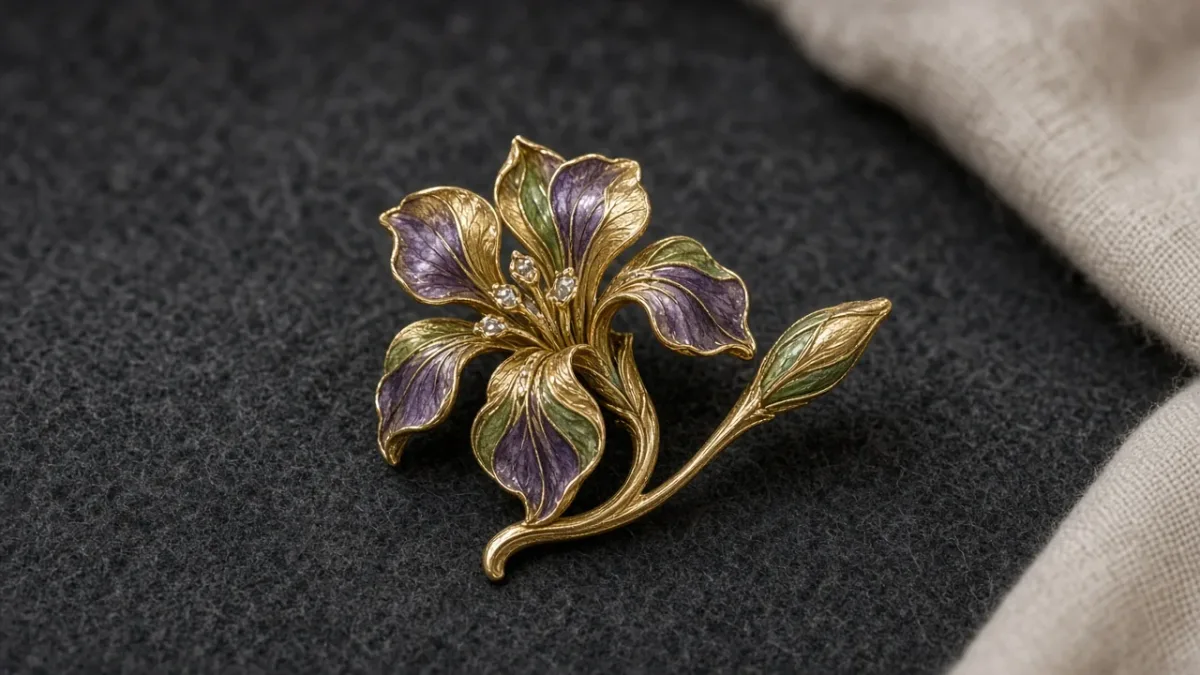
Period Liberty jewels, when they appear, tend to be brooches, hair ornaments, buckles and small pendants rather than full diamond rivières. Yellow gold at 18 carats (stamped 750 when marked at all) is the usual body. Enamel, where present, is champlevé or basse-taille in recessed cells; plique-à-jour, the translucent enamel without a metal back, is far more common in French and Belgian work than on documented Italian pieces. Stones are chosen for colour as much as for value: demantoid, peridot, moonstone, opal, pearl. Rose-cut and old-brilliant diamonds continue on Italian benches; they do not by themselves prove a French atelier.
Construction is hand-assembled. Look for a round wire pin, a simple C-catch or early tube hinge, and solder that follows the outline of the motif rather than a stamped sheet with a separate, later finding. Knife-edge links, millegrain and platinum galleries belong more often to the garland group discussed below.
A floral spray in 18-carat gold with later rhodium plate, machine-cut melee and a 1968 star-and-province punch is not Liberty. It is a later jewel using a Liberty motif.
Workshops that can be named
Musy, Turin
The house that can be tied to the 1902 exhibition with archival certainty is Musy. MuseoTorino records Giacomo Musy, a Geneva-trained watchmaker from Massonay in the Chablais, settling in Turin in 1707 in the vanished wing that joined the Palazzo Reale to Palazzo Madama. Heirs were already royal suppliers by 1765. A fire in 1818 forced the move to via Po. Andrea Perelli, ebanista, made the present shopfront in 1865; the drawing is Archivio Storico della Città di Torino, TD 94.1.266. In 1837 Eugenio di Savoia, prince of Carignano, granted a jewellers’ patent. Vincenzo Musy and his nephew Amedeo were named suppliers to Umberto I in 1882.
At the 1902 Esposizione the firm built a Liberty pavilion and received a Diploma d’Onore for decoration, display, manufacture and elegance. The family archive, now at the Archivio di Stato di Torino, preserves the diploma (mazzo 82, fasc. 143 and related files) and drawings of diadems, colliers, brooches, combs and gentlemen’s objects. Those drawings are the right comparison set for a claimed Musy Liberty jewel: high-status goldsmithing, not a stamped floral badge. A 1925 warrant from Vittorio Emanuele III post-dates the Liberty years and does not date an individual object to 1902. The shop remained in family hands until 2011.
Unsigned gold sold in Turin in these years may have passed through Musy as retailer. A Musy case, if original and unaltered, is evidence of retail, not of manufacture.
Calderoni, Milan
Calderoni’s own history places the foundation in 1840 in via della Lupa, now via Torino, with a Piazza Duomo premises from 1870 and a move to via Montenapoleone in 1942. The firm states that it supplied the House of Savoy. A May 1908 trade sheet printed by Giussani in Milan, 37 × 28.5 cm, uses Liberty ornaments around advertisements for jewels, rings and leather goods. That document proves the house was selling in the Liberty visual language. It does not, by itself, attribute an unmarked brooch.
Period Calderoni jewels are frequently unsigned. Electronic tests for 18-carat gold and platinum, and comparison with Gabardi’s plates for 1900–1914, are the usual method of argument. Treat “attributed to Calderoni” as a dealer hypothesis unless a punch, a case with matching inventory, or a documented commission is present.
Filippo Chiappe, Genoa
Filippo Chiappe (1863–1936) trained at the Academy of Arts in Massa, then in Algiers and Paris. He directed the Genoese house Vassallo before opening on via Roma, later adding premises in Milan, Paris and Rome. Sotheby’s, selling a diamond necklace-diadem of about 1910 (London, 2010, lot 109), recorded a signature F.Chiappe on the clasp, garlands millegrain-set with circular-, single- and rose-cut diamonds, knife-edge links, length about 410 mm, and a deficient diadem fitting. The catalogue note stresses pearls and a classical, traditional manner, not organic enamel sculpture.
Chiappe is therefore a secure Italian name of the years, and a warning. His documented jewels belong with the garland and Belle Époque group that Gabardi separates from Liberty. A signed F.Chiappe diamond swag is period Italian jewelry of about 1900–1914. It is not proof that the object is Liberty.
Petochi in Rome, opened in 1884 at via della Croce 50 according to the house, belongs to the same urban circuit. Its published royal material is later (a 1926 Savoy warrant is the firm’s own date). Do not use the name as a Liberty default.
Hallmarks that date a piece
Italian gold marking is the hardest evidence, and it is often absent.
The law of 2 May 1872, no. 806, in force from 1 June 1873, made assay optional. The 27 January 1873 regulation in the Gazzetta Ufficiale describes six official punches. For gold: an octagon with the head of Jupiter and the numeral 1; a hexagon with Minerva and 2; a horse’s head and 3. Local compulsory systems were abrogated. Many jewels of 1873–1934 therefore carry only an unofficial 750, a maker’s initials, or nothing. Absence of a state punch is normal. It is not a sign of fraud, and it is not a date.
The law of 5 February 1934, no. 305, changed the rules. The Camera di Commercio of Naples summarises the system that collectors still meet: gold fineness in a hexagon; silver fineness in an oval; a lozenge for the maker containing a registration number, the Fascist fascio, and a two-letter province code. The maker’s mark became obligatory; assay remained optional. A lozenge with fascio dates the object to the years after the 1934 statute, conventionally 1935–1944. That is two decades after Liberty.
Decreto legislativo 26 October 1944, no. 313, removed the fascio. Law 30 January 1968, no. 46, introduced the present identification mark: a star, a number and a province code in a polygonal cartouche. A star-and-province punch on a “Liberty” brooch is a floor, not a suggestion. The object was made in 1968 or later. The same logic that dates Italian silver by 800, 925 and numbered lozenges applies to gold, with 750 in place of the silver standards.
Platinum, used for millegrain galleries from about 1900, may be unmarked or later tested. A mixed gold-and-platinum mount with old cuts and a closed C-catch can be period. A platinum-looking white metal with later brilliant-cut melee and a star mark is not.
What is not Liberty
Garland style. Diamond swags, laurel, knife-edge collets and platinum lace around 1905–1915 are Belle Époque classicism. Chiappe’s 1910 necklace is the type. French houses produced the same manner. Calling every garland “Art Nouveau” inflates the Liberty market and misdates the object by vocabulary.
Neo-historicism. Gabardi opens with this group. Castellani in Rome, Giacinto Melillo in Naples, and the shell cameos of Torre del Greco continue an archaeological language of granulation, scarabs, micromosaic and shell. Roman micromosaics in gold collets are Grand Tour and papal-Rome work, not Liberty enamel. Torre del Greco coral beads and carvings were mounted in these years, as they had been since the nineteenth century; a coral parure with 750 and no star can be period without being Liberty.
Buccellati. Mario Buccellati, born in Ancona on 29 April 1891, took over Beltrami e Besnati at via Santa Margherita, Milan, in 1919 (Treccani). The date is after the Liberty exhibitions. His engraved gold, later described as tulle and nido d’ape, belongs to the 1920s and after. Assigning a Buccellati texture to 1902 is a category error.
Ravasco. Alfredo Ravasco (1873–1958) is documented in Gabardi and in the 2015 Villa Necchi Campiglio exhibition curated by Paola Venturelli. Hardstones, malachite, lapis, onyx, agate and coral, with a Milanese goldsmith’s debt to the Saracchi and Miseroni, align with the 1920s decorative-arts exhibitions (Paris and Monza, 1925). That is the matter of a later article, not of Liberty.
Industrial revival. Valenza, Vicenza and Arezzo, surveyed by Lia Lenti and Giuliano Centrodi in Gabardi’s volume, produced large quantities of floral gold in the late twentieth century. Machine stamping, identical repeats, thin sheet, imported chain, and the 1968 star mark are the usual evidence. Some of this work is well made. None of it is 1902.
Condition, conversion, and the trade
Period catches are replaced. A Liberty brooch converted to a pendant, a comb reduced to a brooch, or a missing diadem fitting (as on the Chiappe necklace) is common and should be stated. Enamel losses along high points, especially on irises, lilies and insect wings, are expected; wholesale re-enamelling produces a glassy, even surface that does not match adjacent wear on the gold.
Cases are not proofs. A Musy or Calderoni leather box can house a later jewel. Inventory numbers, if present, need a matching house record.
Attribution without a punch should be written as comparison, not as fact. “In the manner of Turin, about 1900–1910, 18-carat gold, C-catch, no 1934 lozenge” is an honest label. “Italian Art Nouveau by Calderoni” is a claim.
FAQ
How can a piece be Italian Art Nouveau if it has no maker’s mark?
Because the 1872–1934 assay system was optional. Many gold jewels of those years carry only 750, a retailer case, or nothing. Judge metal, construction, stone cuts and the absence of later state punches. Do not treat a missing name as a missing date.
Does a 750 stamp prove a Liberty date?
No. 750 is the Italian 18-carat standard across the twentieth century. Combined with a hexagonal title punch and a numbered lozenge it points to 1934 or later. Combined with a star and province code it points to 1968 or later.
Are horn and ivory combs Italian Liberty?
Horn, ivory and tortoiseshell hair ornaments are central to French and Austrian Art Nouveau. Italian houses made and sold combs; Musy drawings include them. Material alone does not localise the object. Look for Italian gold mounts, punches and retail cases.
Is every floral diamond necklace from Genoa Liberty?
No. Chiappe’s signed work shows that Genoese production of about 1910 was often garland and pearl jewellery in platinum and gold. Floral diamond work can be Belle Époque classicism.
Period Italian Art Nouveau jewelry is a thin stratum between archaeological revival and the diamond garland, made for a short season around the Turin exhibition of 1902 and the First World War. Later Liberty is a different industry. The marks of 1934 and 1968, the construction of the catch, and the difference between enamel sculpture and millegrain swags are what the market still misses.