
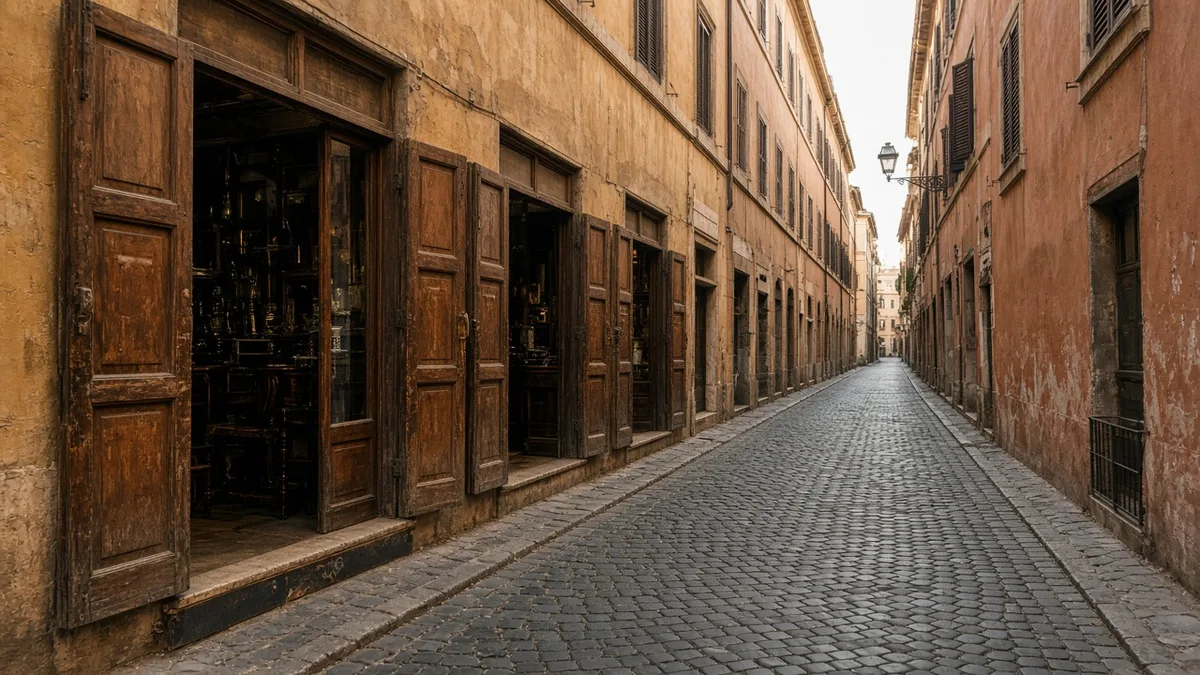
Rome Antiques Walking Guide: Via dei Coronari, Stampe & Markets
A practical 48-hour map of Rome antiques: Via dei Coronari dealers, Mercato delle Stampe, Piazza Quiriti, Ponte Milvio and how to use Porta Portese without wasting the morning.
Rome’s antiques trade still has a centre of gravity: Via dei Coronari and nearby dealer streets near Navona, plus a weekday print market at Largo della Fontanella di Borghese. Sunday spreads the map—Porta Portese for volume, Ponte Milvio for a more antiques-focused open-air fair, and Piazza dei Quiriti once a month in Prati. Two days are enough if you treat the Colosseum–Forum axis as sightseeing, not shopping. Market calendars shift for holidays and weather; confirm before you go.
For parallel city walks built the same way, see our Florence antiques guide and Milan antiques guide.
How Rome’s antiques map works
| Layer | Best for | Typical stock |
|---|---|---|
| Via dei Coronari (+ Via Giulia, Via dell’Orso, Banchi Vecchi) | Documented furniture, objects, paintings | Higher prices, invoices, quieter negotiation |
| Via del Babuino / Via Margutta | Gallery-grade decorative arts near the Tridente | Formal shops; fashion district adjacent |
| Mercato delle Stampe (Fontanella di Borghese) | Prints, maps, posters, ephemera | Weekday specialist market |
| Ponte Milvio Antiquariato (Sunday) | Broader antiques / modernariato selection | Riverbank walk; confirm summer dates |
| Piazza dei Quiriti (fourth Sunday) | Smaller curated fair in Prati | Closed July–August |
| Porta Portese (Sunday morning) | Flea volume; occasional antiques pockets | Sorting market; arrive early |
Via Condotti and the Spanish Steps sell luxury fashion. Useful for the city, weak for learning Italian antiques.
Day 1 — Dealer streets and the print market (4–5 hours)
Morning: Via dei Coronari. Start from Piazza Navona or Piazza dell’Orologio and walk the cobbled stretch toward the Tiber. This has been Rome’s main antique-dealer street for generations: furniture, sculpture, silver, paintings and decorative objects in formal shopfronts. Many dealers open roughly Tuesday–Saturday late morning to evening; Monday is often closed or by appointment. Looking costs nothing. Ask for period, materials, restoration and export status before price.
Midday: adjacent streets. Loop Via Giulia, Via dei Banchi Vecchi and Via dell’Orso for frames, paintings and further furniture. If you are considering silver, apply the same mark discipline as elsewhere—see Italian silver hallmarks. For furniture, judge joinery and later replacements against criteria in our Italian furniture notes.
Afternoon: Mercato delle Stampe. At Largo della Fontanella di Borghese, permanent stalls specialise in antique prints, maps, posters, postcards and illustrated books. Local listings commonly give Monday–Saturday, about 10:00–19:00 (closed Sunday). This is the best weekday stop for flat works you can carry. Photograph plate margins and any publisher marks; condition of paper matters more than a romantic attribution.
Optional late day: Via del Babuino. Between Piazza di Spagna and Piazza del Popolo, Babuino and side streets such as Via Margutta still hold antiquarians and galleries. Use them to calibrate prices after Coronari, not as a first stop when tired.
Day 1 buying rule. Prefer a receipt and a written description from a shop. Save aggressive bargaining for Sunday markets.
Day 2 — Sunday markets
Build the day around which fair falls in your stay. You cannot cover Porta Portese, Ponte Milvio and Quiriti thoroughly in one morning.
Every Sunday morning — Porta Portese. Rome’s large open-air market runs along Via Portuense, Via Ippolito Nievo and related streets near Trastevere, commonly about 06:00–14:00. Official tourism copy still lists furniture, paintings, books and leather among the stalls; in practice most of the length is clothing, new goods and bric-à-brac. Antiques and modernariato pockets are often reported toward Via Ippolito Nievo / Via Parboni / Via Bargoni—walk with that filter, not as a full two-kilometre browse. Arrive early; free entry. Treat it as a sorting market.
Every Sunday — Ponte Milvio Antiquariato. The official fair site places the market along the Tiber from the right side of Ponte Milvio on Via Capoprati toward Ponte Duca d’Aosta, roughly 09:00–18:00, with possible summer interruptions—verify the current calendar. Stock is positioned as antiques, modernariato, collectibles and related objects: a clearer antiques walk than most of Porta Portese when it is running.
Fourth Sunday — Piazza dei Quiriti (Salotto di Prati). In the Prati district, selected exhibitors set up in Piazza dei Quiriti on the fourth Sunday of the month, typically 09:00–19:00, with a break in July and August. Listings cite porcelain, clocks, prints, paintings, silver, jewellery and books. Free entry. Combines well with a quiet Prati afternoon; do not try to finish Porta Portese the same morning.
If your Sunday is not a Quiriti day: choose Ponte Milvio for antiques focus, or a short, early Porta Portese pass aimed only at the antique pockets, then return to Coronari shops that open after lunch.
What to look for (and what to leave)
Worth examining
- Roman and Central Italian furniture with readable construction
- Ecclesiastical and architectural fragments only with clear ownership and export status
- Prints and maps from the Stampe market (portable, documentable)
- Silver and jewellery with marks you can photograph—see Italian silver hallmarks
- Clocks and small objects when mechanism and case agree—compare with Italian antique clocks
- Ceramics when weight, glaze and marks align—see Italian ceramics
Usually skip on a short trip
- “Ancient Roman” small finds without paperwork
- CITES materials (ivory, tortoiseshell) without papers
- Large furniture before you have a shipper
- Unsigned luxury claims sold only with atmosphere and no condition talk
Buyer’s checklist for foreign visitors
1. Calendar first. Porta Portese and Ponte Milvio = Sunday. Quiriti = fourth Sunday (not Jul–Aug). Stampe = weekdays. Build 48 hours around whichever falls in your stay.
2. Transport. Navona / Coronari on foot from the historic centre; Trastevere tram/bus for Portese; Flaminio / Ponte Milvio area for the river fair; Ottaviano / Lepanto for Prati.
3. Cash and card. Markets: cash still useful. Galleries: card and invoice.
4. Export. Ask about free circulation / export licences before paying for older works. Do not request under-invoicing. Rome’s ecclesiastical and archaeological adjacency makes careless buying riskier than in Milan.
5. Shipping. Confirm courier for furniture; markets rarely handle export logistics.
6. Condition. Ask what was restored. Photograph marks, backs and undersides.
7. Negotiation. Expected at Porta Portese and open-air fairs; restrained on Coronari.
8. Pickpocket awareness. Dense Sunday markets—keep bags closed; decide purchases off the main crush.
Suggested 48-hour skeleton
| When | Where | Purpose |
|---|---|---|
| Day 1 morning–midday | Via dei Coronari + side streets | Gallery stock, buyer’s eye |
| Day 1 afternoon | Mercato delle Stampe | Prints / maps |
| Day 1 late (optional) | Via del Babuino | Price calibration |
| Day 2 early Sunday | Porta Portese (short pass) or Ponte Milvio | Market volume vs antiques focus |
| Fourth Sunday alternative | Piazza dei Quiriti | Compact curated fair |
If you only have one free morning, prioritise Ponte Milvio or Quiriti when they coincide with your trip; otherwise Coronari + Stampe on a weekday beats a late Porta Portese wander.
FAQ
Is the Colosseum area good for antiques?
No. Use Coronari, the Stampe market and the Sunday fairs listed above.
When is Porta Portese?
Every Sunday morning, roughly 06:00–14:00 near Trastevere / Via Portuense. Most stalls are not antiques.
Where should I buy prints?
Mercato delle Stampe at Largo della Fontanella di Borghese, Monday–Saturday.
When is the Piazza dei Quiriti antiques market?
Typically the fourth Sunday of the month, 09:00–19:00, closed July and August.
What should I buy first?
A small, receipted object from a Coronari dealer—or a print you can carry from the Stampe market—before committing to furniture.
Conclusion
Rome separates cleanly: Coronari and related streets for structured dealing, Stampe for flat works on weekdays, and Sunday for Porta Portese volume or the more antiques-oriented river and Prati fairs. Plan around the fair that actually falls in your visit, keep one weekday for shop streets, and treat the monumental centre as scenery. Ask concrete questions about period, condition and export; leave the atmosphere for after the shortlist is decided.