
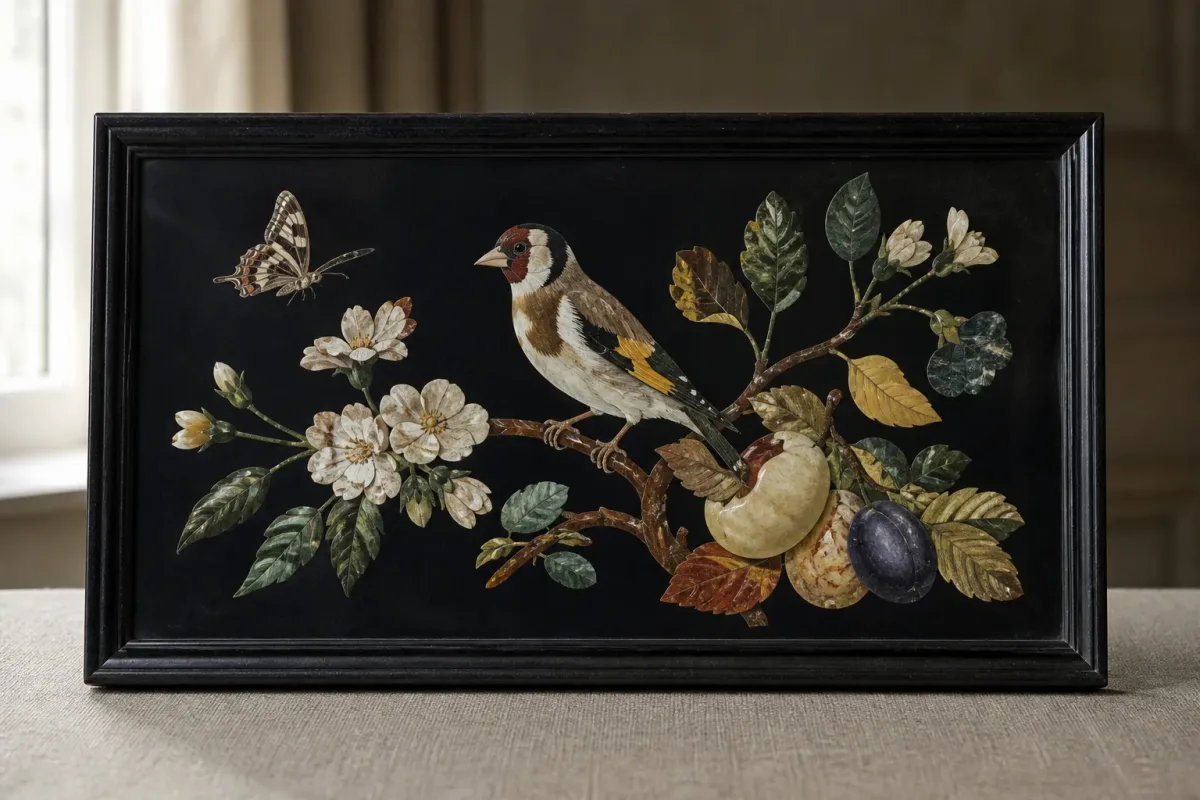
Florentine Pietra Dura: History, Identification & Collector's Guide
Identify Florentine pietra dura: Medici commesso technique, typical stones, Grand Tour plaques, and how hardstone inlay differs from scagliola copies.
English dealers still call it Florentine mosaic. Italian workshops call it commesso fiorentino. Auction catalogues prefer pietre dure. All three names point to the same thing: thin, irregularly cut slices of hardstone fitted edge to edge until the joints nearly vanish, then polished as one plane. It is closer to wooden intarsia than to a floor mosaic of small cubes. The Metropolitan Museum of Art’s 2008 exhibition Art of the Royal Court put the distinction plainly: Florentine work exploits the colour and figure already inside the stone, rather than painting on it.
This guide is for collectors who meet those plaques, tabletops, and cabinet panels on the international market and need to know what they are looking at — Medici court production, later tourist work, or a plaster imitation.
What “pietra dura” actually means
Pietra dura is Italian for “hard stone.” The plural, pietre dure, is what museums use when they mean the medium as a whole. Commesso comes from the Latin committere, to join. In Florence the join is the art: each piece is sawn to a cartoon, not chopped into tesserae.
Roman opus sectile — cut marble laid in large shapes — is the ancient ancestor. Papal Rome revived geometric marble tabletops in the mid-sixteenth century; Milan specialised in carved rock crystal and gem vessels. Florence took a third path. After about 1600, as the Met’s exhibition text notes, naturalistic flowers, birds, fruit, and small landscapes dominated the Galleria dei Lavori. Jacopo Ligozzi (d. 1627), a court draftsman with a naturalist’s eye, set the pictorial language that later workshops copied for two centuries.
Dealers also sell Indian marble inlay under the same English name. Mughal pietra dura is a related luxury craft, but it is not Florentine commesso. A Taj Mahal-style panel is typically white marble with small gemstone inserts; a Florentine plaque is usually a pictorial jigsaw on a dark paragone (touchstone) or slate ground. If the ground is white Carrara and the flowers look like jewellery set into marble, you are probably not in Tuscany.
The Medici workshop, 1588
Francesco I de’ Medici had already gathered lapidaries at the Casino di San Marco. In 1588 his brother Ferdinando I, as Grand Duke, founded a court manufactory in the “Galleria dei Lavori,” in the east wing of the Uffizi. That date is the one the Opificio delle Pietre Dure itself uses. The Met Journal essay on Prince Karl I of Liechtenstein’s tabletop notes activity in the Uffizi by 1586 and a reorganisation two years later; the institutional birth certificate remains 1588.
The workshop was not a souvenir shop. The Opificio’s official history states that it made objects for grand-ducal residences and for diplomatic gifts. Its longest architectural job was the cladding of the Cappella dei Principi at San Lorenzo, the Medici mausoleum — work that continued, under the Lorraine grand dukes as well, into the nineteenth century.
Ferdinando understood the propaganda. A tabletop that would not fade, assembled from lapis, jasper, and agate, advertised both geological reach and workshop control. He gave such a table to Emperor Rudolf II; Rudolf promptly ordered another. The second, begun in 1590 by the Milanese Caroni brothers and Cristofano Gaffuri under the goldsmith Jacques Bylivelt, was paid for in 1597 and is now lost. Rudolf’s Prague workshops, staffed in part by Florentine Castrucci craftsmen, became the first true offshoot of the Galleria.
The same export logic later moved Florentine hands to Paris (Louis XIV installed lapidaries at the Gobelins in 1668), Naples (the Bourbon real laboratorio under Charles of Bourbon), and Madrid (Buen Retiro, 1761, shut in the Napoleonic occupation of 1808). When you see “Florentine” used loosely on a Central European cabinet, the plaques may be Florentine, Prague-school, or later mounts of mixed origin. Attribution follows the stones and the cutting, not the stand.
How a commesso is made
Every serious piece starts with a full-scale design. From the sixteenth century those models were oil on canvas or, more often, watercolour on paper. The Met’s exhibition notes that the painter had to think in the palette of available stones, not in mixed pigments. The cartoon is then cut into templates; each paper shape is glued to a chosen slice; the slice is sawn.
The traditional tool is the archetto: a chestnut bow saw whose iron wire, charged with wet emery, cuts the stone. Edges are slightly bevelled so neighbouring pieces lock. The assembled picture is glued to a rigid support — often slate or black marble — and ground until the surface is flush. Polish, not paint, produces the sheen.
That process explains what you should see under a loupe. Natural stone shows crystals, inclusions, and a change of colour within a single piece. Shading on a petal should come from choosing a slice that already grades from cream to rust, not from a wash of pigment in a joint. Gaps filled with tinted resin, printed paper under a clear coat, or identical repeated flowers are later shortcuts.
Tuscan stones matter as much as imported ones. Pietra paesina, a limestone from the Apennines around Florence, carries dendritic iron and manganese stains that look like ruined cliffs and cloudy skies. The Italian Gemological Review records its use by the Medicean Opificio from the second half of the sixteenth century, when it was known as the stone of Florence. The Victoria and Albert Museum’s early-seventeenth-century orange-tree panel from the oratory at Poggio Imperiale uses paesina precisely that way: the “landscape” behind the tree is the stone’s own figure, not a drawing. Verde d’Arno, often grouped with paesina by dealers, is a different limestone, found as river pebbles, with more geometric fracture stains. Lapis lazuli, jasper, agate, chalcedony, onyx, malachite, and alabaster fill the imported list that appears in both Met and V&A catalogue language.
What collectors actually find
Museum masterpieces are tabletops and architectural panels. The market most collectors see is smaller.
Cabinet plaques. Seventeenth-century Florentine flowers and birds on black grounds were made to be set into ebony or ebonised cabinets. John Evelyn bought nineteen such panels in Florence in 1644 for a cabinet now at the V&A (W.24-1977). Eighteenth-century English patrons repeated the idea: Sotheby’s has catalogued George III mahogany cabinets whose pietre dure plaques are mid-seventeenth-century Florentine work, collected on the Grand Tour and remounted at home. The stand is often later than the stone. That is not a defect; it is how the objects travelled.
Tabletops. Grand-ducal tops are rare. Nineteenth-century visitors to Florence bought circular or rectangular tops and had them mounted by cabinetmakers in Vienna, London, or New York. The Met’s own table with an Opificio top of about 1855–65, on a later Austrian stand by Theophil Hansen, is a documented case of that Grand Tour habit. Do not assume a Renaissance date from a black-and-semiprecious top on a carved walnut base; the wood is frequently a different century and country.
Independent plaques. Late-eighteenth- and nineteenth-century Florence produced framed pictures for travellers: a goldfinch on a fruiting branch, a vase of flowers, a pair of butterflies. Quality ranges from Opificio-level cutting to coarse tourist work with wide joints. The Museo dell’Opificio delle Pietre Dure, in the historic seat at via degli Alfani 78, is the place to calibrate your eye before buying. The V&A’s Poggio Imperiale panels, sold from the Opificio’s own holdings at the 1867 Paris Exposition, show how even court-level work later entered the museum market.
These objects sit in the same luxury interior as antique Italian furniture — cassoni and walnut case-pieces that sometimes received hardstone tops — and as court silver. If you already use hallmarks to date antique Italian silver, you will notice the contrast: pietra dura almost never carries a punch. Dating is by technique, stones, support, and (when you are lucky) a documented mount.
Tuscany exported more than hardstone. Empoli glass is a later, cheaper Tuscan craft aimed at a broader market; it is useful as a reminder that “Florentine” and “Tuscan” are not interchangeable quality grades. For a parallel Renaissance luxury language in clay rather than stone, see Deruta ceramics.
How to identify and date a piece
There is no national hallmark for commesso. Work through the object.
1. Ground and joints. Court and good private work of the seventeenth and eighteenth centuries usually sits on black paragone or dark marble. Joints should be hairline. A network of beige filler, or a ground that is painted wood pretending to be slate, is a warning.
2. Stone versus scagliola. Scagliola is coloured gypsum plaster, developed in the seventeenth century as a cheaper way to imitate marble inlay and, later, pictorial commesso. It can be extraordinarily fine — sometimes finer in linear detail than stone, because plaster takes a pen-line. It is also softer. A pin will not scratch jasper; it will mark scagliola. Under magnification, plaster lacks crystal structure. Treat scagliola as its own craft, not as “fake pietra dura.” Many eighteenth-century tabletops that look like commesso at six feet are scagliola at six inches.
3. Motifs and period. Ligozzi-derived birds and flowers on black grounds run from the early seventeenth century well into tourist production. Architectural landscapes and figure scenes in the manner of Giuseppe Zocchi belong mainly to the eighteenth century and are scarce on the open market. Simple oval plaques of roses against black, in giltwood frames, are often late nineteenth or early twentieth century. Repeat motifs across a “pair” that are identical rather than mirrored can indicate a workshop using mechanical aids.
4. Reverse and mount. Look at the back. A slate bed with old hide glue, saw marks, and oxidation is more convincing than a modern plywood panel. Paper labels from Florentine retailers of the 1880s–1920s are useful for tourist-period pieces; they do not make a plaque Medici. Branded coats of arms or inked names on the reverse of frames are ownership marks, not maker’s marks — auction notes on seventeenth-century panels sometimes record them.
5. Condition. Hardstone itself is stable; colour barely fades. What fails is the adhesive and the support. Watch for lifted pieces, replaced petals in a slightly different jasper, and overpolish that has dished the softer limestone (paesina) below the harder lapis. Restoration is normal. Undisclosed wholesale replacement is not.
6. Indian and composite work. Twentieth-century marble tables with floral borders in lapis and malachite are often Indian export, sometimes very well made. They are not Florentine commesso. Mixed objects — a genuine old plaque reset in a new table — should be described as such.
Where to look, and what not to expect
The Museo dell’Opificio delle Pietre Dure remains the reference collection: commessi, stone samples, and historic tools from the Medici and Lorraine centuries. The Cappella dei Principi at San Lorenzo is the architectural extreme. Palazzo Pitti and the Uffizi hold court objects; the V&A and the Met hold panels and furniture that left Florence with travellers and dealers.
After the Grand Duchy ended and Tuscany joined the Kingdom of Italy, the Opificio lost its principal patron. Under director Edoardo Marchionni it shifted toward restoration of mosaics and stone. In 1975 it merged with Florence’s Gabinetto Restauri to become the modern Opificio delle Pietre Dure e Laboratori di restauro, a Ministry of Culture institute. It is no longer a commercial factory. Contemporary Florentine workshops still cut commesso; they should be judged as living craft, with invoices and named makers, not as antique Opificio work.
Prices move with quality, size, and whether the stone is still in a period mount. Early court tabletops and documented seventeenth-century cabinet sets sit in a different market from a late plaque of a bird on a branch. Do not use souvenir-shop “certificates” as dating evidence. Compare joints and stones with museum pieces, and ask a specialist decorative-arts dealer or conservator before paying court-level money for a tourist-level object.
FAQ
Is Florentine mosaic the same as pietra dura?
In English dealer language, yes: “Florentine mosaic” usually means commesso di pietre dure, not glass tesserae. In Italian, mosaico fiorentino is a looser popular term. If the piece is built from tiny uniform cubes, it is mosaic in the ordinary sense, not commesso.
Do authentic pieces have hallmarks?
Almost never. Unlike Venetian silver, Florentine hardstone was not assayed. Provenance, technique, and comparison with documented workshop production have to do the work that a punch does on metal.
How can I tell pietra dura from scagliola?
Hardness, crystal structure, and the way colour sits in the material. Scagliola is plaster; it can look painterly because it is painted into a gypsum matrix. Pietra dura is assembled stone. A conservator can confirm with a microscope in minutes.
Are nineteenth-century Florentine plaques worth collecting?
Yes, if the cutting is fine and the stones are real. The Opificio was still producing serious tabletops in the 1850s and 1860s, and private workshops supplied the Grand Tour. They are not Medici court objects. Catalogue them as nineteenth-century Florentine commesso, not as “Renaissance.”
What stones should I recognise first?
Black paragone or slate as ground; lapis for blues; malachite for dense greens; jasper and agate for fruit and feathers; pietra paesina for accidental landscapes. If every “stone” is the same plastic-looking opacity, walk away.
Florentine pietra dura is a court technique that became a tourist craft without ever becoming easy. The difference is in the saw-cut, the stone, and the join — the commesso the name promised in 1588.