
Authentic vs Later Venetian Trumeaux in Walnut and Lacquer
Venetian trumeau cabinets of the eighteenth century are walnut-burl or lacca povera bureau-bookcases. Later copies fail on carcass, glass and mounts.
In Italian trade speech a trumeau (also trumò) is a bureau-cabinet: a chest of drawers, a fall-front writing surface, and an upper stage with doors, usually mirrored or glazed. Treccani records the French architectural sense first (the wall between two windows, or the pier glass hung there) and then the furniture type that Italian catalogues have used since the eighteenth century. English auction houses prefer “bureau cabinet” or “secretary.” The object is the same.
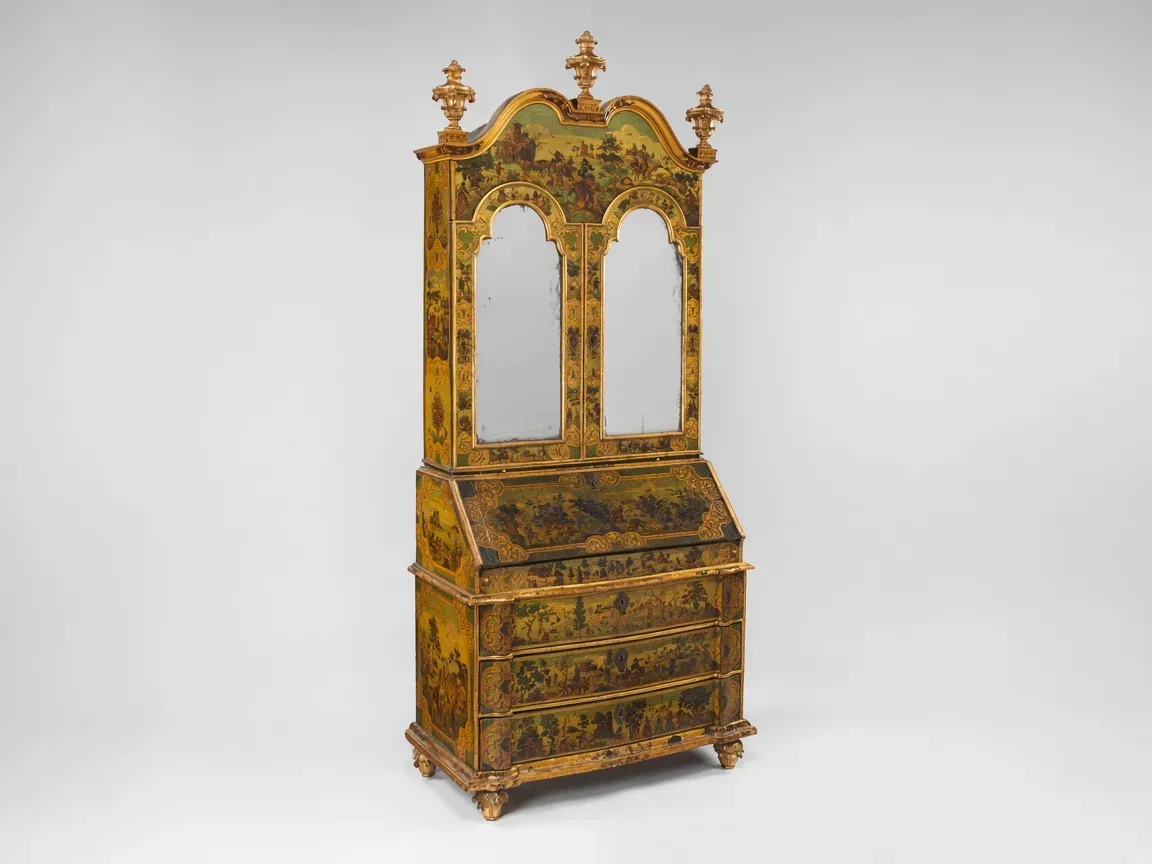
The name is a misnomer. Sotheby’s, following Giuseppe Morazzoni’s Il mobile veneziano del Settecento (Milan, 1958), notes that the form comes from the Anglo-Dutch bureau-bookcase, not from a French looking-glass. The Metropolitan Museum of Art says the same of its Venetian secretary of about 1730–35 (acc. 25.134.1a, b): the shape is an English bureau bookcase, the surface is Venetian.
What the form actually is
A period example is built in two or three stacked parts. The lower case is a serpentine or bombé chest, commonly with three long drawers. Above it sits a hinged slant front that drops to a writing surface and opens onto pigeonholes, small drawers, and a central well. The upper stage is a cabinet, often with a pair of arched doors. Those doors may carry mercury-backed plates, engraved glass, or (on some lacquered pieces) painted panels. A scrolling or broken pediment, sometimes with giltwood urns, finishes the outline.
Heights in museum and auction records cluster between about 226 and 276 cm. The Met secretary measures 259.1 × 111.8 × 58.4 cm. A yellow lacca povera cabinet sold at Christie’s, London, in 2004 (Venice, circa 1740) was 273 × 127 × 61 cm. A parcel-gilt walnut example at Sotheby’s in 2008, described as a rare small size, was 226 × 109 × 61 cm. Depth is usually close to 60 cm. A piece much shallower is worth treating as a later wall cabinet, not as a writing furniture type.
The interior is the functional argument. Doors open onto pigeonholes and a prospect cupboard. The fall-front hides further drawers. Secret wells behind the central door are period practice, not a dealer invention. Replacement safes, later engraved inner plates, and silk linings on the writing surface are common alterations. The Met example has a silk lining on the fall-front that the museum records as not original.
Palace walnut and villa lacquer
Morazzoni’s distinction, repeated in later sale notes, still holds as a first sort. The finest lagoon palaces took burr walnut, parcel-gilt carved members, and engraved mirrors. Country villas more often took painted lacquer or arte povera (also lacca povera, lacca contrafatta), the decoupage varnish that imitates Asian lacquer at lower cost. Neither finish is a later invention. Both belong to the Venetian settecento.
Ca’ Rezzonico, the Museo del Settecento Veneziano, keeps the palace type in the Sala Tiepolo: an imposing bureau-trumeau in walnut-root veneer, dated to the mid-eighteenth century, described by the Musei Civici as unmatched in Venetian cabinetmaking for size and state of preservation, and perhaps original to the palace. Getty’s room photograph of the same hall dates that walnut cabinet about 1740–1760. It is the object Italian dealers mean when they say trumeau in radica di noce.
The villa type is documented with equal precision. The Met secretary is pine, with carved, painted, gilded and varnished linden wood, coloured decoupage prints, and mirror glass. Daniëlle O. Kisluk-Grosheide’s 1996 study in the Metropolitan Museum Journal records the construction: two arched mirrored doors enclosing thirteen small drawers around a central niche; a sloping fall-front with six tiny drawers; three long drawers below; four carved feet; a scrolling pediment with three vase-shaped finials. The wood was painted blue-green over a thin gesso. The varnish has yellowed, which is why the object now reads yellow-green. Gilding is confined to mouldings, finials and feet. The pasted prints (hunting and harbour scenes, couples, chinoiserie, gods) come from French and German plates, not from a single Bassano pattern book.
Christie’s 2004 yellow cabinet shows the same technique on a golden ground, with Watteauesque pastorals on the sides, a naval scene on the fall-front, and hunting subjects on the drawers. Eighteenth-century ink on those drawers reads Prima, Seconda, and Terso di fondo. The cresting was catalogued as possibly associated; the block feet as later. Surface and carcass must be judged separately.
The varnish system itself is treated at length in the existing note on Venetian lacquer furniture of 1700–1800. On a trumeau the question is not only whether the film is sandarac, but whether the carcase under it is an eighteenth-century bureau-cabinet.
Carcass, drawers and hardware
The Met object is frank about construction: “very basic,” with the labour spent on the surface. That is typical. A Venetian carcase is a softwood box. Pine is recorded on the Met secretary. Drawer linings, backs and dustboards should be inspected for saw marks, oxidation, and the fit of the runners. Machine-planed backs, plywood, and Phillips screws are later. Hand-cut dovetails that stop short of the visible walnut or lacquer face are consistent with period work.
Drawer arrangement on the lower case is usually three long drawers of serpentine or bombé outline. Two short over three long occurs. Ink numbering on drawer backs, as on the Christie’s yellow cabinet, is useful when original. Later copies often omit it, or add it in a modern hand.
Mounts are gilt bronze or giltwood. Period pulls are cast, with corresponding lock plates that sit in the veneer rather than on it. Many feet are later. Christie’s walnut bureau cabinet of mid-eighteenth-century Venice was catalogued with later feet; the yellow lacca povera example stood on later block feet. A perfect set of carved gilt feet under an otherwise worn carcase is a warning, not a virtue.
Locks and keys are among the easiest later substitutions. A period lock is iron, often with a hand-filed bolt. Nickel, bright brass lever locks, and machine-stamped wards belong to the nineteenth century and after.
Mirrors and the upper stage
The upper doors are where the French word and the Italian object meet. Period plates were tin-mercury amalgam, slightly grey, with a characteristic sparkle of tin crystals under raking light. Bevels, when present, are narrow and a little irregular. The identification of Venetian wall mirrors applies here: backing method and glass quality date the plate, not a “Murano” label.
Engraved inner faces (a cavalier, a lady, a vase of flowers) are documented on palace walnut pieces. They are also a favourite of twentieth-century copies. An engraved pair that is optically brighter and chemically cleaner than the outer plates is usually later glass in an older door. Sotheby’s 2008 walnut cabinet had arched mirrored doors, a cartouche-shaped mirror in the cresting, and parcel-gilt urn finials on a pierced swan-neck pediment. That combination of engraved or plain plates with giltwood sculpture is the lagoon palace formula.
Glazed rather than mirrored doors occur. They do not make the object French. They make it a bookcase upper on a bureau base, which is what the Anglo-Dutch prototype was.
The upper interior should be fitted, not empty. Bare shelves behind mirrored doors often mean a lost interior or a later carcase. A central prospect door with a secret well behind it is the expected arrangement.
Later copies and redecorated originals
The market mixes four things that catalogues sometimes collapse into one word, trumeau.
Period walnut. Burr or figured walnut on a softwood carcase, parcel-gilt carving, mercury plates, serpentine drawers, mid-eighteenth-century Venice. Ca’ Rezzonico is the museum benchmark.
Period lacquer and lacca povera. Painted or decoupage surfaces of the 1730s–1760s, often with later feet, later silk, and associated crestings. The Met and Christie’s yellow cabinet are the published types.
Redecorated carcasses. Christie’s sold a green and gilt-japanned Venetian bureau-cabinet in 2010 as “mid-18th century and re-decorated,” with a reconstructed upper case, later bracket feet, and a Waring and Gillow label on the back. Japanning that sits over sanded losses, or chinoiserie that does not continue under the mounts, is later paint on an older box.
Copies and “Rococo style.” Christie’s has catalogued “Venetian Rococo style” walnut bureau-cabinets as a separate class from period Venice. In the Veronese furniture towns, especially around Cerea, workshops from the 1920s onward made full-size copies of palace trumeaux, including documented 1970s copies after the Ca’ Rezzonico type, signed and dated by the cabinetmaker. Those copies can use walnut-root veneer, square nails, and fir interiors in conscious imitation of eighteenth-century practice. They fail, when they fail, on glass chemistry, lock manufacture, the regularity of the veneer, and the absence of two centuries of movement in the joints.
A period piece moves. Hairline construction cracks in the walnut, filled and conserved, appear in the Sotheby’s 2008 condition report. A copy of 1977 does not have that history. It may have excellent craft. It is not a settecento trumeau.
Northern Italian relatives confuse the type further. A cassettone is a chest without the writing fall and upper cabinet. A wall console is finished on three sides and has no interior. Maggiolini’s pictorial marquetry, treated separately among Lombard inlaid furniture, is a different workshop culture: signed, neoclassical, and based on inlay rather than lacquer or burr. A trumeau with Maggiolini-style landscapes in veneer is almost certainly later pastiche.
Piedmontese bureaux in solid dark walnut or mahogany, with wooden upper doors and little or no mirror, are a related writing form, not Venetian. English mahogany bureau-bookcases of the same century share the typology and are sometimes the source, not the copy.
What to record before buying
Photograph the back, the underside, the drawer sides, every lock, and both faces of the mirror plates. Measure height, width at the widest bombé point, and depth of the writing section separately from the upper cabinet. Note whether the upper and lower cases are pegged, screwed, or merely stacked. Record any ink on drawer backs. If the cresting comes off, look at the colour of the wood underneath.
A mercury plate that has been resilvered, a fall-front relined, or a foot replaced does not by itself condemn an eighteenth-century carcase. A machine-sawn back, a bright bevelled mirror of even thickness, and a perfectly repeating walnut-root pattern usually do.
Very few Venetian cabinet-makers, carvers or gilders are named on these objects. Morazzoni already recorded the documentary gap. An invented workshop attribution is not a substitute for the carcase.
FAQ
What is a Venetian trumeau?
In Italian usage it is an eighteenth-century bureau-cabinet: drawers below, a fall-front writing surface, and an upper cabinet with mirrored or glazed doors. The French word originally meant a pier glass. Auction catalogues in English usually say bureau cabinet or secretary.
Is walnut more “correct” than lacquer?
No. Palace examples in Venice were often veneered in walnut burl with parcel-gilt carving. Pieces for villas were often lacquered or decorated in lacca povera. Both are period Venetian surfaces. Later copies exist in both materials.
How can later copies be recognised?
Look at the carcase first: saw marks, oxidation, drawer linings, locks. Then the glass: mercury amalgam versus modern silvering. Then the feet and cresting, which are frequently associated even on genuine pieces. Twentieth-century Veronese copies can be well made; they still lack the movement, wear and hardware of a settecento object.
Were makers’ names used?
Rarely. Sotheby’s, citing Morazzoni, notes that almost no cabinet-makers, carvers or gilders can be tied to surviving trumeaux. Unsigned is normal. A confident named attribution needs a document, not a verbal tradition.