
Italian Marquetry Furniture: Maggiolini Inlay & Collecting Guide
Identify antique Italian marquetry furniture: Maggiolini cassettoni, Piedmont ivory inlay, Sorrento tarsia, and how workshop pieces differ from later copies.
Italian marquetry furniture is not one workshop look. A fifteenth-century studiolo panel, a Turinese ivory-inlaid console, a Lombard neoclassical cassettone, and a Sorrento tourist box all use wood as a drawing medium, but they answer different patrons and different ideas of what a picture on furniture should do. For a collector, the useful question is rarely “is this Italian inlay?” It is which school made it, when, and whether the carcass is as old as the veneer.
This guide is for people who meet Italian marquetry furniture in auctions and dealer inventories: Maggiolini cassettoni from Habsburg Milan, Piedmontese ivory work associated with Pietro Piffetti, Renaissance perspectival intarsia, and later Sorrento tarsia lignea. A broader map of chests, walnut carving, and Venetian lacquer sits in our antique Italian furniture overview. What follows is the inlay itself.
What collectors mean by marquetry, intarsio, and tarsia
English-speaking catalogues usually say marquetry for pictures assembled from thin veneers and glued onto a carcass. Italian intarsio and tarsia cover a wider field: veneers laid as a mosaic, and also pieces let into a solid ground. Renaissance rooms at Urbino and Gubbio are intarsia in that older, architectural sense. Maggiolini’s mature furniture is ebanisteria — cabinetmaking whose decoration is wood on wood. Piffetti’s court pieces mix woods with ivory, mother-of-pearl, and tortoiseshell. Dealers blur the words; the object does not.
Two technical habits recur across centuries and help with dating. Hot-sand shading (tessere warmed in hot sand so one edge darkens) gives leaves and petals a modelled shadow without paint. Chemical tinting supplies colours no timber grows — green is the usual eighteenth-century example. Neither trick is uniquely Italian. What is Italian is how schools combined them with local species: walnut, maple, holly, olive, boxwood, fruitwoods from the lakes and hills, and, after transatlantic trade thickened, mahogany, rosewood, and ebony.
Hardstone mosaic is a different craft. Florentine commesso in semi-precious stones — Florentine pietra dura — can sit on a cabinet next to wood marquetry and is easy to confuse in a photograph. On the object, stone reads cold and mineral; wood reads as grain and pore.
Renaissance intarsia: the studiolo standard
Before Maggiolini was a surname on a label, Italian inlay had already been asked to do the work of painting and architecture at once. The useful museum benchmark is the pair of studioli made for Federico da Montefeltro. The room still in the Palazzo Ducale at Urbino, and its counterpart from Gubbio — designed in association with Francesco di Giorgio Martini and executed by Giuliano da Maiano’s Florentine workshop — turn entire walls into illusionistic cabinets: half-open lattice doors, books, armour, instruments. The Metropolitan Museum of Art now holds the Gubbio room and stresses linear perspective and the thousands of fitted slivers that produce shadow as well as object.
That standard matters in the trade for a negative reason. Portable “Renaissance intarsia panels” offered as fifteenth-century work are usually later: church fragments, nineteenth-century perspectival exercises, or Sorrento pictures with a Latin tag. A genuine Quattrocento architectural panel is thick and tied to a room. A thin picture-veneer with a hanging wire is another century.
Two eighteenth-century capitals: Turin and Parabiago
For practical collecting, eighteenth-century Italian marquetry splits into two courts.
Pietro Piffetti and Piedmont ivory inlay
Pietro Piffetti (Turin, 1701–1777) was appointed ebanista reale to Carlo Emanuele III on 13 July 1731, a post created for him. Auction scholarship following Alvar González-Palacios records a Roman stay around 1730–31 and contact with the French cabinetmaker Pierre Daneau, whose floral inlay — a taste with Dutch and French roots — Piffetti brought back to Savoy. His furniture for the royal palaces mixes engraved ivory, mother-of-pearl, and tortoiseshell with rosewood and walnut, often with gilt-bronze mounts by Francesco Ladatte. Early documented work includes a pair of cabinets of 1731–33 for the Gabinetto di Toeletta of Queen Polissena in the Palazzo Reale.
If a piece is crowded with engraved ivory arabesques on a dark ground, with restless Rococo outlines and precious materials that are not wood, think Turin before you think Milan. Piffetti’s market is museum and royal-collection adjacent. Most “Piffetti” labels on the open market mean in the Piedmontese taste.
Giuseppe Maggiolini and Lombard ebanisteria
Giuseppe Maggiolini (Parabiago, 1738–1814) is the name the trade uses for mature Lombard wood mosaic. Treccani places him in Milan from 1771, working with Giuseppe Piermarini on the renovation of the Palazzo Reale — furniture and the inlaid floor of the room later called Napoleon’s. The civic museums of Milan keep the documentary core of the story.
An early documented cassettone in the Museo dei Mobili at Castello Sforzesco (inv. Mobili 346, about 1773) still has a Rococo carcass: shaped outline, marble top, gilt-bronze mounts with theatrical masks and Chinese figures. The central chinoiserie medallions follow drawings by the young Andrea Appiani. The castle’s label notes local and imported woods and a donation to the civic collections in 1895. This is Maggiolini before the flat neoclassical box became a brand.
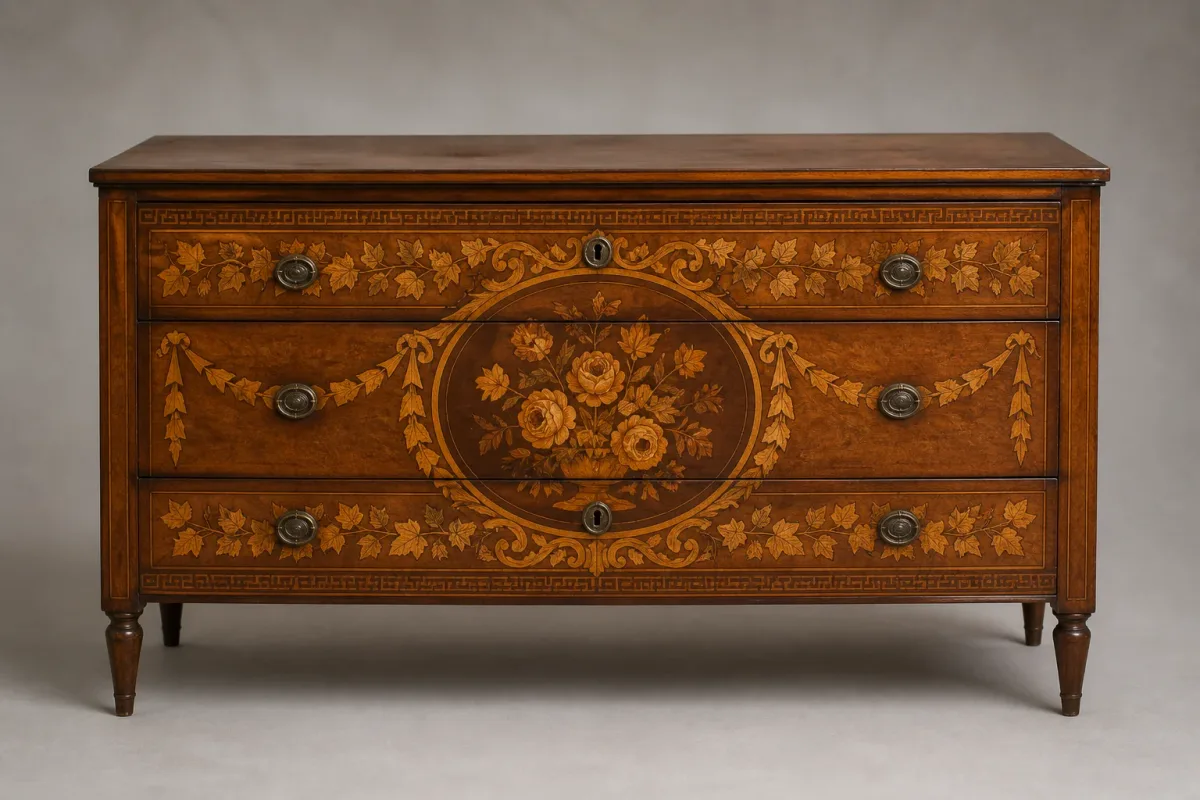
The mature type is almost the opposite. Geometric planes, little or no carving, tapered or vase-turned feet, and a façade treated as a picture: garlands, trophies, lyres, allegories, or “alla cinese” scenes assembled from naturally coloured woods. Italian biographical tradition credits the shop with several dozen species — more than eighty in the older literature — maple, holly, olive, boxwood, and hawthorn from the Como and Lecco hills, mahogany and ebony from overseas. Where no timber supplied a hue, veneers were tinted. Shadows were often sand-scorched. Cartoons came from painters and ornamentists in the Milanese orbit: Appiani, Giuseppe Levati, Giocondo Albertolli, Agostino Gerli.
A signed and dated civic example, discussed by the restorer and cataloguer Giuseppe Beretti, is the commode inv. 341 at Castello Sforzesco, marked with a burin on the left side Maggiolini Intarsiatore Delle LL.AA.RR. 1790 — inlayer to Their Royal Highnesses, the Habsburg court title. Signatures of that kind are rare. The title is a dating clue (Habsburg Milan before the French occupation of 1796) more than a certificate that Maggiolini’s own hand cut every leaf.
After 1796 the new French taste — mahogany fields and gilt-brass mounts — squeezed the old polychrome intarsia market. Maggiolini adapted. Treccani records the workshop continuing under his sons, including Carlo Francesco (1758–1834). The pupil Cherubino Mezzanzanica is named in the Parabiago literature as another heir to the bench. Production “in the Maggiolini manner” did not stop in 1814.
How a Maggiolini cassettone is built
Collectors buy the front and pay for the box. An eighteenth-century Lombard carcass is typically walnut with fir or poplar, drawers lined in pale secondary wood, hand-cut dovetails slightly irregular, runners worn. Show veneers should run continuously across a drawer front except where a restorer has pieced them. The inlay is pictorial, not a stamped transfer: leaf tips vary, sand-shading follows the form, and a burin may pick out a lyre string or a cartouche.
Beretti’s 1790 civic model is a useful template even when a market piece is not that exact type: a wide central drawer framed by narrower ones, the same division on the sides, walnut feet turned as vases with a simple groove and almost no inlay on the feet. Matching a motif to a sheet in the Fondo Maggiolini is stronger evidence than matching a photograph in a decorative-arts book.
Signatures, the Fondo Maggiolini, and the “stile Maggiolini” problem
Milan’s Gabinetto dei Disegni at Castello Sforzesco holds the Giuseppe Maggiolini graphic fund, acquired in 1882. Beretti and Alvar González-Palacios’s 2014 catalogue raisonné of the drawings treats nearly two thousand sheets as the visual archive of the shop: sketches, workshop copies, and cartoons supplied by Appiani, Albertolli, Levati, Gerli, and others. That archive is why Maggiolini scholarship can be unusually precise — and why auction houses still hedge.
A piece that corresponds to a numbered sheet is an attribution argument. A piece that merely has flowers on a rectangular commode is stile Maggiolini, the habit of covering a neoclassical box with wood garlands. Village joiners and nineteenth-century shops produced the latter in quantity. Some are honest furniture. They are not court inlay.
Practical tests:
- Drawing quality. Maggiolini-level work reads as a painting in timber: overlapping petals, convincing ribbon knots, acanthus that turns in space. Later copies flatten into silhouette.
- Wood, not stain. The older literature insists the shop preferred natural colour. Heavy aniline stain soaking into a “bouquet” is a later surface.
- Carcass date. A plywood back, machine dovetails, or identical routered mouldings around every drawer date the box, whatever the top looks like.
- Signature hunger. Engraved Maggiolini on a cartouche is not automatically genuine; Beretti has published cases where the furniture is right and the inscription wants a second look, and the reverse is commoner. Treat a name as a claim.
The same caution applies to “Piffetti.” Ivory engraved in the Turinese manner was imitated in the nineteenth century. Ask for a written material description before you bid — ivory and tortoiseshell now carry wildlife-law paperwork regardless of date.
Sorrento tarsia lignea: a nineteenth-century export school
Southern Italy’s best-known inlay school is later and more portable. The Museo Correale di Terranova in Sorrento dates the local industry to about 1830, when the cabinetmaker Antonio Damora began using straight-cut, two-colour marquetry — typically walnut against orange — with thin perimeter cuts filled with black stucco to sharpen the drawing. Damora’s furniture workshop on Via Tasso grew into a factory. Luigi Gargiulo turned toward small objects for travellers. Michele Grandville, whose shop is said to have employed dozens of hands, won a prize for inlay at the 1862 London International Exhibition.
By the late 1850s, guides already treated marquetry as a primary local industry. Subjects run from Pompeian ruins and the tarantella to later floral panels. Olive appears constantly, with walnut, poplar, orange, and, on ambitious pieces, ebony and rosewood. Early shading used hot sand; later work often adds Indian-ink hatching (ricacciatura) that can fade and leave blank silhouettes — a dating point. The Correale notes that polychrome wood mosaic recalling Roman opus tessellatum often marks historical Sorrento work against other nineteenth-century inlay.
The museum’s Saltovar collection, given in 1937 by Silvio Salvatore Gargiulo, includes tables, caskets, and the unfinished secrétaire à dos d’âne that occupied Giuseppe Gargiulo for about a decade after 1900. That is the quality ceiling. The trade floor is a twentieth-century jewellery box with Vesuvius. Both are Sorrento tarsia. Only one belongs next to a Maggiolini cassettone. It is a tourist-economy craft with documented founders, not a fake of Urbino and not a downgrade of Milan.
How to identify and date Italian marquetry furniture
Work through the object in this order.
1. Form and region. Bombe outline and painted or lacquered skin is Venetian, not Lombard inlay — see the lacquer section of the furniture guide. A flat rectangular commode with pictorial wood mosaic and little bronze is the Maggiolini problem. Ivory arabesques on a dark, curved Piedmontese carcass are the Piffetti problem. A small olive-wood box with a folk scene is Sorrento until proved otherwise.
2. Materials. Count species and look at edges. Eighteen-century Lombard work shows many small, tightly fitted tessere with sand-shaded tips. Sorrento often shows bolder two-colour contrast and black-stucco outlines. Ivory and shell move you to Turin or to a later pastiche.
3. Joinery. Pull a drawer. Eighteenth-century linings are pale, oxidised, and slightly out of square. Twentieth-century reproductions are regular, bright, and sometimes stapled. The backboards tell the truth the façade conceals.
4. Hardware. Original Lombard mounts are sparse on mature Maggiolini pieces; the 1773 chinoiserie cassettone is the exception that still wears Rococo bronze. A full set of identical, sharp “antique” handles on an otherwise tired commode is often a recent dressing. Compare mount holes inside the drawer front.
5. Wear and context. Genuine inlay abrades on corners and around handles. A crisp bouquet on worm-eaten feet is two dates glued together. In period rooms a Maggiolini-style commode sat with antique Italian silver and maiolica — including Deruta ceramics — not with a matching “set” invented last year.
None of this replaces a specialist who can stand the piece beside the Fondo Maggiolini. It stops you paying court prices for a 1900 bedroom suite.
Buying, condition, and export
Condition is almost never untouched. Drawer fronts split; restorers flood cracks with tinted filler that photographs as original shadow; tops and feet are swapped. Ask to see the underside and the drawer sides. Value tracks drawing quality, correspondence to a documented cartoon, completeness of a pair, and honesty of date — not how pretty the listing thumbnail is.
If you buy in Italy, objects of cultural interest may need an attestato di libera circolazione from the export office of the Ministry of Culture (Cultural Heritage Code, Legislative Decree 42/2004). Inlay does not exempt a commode. Ivory and tortoiseshell add wildlife-law paperwork on top of heritage law.
FAQ
Is most “Maggiolini” furniture by Giuseppe Maggiolini?
No. Documented workshop pieces are scarce. The shop under Carlo Francesco and later imitators across northern Italy produced stile Maggiolini furniture into the nineteenth century. Use the drawings in Milan, the quality of the inlay, and the construction of the box — not the name on a label.
How can I tell Maggiolini wood inlay from Sorrento tarsia?
Date, form, and contrast. Maggiolini work is usually furniture-scale, neoclassical or late Rococo, and pictorial in many natural woods. Sorrento work, from about 1830, is often smaller, tourist-portable, and built on bold walnut–orange (or olive) contrast with black outlines. Subjects help: a lyre and acanthus point north; a tarantella or Vesuvius points south.
Did Maggiolini use ivory?
The useful distinction in Italian literature is that Maggiolini’s reputation is ebanisteria — woods of many species — whereas Piffetti’s court manner depends on ivory, shell, and metal. Occasional mixed-media pieces exist in the wider Lombard trade. If ivory dominates the design, start in Turin, not Parabiago.
What is the Fondo Maggiolini?
The workshop’s surviving drawings, acquired by Milan’s civic collections in 1882 and held in the Gabinetto dei Disegni at Castello Sforzesco. The 2014 catalogue raisonné describes nearly two thousand sheets. Matching a piece to a sheet is the strongest non-invasive attribution tool the field has.
Does a marble top prove an eighteenth-century commode?
No. Tops were replaced constantly. The 1773 chinoiserie cassettone in Milan has marble because that was the Rococo type; later Maggiolini boxes often have wood tops. Date the carcass and the veneers, not the slab.
Conclusion
Italian marquetry furniture is a sequence of workshops, not a national veneer style. Separate Turin’s ivory-and-shell court manner from Parabiago’s wood mosaic. Treat “Maggiolini” as a problem of drawings, woods, and joinery, and Sorrento as a nineteenth-century export school with its own founders. The front of the piece will try to charm you. The drawer lining, the backboard, and the Fondo Maggiolini in Milan will tell you whether the charm is eighteenth-century.