
Albisola Maiolica Marks of the Grosso and Conrado Kilns
Albisola maiolica of Liguria is identified by lantern, crown and fish marks from the Grosso, Conrado and Pescio kilns of the seventeenth century.
Collectors treat Albisola as a Ligurian tin-glaze centre, not as a suburb of Savona. The kilns sat in two adjacent comunes on the Sansobbia: Albissola Marina, independent from 1615, and Albisola Superiore. English catalogues usually collapse both names to Albisola. The ware that concerns the antique market is seventeenth- and eighteenth-century tin-glazed earthenware painted in cobalt on a white or berettino ground, marked with a lantern, a crown, a fish, or a thistle. Later Futurist and Mazzotti production is a different collecting field.
Two comunes, one beach industry
Red clay in the plain, white earth on the hills, timber in the valleys, and a beach for drying and loading explain the site. Municipal history, matching the archaeological sequence kept at the Museo della Ceramica Manlio Trucco in Albisola Superiore, places the start of production in the last quarter of the fifteenth century. From the beginning the shops threw two bodies. Engobed and graffito earthenware, yellow-brown or green, served a cheaper market. Maiolica, biscuit-fired then dipped in a tin-opacified glaze and painted before a second firing, is the export ware.
The oldest cadastre, dated 1569, lists fourteen kilns: thirteen in what became Albissola Marina, one in Superiore. The 1612 cadastre adds a kiln at the hamlet of Capo and the first colour mill on the Sansobbia at Ellera. By 1640–41 the count is twenty-three kilns at Marina, one at Superiore, one at Capo, and two mills at Ellera. That density is the documentary peak of blue-and-white production.
Sixteenth-century output already includes laggioni, wall and floor tiles with Islamic or Renaissance patterns. The Trucco museum holds a maiolica-tile panel signed by Giovanni Giacomo Sciaccarama and dated 1554, the text of a resolution of the administrators of the Hospital of San Nicolò, painted white on blue. The same century produced a berettino type: a bright-blue tin glaze decorated in a darker blue, a Ligurian answer to the Faenza berettino ground. Archaeological fragments also suggest a local compendiario manner, a white field with sparse blue or polychrome drawing.
Calligraphic, tapestry, istoriato
Scholars of Ligurian maiolica distinguish three blue decorations that overlap in date. Calligraphic-naturalistic drawing, recorded in paintings of the first half of the seventeenth century, is taken as the earliest. Tapestry decoration (a tappezzeria) fills the ground with plants, insects and orientalising bulbs. Istoriato, or Baroque scenography, puts a mythological or religious scene in the well and a dense floral tesa on the rim. The sequence is a working tool, not a sealed chronology. A single kiln could paint all three.
The painter most closely tied to Albisola rather than Savona is Gerolamo Merega (also Girolamo), born at Albisola Superiore in 1636 and dead in 1679. In 1676 the pharmacy of Genoa’s Ospedale di Pammatone took in 456 decorated faience pots bearing the Assumption, the hospital’s emblem; the apothecary Giuseppe Curletto handled the supply. Genoese civic cataloguing attributes the Albisola set associated with that commission to Merega’s manufactory. An albarello from the group, Musei di Strada Nuova inv. P.418, is a cylindrical jar 21.5 cm high, painted in blue on white with plant motifs and the Latin contents mark Ung. Dialthee. The base carries a blue crown above a thistle (melega, a pun on Merega) and the capitals G and M. The same factory supplied stagnoni and electuary jars to the Ospedale degli Incurabili. These are the reference Italian albarelli for the Albisola pharmacy type: waisted or cylindrical bodies, parchment rims, animal-head handles on the wet jars, tapestry grounds on the reverse.
Grosso and the lantern privilege
The Grosso family is the Albisola kiln that the international trade can name. In 1641 the Genoese Senate granted their factory the right to mark wares with the Lanterna, the lighthouse of Genoa. Julia E. Poole, cataloguing the Fitzwilliam Museum’s Italian maiolica, states the later ownership as Grosso from 1641, Chiodo and Peirano from 1698 until 1738, and Chiodo alone from then until 1782. That chronology is the one used in the London rooms.
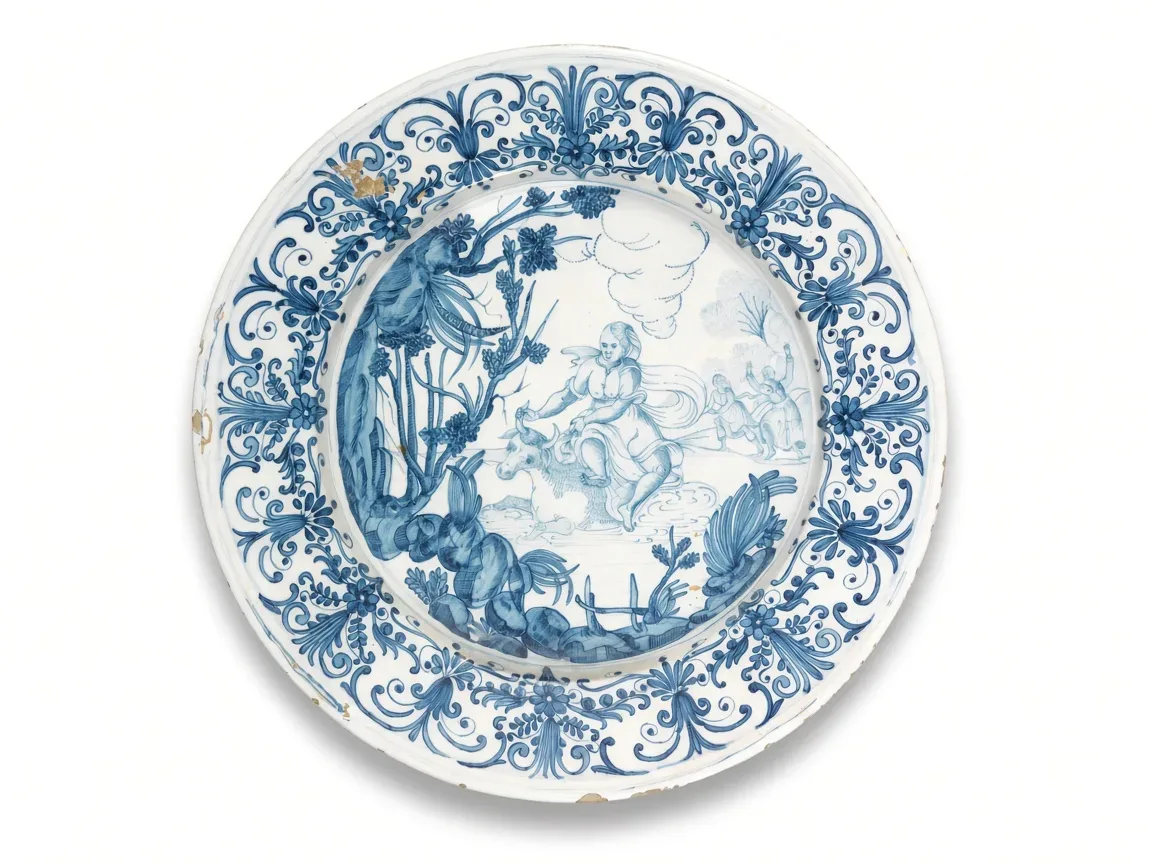
A circular dish sold at Bonhams, London, 7 December 2022 (sale 27800, lot 8), is the type piece. Diameter 45 cm. Painted in blue with the Rape of Europa in the well and a band of alternating floral and foliate motifs on the tesa; the reverse with a striped band reserved with stylised flowers above the footrim; lantern mark in blue; haircrack to the rim. A dish with a similar border and the Triumph of Bacchus, attributed to the same workshop, is in the Museo civico, Genoa, published by Federico Marzinot, Ceramica e ceramisti di Liguria (1979), ill. 259. A smaller Grosso charger, 34.5 cm, with a soldier before houses on a dense floral ground and a kraak-style divided border, carries the same lantern; Cecilia Chilosi, Ceramiche della Tradizione Ligure (Milan, 2011), nos. 64 and 67, are comparanda, with a dated example of 1683 as no. 72.
In 1698 Giovanni Francesco Chiodo and Domenico Peirano, already buyers of the Savonese Salamone equipment in 1694 for 1,300 lire, took over the Grosso manufactory and its privileged mark. Treccani’s biography of the Chiodo (Giuliana Santuccio, Dizionario Biografico degli Italiani, vol. 25, 1981) is the archival spine. Giovanni Francesco was apprenticed to the Salamone at fourteen in 1661, so born about 1647; he married Angela Maria Bianchino in 1667; he was maestro dell’arte sottile by 1702. On 11 August 1699 he and Peirano sold four cases of vessels to the ship captain Giovanni Bartolomeo Sormanok. The Chiodo factory itself stood in Borgo San Giovanni at Savona, not on the Albisola beach. After 1698 a lantern mark can therefore be Albisola Grosso, Savona Chiodo–Peirano, or a subcontractor obliged to use the lantern with painters’ initials. The mark is a privilege, not a GPS coordinate.
Paolo Chiodo, born 1671, and Agostino Peirano sued the maiolica potter Bernardo Corrado in 1715 for counterfeiting the lantern. Corrado, of the Albissola Conrado/Corradi line, marked with a staff, the letters B.C., and a crown. The Chiodo shop closed in 1770 under Giovanni Agostino Chiodo and Domenico Peirano. A later note, used by Ligurian mark lists, has the lantern continuing on Chiodo wares until a 1782 transfer to Pittamiglio–Astengo–Carlevarino, who stopped in 1786. Treat 1770 as the documented closure of the family firm and 1782 as the last commonly cited use of the privileged device.
Christie's sold a pair of late-seventeenth-century two-handled wet drug-jars, 49.9 cm high, with blue lantern marks, as “Savona or Albisola” (27 November 2013, GBP 7,500). Twin animal-head handles on grotesque masks, a mask spout above the flared foot, the Three Fates on one jar and mythological figures on the other: the form is Ligurian pharmacy sculpture, not a Faenza albarello. The catalogue’s hedging between Savona and Albisola is correct once the lantern has left Grosso.
Conrado, Pescio and the other Albisola devices
The Conrado (Corradi, Corrado, Conrade) were potters at Albissola by the late sixteenth century. Members of the family took the technique north. The Metropolitan Museum’s essay on French faience records a Conrado workshop at Lyon that both made local faience and imported Ligurian maiolica. Municipal Albisola history dates a Conrado transfer to Nevers to 1578. The Fornace Alba Docilia in Via Stefano Grosso, now a public seat of the MuDA at Albissola Marina, began in the early seventeenth century with the Conrado; the factory was renamed Alba Docilia in 1919 and closed in 1982.
The crown mark, sometimes misnamed a tocco, is the Conrado device on Albisola wares of the seventeenth and eighteenth centuries, often with the conductor’s initials: MC for Melchiorre Conrado, BC for Bernardo. A fish is assigned to the Pescio or Pescetto family, active in the second half of the seventeenth century and the early eighteenth. A radiated sun is given to the Salamone, a family stronger at Savona than at Albisola. None of these drawings is as tightly dated as the lantern privilege. Attribution still depends on paste, glaze colour, the density of the tapestry ground, and whether the well is calligraphic or fully istoriato.
How to separate Albisola from Savona
Savona is four kilometres west. Its eighteenth-century firms, above all Giacomo Boselli, took the polychrome a figuretti or Levantine style that Albisola produced only sparsely. Blue monochrome on a white or pale-blue glaze, with decoration running to the mid-eighteenth century and then shrinking to rims and cavetto, is the Albisola default. A globus cruciger with LL, BL or AL belongs to the Levantino orbit at Savona, not to Grosso or Conrado. A nail (chiodo) or a trumpet with a crossed banner is a Chiodo factory mark from Borgo San Giovanni, used before and beside the lantern.
Paste and wear help when the mark is missing or suspect. Albisola tin glaze of the high period is a cool, slightly bluish white; the cobalt sits in two strengths, a wash and a linear mark. Rim chips show a pale biscuit, not a brick-red Vietri body. Hairlines at the rim, as on the Bonhams Grosso dish, are common. Later copies thicken the blue, regularise the palmettes, and omit the pinholes and kiln speckle of a wood firing.
After the blue: taches noires and the nineteenth century
By the opening of the nineteenth century Albisola maiolica had shrunk to modest mugs and bowls, plain white or with a simple a fioracci spray in blue or manganese. Engobe-and-graffito ware continued alongside it. An excavation in 1983 at the Giacchino kiln in Albisola Superiore recovered late-seventeenth- and early-eighteenth-century terracotta: conventual graffiti, marbled engobe, kitchen jars, and shipboard containers, now at the Trucco museum.
The popular successor is the terracotta now called taches noires, a term taken from the Statistique of the Department of Montenotte compiled for Napoleon by the prefect Chabrol de Volvic. Manganese stripes or spots are painted under a lead glaze iron-stained to brown. Kilns multiplied at Capo, many bought or built by Genoese noble families, among them Della Rovere and Balbi. The ware was cheap, exported as far as America, then hit by French and Spanish duties. Manufacturers agreed to cap the number of firings per kiln. A darker manganese-brown “black earthenware” followed, then fire pots once the railway reached Capo. None of this is maiolica. A brown-glazed Albisola pot with black streaks is nineteenth-century utility ware, not a failed blue-and-white.
Twentieth-century revival, a separate market
Tin-glaze painting resumed at the turn of the twentieth century. The Poggi firm, from 1862, first made white dishes in the Mondovì manner in a round kiln; Nicolò Poggi moved into artistic ceramics. Giuseppe Mazzotti, called Bausin, entered in 1903. Tullio Mazzotti, known as Tullio d’Albisola, made the town a Futurist firing centre. Manlio Trucco, back from Paris, directed the Casa dell’Arte and then his own kiln, La Fenice; Arturo Martini worked there in 1926–27 on a commission from the Genoese architect Mario Labò. Those names belong in a modern-ceramics catalogue. They do not date a lantern-marked istoriato dish.
Dating checklist
Start with the mark, then distrust it. A lantern before 1698 can be Grosso at Albisola. After 1698 it can be Chiodo–Peirano at Savona, Chiodo alone, or a subcontractor painting under the privilege. A crown with MC or BC is Conrado. A thistle with G M is Merega. A fish is Pescio. Compare the drawing with a museum piece: Merega P.418 in Genoa for pharmacy jars; the Museo civico Genoa Bacchus dish, via Marzinot, for Grosso istoriato.
Date the decoration against the municipal sequence. Calligraphic and tapestry grounds dominate the seventeenth century. Full istoriato wells belong to the same century’s second half. Mid-eighteenth-century pieces go paler, with blue confined to the rim. Polychrome Levantine figurettes are more likely Savona. Taches noires and black earthenware are nineteenth century. Mazzotti and Fenice marks are twentieth.
Condition is part of dating. Wood-fired Ligurian maiolica shows glaze crawl, iron specks, and rim bite. A mint plate with a printed outline and a plastic shine is not a Grosso. Restoration on pharmacy jars is expected at the mask spouts and animal handles; a “perfect” wet drug-jar of this type is the one to question.
The Trucco museum, Corso Ferrari 193, Albisola Superiore, hangs the long series: Sciaccarama 1554, laggioni, the San Martino hospital loan, Giacchino kiln finds, taches noires from San Silvestro in Genoa, and the twentieth-century rooms. Fornace Alba Docilia, Via Stefano Grosso 24–26, Albissola Marina, preserves the wood kilns and settling tanks of a working factory. Liguria’s other historic export from the same coast is Altare glass; the two trades shared beaches and ships, not kilns. For how other Italian centres date by construction and painter rather than by a single privileged device, the Urbino and Castelli catalogues are the useful contrast.
FAQ
How can you tell Albisola maiolica from Savona?
By kiln history and decoration more than by clay. Albisola’s documented strength is seventeenth-century blue-and-white, Grosso, Conrado, Merega and Pescio. Savona’s eighteenth-century shops, Boselli included, pushed polychrome Levantine figurettes. After 1698 the lantern mark itself moves to the Chiodo factory in Savona.
What does the lantern mark mean?
It is the Genoese lighthouse, granted to Grosso of Albisola in 1641. From 1698 it is a Chiodo–Peirano privilege. Poole’s Fitzwilliam note runs the solo Chiodo use to 1782. Variants with painters’ initials record subcontracted work, not a second Grosso kiln.
How do you recognise a Merega pharmacy jar?
Look for the crowned thistle and G M, a blue tapestry or Assumption ground, and a Genoese hospital provenance when it exists. P.418 is 21.5 cm high and inscribed Ung. Dialthee. Merega died in 1679; jars in his manner without the mark are workshop or later.
Are Mazzotti or Tullio d’Albisola pieces antique Albisola maiolica?
No. Giuseppe Mazzotti’s firm dates from 1903. Tullio d’Albisola and Trucco’s Fenice belong to the 1920s and after. They are modern ceramics that happen to have been fired in the same towns.
What are taches noires?
Nineteenth-century lead-glazed earthenware with manganese spots or stripes under a brown iron glaze, named in Chabrol de Volvic’s Montenotte statistics. They are not tin-glaze and should not be catalogued as maiolica.