
Altare Glass: History of Ligurian Glassmaking and a Collector's Guide
Altare glass — Liguria's centuries-old tradition near Genoa. History, SAV cooperative, façon de Venise links, identification tips, and what collectors should know.
Venice dominates Italian glass in the popular imagination, but Altare glass tells a parallel story from the hills of western Liguria. For centuries the town of Altare, in the Val Bormida west of Genoa, produced blown and molded glassware that supplied domestic markets across Europe and, controversially, often passed for Venetian work. Today Altare survives less as a mass-production centre than as a documented craft tradition preserved at the Museo dell'Arte Vetraria Altarese. For international collectors, Altare offers a field where history, migration, and industrial cooperatives intersect — distinct from Murano branding yet deeply connected to it.
Altare in the Italian Glass Landscape
Altare sits roughly forty-five kilometres west of Genoa and eleven kilometres inland from Savona. Its glass industry developed independently of Venice from medieval roots: tradition holds that Norman or French glassmakers established furnaces here as early as the eleventh century, though the precise origin remains debated among historians. What is clear is that by the Renaissance Altare was manufacturing glass visually close to Venetian products at a moment when Venice was tightening control over its secrets.
In the fifteenth century the Venetian Republic confined master glassmakers to Murano under severe penalties, hoping to protect profitable techniques. Altare was not subject to those laws. Craftsmen could travel, teach, and establish workshops abroad. Britannica and other reference histories credit Altare glassmakers — together with Murano emigrés — with spreading Venetian methods across Europe, contributing to the international façon de Venise style of the sixteenth and seventeenth centuries.
That export of knowledge is Altare's defining trait: unlike Murano's guild enclosure, the town historically encouraged mobility. Collectors should therefore expect Altare-related material both in Liguria and in European collections labelled generically as "Venetian" or "Italian glass."
For the Venetian centre that Altare both rivalled and supplied, see our guides to Murano glass history and authentication and Murano glass techniques. For another regional Italian glass tradition focused on colour and utility rather than lagoon luxury, compare Empoli verde glass.
Guilds, the Università, and the SAV Cooperative
Altare's glassmakers organized through a guild-like structure known locally as the Università, which regulated techniques, training, and production rights within the community of vetrai (glass masters). Oral history and local scholarship describe strict control over recipes and workshop practice — not unlike Murano, but with a culture that still permitted outward migration.
A turning point came on Christmas night, 1856, when leading glassmaking families founded the Società Artistico Vetraria (SAV) — often cited as among Italy's earliest industrial cooperatives, pooling capital and labour under internal rules for assigning work, seniority, and mutual aid. The SAV produced:
- Household glass for daily use
- Pharmaceutical and chemical glass for laboratories and apothecaries
- Artistic pieces by master blowers outside routine production runs
The cooperative maintained an in-house company museum from the nineteenth century, saving exhibition pieces and prize-winning objects from national and international fairs. When the SAV failed in 1978, the Comune di Altare acquired that nucleus, forming the basis of today's public museum collection.
Understanding SAV production lines helps collectors: much surviving material is utilitarian or industrial rather than signed art glass. Value often rests on form, period, and documented Ligurian origin rather than a famous designer name.
The Museum Collection and Villa Rosa
Since the mid-2000s the Museo dell'Arte Vetraria Altarese has been housed in Villa Rosa, a Liberty-era villa designed by Nicolò Campora around 1905 and restored under the Italian Ministry of Culture. The building itself reflects glass wealth in Altare: prosperity from production and trade funded elite architecture in the Val Bormida.
The museum displays objects from roughly the late eighteenth century to the late twentieth century, plus tools, molds, and multimedia explaining blowing, tempering, and finishing. Outdoor demonstration furnaces in the garden host visiting maestri during seasonal programs, linking historical technique to contemporary practice.
For collectors, the museum is the primary calibration point. Before paying premium prices for "Altare" attribution at auction, study SAV tableware profiles, pharmacy bottles, and artistic exhibition pieces in the permanent display or published catalogues.
What Altare Glass Looks Like
Altare production spans utilitarian and decorative categories. Typical characteristics include:
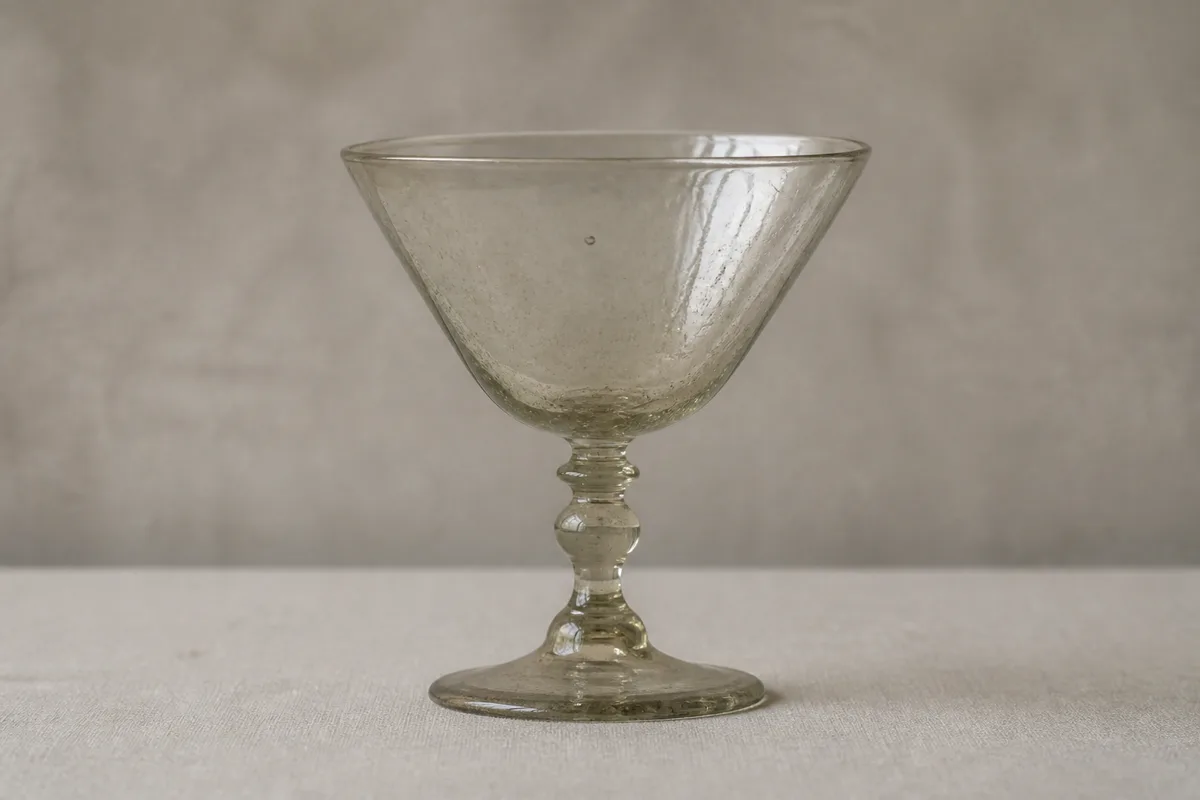
Thin blown soda-lime glass in clear, slightly gray, or pale greenish tones — closer to historical Venetian table glass than to the thick green verde of Tuscan Empoli.
Pharmacy and laboratory forms — bottles, flasks, and graduated ware with ground stoppers or lips, often unmarked but recognizable by standard typologies used across nineteenth-century Italy.
Table services and stemware in façon de Venise profiles — baluster stems, folded feet, and restrained decoration.
Exhibition art glass from SAV masters — rarer, sometimes documented through fair labels or museum provenance.
Because many pieces were sold without permanent factory marks, identification relies on form catalogues, regional dealer expertise, and comparison with museum examples — not on a single stamp like post-1970 Murano labels.
Identifying and Dating Altare Glass
Practical steps for collectors:
Study the base and lip. Hand-blown pre-industrial pieces may show pontil scars or ground pontil marks on the base. Machine-era SAV production shows more regular mold seams and uniform wall thickness from the late nineteenth century onward.
Assess wall thinness. Fine Altare table glass tends toward lightweight walls relative to folk utility bottles. Heavy green demijohns usually indicate other regions (often Empoli or generic industrial production).
Contextualize "Venetian" attributions. European and American inventories frequently label Ligurian or façon de Venise glass as "Venetian." Provenance research — estate location, old inventory labels, specialist dealer notes — often matters more than visual style alone.
Use museum and cooperative archives. The Istituto per lo Studio del Vetro e dell'Arte Vetraria (I.S.V.A.V.), linked to the Altare museum, supports research into local production. Photographing your piece alongside published SAV catalogue forms is safer than relying on online seller descriptions.
Avoid Murano assumptions. Filigrana canes, millefiori murrine, and heavy sculptural animals belong to different collecting markets. Altare's strength is historical blown table and industrial glass, not twentieth-century Murano designer branding.
Collecting Altare Glass Today
The international market for Altare material is specialist rather than mainstream. Expect:
- Entry-level pharmacy and utility bottles at modest prices when unattributed
- Documented SAV or Ligurian provenance pieces at higher tiers in European decorative-arts sales
- Strong institutional demand for objects with exhibition or cooperative history
Condition issues mirror other antique glass: chips, ground mouths, sickness (crizzling), and stopper loss affect value. Restoration of common utility bottles is rarely economical; buy honestly described condition.
Building a focused collection works well through themes:
1. Façon de Venise stemware as a subset of European Renaissance and Baroque table culture
2. Nineteenth-century SAV pharmacy glass as industrial design history
3. Ligurian regional study anchored by a museum visit to Villa Rosa
Photograph bases, measure heights, and record any paper labels or inventory numbers from estates.
Altare vs. Murano and Empoli
Three distinctions help international buyers:
| Aspect | Altare | Murano | Empoli |
|---|---|---|---|
| Primary identity | Migrating craft centre, SAV cooperative | Lagoon art-glass brand | Green verde utility and export design |
| Typical forms | Table glass, pharmacy ware, façon de Venise | Artistic techniques, designer lines | Fiaschi, demijohns, genie bottles |
| Marking | Often unmarked | Labels and signatures more common post-1900 | Sometimes "Made in Italy" on export |
Cross-read our silver hallmarks guide only if your collection spans multiple Italian decorative-arts categories — authentication methods differ entirely by material.
FAQ
How old is Altare glass?
Documented production reaches back to the Middle Ages; most collectible material on the market dates from the eighteenth through twentieth centuries, especially the SAV period (1856–1978).
Is Altare glass the same as Murano glass?
No. Altare is a separate Ligurian tradition. Historically some Altare work was marketed as Venetian, and both contributed to façon de Venise abroad.
What is the Società Artistico Vetraria?
A glassworkers' cooperative founded in 1856, producing household, pharmaceutical, and artistic glass until its closure in 1978. Its company museum forms the core of today's public collection.
Where can I see authentic examples?
The Museo dell'Arte Vetraria Altarese at Villa Rosa, Altare (SV), Liguria, is the main reference institution.
Does Altare glass hold investment value?
It is a scholarly and regional field. Buy for historical interest and documented quality rather than speculative resale; masterpiece pieces with provenance can perform well in specialist European sales.
Conclusion
Altare glass rewards collectors willing to look beyond the Murano label. Medieval furnaces, travelling masters, cooperative industry, and a museum housed in a Liberty villa compose a coherent Ligurian narrative. Whether you pursue a single façon de Venise goblet or a group of SAV pharmacy bottles, start with the Museo dell'Arte Vetraria Altarese, compare forms carefully, and treat "Venetian" attributions with healthy skepticism — Altare is Italian glass history written in migration, craft, and community rather than lagoon monopoly.