
Venetian Bronze Andirons, Knockers and Foundry Marks
Venetian bronze andirons and door knockers are identified by sectional casts, Roccatagliata putti models, and later Vittoria-type replica casts.
The bronze that leaves a Venetian palazzo hearth is not a Paduan inkwell. It is usually an alare (firedog, andiron) cast in stacked sections, or a battente (door knocker) hung on a street door. Both types reuse models for decades. Both rarely carry a punch of the kind used on Venetian silver. Identification is a matter of joints, chasing, and which foundry generation poured the metal.
The national types of small bronze, from Padua and Florence to later Naples, are treated in the antique Italian bronze collecting guide. Fire-gilt Roman mounts belong to a different trade, set out with the Italian gilt bronze workshops. What follows is the Venetian hearth and the Venetian door.
Civic bronze and the Arsenal foundries
Venice ran bronze as an industry before it ran it as furniture. Andrea del Verrocchio modelled the horse for the equestrian monument to Bartolomeo Colleoni. Alessandro Leopardi finished the model and cast it. Marin Sanuto recorded the unveiling on 21 March 1496. Leopardi signed the girth under the horse: Alexander Leopardus V. F. Opus. The marble pedestal carries the date 1495.
In 1503 the Procuratori de Supra (Paolo Barbo, Antonio Morosini, and Nicolò Trevisan) ordered bronze bases to replace the stone flagstaff supports in Piazza San Marco. The central pilo, inscribed with Doge Leonardo Loredan, was raised on 15 August 1505. The two lateral bases followed in 1506. Marine processions, an elephant, and lions in moleca occupy the reliefs. The same foundry culture that poured cannon at the Arsenal also poured candelabra, mortars, and the domestic alare. The Wallace Collection states that point on its Venetian firedog sections (inv. S80 and S81).
Jacopo Sansovino's bronze sacristy door for San Marco was a decade of payments, from 1546 into the 1560s. The founder Agostino Zoppo received advances to buttar l'historie e figure della porta. Piero di Zuane Campanato and Bartolomeo di Cavedoni cast ornament. The sculptor invented. The gettatore poured. That split remains the first fact on a Venetian bronze ticket.
How an alare is built
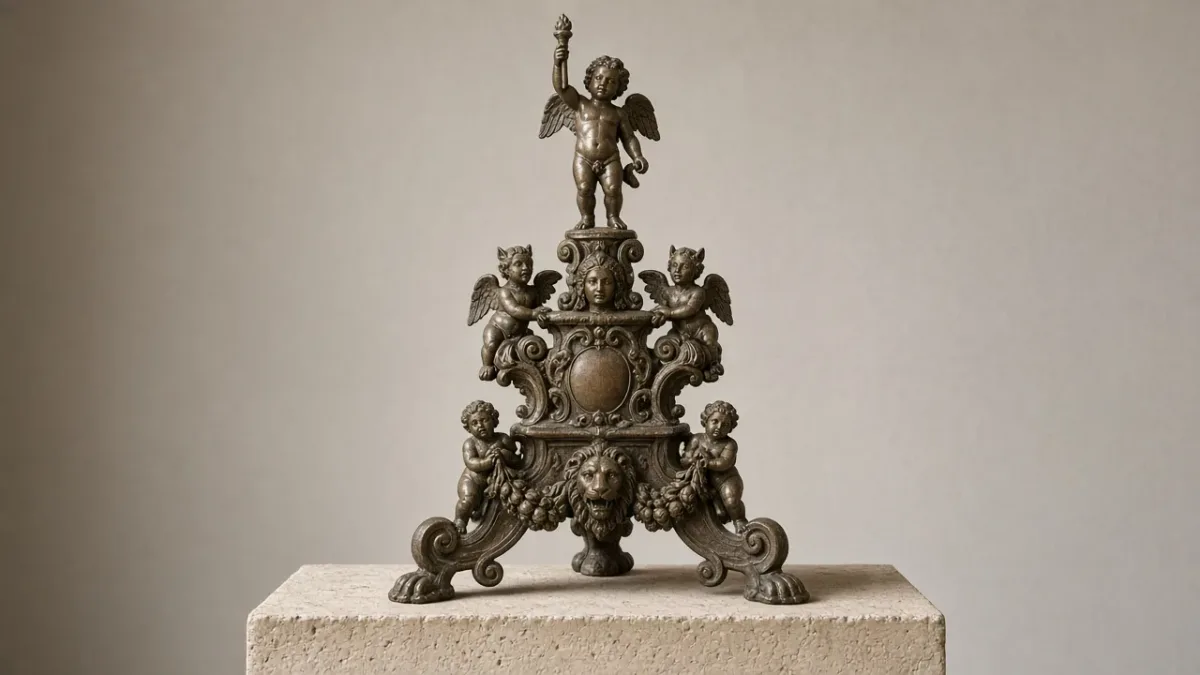
A full Venetian andiron is seldom one pour. The Metropolitan Museum of Art's example after a Roccatagliata model (Robert Lehman Collection, 1975.1.1387a, b) is a copper alloy 125.5 cm high, "cast in three segments," with a warm brown patina under a worn darker skin. The Bargello pair attributed to the same shop uses the same grammar: a wide fantastic base, a middle section of satyrs or putti, and a crowning figure.
The Wallace sections S80 and S81, once catalogued as candlestick bases, match the Bargello middle tier. The height of S81 is 28.43 cm (26.26 cm without a modern addition at the top). Depth is 16.3 cm. Early seventeenth century. Copper alloy, not a punched silver standard.
Museum pieces in the same family include:
- Galleria Giorgio Franchetti alla Ca' d'Oro: a hollow-cast andiron base with a pair of putti ending in grotesque masks, a fruit festoon, an empty shield, and a brown patina. From the Museo Archeologico di Venezia; deposited at Ca' d'Oro about 1926. Leo Planiscig attributed the pair (pendant Br. 96) in 1921 by comparison with putti in the Kunsthistorisches Museum, Vienna. The ICCD unique code is 00020933.
- Nelson-Atkins Museum of Art, 62-19/2: bronze andiron, about 1600, 106.05 × 56.52 × 40.01 cm, tripod base, lion-head mascaron, oval arms with a standing lamb, winged satyrs, and a crowning putto.
- Norton Simon Museum, F.1965.1.117.1-2.S: Mars 82.6 × 49.5 cm; Minerva 95.9 × 53.3 cm. The museum itself calls the Roccatagliata attribution tenuous and notes that the lower bases were not made for these guards. Joseph Duveen sold them as a pair. Completeness is not a given.
Christie's has sold later versions at 93 cm, 107.5 cm, and 116.8 cm. Height alone does not date the pour. A nineteenth-century pair can match a seventeenth-century silhouette.
Nicolò Roccatagliata and the putto shop
Nicolò Roccatagliata was Genoese. The death register of the parish of Santa Marina, Venice, for 22 October 1629 records "mistro Nicolò Rocca Tagliata scultor d'anni 70 in circa." The birth year is therefore about 1559 (Luca Siracusano, Dizionario Biografico degli Italiani, vol. 88, 2017). On 7 November 1571 the orphan Nicolinus bound himself for nine years to the goldsmith Agostino Groppo. Raffaele Soprani later named Agostino's son Cesare as the true master.
Documented Venetian work begins with the Benedictines of San Giorgio Maggiore. On 31 January 1594 (1593 more veneto) the monks commissioned bronze figures of Saint George and Saint Stephen, 61 cm high, still on the choir balustrade of Palladio's church. The Chronicon of the house records payment in 1595 to Cesare Groppo for the metal. On 15 March 1594 the same monks ordered twenty-two bronze wall lamps, each a putto turning into an architectural volute from the waist down. Claudia Kryza-Gersch noted later replicas of that lamp type at the Salute, San Trovaso, and San Nicolò al Lido. On 22 April 1596 Roccatagliata and Groppo contracted jointly for two choir candelabra about 180 cm high. Six putti replace the satyrs and harpies of earlier Venetian torches, among them Andrea di Alessandro Bresciano's paschal candlestick (before 1568, now at the Salute) and the 1577 candelabrum by the founder Orazio in Santo Stefano.
Planiscig's 1921 chapter titled Roccatagliata der Meister des Putto. The label stuck, and it overfilled the catalogue. Musical putti in Vienna, human pyramids of five, six (Museo Correr), and seven children (Prague), and countless andiron finials still travel under the name. Treat "Roccatagliata" on a dealer's card as a type until a specialist argues a specific model.
Cesare Groppo's will of 14 February 1606 left Nicolò, "che è stato mio garzon," half the shop stock. The son Sebastiano, also called Sebastiano Nicolini, is the documented continuer. With the founder Gabriele Orlandini he made the four Fathers of the Church for the choir of San Marco in 1614–15. On 4 December 1633 he and Andrea Balbi were paid for two candelabra in the Rosario chapel at Santi Giovanni e Paolo. On 15 July 1636 he contracted two angels for San Giorgio Maggiore "con l'agiuto del signor Pietro Bosello gettador." Pietro Boselli signed and dated the casts 1644. The French chasers Jean Chenet and Marin Féron cleaned them.
The bronze paliotto in the sacristy of San Moisè carries the most precise shop inscription in this group:
> 1633 / NICOL[INVS] ET / SEBASTIANVS ROCCATAGLIA/TA NICOLINI / INVENTORES // IOHANNES CHE/NET ET MARI/NVS FERON GAL/LI CVSORES ET / PERFECTORES
Inventores, not founders. Cusores et perfectores, the Frenchmen who poured and finished. Nicolò had been dead four years. A second inscription records the gift of Antonio Damiani in 1779. The 2011 restoration directed by the Venice Superintendency (lost-wax; separately cast projections seated in a three-part ground) confirmed the complexity of the pour.
Door knockers: the Neptune type
The street object is the battente, usually lyre-shaped. The most repeated Venetian model shows Neptune between two winged hippocamps, trident raised, tails locked at the hinge, forelegs on a shell handle. Victoria Avery catalogued the example in the Musei Civici di Vicenza (inv. S 123) as a later, summary cast after a mid-sixteenth-century Venetian model. The best-known fusion of that design is in the Kunsthistorisches Museum, Vienna (Manfred Leithe-Jasper, in La bellissima maniera, 1999, cat. 77). Planiscig gave the invention to Alessandro Vittoria. Avery notes more than forty recorded examples, many listed by Nicholas Penny in 1992, plus variants. Jan van Grevenbroeck drew the knockers still hanging in Venice in 1785 for Pietro Gradenigo. The sheets are in the Museo Correr. Grevenbroeck recorded no fewer than eleven Neptune knockers in the city.
The Vicenza cast measures 36 × 28 cm in the 1954 inventory. It came from Palazzo Cordellina in 1884. The coat of arms at the top is broken. Late, coarse chasing and an applied shield are the usual signs of a replica made for a later door, not of a mid-Cinquecento original.
Variants keep the lyre and change the centre: Neptune with lions (Museo Nazionale di Palazzo Venezia, Rome); Venus between dolphins (two in the National Gallery of Art, Washington); Judith, Mars, Hercules, a personification of Venice, a flying putto with grapes. A knocker attributed to Girolamo Campagna at the RISD Museum (about 1570–1599) uses a double-headed eagle, dolphins, and a gorgoneion. The point for the collector is the same as for the alare. The model is Venetian and sixteenth-century. The surviving metal may be seventeenth, nineteenth, or later.
Other names that migrate onto furniture
Tiziano Aspetti, Paduan by origin, supplied Venice with signed public bronze: the Vulcan relief on the anticollegio chimney in the Palazzo Ducale, the Moses and Saint Paul in the façade niches of San Francesco della Vigna, and the Lepanto busts of Sebastiano Venier, Agostino Barbarigo, and Marcantonio Bragadin in the armoury of the Council of Ten, generally placed in 1596–99. Planiscig also gave him a series of mythological statuettes used as andiron finials. Those small figures need the same caution as Roccatagliata putti. A Mars or Venus on a scrolled base is a Venetian furniture type. It is not automatically Aspetti.
Alessandro Vittoria's documented small bronze includes the Saint Sebastian of 1566 in the Metropolitan Museum of Art (40.24; 54.3 × 16.2 × 16.2 cm). Church figures of that class do not often reach the trade. What does reach the trade is the Neptune knocker design long associated with his name, and later reductions that borrow his proportions.
Girolamo Campagna held the large church contracts of the 1590s, including the high altar of San Giorgio Maggiore. Domestic objects from his shop are fewer and usually attributed rather than inscribed.
What later casts look like
Venetian models outlived the shops. The Wallace catalogue is blunt: designs continued over several generations, and most casts cannot be dated from motif alone. Practical tests follow.
Sections. An original alare is assembled from separately cast members with iron or bronze pins. A later single-pour souvenir compresses the tiers. A pair that does not share the same alloy colour, wall thickness, or core-pin pattern is a marriage.
Reverse and interior. Hollow Renaissance and early Baroque bases show investment residue, chaplet plugs, and often an unfinished back on the lowest tier. Christie's recorded that unfinished reverse on a late-sixteenth or early-seventeenth Jupiter andiron with the arms of the Soranzo family (118.7 cm), later converted by Robert Adam into a candelabrum for Luton Park after the 3rd Earl of Bute bought it in Venice between December 1769 and spring 1771.
Arms cartouches. Empty shields, as on the Ca' d'Oro bases, were stock. Applied arms can be original to the first owner or a later addition. The Soranzo example is cited because the cartouche facture matches the rest of the piece.
Chasing. Roccatagliata-type putti of good date have tight, rapidly modelled curls and a light cesello on eyelids and drapery. Nineteenth-century "in the manner" pairs (Christie's, 116.8 cm and 93 cm) repeat the silhouette with flatter hair and even, chocolate patination.
Completeness. Finials travel. The Norton Simon Mars and Minerva sit on bases that do not belong to them. Duveen also sold War and Peace figures from the same Cadogan group on smaller marble socles. A putto on a later ebonized wood base is a fragment, not a reduced masterpiece.
Knockers still on doors. Grevenbroeck's 1785 census is a reminder that Venice reused models in public. A Neptune battente offered as Vittoria is more often a later fusion of a popular type. Penny's list of forty-plus examples is the starting bibliography, not a census of autograph works.
Grand Tour bronze from Naples, and the Chiurazzi catalogue casts, belong to the national bronze story already published. They are not Venetian foundry products. A hearth pair in a lacquered salon of the eighteenth century is more likely to be a reused Seicento alare than a new Rococo invention. For the furniture around that hearth see Venetian lacquer furniture, 1700–1800.
FAQ
Did Roccatagliata sign his andirons?
Documented signatures belong to church work, above all the 1633 San Moisè paliotto, which names father and son as inventores and Chenet and Féron as founders. Domestic alari are attributed by comparison with the San Giorgio putti and candelabra. A modern plaque is not a period signature.
How can I tell a seventeenth-century alare from a nineteenth-century replica?
Read the joints, the reverse, and the chasing. Matching height (around 90–125 cm) is normal in both centuries. A single even patina, sand-cast softness, and perfectly paired arms usually argue for a later pair made as furniture.
Is a Neptune door knocker by Alessandro Vittoria?
The Vienna cast is the reference for the design. Planiscig gave that design to Vittoria. Most of the forty-plus recorded examples, including the Vicenza museum knocker, are later workshop or commercial fusions. Buy the type, not the name, unless a specialist argument is attached.
What foundry marks should I look for?
Unlike silver, Venetian bronze is seldom punched with a town mark. The useful inscriptions are long Latin texts on civic or church bronzes (Leopardi on the Colleoni girth; Roccatagliata and the French founders on San Moisè). An andiron or knocker is more often unmarked.
Should incomplete pairs be bought?
Yes, as fragments, priced as such. A detached putto, a middle section of the Wallace type, or a knocker whose hinge plate is lost is still a Venetian bronze object. It is not a complete hearth set.
Conclusion
Venetian bronze in the trade is a foundry product tied to the Arsenal and to a small group of named shops. Leopardi's civic casts show the industrial base. Roccatagliata, Groppo, Sebastiano Nicolini, Chenet, and Féron show how invention and pouring were split. The objects that circulate are stacked alari and lyre-shaped battenti, both of them models that outlived their inventors. A collector who can read a three-part andiron and a late Neptune knocker does not need a famous name on the ticket.