
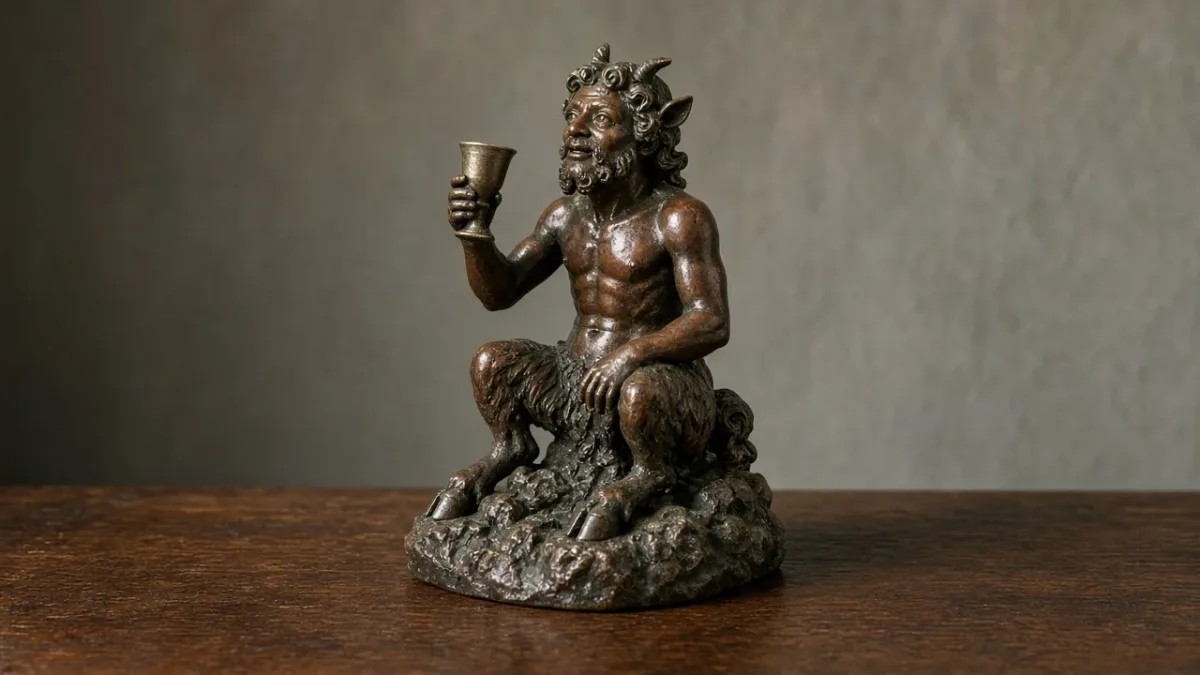
Antique Italian Bronze: History, Identification & Collector's Guide
A collector's guide to antique Italian bronze: Renaissance bronzetti, Padua and Florence, later casts, patina, and how to tell workshop from tourist copy.
The bronze on a dealer's table is almost never a Donatello. What the market still offers as antique Italian bronze is a small, handled object: a satyr with an inkwell, a Mercury on a round socle, a pair of andirons with putti, or a nineteenth-century reduction of a statue from Naples. The alloy belongs to the same family as the Gattamelata in Padua. The date, the foundry, and the finish almost never do.
This guide is for collectors who need to separate a Renaissance bronzetto from a workshop replica, and both from a Grand Tour cast that still has every right to sit on a shelf — provided it is bought as what it is. For hallmarks on precious metal, use our antique Italian silver hallmarks guide. Bronze, unlike silver, was rarely punched. Identification is a matter of facture, patina, and type.
What bronze is — and is not
Bronze is an alloy of copper and tin. Brass is copper and zinc. Florence preferred a lustrous reddish bronze; some northern European foundries ran brassier. Italian dealers still say bronzo for both, so the word on a ticket is not a laboratory result.
The usual method is lost-wax casting, cera persa. A wax model is invested in a refractory mould, the wax is melted out, and molten metal fills the cavity. Two families of this process matter for dating.
Direct casting destroys the wax original. One bronze, one model. If the pour fails, the sculptor's work is gone. Andrea Riccio in Padua often worked this way; the finished metal was then hammered and chased so light breaks across the surface.
Indirect casting takes piece-moulds from a surviving model, so the composition can be repeated. The Mantuan sculptor Pier Jacopo Alari Bonacolsi, called Antico (c. 1460–1528), is the earliest Italian artist known to have used the method routinely. Giambologna's Florentine shop later made replication a court industry. Later still, foundries in Naples and Florence used the same logic to sell reductions of museum statues. Multiples are not automatically fakes. They are evidence of a system. The question is which century ran it.
After the metal cools, the founder removes sprues, patches flaws with plugs, and a chaser (cesellatore) sharpens hair, eyelids, and drapery. Small iron core pins, or chaplets, that held the clay core in place often survive as tiny plugs.
From baptistery doors to the scholar's desk
Florence made bronze civic before it made bronze domestic. Lorenzo Ghiberti's two pairs of doors for the Baptistery (1404–24 and 1425–52) and Donatello's mature work set the standard. In Padua, Donatello's equestrian monument to the condottiere Erasmo da Narni, called Gattamelata — generally dated 1447–53, standing in the Piazza del Santo — is the earliest surviving Renaissance bronze horse and rider. It revived a Roman type known from the Marcus Aurelius in Rome.
For some eighty years from the 1440s, Padua, not Florence, was the main Italian centre for ambitious bronze. It was also where small bronzes for private rooms first became common. Art historian Andrew Butterfield, writing on Paduan bronze, noted the contrast: at a date when almost no one in Florence owned bronze statuettes, they were ordinary in the houses of the learned in the Veneto. Most Paduan examples are useful objects — lamps, bells, inkwells, incense burners — not pure display figures. Pomponius Gauricus, a friend of Riccio's, published De sculptura in Padua in 1504 and treated sculpture as a way to depict gods, men, and the whole of nature.
Wilhelm von Bode's catalogues of about 1904–07 put Italian small bronzes on a scholarly map. He assigned too much to Riccio. Later work peeled the group apart. That history matters because sale captions still recycle Bode's names.
Padua, Mantua, Florence, Venice
Padua. Andrea Briosco, called Riccio (1470–1532), is the name most often printed and the one most often stretched. Satyrs, drinking figures, and functional desk pieces in a dark, worked surface are the type. Severo Calzetta da Ravenna ran a far larger shop. In 1935 Leo Planiscig identified him from a sea-monster bronze in the Frick Collection signed O. SEVERI RA.; a marble St John in the Basilica del Santo at Padua is signed OPUS.SEVERI.RAV. Documents published by Silvio Bernicoli in 1914 show Severo's son Niccolò heading the workshop by 1538. The shop produced inkwells, oil lamps (including the acrobat type once mistaken for ancient), and animals. Desiderio da Firenze is a third Paduan personality, reconstructed by modern scholars from groups once given to Riccio.
Mantua. Antico worked for the Gonzaga and for Isabella d'Este. His nickname records the point: small bronzes all'antica, often with parcel-gilt details and silver-inlaid eyes, closer to a goldsmith's finish than to Paduan roughness. He also restored ancient marbles. If a "Renaissance bronze" looks like a cool, complete miniature of a famous antique, Mantua is the first file to open — then the nineteenth-century copy of that idea.
Florence. Giambologna (Jean Boulogne, 1529–1608), a Fleming in Medici service, turned the statuette into a court product. Compositions in the figura serpentinata — Mercury, Nessus and Deianira, bathing Venuses — were designed to be turned in the hand. Antonio Susini and his nephew Giovanni Francesco Susini continued the models into the seventeenth century. Technical studies of their shop show differences of alloy and assembly: Giambologna's figures often in a single pour; the Susini sometimes casting in parts and flow-welding joins for a cleaner skin. Florentine bronzes of the sixteenth to eighteenth centuries are prized for a translucent red-gold or reddish-brown lacquer, still visible in protected recesses if no one has stripped it. Massimiliano Soldani-Benzi (1656–1740) carried that lacquered finish into Medici Baroque reliefs, vases, and small groups.
Benvenuto Cellini's Perseus (1545–54) is the public Florentine bronze everyone knows. It is not what you will be offered at a fair. The market object is the reduction, the workshop variant, or the later aftercast.
Venice. Venetian founders supplied churches and palaces with andirons (alari), door knockers, and firedogs as much as with independent statuettes. Niccolò Roccatagliata (Genoa, 1559–Venice, 1629) is the name attached to late Mannerist andirons with putti, satyrs, and lion masks; a prototype is in the Museo Nazionale del Bargello. Tiziano Aspetti and Alessandro Vittoria belong to the same civic bronze culture. Fireplace bronzes often survive in later recasts; chasing and whether the elements were meant to stack are better tests than a famous surname.
The Bargello in Florence holds more than seven hundred small bronzes. A 2020–22 cataloguing project there stressed how early some provenances can be traced — into the sixteenth century, close to the pour — and how many objects are assemblies after the antique rather than unique inventions. Museum parallels are the collector's first tool. Attribution to a named hand is the last.
Bronze mounts and andirons also travel with antique Italian furniture: a walnut cassone or a Venetian commode may carry later mounts that have nothing to do with the carcass date. Judge the wood and the metal separately.
What collectors actually find
Autograph fifteenth-century bronzes of museum quality are not a hunting category. What appears, in roughly descending seriousness:
1. Sixteenth- and seventeenth-century workshop casts after Paduan, Mantuan, or Florentine models — sometimes contemporary with the inventor, often a generation later. Detail in hair and fingers, a coherent old surface, and a weight that matches the scale are the tests.
2. Eighteenth-century Florentine reductions from the grand-ducal bronze tradition: smoother, more even, still with that translucent lacquer when it survives.
3. Nineteenth-century foundry reproductions, especially from Naples and Florence, sold to travellers as honest copies. These are antiques in their own right.
4. Twentieth-century and later aftercasts (surmoulages) taken from existing bronzes: slightly smaller, edges softer, file marks crude, patina sprayed or chemically even.
The Neapolitan trade is the one most often mislabelled "Grand Tour bronze" without a foundry. Gennaro Chiurazzi (1840–1906) opened a foundry in Naples in 1870, later working from the Albergo dei Poveri. The firm took moulds in the Museo Archeologico Nazionale di Napoli and in Roman and Florentine museums; more than fifteen hundred plaster piece-moulds survive as the company's capital. Chiurazzi used lost-wax rather than the sand casting then common in industrial shops, which is why the best examples keep crisp detail. Sale catalogues offered the same model in several sizes and in three named patinas: Pompeii (green), Herculaneum (dark), and Renaissance (bright bronze). Sabatino de Angelis & Fils, another Neapolitan house recorded from about 1840 until 1915, supplied similar souvenirs; Karl Baedeker's 1896 handbook of southern Italy named both foundries as the city's best for copies of ancient bronzes. The two firms collaborated as the Società Chiurazzi–De Angelis, issued separate catalogues around 1900, and in 1910 merged as Fonderie Artistiche Riunite. De Angelis was absorbed by Chiurazzi by 1915. Signed bases — read them before you accept a Renaissance caption.
Florence had its own revival foundry. Clemente Papi (Rome 1803–Florence 1875), named Real Fonditore di Statue in Bronzo in 1843, recast large public bronzes, including the bronze David later placed on the Piazzale Michelangelo. After his death the Galli brothers signed work F.lli Galli / successori Papi. A signed Galli or Chiurazzi cast is a documented nineteenth-century object. An unsigned green "Pompeian" figure with no core-pin logic and a uniform cold patina is a later tourist bronze until proved otherwise.
Travellers who bought Chiurazzi reductions in Naples were shopping in the same souvenir economy as those who bought Roman micromosaics. The bronze is not lesser for that. It is a different category.
How to look at a piece
Work from the object, not the label.
Weight and wall. A lost-wax bronze of this scale is hollow but not tinny. Aftercasts from a finished bronze (rather than from a mould of the model) shrink and lose undercutting. Compare measurements with a published example; even a few millimetres matter.
Underside and interior. Look for core-pin plugs, remnants of investment, and whether the base was cast with the figure or soldered later. A perfectly smooth, unchased underside on a "Paduan inkwell" is a warning.
Chasing. Renaissance and good seventeenth-century surfaces show work in the metal: punched hair, sharpened lids, file marks that follow form. Sand-cast or late aftercast surfaces look porridge-like in the recesses.
Patina. Original Florentine lacquer is thin, warm, and worn on the high points. Chemical greens that sit on top of file marks are later. The Getty guidelines note that modern pigments and resins in a coloured coating can flag a recut or a fake; original layers sometimes survive only in recesses. Do not confuse a dealer's wax shine with age.
Marks. Renaissance bronzes were rarely signed. A crisp foundry stamp is usually nineteenth century or later — useful when it names Chiurazzi, De Angelis, or Galli; suspicious when it names Giambologna in Roman letters on a base that was never chased.
Type. An oil lamp shaped as an acrobat, a satyr inkwell, a sea-monster, a small Mercury, a pair of putto andirons: these are published types. If the dealer cannot point to a museum comparison, you are buying decoration.
Florentine hardstone cabinets and tabletops from the same Medici world are a parallel collecting field; see our Florentine pietra dura guide. The bronze and the hardstone were made for the same rooms. They do not authenticate each other.
Care, fakes, and export
Do not polish. Abrasive cloth takes off lacquer and the brown oxides that are the object's skin. Dust with a dry soft brush. If corrosion is active (powdery green, especially around iron pins), a conservator who treats sculpture — not a furniture restorer with metal polish — is the right trade.
Fakes in this field are usually aftercasts and misattributions, not newly invented compositions. A "Riccio satyr" with a uniform chocolate coating, no wear in the cup rim, and a drilled marble plinth from a lighting shop is a type, not a mystery. Later signatures added to unsigned casts are known; treat them as a warning, not as a bonus.
Export from Italy is not automatic for works of artistic interest. Nineteenth-century foundry reductions with invoices are one case; a claimed sixteenth-century bronzetto is another. Ask for export paperwork before you pay, as you would for any object that a Soprintendenza might notice.
FAQ
How can I tell a Renaissance Italian bronze from a later copy?
Start with facture, not the subject. Early casts tend to be individually finished in the metal, with wear consistent with handling and a patina that is worn, not sprayed. Later aftercasts are slightly smaller, softer in the face and fingers, and often sit on bases that do not belong. A Chiurazzi or De Angelis stamp is a gift: it dates the object to the Naples reproduction trade. An unsigned piece needs a museum parallel and, for serious money, technical examination.
Are antique Italian bronzes hallmarked like silver?
No. Civic punches that guarantee fineness belong to goldsmiths' guilds, not to bronze founders. A foundry name or inventory graffito is not a hallmark. If a bronze is sold with a "hallmark," ask what the punch actually is.
What is a bronzetto?
A small bronze, usually a statuette or a functional desk object, made to be handled and displayed indoors. Italian museums use bronzetto for the Renaissance and later cabinet bronze. The word does not mean "old" by itself.
Were Paduan bronzes all by Riccio?
No. Bode grouped too many Veneto bronzes under Riccio. Severo da Ravenna's shop, Desiderio da Firenze, and anonymous Paduan founders account for a large share of inkwells, lamps, and animals. Treat "Riccio" on a ticket as a type label until a specialist argues otherwise.
Should I buy a Chiurazzi bronze?
Yes, as a nineteenth- or early twentieth-century foundry cast. The best are lost-wax, sharply chased, and documented in the firm's catalogues. They are not Renaissance, and they should not be priced as if they were. Signed bases and one of the three named patinas (Pompeii, Herculaneum, Renaissance) are the usual evidence.
Can I clean the green on an old bronze?
Not with household products. Stable dark browns and worn lacquers are original or long-term surfaces. Powdery or bright powder-green corrosion needs a conservator. Green that was applied to look "Pompeian" is a finish; removing it is a restoration decision, not a cleaning.
Conclusion
Antique Italian bronze is a foundry problem before it is a famous-name problem. Learn Padua as the first home of the domestic bronzetto — Riccio, Severo, the inkwell and the lamp — then Florence as the court shop that learned to repeat a model without killing it. Venice supplied the hearth as much as the cabinet. Naples, in the age of Baedeker, sold the ancient world back to travellers in three catalogue colours. Without that sequence you are buying a satyr and a story. With it, you can tell a worked Paduan desk bronze from a Susini-type Mercury, and a Chiurazzi reduction from a tourist aftercast that only looks like one.