
Venetian Silver: Hallmarks, Lion of St Mark & Collector's Guide
Identify antique Venetian silver by the lion of St Mark, Zecca hallmarks, and 18th-century coffee pots. A collector's guide to dating marks.
The surest way to identify antique Venetian silver is not a gondola chased on the body, but a small punch: the winged lion of St Mark, usually crouched and seen head-on. That mark belongs to the Republic’s mint, the Zecca, and to the assayers who tested metal for the Arte degli Oresi. It is a civic guarantee, not a souvenir motif.
This guide is for collectors who already know the national Italian system — 800 versus 925, the 1934 lozenge, the 1968 star — and now need Venice as a separate file. For the later Kingdom and Republic of Italy punches, use our antique Italian silver hallmarks guide. What follows is the lagoon’s own language: guild rules at Rialto, the lion in moleca, the two punches you will actually find, and the coffee pots, sugar bowls, and church plate that survive in the market.
The Arte degli Oresi at Rialto
Venice treated gold and silver as a regulated civic craft, not a private luxury trade. Goldsmiths and silversmiths belonged to the Scuola, or Arte degli Oresi, one of the city’s oldest corporations. A surviving capitolare of 1233 — the guild’s written statutes, also called a mariegola — required members to mark finished work with the lion of St Mark and with the initials of the massari, the officers charged with inspection.
Training was long by design. An apprentice spent two or three years in a workshop, then worked as a lavorante (journeyman) before sitting a master’s test and opening a shop. Unlike Murano glass, which the state confined to one island, goldsmiths were free to set up where they chose. In practice they clustered on the Ruga dei Oresi at Rialto, the street still named for them. Related workshops on the mainland — Padua and Vicenza especially — belonged to the same commercial world; Vicenza remains a European jewellery centre.
The trade was large even in the Republic’s last decades. In 1773, when Venice’s population was nearly twice what it is today, the city counted 415 goldsmiths and jewellers, together with hundreds of gold-beaters (tiraoro and battioro) and diamond cutters. Everyday plate — pitchers, candlesticks, cutlery — sat beside jewellery in gold and silver filigree, enamel, and rock crystal. The guild itself vanished with the fall of the Republic at the end of the eighteenth century. Much of the jewellery heritage went with it; table silver and church plate are what collectors still handle.
Venetian interiors mixed that silver with carved walnut, lacquer, and glass. For the furniture that sat under it, see our antique Italian furniture guide.
How Venetian silver was marked
The theoretical five punches — and the two you will see
Under the Republic, the rule book imagined five marks on each object: the maker’s initials; a workshop sign (contrassegno di bottega); two assayer punches; and the Zecca (mint) mark. Piero Pazzi’s I punzoni dell’argenteria e oreficeria veneta (1992), the standard dictionary for the field, records that this full set was almost never applied. Giorgio Busetto’s plates for the Association of Small Collectors of Antique Silver make the same point: no surviving object with all five punches is known. Most Venetian silver carries two: an assayer and the Zecca.
That matters when an auction catalogue calls a pair of initials a “maker’s mark.” On Venetian hollowware those letters are often the toccador or sazador in Zecca — the public assayer — not the silversmith. A coffee pot punched MG with two stars, for example, is routinely catalogued as “maker MG”; specialist literature treats MG as an unidentified eighteenth-century assayer whose punch appears on pots, trays, and sugar bowls. Attribution to a named workshop then depends on a separate contrassegno, which is frequently missing.
The lion in moleca
The civic punch is the lion of St Mark in moleca (Venetian: in moéca): crouched, facing the viewer, wings fanned like a crab’s claws. Moleca is lagoon dialect for a soft-shell crab in molt; the compact frontal lion fits a small round punch the way a walking lion fits a flag. In fuller versions the lion holds the Gospel, sometimes with PAX TIBI MARCE EVANGELISTA MEUS (“Peace to you, Mark, my evangelist”).
The punch evolved from the fourteenth century to the end of the eighteenth. Early seals and later Zecca stamps are not identical; dating a piece from the lion’s drawing alone is a specialist’s job, which is why Pazzi and Ugo Donati’s I marchi dell’argenteria italiana exist. What the collector can do in the field is confirm that the lion is a struck, recessed punch with depth — not a shallow, “flat” engraving added to look Venetian.
Named assayers as dating tools
Because maker’s marks are scarce, documented assayers become the clock. Frequently cited punches include:
- Zuanne Cottini, goldsmith and assayer at the Venetian Zecca, with notices spanning the late seventeenth century into the 1740s. His initials, often with a tower between them in a quatrefoil reserve, appear on early-eighteenth-century coffee pots and on a documented tureen of the first half of the century.
- Marc’Antonio Bellotto, toccadore all’argento from 1776 to 1788, used by scholars to date rococo holy-water stoups and other late-century plate.
- Zuan Piero Grappiglia (1727–1802), whose punch appears with the lion on eighteenth-century reliquaries.
Chiara Tozzi’s study of a silver crucifix at Riva del Garda, derived from an Alessandro Algardi model and made in Venice in the last two decades of the seventeenth century, shows how far the system can be pushed: the object bears the territorial lion in moleca plus punches of Zecca assayers active around 1700 (including Anzola Castelli and Antonio Poma). Three assayer punches on one work is unusual; it is not evidence that the five-mark rule was commonly obeyed.
Marks on the Terraferma
The Republic was not only the lagoon. Before 1664, mainland towns used their own devices: Brescia a rampant lion, Padua St Anthony, Verona a shield with a cross, Vicenza an angel. In 1774 assay offices opened in twelve towns, each with a number in the assayer’s punch (Padua 1, Vicenza 2, Verona 3, and so on). A “Venetian” lion on a Paduan or Veronese object is state geography, not a contradiction.
After 1797: new rulers, new punches
The Republic fell in 1797. The Peace of Leoben assigned Venice to Austria until 1805; from 1805 to 1814 it belonged to Napoleon’s Regno d’Italia under Viceroy Eugène de Beauharnais; after Vienna it sat in the Austrian Regno Lombardo-Veneto until Veneto joined Italy in 1866.
Hallmarks followed the flags.
- Republican punches continued, with a brief Austrian interruption in 1805, until 1812. In 1805 Austria extended its lot-based system to Venice (15-lot and 13-lot fineness punches are recorded) for a few months only. The old Venetian marks then resumed until 1810–12.
- French decimal marks, approved by Beauharnais on 25 December 1810 and activated in 1812, replaced the lion system. After Napoleon’s fall the Austrian administration kept this “French” scheme for Lombardy–Veneto until 1872. Collectors then look for millesimal fineness (800/1000 for large works, 950/1000 for small) and territorial town marks — including, for Venice, devices such as the aplustre (a classical stern ornament) discussed in nineteenth-century northern catalogues.
- National Italian marks after 1872 are the optional, then compulsory, sequence already covered in the Italian silver hallmarks article: unofficial “800,” the 1934 lozenge with fasces, the 1944 lozenge without, the 1968 star, and province code VE.
The Republic did not stamp 800 or 925 on table silver. If you see a millesimal oval, you are after 1812, not in the Serenissima.
Forms collectors actually see
Coffee pots and table silver
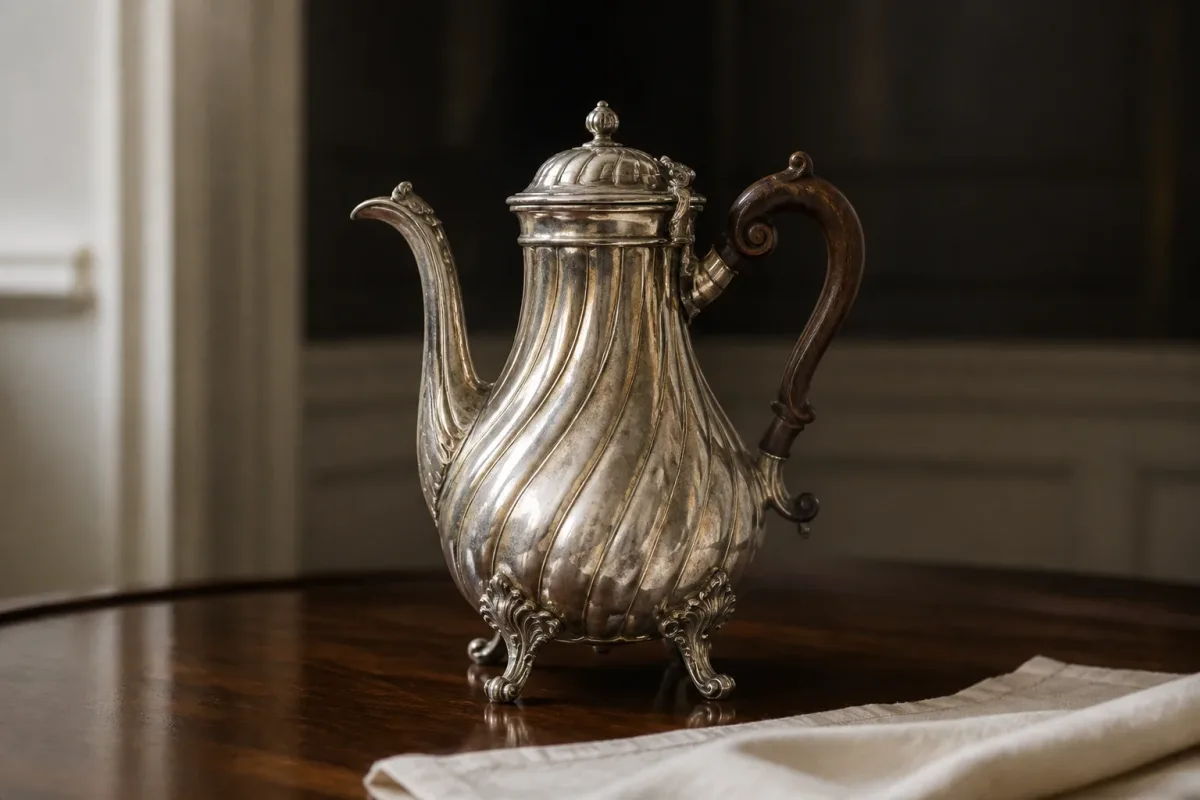
The object most people mean by “Venetian silver” in the trade is an eighteenth-century coffee pot: pear-shaped or fluted baluster body, three scroll feet, hinged cover, carved wood handle (often a bird’s head or a simple volute). Documented lots sit around 20–27 cm high and several hundred grams. Spiral gadrooning and a wooden insulator on the handle are workshop habits, not tourist style.
Closely related are oval, lobed sugar bowls with cast openwork cartouches around the rim — spoon holders — on a conforming pedestal foot. They were paired with spoons in a fiddle-thread taste that remained current in Venice well into the nineteenth century. Trays, salvers on foot, and tureens with artichoke finials and rocaille handles belong to the same dining service. Style moves from high Baroque swelling, through barocchetto and rococo, toward the cooler classicism of the 1780s–90s and then Empire after the French occupation.
Do not confuse this thin, highly chased sheet silver with later factory 800. Republican work is often lighter than a nineteenth-century Milanese pot of the same capacity; the quality is in the chasing and the punches, not in melt weight.
Church silver
A second, older market is liturgical: chalices with pierced, mixtilinear sub-cups and cherub heads; monstrances; reliquaries; crucifixes. A Venetian chalice in the national heritage catalogue shows the Zecca lion, an eighteenth-century toccatore punch matching Donati, and a workshop sign abbreviated L. SAM. A. Large baroque reliquaries with the lion and Grappiglia’s assayer mark still appear at Italian auctions. Treat these as ecclesiastical objects, not fancy tableware: export rules are stricter, and the iconography is liturgical.
How to identify a genuine piece
Work in this order, with a 10× loupe, before you polish anything.
1. Find the punches. Look under the foot of a coffee pot, on the base rim of a bowl, inside a cover flange, on the reverse of a spoon stem. Republican silver should show a lion in moleca and, usually, an assayer’s initials (sometimes with a small device between the letters).
2. Read the lion as a strike, not a picture. A genuine punch is a tool impression: edges slightly irregular, metal displaced, the lion’s wings and Gospel readable under magnification. A later “Venice-style” piece may chase a walking lion on the body and stamp a national 800 — pretty, and not Serenissima.
3. Do not assume initials are the maker. Check Pazzi, Donati, and Busetto before you write a name on a label. Cottini, Bellotto, and Grappiglia are assayers. A square cartouche with letters can be a workshop sign; it can also be unread.
4. Match style to the punch’s date. A Cottini-period pot should look first-half eighteenth century: strong fluting, barocchetto feet. A Bellotto-period stoup should look 1770s–80s rococo leaning classicist. A mismatch is a warning, not a romantic “reuse of old tools.”
5. Weigh the object as metal, not as theatre. Electroplate, ARG-plus-number stamps, and worn rims showing yellow base metal belong to a different article.
6. Use the later systems as negative evidence. A fasces lozenge or a star-and-VE polygon dates the piece to the twentieth century. It can still be Venetian manufacture; it is not Republic silver.
Fakes, spurious lions, and “Venice style”
Christie’s has catalogued an “Italian silver coffee pot, maker’s mark MM, Venice, circa 1750” that a saleroom notice re-described as bearing spurious marks for Venice, twentieth century. The form is easy to copy; the punch is the whole argument.
Italian specialist literature on anomalous punches describes modern lion in moleca stamps that are too flat, off-centre, and inconsistent from spoon to fork within a single canteen — a giveaway that a “San Marco” flatware service was dressed after the fact. The nineteenth-century aplustre is likewise imitated. Revival rococo of the late nineteenth and twentieth centuries often copies the fluted pot and then obeys national 800 rules. Price those as later Italian silver, not as Serenissima.
Over-polishing is a quieter form of damage. The lion lives in a few millimetres of struck metal. Abrasive paste can erase the only dating evidence the piece has. Photograph the punches before any conservation.
Museums, books, and the trade
For civic context, the Museo Correr on Piazza San Marco holds Teodoro Correr’s mixed collection, silver included. Ca’ Rezzonico, the Museo del Settecento Veneziano, shows how plate sat in a palazzo among furniture and ceiling canvases, not as a spotlighted trophy. Liturgical silver is scattered through churches, the Museo Diocesano di Arte Sacra, and mainland sacristies; the Riva crucifix is a reminder that “Venetian” work travelled with patrons far from the lagoon.
On the shelf: Pazzi for punches to Christmas Day 1810; Donati for Italian marks in one volume; Busetto / silvercollection.it for plates of the lion and of Lombardo-Veneto millesimal stamps. Auction silver departments remain the practical school for seeing Cottini and the lion on real feet.
Venice was a city of more than one luxury craft. Glass belongs to a different guild and a different island; start with our Murano glass history and authenticity guide rather than treating a millefiori paperweight as evidence for a silver punch. For another northern Italian furnace tradition, see Altare glass in Liguria.
FAQ
What is the single most useful mark on antique Venetian silver?
The Zecca lion of St Mark in moleca, almost always paired with an assayer’s initials. Treat those initials as a dating tool, not automatically as the maker.
Did Venetian silversmiths use 800 silver?
Not under the Republic. Decimal 800 and 950 belong to the French-inspired system introduced in 1812 and kept in Lombardy–Veneto until 1872. After Italian unification, 800 becomes the ordinary working standard nationwide.
Why do catalogues disagree on “maker” versus “assayer”?
Because the five-mark rule was rarely followed. International catalogues often read any initials as a maker. Venetian scholarship (Pazzi, Busetto, museum cataloguers) usually reads them as the toccador unless a separate workshop sign is present.
How can I tell a Republic piece from later “Venice-style” silver?
Look at the punches first. A republican object should carry a struck lion and an assayer. A revival or tourist piece often has a chased lion in the ornament and a national 800 or a star-and-province mark. Inconsistent, shallow lion punches on a whole flatware service are a documented fake pattern.
Are mainland pieces (Padua, Verona, Vicenza) “Venetian silver”?
They are silver of the Venetian state. Before 1664 they used local civic devices; after 1774 they used numbered assay-office punches. Collect them with the Terraferma in mind, not as lagoon workshop work.
Is church silver a good place to start?
Only if you want a specialist category. Chalices and reliquaries are among the best-documented objects — heritage catalogues often transcribe every punch — but they raise liturgical, conservation, and export issues that table silver does not.
Conclusion
Antique Venetian silver is a mint problem before it is a style problem. Learn the lion in moleca, learn that two punches were the norm, and learn a handful of assayers whose dates you can check. Then the coffee pot with the wooden handle and the fluted body becomes readable: Republic or Lombardo-Veneto, lagoon or Terraferma, honest strike or later costume. The chasing will still matter, and so will condition. Without the punches, though, you are guessing at a souvenir. With them, you are in the same civic system the massari of the Arte degli Oresi were paid to enforce.