
Antique Italian Furniture: Cassoni, Walnut & How to Identify
Identify antique Italian furniture by period and region: cassoni, walnut carving, Venetian lacquer, Maggiolini marquetry, and 19th-century revival.
Italian furniture is not one style with a national hallmark. A Florentine cassone of about 1550, a Venetian lacquered commode of about 1750, and a Lombard inlaid cassettone of about 1790 share a peninsula and little else. What they do share is a workshop culture: local woods, architectural ornament, and a market that — from the Grand Tour onward — has been unusually willing to copy itself.
This guide is for international collectors who meet “antique Italian furniture” in auctions and dealer inventories. It covers the forms that actually survive, how regional schools differ, and how to tell a sixteenth-century chest from a nineteenth-century one made to look like it.
The Cassone: Where Italian Furniture Begins
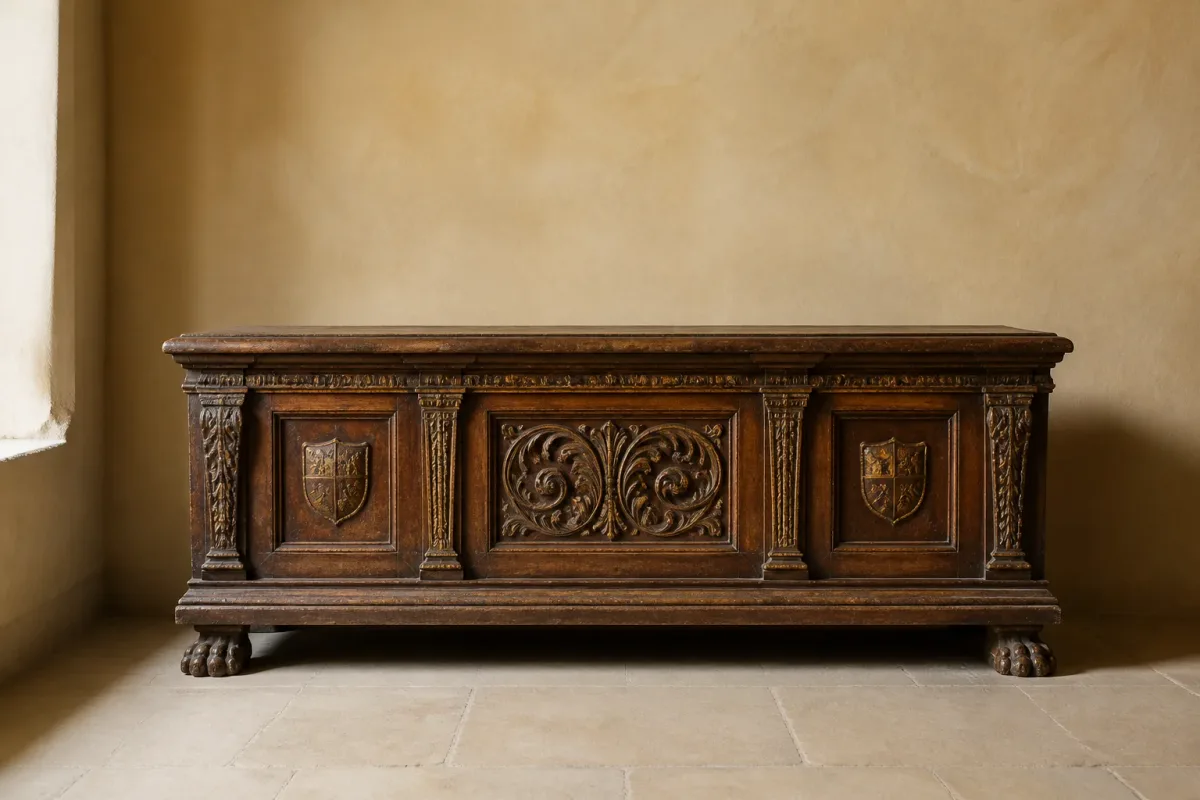
The object most people picture first is the cassone, a large decorated chest made in Italy from the fourteenth to the sixteenth centuries. Next to the marriage bed, it was among the most valued furnishings in a wealthy Renaissance household. Chests held clothing, precious fabrics, and other valuables. They were often commissioned around a marriage and carried, laden with the bride’s goods, in the nuptial procession.
The Metropolitan Museum of Art’s Heilbrunn essay on nuptial furnishings (Deborah L. Krohn, 2008) is the clearest English-language summary of what the documents actually say. Contemporary inventories used cassone and forziere for large storage chests. Archival work has suggested that fifteenth-century Florentine inventories preferred forzieri da sposa — betrothal chests — for the pairs ordered to hold the dowry. Cassone may describe a subset of those chests, especially ones shaped like antique sarcophagi. Between the public marriage agreement (giuramento) and the ring day (anellamento) there were often three to six months in which a pair of chests, plus other furnishings for the nuptial chamber, could be made: spalliere (wainscoting or shoulder-height painted panels), lettucci (daybeds), and lettiere (beds).
Workshops coordinated carpenters, gilders, painters, and locksmiths. An account book of the Florentine painter Apollonio di Giovanni, known from a 1670 copy covering eighteen years of the shop, confirms that wedding chests were commissioned in pairs and that a painted front could take about a month. Giorgio Vasari, writing in the mid-sixteenth century, already treated painted cassoni as a fashion of the recent past, still visible in Medici and other noble houses. Subjects on the fronts were secular: classical history, chivalric romance, biblical narrative used as a moral for the newly married — not altarpiece piety.
Construction varies with date and ambition:
- Painted and gilded gesso on poplar or pine carcasses is typical of many Quattrocento examples. Raised ornament was often modelled in gesso, sometimes with moulds, then gilded. The Met’s Tuscan cassone of about 1425–50 (Robert Lehman Collection) uses that method: facing eagles, armorial shields, fleurs-de-lis.
- Carved walnut, more common as the Cinquecento advanced, is the type collectors still find in the trade. A mid-fifteenth-century Florentine cassone in the Met is walnut, gilded and painted; later Roman and Florentine chests push the carving toward architectural relief — pilasters, acanthus, sphinxes, paw feet.
Genuine fifteenth- and sixteenth-century cassoni with intact carpentry are rare. Most “Renaissance chests” on the market are later. That is not a scandal if the later piece is honestly dated; it is a problem if a dealer sells a Florence 1880 walnut revival as Florence 1550.
From Chest to Cassettone
Italian writers treat the cassettone (chest of drawers; the French commode) as the architectural descendant of the cassone. The conservation journal In Forestauro summarises a standard chronology: a true multi-drawer chest appears in the sixteenth century and becomes a major form in the seventeenth. Early examples are large, rectangular or slightly trapezoidal, built to hold linen and toilet accessories. By the late Seicento the cassettone is no longer only storage. It is a display object for a reception room, with carved figures, ivory inlay, gilding, and gilt-bronze mounts used with Baroque excess.
The form then splits by region and century. A Brescian or Veronese canterano of the later 1600s may be inlaid, with diamond-patterned formelle and a carcass of fir or poplar. A Venetian commode of the 1730s–60s is another animal: bombe outline, thin cabriole legs, and a painted or lacquered skin. A Maggiolini cassettone of the 1780s–90s is almost the opposite — flat neoclassical planes covered in wood mosaic.
Baroque: Rome Is Architecture, Venice Is Surface
Italy invented the Baroque, and furniture followed architecture. Roman production, shaped by the papal court, tends toward mass and stone: console tables with carved gilt bases and marble slabs, cabinets that read as small façades, gilt bronze, polychrome marble. Venetian furniture of the same century is lighter in silhouette and more decorative, with a long habit of painted and gilt surfaces that the next century would turn into lacquer.
Do not date a piece by “Baroque” as a brand. Look at the mass of the legs, the depth of the undercutting, and whether the ornament is carved from the structural wood or applied. Reproductions often get the scrolls and fail the hidden tenons.
Settecento Venice: Lacquer and Lacca Povera
Eighteenth-century Venice is the Italian furniture school most foreigners already think they know: pale grounds, chinoiserie, floral trails, bombe commodes that look too curved to stand. Two techniques are easy to confuse.
True Venetian lacquer is painted decoration under many coats of varnish, often in imitation of East Asian lacquer that arrived through the city’s trade. Grounds run red, black, pale blue, verde, cream. Quality is in the drawing, the evenness of the ground, and the depth of the varnish, not in how “Chinese” the scene looks.
Lacca povera (also called arte povera or lacca contraffatta in period language) is a cheaper, faster cousin. Craftsmen glued cut-out prints onto the wood, coloured them, and sealed the surface with repeated thin coats of varnish (often described as sandarac or shellac in later Italian literature) so the paper disappeared and the piece looked painted. The Remondini family of Bassano del Grappa printed small sheets specifically for this use — figures, flowers, landscapes, gallant scenes — on thin paper meant to vanish under the finish. The same method was used inside drawers and cupboard doors.
Lacca povera is not a fake of lacquer in the modern sense. It was a recognised Venetian product. Surviving examples are now scarce enough that they often cost more than a comparable fully painted piece of the same date. What you should distrust is a “Venetian lacquer commode” whose prints sit on the surface like decoupage, with modern polyurethane shine and no wear in the handles.
Maggiolini and Lombard Intarsia
If Venice painted, Lombardy inlaid. Giuseppe Maggiolini (Parabiago, 13 November 1738 – 16 November 1814) is the name attached to the mature Lombard cassettone. The civic museums of Milan keep a documented early work: a rococo cassettone with chinoiserie decoration, gilt-bronze mounts, and a marble top, about 1773 (Castello Sforzesco, Museo dei Mobili e delle sculture lignee, inv. Mobili 346). The central orientalising scenes follow drawings by the young Andrea Appiani. The piece entered the civic collections in 1895.
Maggiolini’s mature work is neoclassical: geometric carcasses, tapering or truncated-cone feet, and surfaces treated as pictures in wood. He used local Lombard species together with imported mahogany and ebony. Designs came from painters and architects in the Milanese orbit — Appiani, Giuseppe Levati, and, in the broader neoclassical circle, figures such as Giuseppe Piermarini. In Forestauro notes that Italian literature also associates Maggiolini’s shop with cartoons after Piranesi. Workshop drawings survive in Milan and are the scholarly control for attributions. A piece “in the manner of Maggiolini” is common; a piece that matches a documented cartoon is not.
After 1796 the Napoleonic taste for mahogany and brass mounts squeezed the old polychrome intarsia market. Maggiolini adapted; the shop continued under his son Carlo Francesco and the pupil Cherubino Mezzanzanica. For collectors, “Maggiolini” on a label is a wish. Look for the drawing quality of the inlay, the range of woods, hot-sand shading in the leaves, and a carcass that is eighteenth-century in construction, not a nineteenth-century box with a pretty top.
Empire, Restoration, and the Long Nineteenth Century
Empire furniture in Italy follows the French model more closely than Venetian rococo ever did: mahogany or walnut parallelepipeds, marble tops with sharp arrises, gilt-bronze mounts used sparingly and symmetrically, block feet or a moulded plinth rather than tall Directoire legs. In Forestauro’s account of the cassettone describes a typical bedroom commode: a shallow frieze drawer under the top, two deep drawers below, side pilasters that may end in classical heads or capitals, ring handles on round backplates.
This is honest furniture and often undervalued next to the Settecento. It is also easy to confuse with later hotel Empire. Original mounts have crisp chasing and a colour that gilt paint cannot fake. Later copies have identical “antique” mounts on every drawer, machine-cut dovetails, and mahogany veneer over particle board or plywood.
The second half of the nineteenth century produced something more dangerous to the Renaissance collector: revival carving of very high quality, especially in Florence. Luigi Frullini (1839–1897) ran a workshop in Via Santa Caterina and exhibited Renaissance-revival walnut at the 1862 London International Exhibition and at the Paris Expositions Universelles of 1867 and 1878. The Metropolitan Museum holds his walnut relief Triumph of Bacchus (about 1890). Auction catalogues record signed cabinets, folio stands, and X-frame armchairs for English and American patrons. His carving is not a fake of 1550. It is a nineteenth-century sculptural performance in walnut, often signed, and it should be collected as such.
Florentine historicist shops of this generation — Frullini, pupils such as Rocco Focá, and many unsigned benches — are why a “sixteenth-century” cassone needs a construction argument, not a style argument.
Woods, Joinery, and What Age Looks Like
Walnut (noce) is the signature structural timber of carved Tuscan and Roman furniture. It darkens, moves across the grain, and takes a deep polish. Poplar and fir are carcass woods, especially in the north and in painted work. Limewood appears in carved gilt bases. Mahogany is a dating clue for Empire and later. Fruitwoods, boxwood, holly, olive, and maple show up as inlay.
Construction tests that still work:
- Joinery. Hand-cut dovetails are irregular. Mortise-and-tenon frames predate the staple gun by several centuries. A perfectly uniform machine dovetail on a “Baroque” carcass is a date, not a virtue.
- Tooling. Hand-carved acanthus has slight asymmetry and undercutting you can feel. Routered ornament is even at every repeat.
- Gilding. Water gilding over red or yellow bole can show leaf overlaps and worn high points. Spray gilt is flat and brassy.
- Hardware. Hand-forged nails, replaced locks, and later handles are normal. A full set of identical, sharp, “period” mounts on an otherwise tired commode is often a recent dressing.
- Oxidation. Interior wood that is as dark as the show face has been stained. Interior wood that is paler, with dust and old glue in the joints, is more believable.
None of these tests replaces a specialist. They stop you paying quattrocento money for a Grand Tour souvenir.
How Period Rooms Were Actually Furnished
A cassone did not stand alone. Renaissance chambers mixed chests with textiles, painted spalliere, and, later, tin-glazed earthenware. Dining rooms of the eighteenth and nineteenth centuries put furniture beside antique Italian silver and maiolica. Tuscan interiors of the last two centuries often added coloured Empoli glass on a sideboard. Sicily’s ceramic fame — including teste di moro — is a different collecting field from island cabinetmaking, which is scarcer on the international market than Caltagirone pottery.
Those pairings matter when a “set” is offered. Matching a Maggiolini-style commode with a 1970s Vicenza silver tray and a Murano souvenir vase is interior decoration, not provenance.
Buying, Condition, and Export
Condition on Italian furniture is almost never “untouched.” Lids of cassoni were replaced; marble tops were swapped; lacquer was refreshed; feet were rebuilt after damp. Disclose restoration, photograph the back and the underside, and be suspicious of a piece that has been stripped to “show the walnut.”
Value tracks quality of carving or inlay, regional identity, completeness of a pair, and honesty of date — not square metres of wood. A documented Maggiolini cassettone and a good Frullini cabinet live in a different market from a serviceable nineteenth-century walnut credenza, even if the credenza is larger.
If you buy in Italy, objects of cultural interest may need an export licence (attestato di libera circolazione) from the export office of the Ministry of Culture. The framework is the Cultural Heritage Code (Legislative Decree 42/2004). Ask the dealer to state in writing whether a licence is required. Do not assume a chest is exempt because it is “only furniture.”
Useful starting points: the Met’s cassone collection and Krohn’s 2008 essay; the V&A catalogue At Home in Renaissance Italy (2006); Milan’s Museo dei Mobili for Maggiolini; Enrico Colle’s surveys of Italian furniture.
FAQ
Is most “Renaissance” Italian furniture actually Renaissance?
No. Museum-quality fifteenth- and sixteenth-century cassoni rarely leave institutional collections. The trade is dominated by seventeenth-century walnut, eighteenth-century painted and inlaid work, and nineteenth-century revival carving. Treat a quattrocento date as a claim that needs construction, wood, and provenance — not a default.
How do I tell a cassone from a later blanket chest?
Look at the lid construction, the depth of the relief, the feet, and the interior. Renaissance examples may show gesso ornament, old gilding in the recesses, and a sarcophagus profile. Later pieces often have machine-regular carving, bright stain, and modern plywood in the base. When in doubt, date the joinery, not the acanthus.
What is the difference between intarsio, tarsia, and marquetry?
In English, marquetry is the usual word for pictures made of veneer. Italian intarsio / tarsia covers both inlay into a solid ground and veneered mosaic. Maggiolini’s fame is ebonisteria — furniture whose decoration is wood on wood — rather than ivory-and-wood mixed inlay. Dealers use the words loosely; the technique on the object is what matters.
Is Venetian lacca povera less “authentic” than painted lacquer?
It is a different, historically documented technique, not a modern fake. Authenticity here means eighteenth-century paper, varnish, and wear, not whether a brush touched every flower.
Does a marble top prove an eighteenth-century commode?
No. Tops were replaced constantly. The carcass, drawer linings, and mount holes are better witnesses than the slab.
Conclusion
Antique Italian furniture is a map of workshops, not a single “Italian look.” Start with the cassone and the documents that explain why it was made in pairs. Learn the cassettone as it changes from Baroque mass to Venetian curve to Lombard inlay. Keep Frullini and the Florentine revival in mind whenever a chest looks too crisply Renaissance to have survived four centuries of moving house. Walnut, poplar, lacquer, and wood mosaic will tell you more than a label that says “Italia, XVIII secolo.” Handle the back of the piece as seriously as the front, and the field becomes readable.