
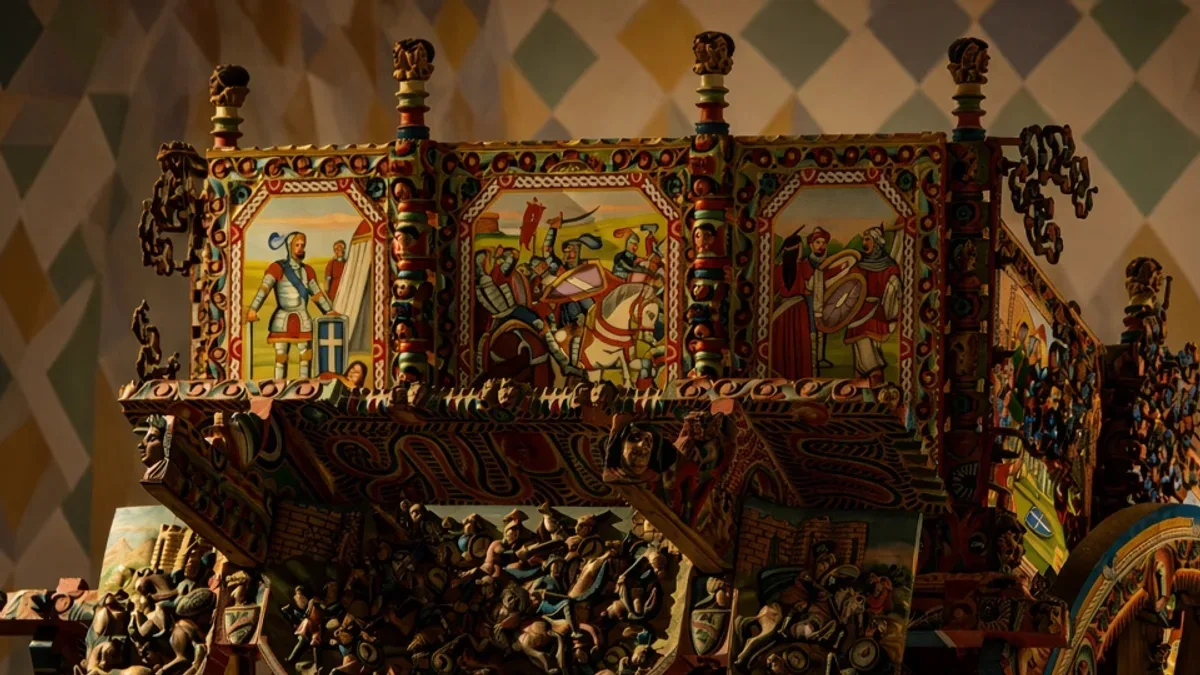
Sicilian Painted Carts of the Palermo and Catania Schools
Sicilian painted carts are identified by school. Palermo uses trapezoidal yellow masciddari; Catania, rectangular sides, ironwork and signed panels.
The Sicilian carretto is a two-wheeled work cart. It is not a carnival float, and it is not a souvenir panel sawn off a wreck. Four shops built it: the carradore (cartwright), the firraru (blacksmith), the intagliatore, and the pittore. Collectors date surviving examples by school and construction, not by colour alone.
The Museo Etnografico Giuseppe Pitrè in Palermo places the type in the first years of the Ottocento, first on urban circuits, then on the extra-urban trazzere that linked the coast to the interior. Paint began as a coat of linseed oil and pigment to keep rain out of the timber. Saints and symbols were added as protection. Street vendors wanted the same colour to stop a buyer. Those three functions still sit on one object.
Guy de Maupassant, landing at Palermo in 1885, recorded the painted carts among the first street facts of the city. The Museo del Carretto delle Madonie cites an earlier witness, Gonzalve de Nervo in 1833: a small cart on a high axle, the Virgin or a saint on the panels, the horse in copper plates and gilt nails with a coloured plume. Carlo Levi, in Le parole sono pietre after his 1951 journey, still saw “myriads” of painted carts on the roads. Motor traffic ended that use. What reaches the trade now is a cart built for work, a later parade rebuild, a miniature, or a detached masciddaru.
Four shops, then the painter
The carradore selected the timber. The Madonie museum’s construction notes are specific: spruce for the floor (fonnu di càscia), beech for shafts, shelves and the two tavulazzi, walnut for the side panels (masciddari) and the removable tailgate (puttèddu), ash for the spokes (iammuzzi). The only dimension that every cartwright was expected to hold was the track between the wheels, so that carts followed the same ruts.
Each wheel is a high, thin disc. Diameters on documented Palermitan carts sit around 125 to 132 cm. Twelve spokes meet a conical bronze bush (boccola) in the hub. The Madonie notes give the alloy as Campana bronze, 78 parts copper to 22 tin, running on an iron axle with washers that are meant to clack. That clack is u toccu. A finished cart was judged in frasca (the wood) and in tono (the sound). If both tests failed, it did not go to the painter.
The blacksmith then belted the body and built the cascia di fusu, the carved and often iron-dressed box that takes the axle. In the Palermitan type the iron is an arabesque, the rabbiscu. In the Catanese and Ragusano types the same member is a denser, almost Baroque cluster of foliage, animals, and small figures. The intagliatore cut almond and mammalucco profiles, paladin heads on the barrùni, and a small religious relief, the pizzo, on the beam above the axle. San Giorgio is the usual subject on that hidden face. The Madonie notes that the carver’s name is rarely on the cart. The cartwright’s and the painter’s names sometimes are.
Palermo, Catania, Trapani, Castelvetrano
Silvia Craparotta, writing in Papireto for the Accademia di Belle Arti di Palermo in 2022, repeats the four geographic types used by Capitò and Buttitta, Lo Presti, and the Palazzo d’Aumale guides: palermitano, trapanese, castelvetranese, catanese.
The Palermitan cart has trapezoidal masciddari, each divided into two scacchi (picture fields) by wooden barrùni and a metal centuni. Ground colour in the western literature is yellow-ochre, with red and yellow also named as the municipal colours of Palermo. Ornament on the non-figural surfaces is geometric: lozenges, slices, Norman-Gothic echoes that Lo Presti compared with the Cappella Palatina, Cefalù, and Monreale. Figural painting is flat, with little modelling. Religious and chivalric subjects share the scacchi. Western work carts further split by load: the vinaloru (wine and grapes) with trapezoidal sides and inclined tavulazzi; the furmintaru and the lower-sided tirraloru for earth, sand, and stone.
The Catanese cart is smaller. Sides are rectangular, still two scacchi with a cintuni. The western rabbiscu is here called pampinigghi or ’nfrascatura and turns zoomorphic and anthropomorphic. Ground colour is the point on which catalogues disagree, and a collector should not force a single answer. Craparotta, following Lo Presti, treats the lion (ù liuni di carrettu) as a Catanese emblem. The Madonie museum describes a turchino ground, still visible because the figurations are less crowded. Painters in the eastern school, including Gianfranco Fiore in the 2022 interview, speak of cinnabar red and more modelled drapery, closer to opera illustration than to Palermitan paladins. Use side shape, the cascia di fusu, and the carving of eagles and hippogriffs before you trust a colour note on a dealer’s card.
Trapani builds a larger cart. The sides divide into three fields with four barrùni and a horizontal bar, the falichetta. The Castelvetrano type, inland in the province of Trapani, omits the cascia di fusu and keeps trapezoidal sides. The Ragusano, Vittoria, and Rosolini carts follow the Catanese rectangular division.
Giuseppe Pitrè took a cart to the Esposizione Industriale di Milano in 1881. The Pitrè museum dates the national souvenir market, the carretto-gingillo, from that display. A working cart and a miniature made for export are not the same object. Measure the wheel, the iron, and the back of the panel before you pay for a name.
How the pictures were laid in
Painting ran in three named stages: coloritura, decorazione, figurazione. Linseed oil opened the wood. Filets, rosettes, lions, dolphins, and tabbaccheri (small framed still-lifes of fruit and animals) filled the ground. Then the scacchi received the stories.
Until about 1860 the visible and hidden images were largely protective: saints, the Virgin, San Giorgio on the pizzo. Craparotta, citing Capitò and Buttitta, places the shift to chivalric narrative after that date, when Storia dei paladini di Francia of Giusto Lo Dico and, later, Cavalleria rusticana supplied the plots that a buyer who had left school at the fifth grade already knew. Paladins, the Sicilian Vespers, and the Prussian war are the scenes the Pitrè museum still lists on its nineteenth-century Palermitan carts. After the fall of the Bourbons the same panels take Otello, Tosca, the Expedition of the Thousand, and Columbus. Captions under the scacchi are often half dialect and ungrammatical. That is a period feature, not a later fault.
The transfer method was tracing. Between the side and the source sheet went a paper that differed from Palermo to Catania. Contours were gone over in colour; a vilina was pressed and reused on the next cart. At Aci Sant’Antonio the Museo del Carretto Siciliano records Vincenzo Di Mauro’s spruuli: cartoons pricked along the outlines, then pounced with coloured dust. The same economy of templates explains why paladin groups repeat across decades. Antonino Buttitta traced the imagery to litter painters, carriage painters, glass painters, and above all the cartelli of the Opera dei Pupi. Other scholars point to school lithographs, illustrated novels, images d’Épinal, and the Domenica del Corriere. The painted ex-voto tablet is the closest cousin in Sicilian popular painting: a flat scene, a written caption, a saint who occupies the upper register.
Do not look for a silver-style punch. Sicilian metalwork of the same towns is a different trade, dated by civic marks set out for Palermo and Messina silver. A cart is dated by timber, iron, and the painter’s hand.
Bagheria and Aci Sant’Antonio
The western painter’s shop that museum catalogues name first is Ducato of Bagheria. Michele Ducato, aged fourteen in 1895, spent three weeks with the Palermitan cart painter Nicola Carrozza, took drawing from the church painter De Simone, and opened on the road that is now Via Rammacca, opposite Villa Cattolica. Carradore, farrier, and founder stood in the same yard. The Museo Guttuso bought Domenico Ducato’s shop in 1966, the year Renato Guttuso painted Il pittore di carretti. Guttuso’s own memory was of Emilio Murdolo, whose booth faced the house where he grew up, and then of Michele Ducato. Michele died in 1943. The sons Onofrio, Ernesto, Giovanni, Domenico, and Giuseppe signed as Fratelli Ducato until they closed the shop in 1955. A work cart in the Guttuso collection was built in the 1950s and painted in 1985 by Domenico Ducato: construction date and paint date need not match. Giovanni Accomando, a Bagheria cartwright, kept a shop from 1944 until 2011. His son Salvatore’s loan to the museum includes Ducato veline, Murdolo, Mariano Picciurro, Paolo Cardinale, Giulio Canadese, and Tommaso Scirè.
The eastern school centres on Aci Sant’Antonio. Vincenzo Di Mauro was born there on 1 August 1883, trained at Giarre, opened behind the church of the Mercè after the First World War, and later moved to the Quattro Canti on Via Vittorio Emanuele. He opened a second shop at Militello in Val di Catania for the Gran Michele, Vizzini, Mineo, and Scordia trade; his son-in-law Raimondo Russo took that shop. Vincenzo died at Aci Sant’Antonio on 8 December 1957. Russo died on 12 December 1985. The nephew Domenico, called Minicu, was born at Guardia Mangano (Acireale) on 4 April 1913, entered Vincenzo’s shop at twelve, and died at Aci Sant’Antonio on 20 March 2016, aged 102. The Emilia-Romagna cultural-heritage file records a cart of his in the Musée de l’Homme, Paris, after the Fête de l’Humanité at La Courneuve. Eastern masciddari of this group are more modelled than Palermitan ones. That is a school difference, not proof of a later fake.
What later and broken objects look like
The Regione Siciliana keeps about seventy carts at Palazzo d’Aumale, Terrasini, the largest public holding. The Pitrè museum keeps nineteenth-century Palermitan examples in sala 10. Those complete vehicles are the reference. Most of what is offered abroad is a fragment.
Detached masciddari appear at regional American sales as “Sicilian cart panels,” often 140 cm long by 40 cm high, sometimes inscribed. An Austin sale of January 2024 included a Palermitan panel signed “Cronio pittore di carri” with a Garibaldi at Calatafimi caption. The inscription identifies a painter, not a date of the timber. Look at the reverse: a panel taken from a working cart has iron-nail scars, weather on the top edge, and a colour that continues around the barrùni. A panel painted as a picture for the wall is usually plywood or a new walnut board, with even varnish and no axle wear.
Miniatures and souvenir carts belong to the market Pitrè opened in 1881. They copy the scacchi and omit the boccole. Wheel diameter collapses. The cascia di fusu becomes a cast ornament. Parade carts painted after the 1960s, including work bodies given a new coat in the 1980s, are honest as later paint. They are not Ottocento survivors.
The intagliatore is the silent partner. Empty paladin-head barrùni with crude faces, or a pizzo that is a printed saint glued on, are later. So is a four-wheeled wagon sold as a carretto. The type has two wheels.
Ceramics from the same island, teste di moro included, share the tourist circuit and none of the construction. Do not date a cart by a ceramic comparison.
The carretto is listed in the Registro delle eredità immateriali della Sicilia. A UNESCO file has been discussed; it is not an inscription. Opera dei Pupi already has that status. A dealer’s “UNESCO cart” is a phrase, not a mark.
FAQ
How do I tell a Palermitan cart from a Catanese one?
Read the masciddari. Trapezoidal sides and geometric filets belong to Palermo and Trapani. Rectangular sides, a central cintuni, and denser iron on the cascia di fusu belong to Catania and the Iblei. Treat ground colour as supporting evidence only. Catalogues do not agree on whether the Catanese field is turchino or cinnabar.
Did the painter sign the cart?
Sometimes, on a scacco or along the upper rail: “pittore di carri,” a street in Palermo, or a family name such as Ducato. The cartwright may be named on the chiave between the shafts. The carver is usually anonymous. A modern brass plaque is not a period signature.
Are loose panels worth buying?
Yes, as panels, priced as such. A masciddaru with period nails, weather, and a traced paladin group is a Sicilian painting on a cart member. It is not a cart. Check that the two scacchi belong to the same campaign of paint.
What is the cascia di fusu?
The carved box that receives the iron axle, often dressed with the blacksmith’s rabbiscu. It is the most expensive wooden member after the wheels. Palermitan arabesque versus Catanese Baroque foliage is a school test. Castelvetrano carts omit it.
Should a miniature be catalogued as a carretto?
Catalogued as a miniature or gingillo, dated to its paint, and kept out of the working-cart column. Pitrè already separated that market in 1881.
Conclusion
A Sicilian painted cart is a two-wheeled vehicle made in four shops and painted in named schools. Palermo and Trapani use trapezoidal masciddari and geometric grounds. Catania uses rectangular sides and a heavier cascia di fusu. The pictures are templates: paladins, saints, and, after about 1860, opera and Garibaldi. Ducato at Bagheria and Di Mauro at Aci Sant’Antonio are the shops a catalogue can name with dates. Everything else is comparison with those museums, the Pitrè room, and the Terrasini holding. A collector who can read a masciddaru and a pair of boccole does not need a souvenir caption.