
Sicilian Puppets: Opera dei Pupi History & Collector's Guide
Identify antique Sicilian puppets from the Opera dei Pupi: Palermo vs Catania schools, armour emblems, and how collectors date a working pupo.
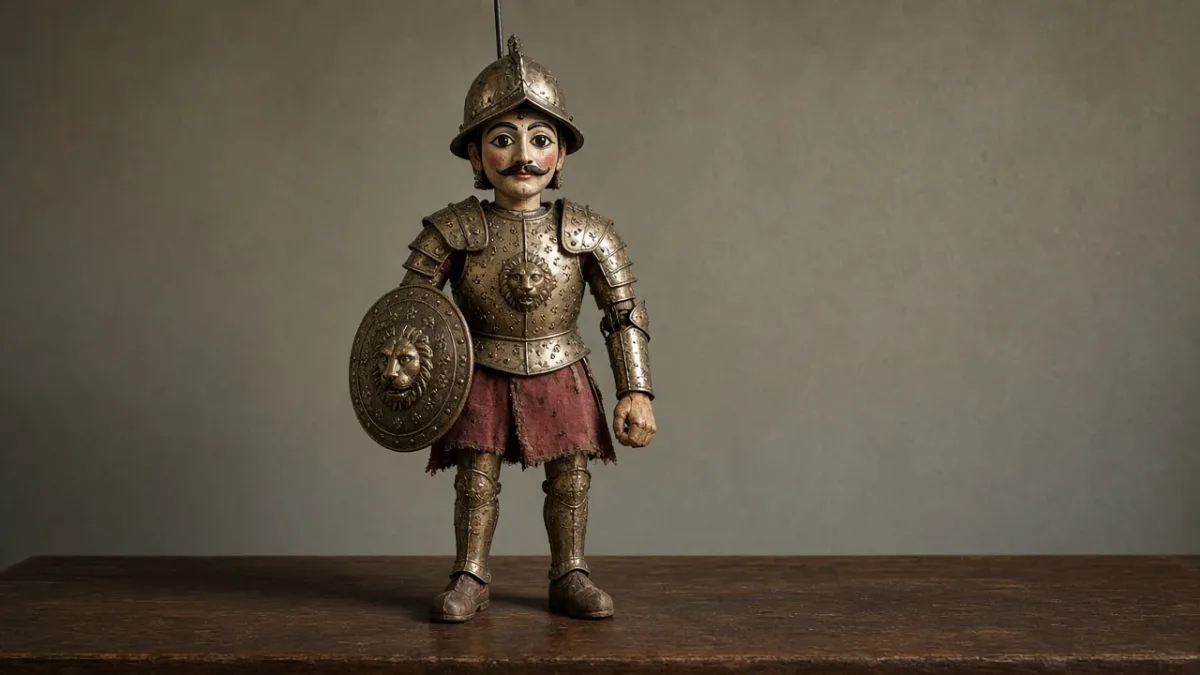
A working Sicilian puppet is a theatre machine, not a doll. The object collectors call a pupo — wood, cloth, and hammered metal, with an iron rod through the skull — was built to fight, kneel, and draw a sword in a family theatre. Tourist copies hang in gift shops at 30 or 40 centimetres. The antiques that matter are heavier, scarred, and coded: Palermo or Catania, paladin or Saracen, Orlando or Rinaldo.
The tradition has a name in Italian, Opera dei Pupi, and a public date. UNESCO proclaimed it a Masterpiece of the Oral and Intangible Heritage of Humanity in 2001 and inscribed it on the Representative List in 2008. That recognition covers a living performance practice. It does not turn every brass-armoured souvenir into a nineteenth-century relic. Date the construction before you date the story.
The same island that painted these faces also made other folk objects travellers confuse with pupi. See the Sicilian Moor's Heads guide. Burano lace is a useful comparison: a named Italian technique, two regional schools, and a flood of later tourist work.
When the Opera dei Pupi became a type
Rod marionettes existed in southern Italy before anyone armoured them. What UNESCO and the Antonio Pasqualino International Puppet Museum in Palermo treat as the Opera dei Pupi is a tighter package that appears in the first decades of the nineteenth century: a fixed chivalric repertoire, metal armour that flashes and rings, and a mechanism built for sword fights.
Family memory names pioneers. In western Sicily, Gaetano Greco (1813–1874) and Liberto (also recorded as Gaspare or Lamberto) Canino of Palermo. In the east, Gaetano Crimi (1807–1877) and Giovanni Grasso (1792–1863) of Catania. Antonio Pasqualino, whose collection became the Palermo museum, argued that the armoured pupo emerged when cloth-and-string marionettists met the wood-and-metal trades already working for urban festivals. There is no single notarised inventor.
The oldest pupo in that museum is Carinda, dated 1828 and once in the Canino family. Oral tradition there holds that Don Liberto Canino built it as the first armoured figure of the line. Treat the year as a family date, not a notarised birth certificate. It is still the earliest object the principal public collection is willing to put on a label.
By 1889 Giuseppe Pitrè could count at least twenty-five theatres: nine in Palermo, three in Catania, two in Messina, and standing houses in Carini, Alcamo, Trapani, Marsala, Girgenti, and other towns. A well-equipped theatre kept about a hundred figures — roughly half warriors in metal — plus spare heads, painted backdrops, and the cartelli that advertised the night's episode. A Palermitan house often supported only one family. When a son married, he usually had to build his own mestiere rather than inherit the father's stage.
What they performed
The plots come from the Carolingian cycle: Charlemagne, Orlando, Rinaldo, the traitor Gano di Maganza, and the wars of Christians against Saracens. Court poems — Pulci, Boiardo, Ariosto's Orlando furioso (1516), Tasso — sit behind the stories, but pupari did not stage those texts as written. From the mid-nineteenth century they used popular compilations, above all Giusto Lodico's Storia dei paladini di Francia (1858–1860), which stitched oral and printed episodes into a sequence a theatre could run night after night.
Dialogue was improvised on a canovaccio, a plot outline. A full cycle could last a year of evenings. Other bills included saints' lives, bandits, the Sicilian Vespers, and, in the east, the occasional Shakespeare play. A serious episode often closed with a dialect farce. Comic servants — Peppennino, Virticchio, Pulcinella — could step in as squires and comment in Sicilian.
Audiences split between Orlando, the loyal paladin, and Rinaldo, who rebels more readily against Charlemagne and Gano. The 1950s boom, cheap cinema, and television broke the nightly habit. Surviving companies shortened the cycles into single-evening fights aimed at schools and visitors. UNESCO's file notes that tourism later thinned shows written for a local public.
Palermo and Catania: two machines
Collectors who skip the school will misdate every measurement. The two Sicilian types share a rod through the head, a second rod to the sword arm, and a string to the left hand. They do not share size, knees, or the puppeteer's stance.
Palermo (western Sicily: Palermo, Agrigento, Trapani). About 80 centimetres to a metre tall, typically 6–8 kilograms. Jointed knees. Operated from the wings, arms outstretched. A string through the clenched right fist lets the figure draw and sheathe the sword. Some Palermitan theatres add a string to the left thigh so the pupo can kneel or start a step. The official Visit Sicily note and the Pasqualino museum both treat this as the lighter, articulated western type.
Catania (eastern Sicily: Catania, Messina, Syracuse). About 120–140 centimetres, often 16 kilograms and sometimes cited up to 30. Stiff knees. Warriors usually keep the sword drawn. Manipulators stand on a raised bridge — the scannappoggiu or ponte di manovra — behind the backdrop and work from above. Rigid legs let the weight rest on the floor between steps. Acireale, Giarre, and Syracuse sit in this eastern orbit.
A third southern type, the Neapolitan pupo, is about a metre high, with jointed knees and strings to both arms, worked from a bridge. Belgian rod puppets of Liège and Brussels share mechanical ideas; the documented Liège house of that kind dates from 1854. Do not catalogue either as Sicilian because the armour shines.
Stage grammar is equally local. Christians and other “good” characters enter from the spectator's left. Paladins wear a short skirt (the faraoncina); Saracens wear baggy trousers (pantaloni alla zuava) and crescents or stars. Palermo cartelli were painted on canvas, divided into panels, and rolled on two sticks. Catania used wrapping paper, one scene, folded for storage. In Palermo a finished character usually kept its identity. In Catania a dead warrior could be stripped and rebuilt as someone else — useful when you date a Catanese armour that no longer matches its head.
How a pupo is built
A theatre pupo is assembled from about nine wooden parts: two feet, two lower legs, two thighs, a torso, and a pair of hands (one fist, one open). Beech, spruce, walnut, lime, and cypress appear in workshop accounts. Heads are carved — cypress or beech is often named — then painted, eyes first. Forearms join the shoulder on stout cloth so the sword arm can swing freely. The right fist is bored to take a blade; the left is open for a shield. On Palermitan figures the thighs swing forward and the knee folds backward about ninety degrees.
Armour is the expensive work. Sheets of copper, brass, or nickel silver (alpacca) are cut, dished over wooden forms with ball-peen hammers, edged, punched, and soldered. Earlier poor theatres used tinplate — lanna di buatta. Decoration is geometric and plant-like: bosses (bbuttuna), lozenges, and applied copper arabesques (rrabbischi). The main iron rod, on the order of 7–8 millimetres thick, runs through the head, hooks into the trunk, and ends in a wooden handle. A second rod drives the right arm. Fine strings work the left hand, the sword, and sometimes the visor.
Emblems identify the principal paladins, and they are not universal. Ethnographic lists used for the Palermitan code give Orlando an eagle, Rinaldo a lion, Oliviero a sun, Charlemagne a flower, and Gano an H. Practising Palermitan builders also put a Latin cross on Orlando's cuirass and an eagle on the helm, and they often dress Orlando in green and Rinaldo in red. Catanese codes differ. A Pasqualino museum note on a Catanese figure (inv. D261) warns that in the eastern system Rinaldo wears green, not red, and carries a lion on the shield. Read school first, then colour, then crest.
The carved head belongs to the same Italian wood-working culture as cassoni and walnut cabinets, even when the subject is a paladin rather than a marriage chest. For that furniture language, see the antique Italian furniture guide.
How to identify an antique Sicilian puppet
Work in this order. Photograph the head, the rod fittings, the knee joints, the back of the armour, and any paper labels before anyone “tidies” the piece.
1. Name the school. Jointed knees, 80–100 cm, side rods: Palermo. Stiff knees, 120–140 cm, bridge operation implied by a longer head-rod and a heavier stance: Catania. Strings to both arms and a metre-high body: ask whether it is Neapolitan, not Sicilian.
2. Confirm it is a rod pupo, not a string marionette. A true Opera dei Pupi figure has a thick iron rod through the cranium, hooked in the trunk, plus a sword-arm rod. Long strings from a horizontal control bar, a hollow cloth body, and no skull rod are a different European type.
3. Weigh the materials. Theatre armour is hammered sheet, soldered, with punch marks and repairs. Vacuum-metallised plastic, identical stamped “armour,” and a “Made in Italy” sticker on a 30-centimetre knight are postwar tourist stock. Country-of-origin marks belong to later export law; their presence on a piece sold as 1830 is a contradiction.
4. Read the face as a carving problem. Period heads are cut from a block, painted in layers, and worn at the nose, cheeks, and helm rim. Cast plaster or resin faces with printed eyes are later. Spare heads were normal in a working theatre; a fine old head on a crude new body is a marriage, not a miracle.
5. Match costume to side. Short skirt and a personal device: paladin. Baggy trousers, crescents, stars: Saracen or “infidel” type. A mix of both on one figure usually means replacement clothes.
6. Do not trust a dealer tag as a maker. A “Daneu Palermo” label, documented on puppets in university and auction contexts, is the mark of a Palermo antiquarian firm founded by Vincenzo Daneu (born Trieste, 1860), not a carver's signature. It is provenance, if genuine, not authorship.
7. Ask whether head, armour, and clothes grew up together. Fresh solder on an oxidised cuirass, a head-rod that does not seat in the trunk hook, or a Catanese lion on a Palermitan-sized jointed body are the usual tells.
Condition, fakes, and the market
Working pupi were beaten. Swords snap, plumes shed, cloth skirts fray, and visors jam. Honest wear at the rod hole, the fist, and the knee pins is evidence. A “perfect” nineteenth-century Orlando with mirror-bright brass, uncracked paint, and no oxidised solder is the piece to walk away from.
Tourist production is the main trap. After the 1950s, companies sold small armoured figures to visitors who had seen a one-hour fight. Auction rooms regularly offer lots of three or four “Opera dei Pupi knights” at decorative prices — tens or low hundreds of dollars or euros — often 30–50 centimetres high and sometimes marked “Made in Italy.” A documented theatre trio is a different market. Lyon & Turnbull sold three twentieth-century figures in 2018, including a Brandimarte given to John Blundall by Antonio Pasqualino, for £1,375. Almost every pupo you will be offered is nineteenth- or twentieth-century. The type itself is nineteenth-century.
Replacement armour is common and not automatically fatal. Heads outlast cuirasses. Record what is old. Do not polish the brass to a gift-shop shine.
Export of named historic stock from a documented Sicilian theatre can fall under cultural-property rules that do not apply to a 1970s souvenir. A complete Canino, Greco, or early Cuticchio mestiere is a heritage object. Budget time for paperwork before you assume it can leave Italy.
Southern Italian luxury crafts sit in a different price band. Torre del Greco coral is jewellery with a factory town behind it. A pupo is folk theatre equipment. Do not flatten the two into one “Sicilian antique” lot.
Families, museums, and what to collect
Train the eye first at the Museo internazionale delle marionette Antonio Pasqualino, Via Butera, Palermo, founded in 1975 by the Associazione per la Conservazione delle Tradizioni Popolari. It holds more than five thousand objects and the largest public group of Palermitan, Catanese, and Neapolitan pupi, including complete theatre sets from Gaspare Canino of Alcamo, Natale Meli of Reggio Calabria, and the Perna family of Frattamaggiore. The museum received ICOM Italy's Museum of the Year award in 2017.
Living companies still work. In Palermo: Figli d'Arte Cuticchio (Mimmo Cuticchio), Teatroarte Cuticchio, Vincenzo Argento, and the Canino line at Alcamo and Partinico. In the east: Marionettistica Fratelli Napoli in Catania (Erasmus Prize, 1978), Turi Grasso in Acireale, Vaccaro-Mauceri in Syracuse. The Manteo family carried a Catanese dialect theatre to New York; Agrippino Manteo (1884–1947) is the documented American node. Those names are context, not signatures on a stray figure.
What you can still hope to buy is a twentieth-century working paladin or Saracen from a known school, with original rod fittings and a carved head; more rarely a late-nineteenth-century piece with a dealer or family provenance. Do not pay museum-object money for a 40-centimetre “Made in Italy” knight. Do not ignore a heavy, jointed Palermitan figure because the skirt is torn. Completeness of the mechanism beats a new plume.
FAQ
What is the Opera dei Pupi?
Traditional Sicilian rod-puppet theatre in its classic nineteenth-century form: chivalric stories, metal-armoured figures, and family companies. UNESCO recognised the practice in 2001 and listed it in 2008. Pupo (plural pupi) is the figure; the puparo is the performer-builder.
How can I tell Palermo puppets from Catania puppets?
Measure and flex the knees. Palermitan pupi are roughly 80 centimetres to a metre, jointed, and worked from the side. Catanese pupi are roughly 120–140 centimetres, stiff-legged, heavier, and worked from a bridge behind the backdrop. Costume colours and emblems also follow different local codes.
Are antique Sicilian puppets valuable?
Documented theatre figures with school, wear, and a carved head are collected. Decorative tourist knights sold in groups are not. Provenance from a named company or from the Pasqualino circle moves the price; a paper “Sicilian marionette” caption does not.
Should I restore the armour?
Not as a first step. Oxidised solder, patched tin, and a dull cuirass are dating evidence. A metals conservator who has seen beaten copper — not a furniture polisher — is the right trade if plates are actively tearing. Leave the face to a polychrome-wood conservator.
Can I export a historic pupo from Italy?
Often yes for later, undocumented tourist pieces; not automatically for a named nineteenth-century theatre figure or a complete working set. Ask for export documentation before you pay, especially on objects tied to Canino, Greco, Cuticchio, or a civic museum loan.
Conclusion
A Sicilian puppet is a school problem before it is a character problem. Learn the Palermitan machine — lighter, jointed, worked from the wings — then the Catanese one — taller, rigid, worked from a bridge. UNESCO dated the tradition; Pitrè counted the theatres; Pasqualino kept the objects. Lodico's Storia dei paladini supplied the nights. Without that sequence you are buying a shiny knight and a story. With it, you can tell an 80-centimetre Palermo paladin from a Catanese fighter, a Daneu dealer tag from a maker's name, and a working rod pupo from the gift-shop armour that followed the tourists in.