
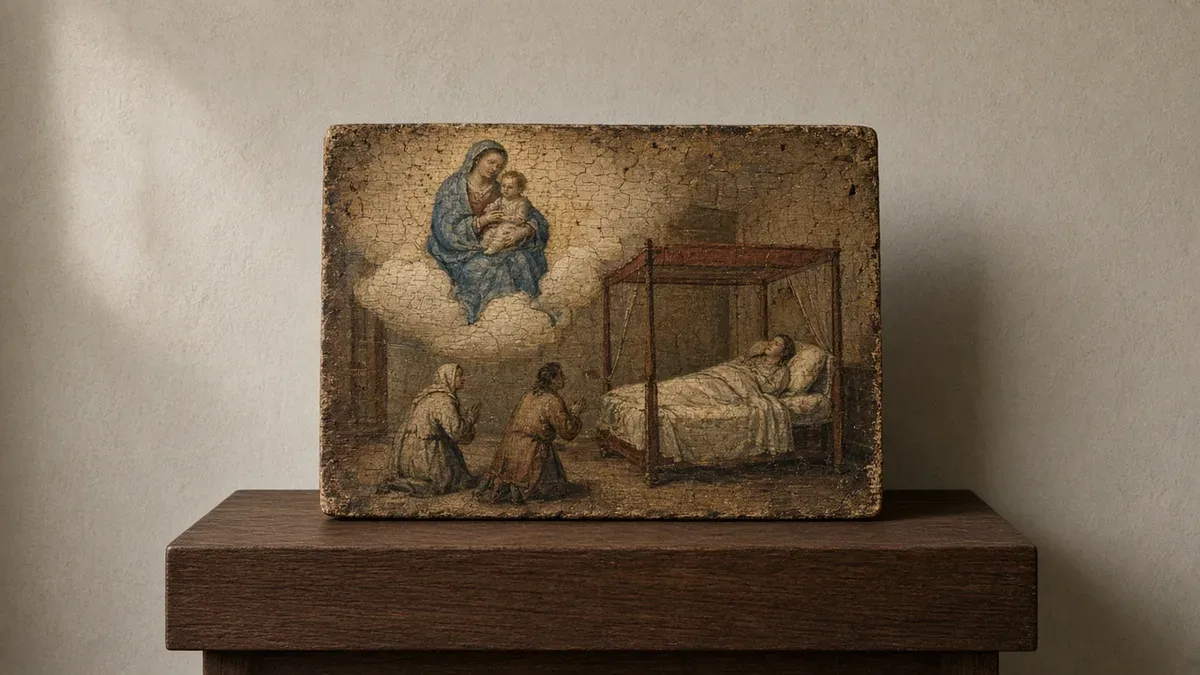
How to Identify Italian Ex-Voto Tablets by Paint, Silver and Inscriptions
How to identify Italian ex-voto tablets by wood support, tempera or oil, P.G.R. and V.F.G.A. inscriptions, silver hearts, and sanctuary provenance.
The Latin tag ex voto suscepto means "from a vow made." In Italian churches the object that discharges the vow is usually a small painted board, a silver heart, or a stamped anatomical plaque. Collectors meet these things first as loose lots: a cracked tablet with a bed and a cloud, a pressed-silver heart with a loop, a tin foot. Identification starts with the object type, the support, and the inscription. The shrine that once hung the piece is the second question.
Painted votive tablets, tavolette votive, became common in Italy in the 1490s. Fredrika Jacobs and Mary Laven treat that decade as a break from the older stock of wax limbs and metal plaques. The new boards are narrative. They show a specific accident or illness and, in the same field, the Madonna or saint who was asked to intervene. They are receipts, not predella fragments and not civic donor portraits.
What an Italian ex-voto is, and what it is not
The contract is simple. A person in danger promises a gift if help arrives. The gift may be cash, a pilgrimage, a length of wax, or an object that pictures the danger. Ancient Italian and Greek sanctuaries already received terracotta and bronze body parts. Medieval and early modern Italy continued that anatomical habit in wax and, later, in silvered sheet. The painted tablet is a later, local overlay on that older practice.
A tablet is not a reliquary and not a santino. It does not contain a saint. It is not, by itself, proof that a miracle occurred. It is proof that someone paid for a picture of a vow completed.
Silver hearts and anatomical plaques belong to the same contract but to a different trade. They are serial. One heart looks much like another. A tablet is particular: a named child, a named ship, a recognizable bedcover, a local church façade. That is why tablets can be dated more closely than anonymous metal, and why metal is harder to steal from its shrine without being noticed as a type.
Southern Italy still produces both classes. The same Campania market that supplied Neapolitan presepe figures also fed the walls of Madonna dell'Arco, a few kilometres north of Vesuvius. The silver shops of Naples, whose NAP and Parthenope punches are treated elsewhere, made hearts, eyes, and breasts for the same pilgrims.
How to read a painted tablet
Work from the board outward. Do not start with the story on a dealer's ticket.
Support. Early tablets are thin wooden boards, often poplar or another cheap local timber, usually painted in landscape format. Mary Laven, writing from the hanging walls at Madonna dell'Arco, gives the ordinary width as twenty to thirty centimetres. The Istituto Centrale per il Catalogo e la Documentazione has published Tolentino examples in that range: 21.5 × 18 cm for a late-fifteenth-century kneeling figure; 30.8 × 20.5 cm for a seventeenth-century child rescued from a well. Later pieces appear on canvas, on paper glued to wood, on tin (latta), and on clay. A nineteenth-century oil on canvas in a gilt frame is still an ex-voto if the iconography is votive. It is not a Renaissance tavoletta.
Paint. Fifteenth- and sixteenth-century boards are usually tempera. Oil becomes common later. The surface is often worn, wormed, and overpainted. Successive restorations are normal in sanctuary collections and are one reason dating is difficult. Fresh, even acrylic on an old-looking board is a warning. So is a perfectly clean back with no nail holes, no limewash stains, and no rusted tacks. Tablets were nailed or wired to masonry. A board that has never been hung is either unused stock or a later picture made to look like one.
Composition. The field is split. The upper zone holds the intercessor: the local Madonna, a saint with his attributes, sometimes a pair. The lower zone holds the earthly event: a sickbed, a fall from a horse, a ship in a squall, a childbirth chair, a prison. Laven notes thematic grouping on the Arco walls (shipwrecks, overturned carriages, hospital rooms) but little chronological order. Blank cartouches occur on serial sickbed types; the miracolato was meant to add a name and was often left blank.
Inscriptions. These are the most useful marks on the object itself. They are not workshop punches.
- EX VOTO in Latin is common at Tolentino in the sixteenth century.
- PER GRATIA RICEVUTA, usually shortened to P.G.R. or PGR, is the Italian formula used across the peninsula and still written on modern tablets.
- V.F.G.A. or VFGA expands to votum fecit, gratiam accepit ("he or she made a vow and received a grace"). At Madonna dell'Arco this quartet is the house brand. Laven records it painted in a white leaf-shaped panel that refers to the shrine's lime tree. The first-person form votum feci et gratiam accepi also appears.
- Longer texts name the beneficiary, the town, and a date. At Lonigo more than sixty of a sample of about 150 early tablets carry at least a date or initials. One, published by the Lonigo cataloguers, is the 1506 declaration of Messer Zaneto de Friza of Longara for two sons with nosebleeds. Another, at Tolentino, names Donna Pira, a Genoese woman living in Senigallia, and is dated 11 August 1493.
Unsigned painters are the rule. A named artist should be checked against a sanctuary inventory, not a frame label. Giovanni Fattori's ex voto for a fall from a horse in via Augusta Ferdinanda, Livorno, painted about 1848 and kept at Montenero, is documented by civic museum scholarship (Vera and Dario Durbé), not by a dealer attribution.
The sanctuary corpora that fix types
A tablet without a shrine is a type. A tablet that still matches a published sanctuary corpus is a document. Four collections set the Italian standard.
Madonna dell'Arco, Sant'Anastasia (Naples). Arcangelo Domenici, writing in the early seventeenth century, dated the cult to Easter Monday 1450, when a youth struck a Madonna painted in an arch. The present church was begun in 1593; Bartolomeo Picchiatti's tempietto over the image is 1621. The sanctuary holds the largest painted-tablet collection in Italy: about 7,000 boards, with a 1499 tablet cited as the earliest. Laven's count of pieces before 1600 is about 784, most of them from the 1590s. Paolo Toschi and Renato Penna published a selection in 1971. A study centre opened in 1995 and a museum in 2000 (moved 2018, reorganized 2022). A 1590s inventory listed silver, cloth, and rosaries and omitted the painted boards, which had little scrap value.
San Nicola, Tolentino (Marche). Nicholas of Tolentino died in 1305 and was canonized in 1446. The sanctuary museum keeps 381 painted ex-votos on wood, canvas, and paper from the late fifteenth century to the early nineteenth, and about 140 silver ex-votos that survived Napoleonic requisition. Civic pages round the painted series to about 400. Early tablets here often say EX VOTO or PGR.
Madonna dei Miracoli, Lonigo (Vicenza). Olivetan monks founded the shrine in 1486. The museum in the old sacristy, opened in 1997, holds 353 painted tablets dated from 1486 to 1893, two small canvases of 1617, silver and embroidered hearts, and more than 200 anatomical plaques in sheet metal. The Regione Veneto catalogue names the tablet given by Felipo Campese on 3 June 1491 as the earliest Italian tavoletta dated with certainty. Giovanni Domenico Bertani's Historia della gloriosa imagine della Madonna di Lonico (Verona, 1605) already treated the boards as proof (in fede di). A 2005 parish catalogue remains the reference.
Madonna delle Grazie, Montenero (Livorno). The Vallombrosan sanctuary on Monte Nero is a maritime archive. A 1981–82 exhibition at the Bottini dell'Olio, published by Pacini, catalogued the seafaring tablets. Don Luca Giustarini, interviewed in 2024, put the unexhibited total at about 14,000 and the hung gallery at about 700, mostly nineteenth century and later. Ships, storms, and Livorno quayside accidents are the local subjects. Italiavotiva records the brigantine La Cesira under Giovanni Cochella, saved on 25 April 1853, painted in tempera on paper. Fattori's horse-fall tablet is a named painter in a corpus of anonymous sea pieces.
Other early groups survive at Viterbo (Madonna della Quercia), Cesena, and Ossuccio on Lake Como (142 tablets; UNESCO Sacro Monte, 2003). Restoration of 36 Ossuccio boards was published in 2018; several had already left for private collections later shown by the Fondazione P.G.R. Loreto is the warning case. Montaigne, at the Holy House in 1581, found the brick chamber lined with tablets "all the way to the ground." Most of that early painted skin is gone.
Silver hearts, wax limbs, and other serial offerings
Anatomical ex-votos are older than the painted tablet and remain the default gift at many shrines. Madonna dell'Arco still hangs mass-produced metal feet, hands, hearts, breasts, and small full figures, together with crutches. Lonigo keeps more than 200 sheet-metal plaques. Tolentino's silver series is the high end of the same idea.
Hearts (cuori d'argento) sit between anatomy and emblem. A Bertolami Fine Art lot of three Neapolitan silver ex-votos (eighteenth to nineteenth century) showed a mouth, a pelvis, and an Immaculate Heart, the first two inscribed V.F. – G.A. (voto fatto, grazia avuta). Heights ran from 8.5 to 15 cm. ICCD records a heart-shaped silver sbalzo already in a church inventory of 1879. Read these with the punches used on secular plate. Italian law (D.L. 251/99) provides titles 800, 835, and 925 in an oval, plus a maker's mark; see the Italian silver hallmarks guide. A lone "925" without a maker, or an "R 925" in a rectangle, is plate or a later tourist heart.
Wax is a different survival problem. The Benintendi, also called Fallimagini, supplied dressed votive effigies to Florence's Santissima Annunziata. After 1468 the same family ran the wax shop at Viterbo's Madonna della Quercia until 1609, succeeding the Ciffarelli. Luca Ferrini's Coróna di sessanta tre Miracoli della Nunziata di Firenze (1593) already lists broken wax and the first "tablets" only from a miracle dated 1544. What reaches the market as "Renaissance wax ex-voto" is often later anatomical stock. Coral beads travelled some of the same southern roads; they belong with the Torre del Greco coral trade, not with the tablet wall.
Dating, copies, and later stock
Laven's caution is the working rule. Tablets are hard to date because the materials were poor, restorations were repeated, the iconography is conservative, and documentation is thin. A costume detail (ruff, quilt pattern, a railway carriage, a hospital trolley) is firmer than a "sixteenth-century manner." Dated inscriptions can be added later. Compare letterforms with the paint beneath. A P.G.R. in a twentieth-century script on a board sold as 1600 is a later gift or a fake.
Serial production is old. Pharmacies sold wax parts in the sixteenth century; an apothecary fresco at Issogne shows them hanging above the jars. Painted sickbed scenes were also sold ready-made, with a cartouche left blank. A repetitive composition is not therefore modern. What is modern is the jewelry-counter heart, the printed tin plaque, and the "antique" tablet painted last year on distressed pine.
After the Second Vatican Council a number of parishes cleared votive clutter from walls. The Fondazione P.G.R. (Per Grazie Ricevute), established in Milan in July 2013, exists because of that purge. Its exhibited group is just over 700 tablets, fifteenth to twentieth century, on wood, tin, canvas, and clay, bought in the 1960s and 1970s. The founder's father once held more than 6,500; most of those went to the Museo del Paesaggio at Pallanza and to the Diocese of Bergamo. Legal title in those cases rests on parish disposal, not on theft from a locked treasury. Many other stray tablets have no such paper.
Provenance and the Codice
Ex-votos that still belong to an ecclesiastical body are cultural property if they meet the tests in D.Lgs. 42/2004. Article 10 includes movable things of artistic, historical, or ethno-anthropological interest owned by recognized church entities. Article 9 requires the Ministry to act in agreement with the religious authority on cult needs. Article 65 restricts definitive export of declared or verified cultural goods and, cautiously, of public and non-profit holdings more than seventy years old. A board photographed in a sanctuary catalogue and later offered in a foreign sale is a restitution problem, not a bargain.
Ask for the sanctuary, the inventory number, and the date of legal alienation. A tablet that matches a published Ossuccio or Lonigo photograph should be checked against those catalogues before money moves. Private collections formed in the 1960s–70s can be legitimate. So can family pieces that never hung in a church. What cannot be assumed is that a "folk painting, Italy, 1700" in a mixed lot has a clean exit from a nave wall.
Condition notes are ordinary antiques notes. Active worm, flaking tempera, and oxidized silver need a conservator, not household polish. Do not clean a fire-gilt or leafed frame with metal polish. Do not "complete" a blank cartouche with an invented name.
FAQ
What does P.G.R. mean on an Italian ex-voto?
Per grazia ricevuta ("for grace received"). It records that the vow was fulfilled. The Latin counterpart at Madonna dell'Arco is V.F.G.A. (votum fecit, gratiam accepit). Neither mark names a painter.
How old are painted votive tablets in Italy?
They become common in the 1490s. Lonigo's Felipo Campese tablet of 3 June 1491 is the earliest Italian example dated with certainty in the Veneto catalogue. Madonna dell'Arco cites a tablet of 1499. Earlier practice used wax, metal, and cloth.
Are Italian ex-votos signed?
Almost never. A named artist (Fattori at Montenero is the published exception) needs a sanctuary or museum paper trail.
How can I tell a sanctuary tablet from a later decorative panel?
Look for a thin cheap board, hanging holes or lime stains, worn tempera, and a split field (saint above, accident below). A thick new panel, a print, a tourist heart marked only "925," or a genre scene with no intercessor is not a period tavoletta.
Can I export an antique Italian ex-voto?
Not freely if it is church property or a declared cultural good. A privately owned tablet more than seventy years old may still need an attestato di libera circolazione. The exporter files the paperwork.
Are silver anatomical ex-votos hallmarked?
Sometimes. Neapolitan pieces of the eighteenth and nineteenth centuries can carry city and maker punches; many small hearts were never assayed. A modern 800 or 925 jewelry heart is a souvenir of a type, not a shrine document.
The market offers few Arco boards of 1590 and many nineteenth-century sickbeds, maritime canvases, and unsigned silver hearts. Completeness of the inscription, a match to a published sanctuary corpus, and a lawful alienation matter more than a caption that says "Renaissance folk art." The workshops that painted these boards were not named. The shrines that kept them were. Identification follows that order.