
Sicilian Moor's Heads (Teste di Moro): Caltagirone History & Collector's Guide
Sicilian Moor's Heads (teste di moro): the Caltagirone legend, how to identify handmade maiolica, and practical collecting advice for buyers.
Sicilian Moor's Heads — teste di moro in Italian — are among the most recognizable ceramic forms to leave southern Italy. A hollow maiolica head, often crowned with citrus, grapes, or a modeled turban, sits on a balcony or sideboard and reads immediately as Sicilian. For international collectors the problem is not recognition. It is sorting folklore from documented ceramic history, and handmade Caltagirone work from the resin and stencil copies that now travel with the same name.
This guide keeps those layers apart: the legend that made the type famous, the town that still produces it, the technical clues that identify tin-glazed earthenware, and the market realities of pieces that are usually modern or twentieth-century rather than medieval.
What a Testa di Moro Actually Is
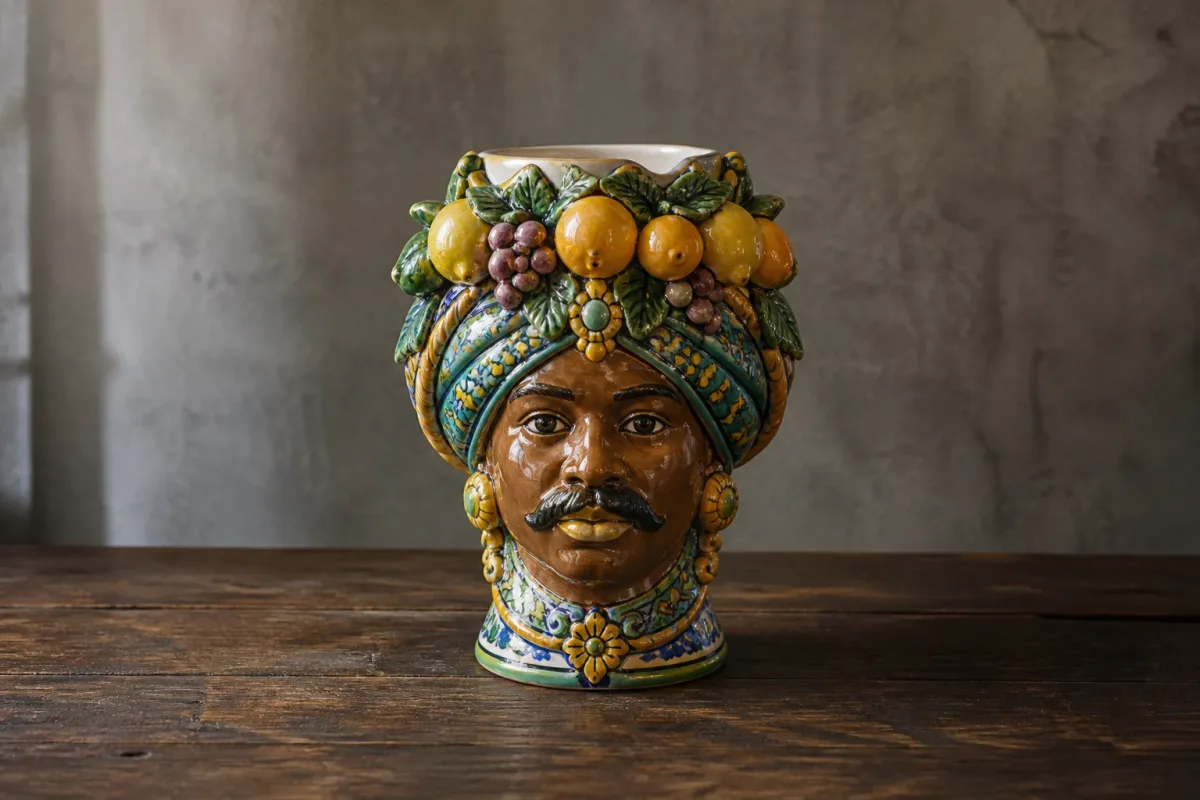
A testa di moro is a ceramic head conceived as a vase or jardinière. The crown or turban is open so the vessel can hold a plant — traditionally basil — or stand as sculpture. Production is concentrated in Caltagirone, in the province of Catania, though other Sicilian workshops now make the type.
Collectors usually meet the form as a pair: a male head with darker modeled features and a female companion. Italia.it, the Italian national tourism portal, notes that the female type was added over time to a tradition that began with male heads. Pairs sell more readily than singles, a pattern visible in Italian regional auctions as well as export retail.
The Italian word moro here is historical vocabulary. In Sicilian storytelling it refers to a North African or Arab figure from the centuries of Islamic rule and later contact across the Mediterranean. The ceramic type is a folk image, not a portrait of a named person.
Material matters more than costume. Serious examples are maiolica: earthenware given an opaque tin glaze, then painted in metal-oxide colors and fired again. Chips show a buff or reddish clay body, not the glassy white fracture of porcelain. That distinction is the same one that separates most historic Italian pottery from later court wares discussed in our collector's guide to antique Italian ceramics.
The Legend — and What It Does Not Prove
Official Italian tourism pages recount a story set in Palermo during Arab rule, around the year 1100. A young Sicilian woman tends plants on her balcony. A Moorish man falls in love with her. She returns the feeling, then learns he already has a wife and will leave for the East. She kills him in his sleep, turns the head into a pot, and plants basil. Neighbors envy the thriving plant and commission ceramic copies.
That is folklore. Italia.it presents it as leggenda, not as a dated workshop origin. Variants circulate: some shift the setting toward Norman-era Caltagirone; others emphasize jealousy, others protection and abundance. None of these stories can be treated as a manufacture date.
A documented literary parallel exists, and it is older than any surviving named testa di moro a collector is likely to handle. In Giovanni Boccaccio's Decameron (mid-fourteenth century), the tale of Lisabetta da Messina (Day IV, Story 5) has a Sicilian woman conceal her murdered lover's head in a pot of basil. Boccaccio did not invent Caltagirone ceramics. He does show that the image of a head, a pot, and basil was already part of Sicilian narrative culture centuries before the souvenir trade.
Treat the legend as cultural context. Date the object in your hands by clay, glaze, modeling, and marks.
Caltagirone: A Documented Ceramic City
Caltagirone sits inland on three hills between the Erei and Iblei ranges, on the historic route between Catania and Gela. Its historic center belongs to the UNESCO serial property Late Baroque Towns of the Val di Noto, inscribed in 2002 with Noto, Modica, Ragusa, Scicli, Palazzolo Acreide, Militello Val di Catania, and Catania. The listing recognizes post-1693 reconstruction, not pottery as such — but the same earthquake that reshaped the town also explains why so little earlier local maiolica survives.
The Sicilian regional archaeological park service summarizes the documentary record clearly. Medieval Caltagirone had good clays; its honey jars (quartare) were known well beyond the town. Sixteenth-century tax surveys, the Riveli, name many potters and record more than one hundred maiolica workshops. Almost none of that production survived the earthquake of 11 January 1693, which devastated eastern Sicily. Seventeenth-century survivals cited by the same source include floor fragments dated 1621 by maestro Francesco Ragusa and later paving associated with Luciano Scarfia.
Caltagirone is also a legally recognized città della ceramica. It belongs to the Associazione Italiana Città della Ceramica (AiCC), founded in 1999, which groups Italian municipalities of established ceramic tradition under Law 188 of 1990. That status covers the town's craft as a whole — tiles, tableware, figurines, pine-cone (pigna) ornaments — not only Moor's Heads.
The monumental Scalinata di Santa Maria del Monte, a staircase of 142 steps climbing through the centro storico, is the public face of that craft. The stair itself dates to 1606; the polychrome maiolica risers that visitors photograph today were applied in the twentieth century (the tile scheme dates to 1954). They are useful as a color education, not as a dating tool for a vase.
Where to Calibrate Your Eye: The Regional Museum
The Museo Regionale della Ceramica opened in 1965 in Caltagirone's public gardens, entered from Via Roma through the Teatrino Bonaiuto. Italia.it ranks it second in Italy, after Faenza's International Museum of Ceramics, for documenting ceramic art. The collection holds about 2,500 objects and runs from prehistory to the early twentieth century.
Hold this in mind when someone calls a Moor's Head "ancient." The museum's historical galleries show Siculo-Arab and Norman medieval wares, Renaissance maiolica, Baroque and eighteenth-century vessels, pharmacy jars, tiled floors, and the celebrated terracotta figurines of Giacomo Bongiovanni (1772–1859) and his circle. A red-figure calyx-krater from the San Luigi necropolis at Caltagirone (Painter of Clio, about 440 BCE) even depicts a potter at the wheel under Athena Ergane. The Regione Siciliana acquired the Russo Perez collection in the 1950s to strengthen this sequence.
Anthropomorphic vessels and lamps appear in the later historical rooms. What the tourist market now brands as a testa di moro — a large, crowned, high-gloss pair for the balcony — is overwhelmingly a nineteenth- and twentieth-century popular type, still made by living artisans. Christie's catalogued a signed twentieth-century Caltagirone example as a "testa di moro" jardinière: 29.2 cm high, modeled with a leafy crown of fruiting grapevine, from the André Leon Talley collection. That is the chronological bracket most buyers should expect.
How They Are Made
A workshop piece is built, not poured as a single tourist blank.
1. Clay. Local earthenware bodies are modeled by hand or over a form. Facial planes, ears, fruit, and jewelry are applied as separate elements. Thumb marks and slight asymmetry are normal.
2. Biscuit firing. The dried head is fired to a porous biscotto.
3. Tin glaze. An opaque white glaze — the defining layer of Italian maiolica — is applied.
4. Painting. Oxides supply the Sicilian palette: cobalt blue, copper green, antimony or related yellows, manganese browns and blacks. Some contemporary luxury pieces add gold leaf or mother-of-pearl lusters after the glaze firing.
5. Glost firing. Colors fuse to the glaze. Crazing (a fine crackle) can appear with age or thermal shock; it is common on genuine tin-glaze and is not, by itself, proof of great age.
Italia.it describes current Caltagirone practice in the same sequence: modeling, glazing, and decoration, including freehand painting, spolvero (pounced cartoons), and stencil. A stencil-only tourist head can still be clay. It will lack the variable line weight of a painted face. The glaze structure is the same family used in Deruta and Faenza.
This is not porcelain. Neapolitan and Tuscan porcelain traditions — Capodimonte and the broader Italian porcelain history of Ginori and Vezzi — use a different body, a different fracture, and a different market. A Moor's Head that feels glassy-light or shows a pure white chip is probably not historic Sicilian maiolica.
How to Identify Handmade Caltagirone Work
Weight and body. Earthenware heads of 30–45 cm are substantial. Resin and mixed-media souvenirs are lighter and warmer to the touch. A magnet will not settle the question; look at a chip or the unglazed foot if one exists.
Modeling. Fruit, leaves, and jewelry should read as applied clay, not as printed texture. Crown points and grape clusters are the first places cheap casts lose sharpness.
Painting. Faces on workshop pieces are drawn, then colored. Look for overlapping strokes at eyelids and mustache, small corrections, and color that sits on the white glaze. Machine decals sit too evenly and often stop short of modeled recesses.
Base and marks. Many historical Italian wares are unmarked. Twentieth-century and contemporary Caltagirone pieces more often carry incised or painted marks: the town name, an artisan signature, or "Made in Italy." Christie's twentieth-century lot was signed Brancaleone, Caltagirone. Italian auction houses routinely catalogue pairs signed Germano, Pulvirenti, Gurreri, and other workshop names. A mark proves origin only when it matches known hands and the quality of the object. It does not make a 1980s vase a Baroque antique.
Pairs. Matching male and female heads, same height and palette, are the commercial norm. A "pair" assembled from unrelated workshops is common in export lots; compare ear ornaments, crown fruit, and the green of the leaves.
Condition. Maiolica chips. Christie's condition note on the Talley jardinière recorded surface dirt, staining, crazing, and minor frits on applied decoration and the foot-rim — ordinary wear for glazed earthenware. Missing fruit, overpaint on the face, and filled crown tips should be priced as restoration.
What the Market Actually Looks Like
Do not shop as if you were buying Renaissance Urbino. Shop as if you were buying signed or unsigned Sicilian studio ceramics, mostly from the last hundred years, with a long living tradition behind them.
Il Ponte, the Milan auction house, offered a signed Caltagirone pair 39 cm high in April 2023 with an estimate of €60–80. The lot, noted as having defects, sold for €450. That spread — modest estimates, stronger results when two heads match and the modeling is good — is more informative than souvenir-shop prices in Taormina.
Christie's New York appearance of a single twentieth-century head in a fashion-world collection shows the type crossing into decorative-arts sales outside Sicily. It does not establish a luxury-antique category comparable to documented Renaissance maiolica.
Retail in Caltagirone itself still includes named workshops. Italia.it points visitors to Giacomo Alessi on Via Principe Amedeo, who models and paints his own work, and to the continuing shop of Totò Regalbuto (a 1960s pupil of the Baca workshop). Those are contemporary makers. Buying from them is buying living craft, which is a different proposition from hunting "antique" heads online.
For comparison with another Italian export ware that is often mislabeled by color and town name alone, see our guide to Empoli glass and Tuscan verde. In both fields, the town is real, the tourist copy is abundant, and the useful question is workshop quality rather than a mythical medieval date.
Building a Small Collection
Decide what you are collecting before you buy the third head.
- One serious pair from a named Caltagirone workshop, kept as furniture-scale sculpture.
- A chronological slice of twentieth-century signed heads, comparing how fruit crowns and facial types change.
- Related Caltagirone forms — pine-cone finials, tiles, or figurines — so the Moor's Head sits inside a town tradition rather than as an isolated souvenir.
Visit the regional museum before you spend on a "period" claim. Walk the staircase for color, then handle shop work still warm from the kiln. Once you know what new glaze looks like, older crazing and softer modeling become easier to read.
Shipping is straightforward for objects under export-control thresholds, but pack for chips at every applied grape. Declare ceramic, age, and value accurately. High-value cultural property leaving Italy can require paperwork; a modern workshop pair usually does not, but a dealer should say so in writing.
Common Mistakes
- Treating the Palermo legend as a manufacture date.
- Calling any glossy head from a Sicilian gift shop "antique Caltagirone."
- Confusing maiolica with porcelain because both are shiny and Italian.
- Paying pair prices for two heads that do not share a workshop or palette.
- Reading "Made in Italy" as a century mark. It is a country-of-origin mark.
FAQ
Are Sicilian Moor's Heads antiques?
Some twentieth-century examples are now vintage; a few earlier anthropomorphic Sicilian vessels exist in museum collections. The objects most often sold under this name are modern artisan or tourist ceramics. Ask for a date range you can verify.
Why are they sold as pairs?
The folk story is male; the commercial type became a couple. Dealers and auction houses treat a matched pair as a single decorative unit, which is why pairs usually outperform singles.
How can I tell resin from ceramic?
Lift it. Look at the foot or a chip. Ceramic is colder, heavier, and shows a granular clay or glaze fracture. Resin smells faintly of plastic in a closed box and flexes less honestly at thin crown points.
Is the term "Moor's Head" still used in Italy?
Yes. Testa di moro / teste di moro is the standard Italian name in museums, tourism, and auction catalogues, including Christie's. In English, "Sicilian Moor's Head" or "Caltagirone head vase" is understood.
Where should I start if I cannot travel to Sicily?
Read the object against museum photographs from Caltagirone and against the broader Italian maiolica framework. Buy from sellers who photograph the base, the interior, and any restoration. Prefer a named workshop over an anonymous "Sicilian style" listing.
Conclusion
Sicilian Moor's Heads succeed as design because they compress a long Mediterranean story into one readable object: a face, a crown of fruit, a pot for basil. The story is older than the souvenir. The clay tradition in Caltagirone is older still, and it is documented — in tax lists, in a 1693 rupture, in a regional museum of 2,500 works, and in workshops that still sign the foot.
Collect the object you can see. Leave the midnight murder on the balcony where it belongs, as legend.