
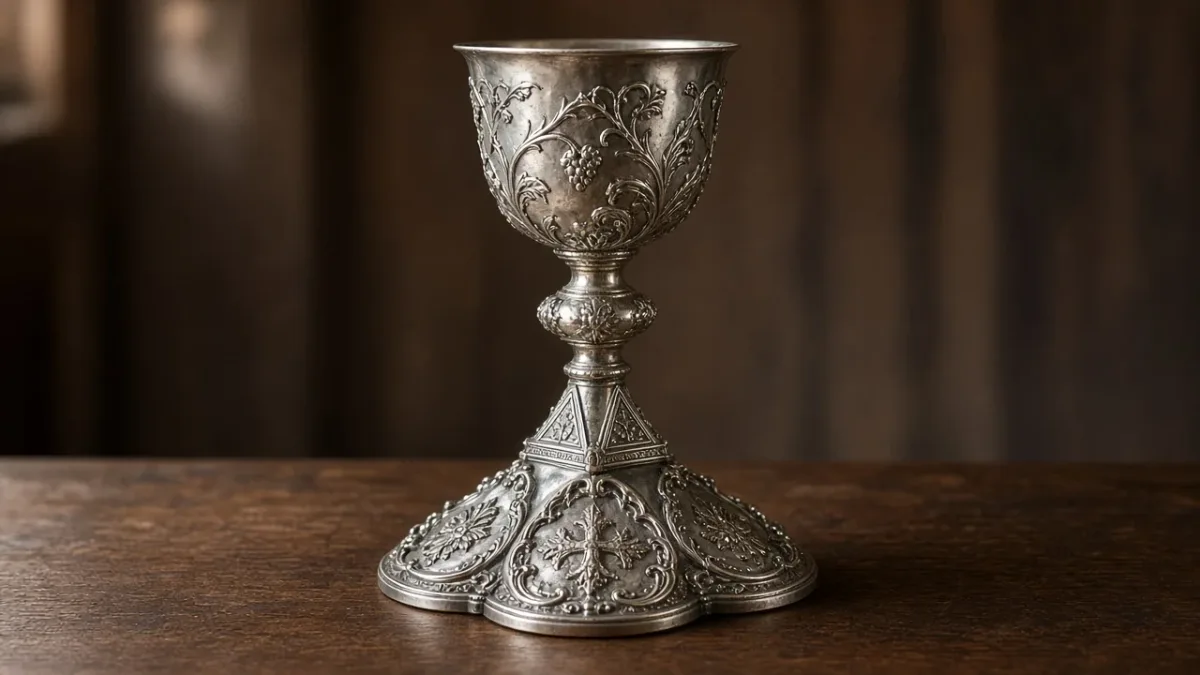
The Silver of Palermo and Messina
Sicilian silver is dated by civic punches: Palermo's eagle, Messina's crowned cross, Trapani's DUI, then the island-wide Ceres head used from 1826.
Sicilian silver is a civic product. The metal is guaranteed by a town punch, not by a souvenir motif of Etna or a triskelion chased on the body. Palermo used an eagle. Messina used a crowned cross. Catania used an elephant. Trapani used a crown, a sickle, and the letters DUI. Those punches, together with the consul's initials and the maker's cipher, are the dating method. Style is secondary.
Before 1872 there was no single Italian hallmark. Sicily ran its own guilds under Aragonese, Spanish, Savoyard, and Bourbon rule. The island's system is therefore not a provincial variant of Neapolitan silver or of Roman papal assay marks. It is a separate sequence of town bullae that ends, island-wide, with the Ceres-head mark of 1826. After that date the later national Italian silver hallmarks apply as they do elsewhere.
Palermo: eagle, consul, maker
The maestranza of goldsmiths and silversmiths in Palermo was instituted on 12 May 1447, under Alfonso the Magnanimous, king of Aragon. The guarantee mark was an eagle, the city's emblem, over the letters now transcribed as RVP or RUP, for Regia Urbs Panormi. Catalogues of the Tesoro of Palermo Cathedral use both letter readings on different objects. The punch is the civic guarantee, not a maker's device.
Three marks are the Palermitan rule in the eighteenth century. The bulla di garanzia is the eagle. The console dell'arte, elected each June, struck his initials and a year date, usually two or three digits. The maker struck his own initials, sometimes with a small device. The consul's punch did not change at the calendar New Year. It ran from June of election to the following June. Gaspare Leone, documented as console degli argentieri from 10 July 1765 to 8 July 1766, is the type: a chalice and paten in a private collection carry the eagle, the maker AG, and GL65.
Wing position dates the eagle. Until 1715 the bird is shown with wings lowered. In that year the punch was recut with wings raised, to match the Savoy eagle of Vittorio Amedeo II, king of Sicily from 1713. An ostensorio with phoenix in the Cathedral Tesoro, dated 1735, is catalogued with the high-flight eagle, the letters RVP, and AG735. An ostensorio of 1739 in the same treasury carries the high-flight eagle transcribed RUP and GCA38, read as Giovanni Costanza, consul in 1738–39. A reliquary of Santa Rosalia dated 1802 carries SC802, read as Salvatore Calascibetta.
Gold and jewels were not under the same rule until 1758. The edict of Viceroy Fogliani extended the guarantee mark to gold objects and jewellery that had previously left the shop unpunched. Silver already in church treasuries can therefore predate that edict even when later gold mounts do not.
The guild kept its statutes in a manuscript of the Capitoli recovered by Maria Accascina in the Biblioteca Comunale and later re-examined by Silvano Barraja. Barraja also dated the Monte degli orafi e argentieri, the craft's mutual fund, to 1594. Workshops clustered on Via dell'Argenteria Nuova and Piazzetta Meli, the so-called quadrilatero delle maestranze. The maestranza itself was suppressed on 13 March 1822.
Palermo's eighteenth-century plate tends to take ornament onto the structure. Salvatore Serio, in his 2015 University of Palermo dissertation on Messinese silver, contrasted that Palermitan rococo, which can alter the profile of a chalice or lamp, with Messina's habit of keeping the vessel's architecture and applying rocaille, lattice, and shell as surface.
Messina: crowned cross and the plague of 1743
Messina's town mark is a cross in a crowned shield, with M and S at the sides, for Messinensis Senatus. In the first half of the eighteenth century the system used four punches: the civic bulla; the consul's initials followed by C; a separate date of two or three digits; and the maker's initials. After the plague of 1743, which emptied the city and halted production, the surviving works show three punches: the civic shield, the consul's initials combined with the last two digits of the year of office, and the maker. That three-mark system lasted until the suppression of the guilds.
The Juvarra workshop is the documented Messinese case that collectors meet in literature. Pietro Juvarra, silversmith, supplied candlesticks to the cathedral and, in 1653, signed PET IUV on an arm reliquary in the cathedral treasury. His son Filippo, born in Messina in 1678, trained in that shop before he became an architect. Early works associated with the young Filippo include a chalice of 1695, two ostensori of 1697 and 1700 for the church of the Giummare at Sciacca and San Giorgio at Modica, eight candlesticks of 1698 and two larger ones of 1701 for the Duomo of Messina. Accascina assigned a paliotto of 1700 in San Filippo Neri at Castroreale, marked AFC 1700 FLIV, to Antonio Fucili as consul and to Filippo Juvarra as maker. Later scholarship treats some of those identifications as readings from punches, not as signed contracts. The Treccani biography of the family remains the control for Pietro's documented commissions.
Christie's has catalogued the same civic system on smaller plate. A seventeenth-century processional cross given to Antonio Dominici had a later Christ figure covering an original engraved corpus, with Saint Sebastian on the reverse, 27 cm high, 228 g. A Messina chalice of 1755 carried consul G.C. and maker P.L.: circular tripartite foot with sacred cartouches, triangular baluster with Instruments of the Passion, vine trails in rocaille on the calyx, 30 cm high. Those dimensions and the four- or three-punch sequence are more useful than a dealer's "Sicilian Baroque."
Catania, Trapani, and the lesser bullae
Catania punched an elephant, the city's emblem, often with the letter A for Agatha, the patron. A chalice catalogued by the Istituto Centrale per il Catalogo e la Documentazione as bottega catanese carries the elephant on the foot rim, the consular punch CMC99, and maker AG. The elephant is not a Palermitan eagle misread.
Trapani used a different civic formula. From 1614 until the 1826 reform, silver made in the city was struck with a crown, a sickle, and the letters DUI, for Drepanum Urbs Invitissima. The oldest silver on the Misteri groups of Trapani's Holy Week, a cross and chalice for Gesù nell'orto, belongs to 1612–1631 and carries that bulla alone. In 1771, under consul Dionisio Porrata, the civic letters appear as CUD, Clarissima Urbs Drepanum. Later pieces carry IUD, Invictissima Urbs Drepanum, or UDI, Urbs Drepanum Invictissima, under an expanded crown. After 1826 the town bulla disappears. From the early 1830s the Ceres head with an Arabic numeral for fineness marks Sicilian silver regardless of city, together with maker and assayer.
Accascina's I marchi delle argenterie e oreficerie siciliane (Bramante, 1976) remains the corpus for these punches, with chapters on Palermo, Messina, Catania, Trapani, Acireale, and Syracuse. Barraja's I marchi degli argentieri e orafi di Palermo (second edition 2011) is the Palermitan directory. Maria Concetta Di Natale's Ori e argenti di Sicilia (Electa, 1989) is the exhibition catalogue that still organises museum comparisons.
Church plate: what the punches sit on
Most surviving antique Sicilian silver is liturgical. Parish and cathedral commissions produced chalices, patens, ostensori, pyxes, processional crosses, paliotti, hanging lamps, and reliquaries in bust, arm, and architectural form. Domestic tea services of the English type are scarce before the nineteenth century.
The Tesoro of Palermo Cathedral is the public reference group. About seventy goldsmiths' works were surveyed for conservation by Iolanda Di Natale for the Osservatorio per le Arti Decorative in Italia. They range from the twelfth century to the first half of the nineteenth, with Palermitan, Spanish, Lombard, and Roman pieces mixed. The rooms, in the Sagrestia dei Canonici, the Cappella del Tesoro, and the Diaconicon, were reinstalled in 2006 and reorganised again in 2019.
Named Palermitan goldsmiths in that treasury include Don Camillo Barbavara, documented 1627–1662, author of the jewelled chalice given by Canon Giovan Battista La Rosa e Spatafora before 1637. Michele Ricca (1633–1650) and Giovanni Duro (1734) made pyxes. Agostino Natoli and Salvatore Mercurio signed an ostensorio of 1775 with enamels, rubies, and diamonds, punched with the high-flight eagle, consular marks AC74 and DCA74 (Andrea Cipolla and Don Cosma Amodei, 1774–75), and Natoli's AN. Francesco Burgarello, active 1752–1782, made the Gioia del Santo Costato. Domenico La Villa punched an ostensorio of 1771 with DLV and NG7, Nunzio Gino consul 1771–72.
Techniques are those of a plate shop, not of a jeweller's bench alone: sbalzo and cesello on sheet, casting for feet and figures, filigree on ampolline and some ostensori, hard soldering. Granulation and gem setting appear on goldsmiths' work. A Palermitan Seder plate of the later seventeenth century, now in the U. Nahon Museum of Italian Jewish Art, Jerusalem, shows that the same civic punches served Jewish ritual plate: eagle with R.V.P., and FCG, read by Accascina as Francesco Gargano, working with Gaetano Signorelli (GS, 1677). Diameter 48 cm.
The Ceres head, 1826–1872
Francesco I of the Two Sicilies issued a royal decree on 14 April 1826. Officine di Garanzia replaced the guild consuls. Three marks were required: the maker, the assayer, and a guarantee punch of the head of Ceres with a numeral for the standard of the metal, identical throughout Sicily. Scholarly catalogues of later chalices treat numbers 1–6 as gold and 7–10 as silver, with 8 read as 800/1000. The Palermitan eagle, the Messinese cross, the Catanese elephant, and the Trapanese DUI all drop out.
A Ceres-head punch therefore dates an object after 1826 and, in ordinary use, before the Kingdom of Italy's 1872 hallmarking law. It does not name the city. Giacomo D'Angelo of Palermo continued to sign GDA, later adding a small angel as a fabbricante device required by the new office, on a wash service at San Martino delle Scale and on Madonie chalices that also carry Ceres and the numeral 8. Hybrid objects exist. A weekday chalice at Petralia Soprana reuses an eighteenth-century cup that still bears the Palermo eagle, a maker DD, and C41 for a consulate of 26 June 1741 to 26 June 1742 read as Gaspare Leone, with a later Ceres 8 on the same bowl.
After 1872 Sicilian shops used the optional, then compulsory, national punches discussed in the Italian silver hallmarks guide. A 925 or 800 lozenge with a provincial number is not a civic bulla. Florentine silver went through its own Grand-Ducal sequence in the same decades. Do not read a Florentine lion as a Palermitan eagle, or a Neapolitan Parthenope as a Messinese cross.
Later work, repairs, and what is missing
Unmarked "Sicilian" plate with a lava cameo or a painted cartouche of Palermo harbour is often later tourist work. Civic punches sit on the foot rim, the reverse of a paten, the stem of an ostensorio, or the reverse of a lamp's canopy. They are small. A torch and a loupe are required. Recast feet lose the original bulla.
Later Christ figures, replaced knots, and refreshed gilding are ordinary on processional crosses and chalices that remained in use. Christie's Dominici cross is the published case: a subsequent corpus covering the engraved original. Record the junction. Do not date the whole object from the added figure.
Condition follows church use. Dents collect at the foot. Candle grease sits in cesello. Active corrosion in copper cores and iron pins needs treatment. Weight in grams, height, and the location of every punch belong in the catalogue note. Italian law on beni culturali can require an export licence for historic church furnishings. That is a separate question from quality of metal.
The punches remain the argument. An eagle over RVP or RUP, a crowned Messinese cross, a Catanese elephant, a Trapanese DUI, or a Ceres head with a numeral will date Sicilian silver more tightly than any regional adjective in a dealer's title.
FAQ
How do you tell Palermo silver from Messina silver?
By the civic punch. Palermo used an eagle over RVP or RUP. Messina used a cross in a crowned shield with M and S. Maker initials alone do not name the city.
What does a Ceres head on Sicilian silver mean?
It is the island-wide guarantee introduced by the decree of 14 April 1826. It replaced town bullae. The numeral gives the standard. It does not identify Palermo, Messina, Catania, or Trapani.
Did Filippo Juvarra make silver?
He trained in the Messina shop of his father Pietro and is associated with early ecclesiastical plate of the 1690s and 1701. His later career is architecture. Treat punch identifications published by Accascina as attributions unless a contract survives.
Are tea services typical of antique Sicilian silver?
No. The documented survival is overwhelmingly ecclesiastical: chalices, ostensori, crosses, lamps, paliotti, reliquaries. Domestic services become more common after the 1826 reform and under the national system.
Can Sicilian silver be confused with Neapolitan silver?
Yes, especially on unmarked rococo chalices. Naples used NAP and Parthenope punches. Sicily used town emblems. Bourbon political history is shared. The assay systems are not.