
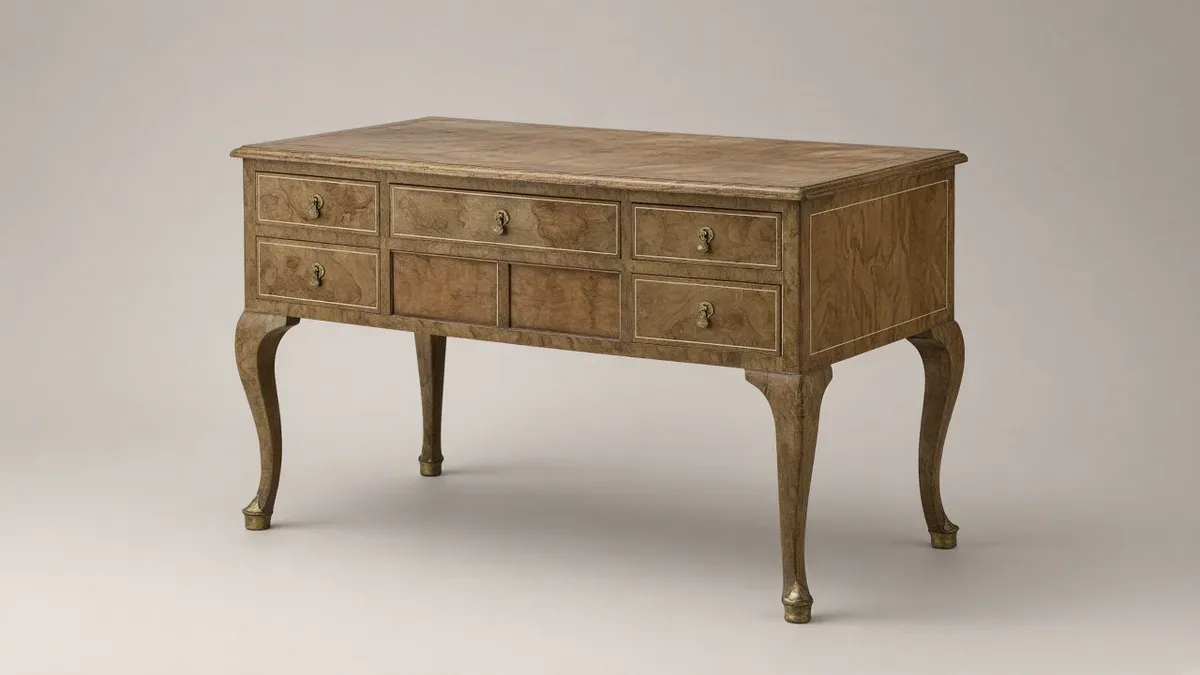
Italian Bureau and Writing Desk Prices at Auction
Auction prices for antique Italian writing desks, from Venetian ribalte to Roman centre desks, and how to tell a period bureau from a later copy.
The Italian writing desk is not one form. Dealers and catalogues use scrivania, scrivania da centro, bureau, ribalta and scrittoio for objects that share a writing surface and almost nothing else. A fall-front bureau with three bombé drawers is a different market from a freestanding centre desk veneered on all four sides, and both are different from the bureau-cabinet already treated as the Venetian trumeau. Price follows that distinction before it follows wood.
English sale rooms call the fall-front type a bureau or secretary. The freestanding table with drawers in the frieze is a bureau plat or centre writing desk. Italian houses keep scrivania da centro for the latter and cassettone a ribalta or bureau for the former. Mixing the terms is how a later wall desk is sold as a palazzo centrepiece.
What determines value
Maker and workshop come first when a name can be argued. Few Italian writing desks carry a stamp. Giuseppe Maggiolini of Parabiago signed and documented commodes and desks in the last quarter of the eighteenth century. A desk that can be placed in that shop, or in the circle recorded by Enrico Colle in Il mobile neoclassico in Italia (Milan, 2005), is priced as a named object. Roman work sometimes sits near Andrea Mimmi (1701–1783), the inlayer paid for the Museo Profano cabinets in the Vatican Library from 1781, an attribution Alvar González-Palacios has used with caution in Il tempio del gusto and in later notes on Roman furniture. Unsigned desks sell on city, timber and condition.
Period is the next cut. Mid-eighteenth-century desks of the barocchetto and rococo, with bombé or serpentine fronts, still lead the Italian rooms. Late-eighteenth neoclassical desks with geometric parquetry and gilt-bronze sabots follow. Nineteenth-century copies of both, and twentieth-century "Luigi XV" olive desks from Tuscan and Veneto workshops, occupy a lower band unless the revival work is of documented quality.
Region is readable in timber and silhouette. Venetian fall-fronts take figured walnut or walnut burl over a softwood carcase, sometimes with lacca povera instead of veneer, as on the Metropolitan Museum secretary of about 1730–35 (acc. 25.134.1a, b). Lombard centre desks of the third quarter of the century use chestnut and chestnut briar, rocaille boxwood inlay, and, on the larger a cattedra type published by Clelia Alberici in Il mobile lombardo, eight carved feet. Tuscan desks of the same century are often olive, with rosewood fillets and boxwood lines framing rectangular reserves, finished on the reverse so the desk can stand in a room. Ligurian and Genoese examples, including the Dorotheum Genoa secretary of about 1760, prefer rosewood veneer on a bombé softwood box. Roman desks of the last quarter tend toward geometric reserves, sliding leather tablets and gilt-bronze shoes. Neapolitan centre desks are veneered in mixed woods and, at the top of the market, can outsell northern work of similar size.
Material is not a synonym for luxury. Olive and walnut burl are the expected show woods. Rosewood (palissandro, bois de rose) and Indian walnut appear on Ligurian and Roman pieces. A leather writing surface is original on some neoclassical tablets and a later replacement on many others. Pine, fir or poplar as a secondary wood is correct for a veneered carcase. Plywood is not.
Rarity is a matter of type more than of a missing twin. A fully veneered scrivania da centro of palace scale, finished on all four sides, is scarcer than a wall-standing ribalta. A documented Maggiolini, or a Lombard eight-foot desk of the kind Pandolfini catalogued from Italian collections in 2016, is rarer still. Small scrittoi with restorations are common.
Condition and restoration move the price more than a catalogue date. Replaced feet, reveneered tops, later leather and supplied gilt-bronze mounts are the usual deductions. Il Ponte's Lombard inlaid centre desk of 25 October 2017 (auction 401, lot 479), catalogued with losses and restorations, was awarded €1,700. The same house awarded €15,000 on 21 October 2009 (auction 264, lot 400) for a Tuscan olive centre desk of 140 × 85 × 80 cm with no such caveat in the published description. Those two results are not a range for "an Italian desk." They are two different objects.
Provenance helps when it is documentary: a named villa, a published collection, a press-noted sale. Verbal palace stories do not.
Size is functional. A centre desk of about 140–160 cm in width, usable from both sides, is the form collectors still want for a room. A 90 cm escritoire is a different, cheaper object. Depth around 70–85 cm is typical for a scrivania da centro. A fall-front bureau is often closer to 50–60 cm.
Market demand has thinned for anonymous nineteenth-century wall desks and held for eighteenth-century centre desks with original veneer and a complete set of drawers. The eighteenth-century cassettone and the writing desk share buyers. A desk that can stand in the middle of a room still has a use a commode does not.
Prices at auction
The figures below are published sale results, not estimates. Hammer and premium are given as the house printed them. Condition, fashion and the room on the day all move the number. None of these lots is a valuation of a desk in private hands.
Il Ponte, Milan, auction 264, lot 400, 21 October 2009. Scrivania da centro veneered in olive, rosewood-filleted, boxwood lines defining reserves, end-grain top moulding, pull-out slide, six side drawers and one under the top, dummy drawers on the reverse, shaped apron and feet. Tuscany, eighteenth century. 140 × 85 × 80 cm. Awarded €15,000 against an estimate of €15,000–18,000.
Il Ponte, Milan, auction 327, lot 503, 15 October 2014. Shaped centre desk veneered in Indian walnut, three drawers in the front, shaped aprons and legs inlaid in rosewood, gilt-bronze feet. Liguria, eighteenth century. 160 × 80 × 70 cm. Awarded €13,000 against €9,000–10,000.
Il Ponte, Milan, auction 401, lot 479, 25 October 2017. Centre desk with four small drawers and one large, inlaid in various woods with vegetal motifs and a rosette, tapered legs. Lombardy, eighteenth century. 90 × 76 × 46 cm. Losses and restorations. Provenance: Conte Ferrari Ardicini. Awarded €1,700 against €1,000–1,200.
Dorotheum, Vienna, Furniture, Works of Art, Glass & Porcelain, 3 November 2022, lot 811. Secretary desk, Genoa, about 1760. Softwood frame, bombé on three sides, rosewood veneer and ornamental marquetry, three drawers, slanted fall-front on two pull-out supports, interior with three drawers, a small mirrored door and open compartments, leather-lined writing surface. 114 × 112 × 60 cm. Realized €8,450 including buyer's premium (estimate €7,000–10,000).
Dorotheum, Vienna, 25 April 2024, lot 828. Italian writing desk, Rome, eighteenth century and later. Rosewood-veneered hardwood and softwood, conical square legs with cross stretcher, bun feet, maple floral and rocaille marquetry, two frieze drawers, later-added drawers in the superstructure, restored. About 91 × 130 × 65 cm. Realized €3,380 including buyer's premium (estimate €2,800–3,800).
Wannenes, furniture sale of 2–3 March 2016, lot 935. Neapolitan centre writing desk of the third quarter of the eighteenth century, veneered in various woods. Reported at €32,240 in the house's published results.
Pandolfini, Florence, furniture sale of 20 October 2020, lot 77. Roman centre desk of the third quarter of the eighteenth century, walnut, walnut burl and other woods, diamond and oval ornament on the frieze, gilt-bronze shoes. Hammered at €20,000 according to the house press note.
Christie's, New York, 27 September 2000. North Italian rococo walnut and parquetry bureau, Venice, mid-eighteenth century. Fitted slant front, three serpentine drawers, cabriole legs (three replaced). 106.75 × 105.5 × 58.5 cm. Price realised USD 5,875 (estimate USD 8,000–12,000).
Taken together, the documented sales do not support a single Italian writing desk band. A restored Roman desk with later drawers made €3,380 including premium in 2024. A complete Tuscan or Ligurian centre desk of palace width made five figures at Il Ponte. A named-city Neapolitan example was reported above €30,000. Fall-front bureaux without an upper cabinet sit between those poles when the carcase is period and the feet are not all later. Bureau-cabinets, priced on a different scale, belong with the trumeau market, not here.
Authentic or later
Construction dates the object more reliably than a verbal city. A period veneered desk is a softwood or secondary-hardwood box. The Art Institute of Chicago's Milanese bureau, attributed to the Fratelli Valentini workshop about 1760–65 (acc. 1947.409), is walnut and ebonized walnut over pine, with brass mounts: 121.3 × 132.1 × 48.3 cm. The bombé outline, called barocchetto in the museum text, is a northern Italian mid-century shape, not a proof of Venice. Drawer sides should show hand-cut dovetails that stop short of the show veneer. Backs and dustboards keep saw and plane marks and an oxidized colour that does not match a freshly stained face. Machine-planed backs, plywood and Phillips screws are later.
The Met secretary is frank: the construction is very basic, and all the attention is lavished on the surface. That remains the first test for a Venetian fall-front. A carcase built like cabinet furniture, with thick walnut throughout and no secondary wood, is more often a nineteenth- or twentieth-century object made to look expensive. Daniëlle O. Kisluk-Grosheide recorded the same economy of structure on the Met piece in the Metropolitan Museum Journal for 1996.
Veneer tells the same story. Period olive and walnut burl are laid in reserves, often book-matched, with contrasting fillets. End-grain banding on the top edge, as on the Il Ponte Tuscan desk, is a Tuscan habit. A single sheet of repeating printed or dyed figure, or a top whose grain does not continue into the edge, is a later skin. Glue lines that sit on a sanded, pale carcase usually mean reveneering.
Hardware is where copies fail first. Period locks are iron, often with a hand-filed bolt. Cast gilt-bronze pulls sit in the veneer. Stamped brass plates screwed onto the surface, nickel lever locks and a complete matching set of bright ormolu on an otherwise tired desk are later. Gilt-bronze sabots on Roman and Ligurian legs are original when the wood is cut for them. They are additions when the foot has been shortened and recapped.
Feet and slides are the usual replacements. Christie's Venetian bureau of 2000 had three legs replaced and still sold as an eighteenth-century object. A perfect set of carved feet under a worn carcase is a warning, as on many Venetian trumeaux. The pull-out writing slide of a scrivania da centro should wear in the runners. A slide that is a later board in a recut frieze is common on assembled desks.
Typical reproductions are not scarce. Tuscan and Veneto workshops of the late nineteenth and twentieth centuries made olive "Luigi XV" centre desks with roller shutters, secret drawers and a fully finished reverse. Some are honest revival work. They are not eighteenth-century scrivanie. Veronese furniture towns, Cerea among them, produced rococo-style fall-fronts in walnut burl from the 1920s onward, using square nails and fir interiors in conscious imitation of settecento practice. They still lack two centuries of movement in the joints and any early glass on an interior door.
Married parts need their own line in a catalogue. A fall-front from one bureau on the drawers of another, or a later superstructure on a Roman writing table, is catalogued by Dorotheum as "eighteenth century and later." That wording is the correct description, not a bargaining flourish. The 2024 Roman desk with later-added drawers is the published type.
Common buyer mistakes repeat. Treating a trumeau as a writing desk and paying bureau-cabinet money for a wall ribalta, or the reverse. Reading "Maggiolini style" as Maggiolini. The Lombard marquetry shop is documented. The adjective is not. Taking olive veneer as automatically Tuscan and eighteenth-century. Ignoring the reverse of a supposed centre desk: if the back is a single stained panel with no dummy drawers, no veneer reserves and no wear, the object was made to stand against a wall. Confusing a Florentine walnut table or a console with a writing desk because both have cabriole legs.
How the forms differ
A scrivania da centro is a table. It has a writing top, drawers in the frieze and four or more legs. The best examples are veneered on all four sides. Some have a pull-out slide or a hidden tablet with a gilt-tooled leather panel, as on the Roman desk González-Palacios related to Andrea Mimmi.
A ribalta or bureau is a chest. The slant lid drops onto two lopers and reveals small drawers and pigeonholes. Below it sit two or three long drawers. There is no upper cabinet. Genoa about 1760, as in the Dorotheum secretary, is a published Ligurian version of this type. The Art Institute Milanese bureau is the Lombard bombé version.
A scrittoio is a smaller writing table, often with lyre or trestle supports in seventeenth-century examples (the scrittoio San Filippo) and with a modest frieze in later ones. It is not a centre desk of palace width.
The bureau-cabinet adds the glazed or mirrored upper stage. That is the trumeau. It is not priced, and should not be examined, as a writing table.
FAQ
What is an antique Italian writing desk worth?
There is no single figure. Documented eighteenth-century centre desks of 140–160 cm have made €13,000–20,000 hammer at Il Ponte and Pandolfini, and a Neapolitan example was reported at €32,240 at Wannenes in 2016. Restored or reduced desks, and those catalogued as "eighteenth century and later," have made low thousands including premium. The result tracks form, city, veneer and the amount of later work, not the word scrivania.
How do you tell a period bureau from a later copy?
Start with the carcase: secondary softwood, hand-cut drawer dovetails, oxidized backs, iron locks. Then the veneer: book-matched olive or walnut burl with fillets, not a repeating printed sheet. Then the feet and mounts. A bright, complete ormolu set on a tired box is later more often than not.
Is a ribalta the same as a trumeau?
No. A ribalta is a fall-front chest with a writing slope and drawers below. A trumeau adds an upper cabinet, usually with mirrored or glazed doors. English catalogues call the larger object a bureau-cabinet or secretary.
Did Italian workshops stamp writing desks?
Rarely. Maggiolini is the exception that dealers quote. Most desks are attributed by timber, silhouette and comparison with published city types. An invented workshop name is not a substitute for the carcase.
A professional appraisal or a written condition report is warranted when the asking price assumes an eighteenth-century centre desk of named city and the object has been reveneered, remounted or assembled from more than one carcase. A restorer who will turn the desk over, pull every drawer and photograph the locks is more use than a verbal date. The prices above describe past sales. They do not value the desk in front of you.