
What Is an Antique Italian Silver Tea Set Worth?
What an Italian silver tea set is worth depends on maker, weight and marks. Verified auction results, and how to spot later or plated services.
A servizio da tè e caffè is a matching set: teapot, coffee pot, sugar bowl and milk jug. Italian catalogues add a tray more often than English ones do. Heavier Milanese services of the twentieth century sometimes include a kettle-on-stand, the bollitore. That complete service is what the market prices as a tea set. A single eighteenth-century caffettiera is a different object.
Italy adopted coffee earlier and more widely than tea. Complete tea-and-coffee services become common in the late nineteenth century and standard in the twentieth. Before that, surviving household silver is usually a coffee pot, a chocolate pot or a sugar box, marked by a city assayer in Venice, Naples, Rome or Florence.
What determines value
Maker and workshop come first. A service struck for Mario Buccellati in Milan, or raised by Ilario Pradella for that shop, sells on the name as well as the metal. An unsigned 800/1000 service from a Milan or Vicenza workshop sells closer to weight, unless the chasing or the tray is exceptional. Cesa in Alessandria, R. Miracoli & Co. in Milan, Argenteria di Leone, Luigi Genazzi and Eredi Mazzetti (lozenge MI 244) appear on documented lots. They do not command Buccellati money.
Period and region are linked. Eighteenth-century Venetian and Neapolitan coffee pots carry city assay marks and sit in the older silver literature: Piero Pazzi for Venice, Elio and Corrado Catello for Naples. A complete twentieth-century service is judged by the national hallmark sequence of 1934, 1944 and 1968–70, not by a lion of St Mark.
Material is 800/1000 for most domestic Italian silver and 925/1000 on export and luxury work. Weight is not a side note. A five-piece 800 service of about 2.4 kg and a five-piece service of 5.8 kg have sold in the same rooms at very different figures. Completeness matters as much as weight: a matching tray, the same finials, the same feet, the same handle timber.
Condition is read on the bodies. A dent in a coffee-pot shoulder, a split at a spout seam, a replaced wood handle, or ivory insulators that trigger export limits, all cut the bid. Restoration that flattens original chasing or replates a worn 800 body is visible under raking light. Provenance helps when it is a named shop or a documented collection. A verbal family attribution does not.
Size follows weight. A coffee pot around 24–28 cm is the usual Milanese scale. Demand currently favours complete, well-marked twentieth-century services and, separately, single eighteenth-century pots with clear city marks. Mixed assembled services sit between the two and usually sell as metal plus a tray.
Prices at auction
These are published results, not a valuation. Condition and the room on the day move the figure.
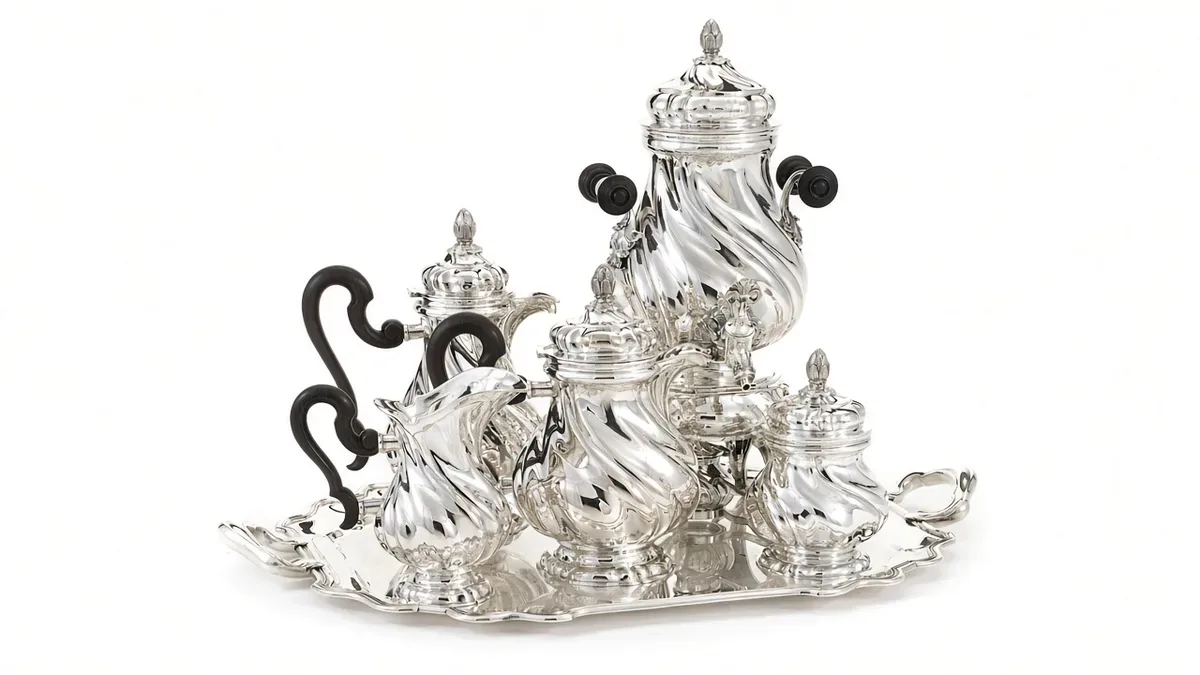
On 23 September 2014 Bonhams, New York, sold lot 1022, an Italian sterling five-piece tea and coffee service with matching two-handled tray by Pradella Ilario for Buccellati, Milan, twentieth century: spirally fluted bodies, rosewood handles, teapot, coffee pot, hot-water urn on stand, cream jug, two-handle covered sugar and cartouche tray, about 301 oz troy. The lot made US$33,750 including premium.
Christie's, New York, 21 April 2016, sold a four-piece Mario Buccellati service with tray, also marked Ilario Pradella on the vessels: urn-form bodies on anthemion-capped paw feet, wood handles, oval tray with pierced gallery and swan feet, coffee pot 28.5 cm, tray 52 cm, 195 oz (6,068 g) gross. Price realised USD 10,625.
Christie's, 22 May 2009, sold a four-piece Buccellati service without a tray: faceted bodies, ivory insulators, coffee pot 24.8 cm, 94 oz (2,930 g). Price realised USD 4,750.
Christie's, 5 March 2014, sold a five-piece service with tray marked Argenteria di Leone, Milan: kettle-on-stand, teapot, coffee pot, cream jug and sugar, fluted baluster forms, wood handles, rococo-cast oval tray 85.1 cm, 339 oz (10,544 g). Price realised USD 7,500.
At Dorotheum, Vienna, 28 June 2022, lot 255, a five-piece Milan service marked R. Miracoli & Co. and 800, coffee pot 24 cm, tray 68 × 45 cm, 5,771 g gross, made EUR 3,840 including premium.
Dorotheum, 13 December 2024, sold an unsigned Italian 800 five-piece service, coffee pot 21 cm, tray 67 × 47 cm, 5,818 g, for EUR 3,900 including premium.
Dorotheum, 17 September 2024, sold a lighter Italian 800 five-piece service with a dent, coffee pot 27.5 cm, tray 54.5 × 33 cm, 2,392 g, for EUR 1,400 excluding premium.
The range those lots support is wide. A named Buccellati service with tray and high weight has reached five figures in dollars. An ordinary 800 Milan service of 5–6 kg has recently sold in the region of EUR 3,800–3,900 including charges. A lighter or damaged 800 set can open near EUR 1,400. Prices vary with condition and the market. They are not an appraisal of any specific service.
Eighteenth-century Italian coffee pots, sold as single vessels, sit on another scale. Bonhams, London, 17 July 2019, lot 89, a Venetian pot with the countersign of Zuanne Cottini, fluted baluster, wood handle carved with a bird's head, 20.5 cm, 19 oz, made £1,275 including premium. Christie's, 23 November 1999, sold a late-seventeenth-century Neapolitan pot with assay mark A.A.C., 23 cm, 24 oz (761 g), for GBP 11,500. The catalogue cited Elio and Corrado Catello, Argenti Napoletani dal XVI al XIX Secolo (1973), and Victor Brett, The Sotheby's Directory of Silver (1986).
Marks that date a service
Read every piece, including the tray. A service is only a service if the punches agree.
The law of 2 May 1872 made official inspection optional. Most pieces of that generation carry only an 800 stamp, sometimes with a maker's initials, in no standard shield. The law of 5 February 1934, n. 305, imposed the lozenge: a registration number, the Fascist fascio, and two letters for the province, paired with an oval 800 or 925. Decreto legislativo luogotenenziale 26 October 1944, n. 313, removed the fascio; old lozenges with the symbol cancelled remained in use for a short time. Legge 30 January 1968, n. 46, and D.P.R. 30 December 1970, n. 1496, replaced the lozenge with a polygon containing a star, the number and the province code. That system is still current.
A full reading of the national sequence is in the Italian silver hallmarks guide. City punches of the older states are treated separately for Florentine assay, Neapolitan workshops and Venetian silver.
Stamps that read ARG 800, ARG 1000 or similar do not mark silver. They mark silverplate. The same warning applies to a 925 struck only on a tray that does not match the pots.
Authentic or later
Construction is the second test. Raised bodies show hammer planishing on the inside and a separately made foot and spout, soldered. Spun bodies show concentric rings. Cast feet and finials should match across the set. Wood handles are fitted on silver sockets with heat-insulating pins or ivory collars; a handle glued to a raw rim is a repair. Hinged lids keep the original pin. A lid that sits on a later gallery, or a tray whose border profile does not repeat the pots, is a marriage.
Typical later and false work includes electroplated copper or alpaca with Italian-looking 800 stamps and no lozenge or polygon; a four-piece 800 service sold with a tray from another shop, sometimes with a retail Buccellati stamp added to the tray only; replacement handles in bright ebonized wood, cut to a different scroll from the sockets; and an “eighteenth-century” service whose every piece carries the post-1970 star polygon.
Buyers often treat weight as value and ignore the punches. They also treat a Buccellati retail stamp as a maker's mark for the whole set. Ilario Pradella's mark on the vessels, with Buccellati on the tray, is a documented workshop relationship, not a contradiction. A Buccellati stamp on one object and blank 800 on the rest is.
Candlesticks from the same shops follow the same punch rules. The candlestick identification note is useful when a service arrives with a pair of lights and the seller claims one workshop for all.
FAQ
Is 800 silver less valuable than 925?
Not by itself. Most Italian household silver is 800. A heavy, well-marked 800 Milan service can outsell a light 925 set with no name. 925 is expected on Buccellati export work.
Does a missing tray ruin the price?
It lowers it. The Christie's 2009 Buccellati four-piece without a tray made USD 4,750. Services with trays in the same rooms have made more, though weight and date also differ. Do not buy an unmatched tray to complete a set unless the punches and the profile agree.
How is a service with a fascio in the lozenge dated?
Between the 1934 law and the 1944 decree, with a short overlap while cancelled fasci were still in use.
Are ivory handle collars a problem?
They can be, for export. Several catalogued Buccellati lots note ivory insulators. Check current CITES and import rules before shipping.
A professional appraisal or a written condition report is warranted when the punches conflict, when a Buccellati or city-assay attribution is the whole of the price, or when the service is to be exported. A jeweller's magnet test and a bathroom scale are not a condition report.