
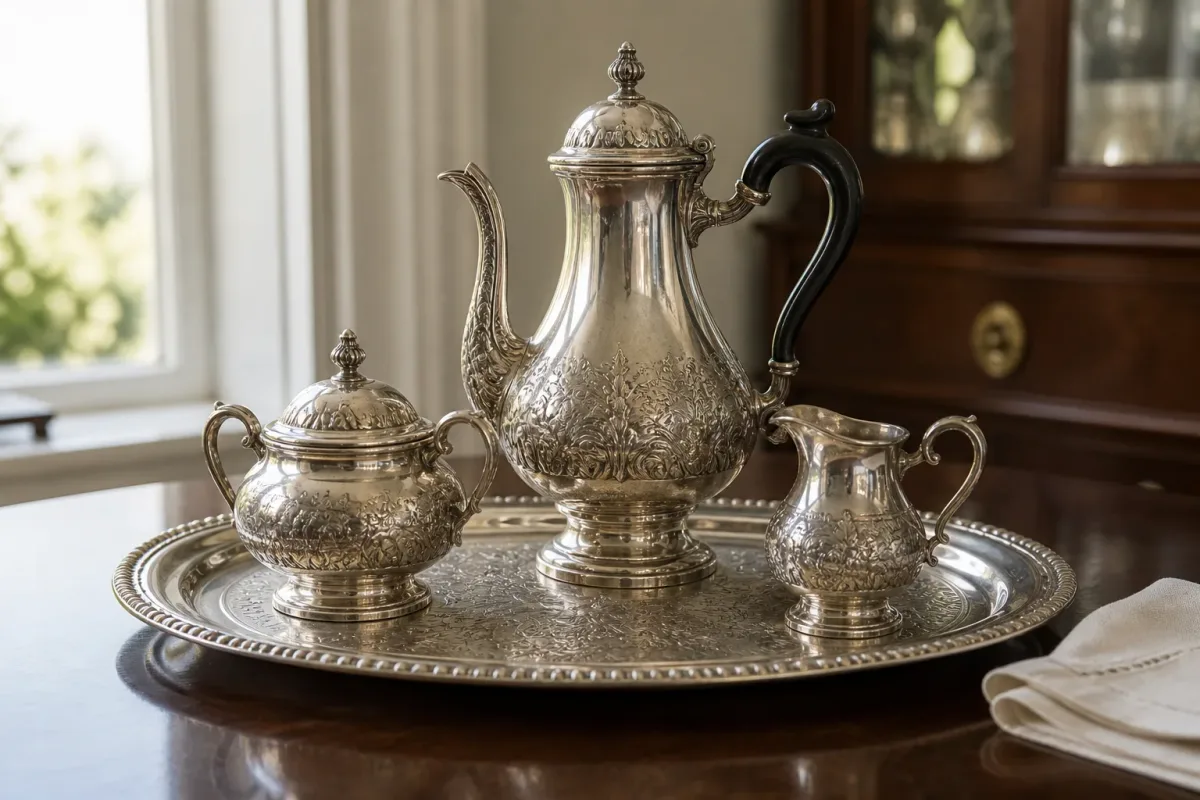
Antique Italian Silver: Hallmarks, 800 vs 925 & Collector's Guide
Learn to identify antique Italian silver: 800 vs 925, hallmarks from 1872 to today, regional schools, and collecting tips for international buyers.
Italian silver is one of the most rewarding — and most confusing — fields in European decorative arts. Before 1870 there was no single Italy, and therefore no single hallmarking system. Venice, Rome, Naples, Palermo, and the Austrian-ruled north each ran its own assay office, guild, and punch. After unification, the Kingdom of Italy first made official inspection optional, then (in 1934) imposed a national maker’s mark that collectors still use to date a coffee pot or tray at a glance.
This guide is for international buyers who meet antique Italian silver in auctions and dealer inventories: how 800 silver differs from sterling, how to read the punches, which regional schools matter, and how to avoid silverplate dressed up as the real thing.
800, 925, and What “Italian Silver” Actually Means
Italian law expresses fineness in parts per thousand. Two standards dominate collecting:
- 800/1000 — eight hundred grams of fine silver in a kilogram of alloy. This is the historic working standard for Italian hollowware: coffee pots, trays, candlesticks, flatware services. Most antique Italian table silver you will handle is 800, not sterling.
- 925/1000 — the international sterling standard. More common on jewellery and on later export pieces; it appears on some twentieth-century hollowware as well.
- 835/1000 — permitted under the 1968–1970 regulations, but collectors almost never see it.
An object stamped only “800,” with no maker’s lozenge, is not automatically fake. Between 1872 and 1934, Italian silversmiths rarely sent work to the optional official assay. Giorgio Busetto’s survey for the Association of Small Collectors of Antique Silver (ASCAS) notes that the unofficial “800” punch — oval, rectangular, or with no outline at all — is what you actually find on most late-nineteenth- and early-twentieth-century pieces, sometimes paired with a maker’s initials.
What is a warning sign: lettered stamps such as ARG 800, ARG 1000, or similar pseudo-hallmarks. Specialist catalogues treat these as silverplate marks, not solid silver.
Pre-Unification Italy: Why the Marks Look Like a Map
Until the capture of Rome in 1870, silver was a municipal and dynastic business. A winged lion, an eagle, or crossed keys can date a piece more tightly than a style of chasing. The standard modern reference for Roman and papal goldsmiths remains Costantino Bulgari’s Argentieri, gemmari e orafi d’Italia; for Venice, Pietro Pazzi’s I punzoni dell’argenteria veneta.
Venice and the lion of St Mark
The Republic of Venice used a theoretical five-mark system: maker, workshop (contrassegno di bottega), two assayer punches, and the Zecca (mint) mark. In practice, Busetto records that no surviving object is known with all five. Typical Venetian silver carries two punches, usually the assayer and the Zecca, both built around the lion of St Mark in moleca — a crouching, crab-like winged lion holding the Gospel.
Those republican punches last, with a brief Austrian interruption in 1805, until 1812. Venice then entered the Franco-Italian and Austrian Regno Lombardo-Veneto system (to 1872). Collectors look for territorial punches such as the Venetian aplustre (a classical stern ornament) and, for 800/1000 “large works,” a globe with zodiac band — marks in Donaver and Dabbene’s Argenti italiani dell’Ottocento.
Venetian table silver of the eighteenth century tends toward thin, highly chased sheets, often parcel-gilt, and forms that sit comfortably beside other Venetian decorative arts. If you are already looking at the city’s glass, the authentication problems are different materials with the same geography: see our Murano glass history and authenticity guide.
Rome and the Papal States
Papal silver is a world of ecclesiastical vessels, reliquaries, and household plate for cardinals’ tables. Guarantee marks used crossed keys and related papal devices; the French occupation of 1810 briefly imposed the decimal system of the law of 9 Brumaire Year VI. After the Restoration, the Bando Generale of 7 January 1815 (Cardinal Pacca) restored an ounce-based scale and new warranty punches. Three finenesses were admitted in Rome: 11.09 ounces (about 947/1000), 10.16 ounces (about 889/1000), and 9.14 ounces (800/1000, reserved for older work). Surrounding papal provinces received letter codes (Bologna B, Perugia p, Spoleto S, and so on).
Naples and the Kingdom of the Two Sicilies
Neapolitan hallmarking is documented from a 1437 privilege of Alfonso of Aragon. The goldsmiths’ corporation later became powerful enough that a 1690 pragmatic (Prammatica LVII De Monetis) concentrated precious-metal work in Naples and a forty-mile radius, setting silver at ten ounces of cupelled metal and two of alloy per pound — 833.33/1000. Guild punches read NAP, NAPL, or NA under a crown, often with date digits.
Napoleonic legislation (Law n. 242 of 17 December 1808) abolished the guilds, introduced decimal fineness of 917 and 834, and aligned Naples with the French assay model. Restoration-period and later Bourbon punches are a separate, still regional language — one reason “Neapolitan silver” deserves its own collecting file, not a footnote to Rome.
Sicily: Palermo, Messina, Catania
Sicilian silver is Spanish-inflected, heavily ecclesiastical, and locally punched. Collector literature and regional dictionaries (including Sandra Bonsignore Vitale on Sicilian silversmiths) associate:
- Palermo — eagle (wings lowered, later raised)
- Messina — cross on three mounts
- Catania — elephant of the city’s arms (the Liotru)
- Trapani — sickle-and-branch device into the early nineteenth century
These city punches, plus a master’s monogram, are how a Palermitan chalice is told from a mainland copy. Sicilian silver sits in the same collecting landscape as other island crafts — including the ceramic teste di moro treated in our Sicilian Moor’s Heads guide — but the metalwork is a guild tradition, not folk pottery.
The National System Collectors Actually Use (1872–Today)
1872–1933: optional official marks
The law of 2 May 1872 created a national framework and then largely stepped back. Official punches existed for 950, 900, and 800, often described as crowned-head marks, but they were not compulsory. Silversmiths stamped “800” in whatever shape they liked, added initials or a full name, and sometimes omitted a standard mark entirely. Dating in this half-century depends on maker’s research, style, and (when you are lucky) a named retailer.
1934–1944: the lozenge with the fasces
Law 5 February 1934, n. 305 is the turning point. Makers had to register. Silver standards were 800 and 925, struck in an oval. The maker’s mark became a lozenge containing:
1. the silversmith’s registration number
2. the fasces (the Fascist bundle of rods and axe)
3. a two-letter province code (MI Milan, RM Rome, NA Naples, FI Florence, VI Vicenza, PA Palermo, and so on)
A tray with an oval 800 and a lozenge that includes the fasces was marked under that statute. The period is short, which is why these punches are useful dating tools.
1944–1968: same lozenge, fasces gone
Decreto legislativo luogotenenziale 26 October 1944, n. 313 ordered the fasces removed. The lozenge kept number and province only. New punches were not instantly available; some workshops cancelled the fasces on old tools and kept using them for a transitional stretch. A lozenge without star and without fasces generally means 1944–1968.
1968–present: the star
Law 30 January 1968, n. 46, implemented with D.P.R. 30 December 1970, n. 1496, is the system still on modern Italian silver. The maker’s mark is a polygon (a rectangle with pointed ends) with a five-pointed star at left, then the registration number and province letters. Fineness — 800, 835, or 925 — remains in an oval. Later legislation (including Legislative Decree 22 May 1999, n. 251, on filled objects, and the 2002 precious-metals framework) adds rules without replacing that visual grammar.
Quick field test: star = after 1968. Fasces = 1934–1944. Lozenge, number, province, no star = 1944–1968. Bare “800” = usually earlier, or at least not fully conforming to the later compulsory pair of punches.
How to Read a Mark on the Object
Punches hide on the reverse of a spoon stem, the underside of a tray, inside a coffee-pot foot, or on a candlestick base. Use a 10× loupe. Do not polish the area first with abrasive paste — you can erase the only dating evidence the piece has.
Read in this order:
1. Fineness — 800 or 925 in an oval (after 1934). If you only see a naked 800, you are probably before compulsory national marking, or looking at a workshop that ignored the optional 1872 assay.
2. Maker — number + province. “26 MI” is a Milan registration, not a date. The number is assigned by the provincial Chamber of Commerce; the same number in another province is a different person.
3. Shape of the maker’s punch — fasces, empty lozenge, or star. That is your date bracket.
4. Extra words — riempito or an R in a square means the object is loaded or silver-skinned over mastic or a base. Italian law allows filling in candlestick bases and knife handles under strict conditions; it is not the same as solid silver throughout. Weight-range stamps such as `3÷5 g` describe the precious-metal skin, not the whole object.
Province codes worth memorising: MI Milan, RM Rome, FI Florence, NA Naples, VI Vicenza (a modern jewellery and silverware capital), AR Arezzo, AL Alessandria, PA Palermo, VE Venice, TO Turin.
Regional Taste After Unification
National marks did not erase local style.
Milan became the twentieth-century luxury address. Mario Buccellati (born Ancona, 1891; died Milan, 1965) took over the Beltrami e Besnati shop in Via Santa Margherita in 1919, added Rome (Via Condotti, 1925) and Florence (Via Tornabuoni, 1929), and built an international clientele that included Gabriele D’Annunzio. Buccellati silver is less about a single “Baroque” shape than about engraved texture — lace, tulle, honeycomb, leaf, and animal surfaces — closer to goldsmithing than to factory hollowware. Post-1968 pieces carry a star and a Milan number; treat the name on a box as marketing until the punches agree.
Florence retained a sculptural, historicist streak. Houses such as Pampaloni (Ermindo Pampaloni’s workshop near the Ponte Vecchio; later generations from the 1950s) are known for revival forms, including silver after Giovanni Maggi’s early-seventeenth-century Bichierografia drawings in the Uffizi. The Tesoro dei Granduchi in Palazzo Pitti — formerly the Museo degli Argenti — is the public collection to visit, though a substantial silver group is the Treasure of Salzburg brought by Ferdinand III of Lorraine, not a survey of Tuscan workshops.
Vicenza and the north-east supply much of the later commercial silver Italy exports. A VI province mark on a 1970s tray is factory geography, not a Renaissance pedigree.
A silver service on an Italian table was rarely alone. Period dining rooms mixed metal with tin-glazed maiolica, court porcelain from Capodimonte and Doccia, and, in Tuscany, coloured Empoli glass. Those pairings help you judge whether a “set” is original or assembled.
Solid Silver, Plate, and Loaded Ware
Italian auction rooms still mix three different materials under one photograph.
Solid silver (argento massiccio) takes a fineness punch. It is heavy for its size; a one-litre coffee pot is typically several hundred grams of metal, not a light shell.
Electroplate sits on brass, copper, or nickel silver. Look for EPNS, EP, sheffield, silverplate, or the ARG-plus-number stamps mentioned above. Wear on rims and handles shows yellow or grey base metal. A plated object can be beautifully designed; it is not 800 silver.
Loaded or filled silver is honest when marked riempito. Candlesticks especially were weighted for stability. Price them as mixed-media objects, not by the kilogram.
A magnet is only a crude screen. It does not replace the punch.
Condition, Restoration, and Buying
Honest wear on an 800 tray — knife scratches, a softened foot ring, tarnish in the recesses of chasing — is normal. Red flags are a washed-out, over-polished surface that has lost the punch, replaced ebony handles glued with modern epoxy and no corresponding age, and “pairs” of candlesticks whose marks do not match.
Restoration of dents is acceptable if disclosed. Re-chasing a worn cartouche to make a piece look eighteenth-century is not. Photograph marks before any polish.
Value follows maker, date bracket, completeness of a service, and quality of handwork — not melt. A documented Buccellati animal or a seventeenth-century Venetian tazza lives in a different market from a 1950s 800 flatware canteen, even if the canteen weighs more. Melt value is a floor, not an appraisal.
If you buy in Italy, objects of cultural interest may need an export licence (attestato di libera circolazione) from the export office of the Ministry of Culture. Rules sit in the Cultural Heritage Code (Legislative Decree 42/2004) and change with thresholds and categories; ask the dealer to state in writing whether a licence is required. Do not assume a small coffee pot is exempt because it is “only silver.”
Useful references: Bulgari for Rome; Pazzi for Venice; Donaver–Dabbene for nineteenth-century northern marks; the ASCAS / silvercollection.it plates for the 1872–present national sequence. Auction silver departments remain the practical school for handling marks on real objects.
FAQ
Is Italian 800 silver “real silver”?
Yes. It is a legal alloy of 80 percent fine silver. It is not sterling (92.5 percent), and it should not be priced as if it were, but it is not plate.
How can I date a piece from the hallmarks alone?
After 1934, the maker’s punch is the clock: fasces (1934–1944), lozenge without star (1944–1968), star (1968 onward). Before 1934 you need style, maker’s initials, and — for earlier centuries — city punches (Venetian lion, papal keys, Neapolitan NAP, Sicilian civic arms).
Why do some genuine pieces have only “800” and no star?
Because compulsory, uniform maker’s lozenges date from 1934, and the star from 1968. A lone 800 is typical of the long optional-assay period after 1872.
What does a number like “1750 AR” mean?
It is not a year. It is maker number 1750 registered in the province of Arezzo, in the post-1968 star format.
How do I tell Venetian silver from later “Venice-style” work?
Look for the lion in moleca or documented Lombardo-Veneto territorial punches, not a gondola in the chasing. Revival pieces of the late nineteenth and twentieth centuries often copy rococo ornament and carry national 800 marks instead.
Are ecclesiastical pieces a separate market?
Yes. Chalices, monstrances, and reliquaries follow liturgical form and often papal or diocesan marks. Treat them as a specialist category, not as fancy table silver.
Conclusion
Antique Italian silver is a federal subject pretending to be a national one. Learn the 800 standard, learn the 1934 and 1968 punch shapes, and then go back to the city-states: the lion in Venice, the keys in Rome, the crowned NAP in Naples, the eagle and elephant in Sicily. Marks will not attribute a masterpiece by themselves, but they will stop you from paying solid-silver money for plate, from dating a 1970s Vicenza tray as “Liberty,” and from flattening five centuries of workshops into a single souvenir. Handle the punches as seriously as the chasing, and the field opens in an orderly way.