
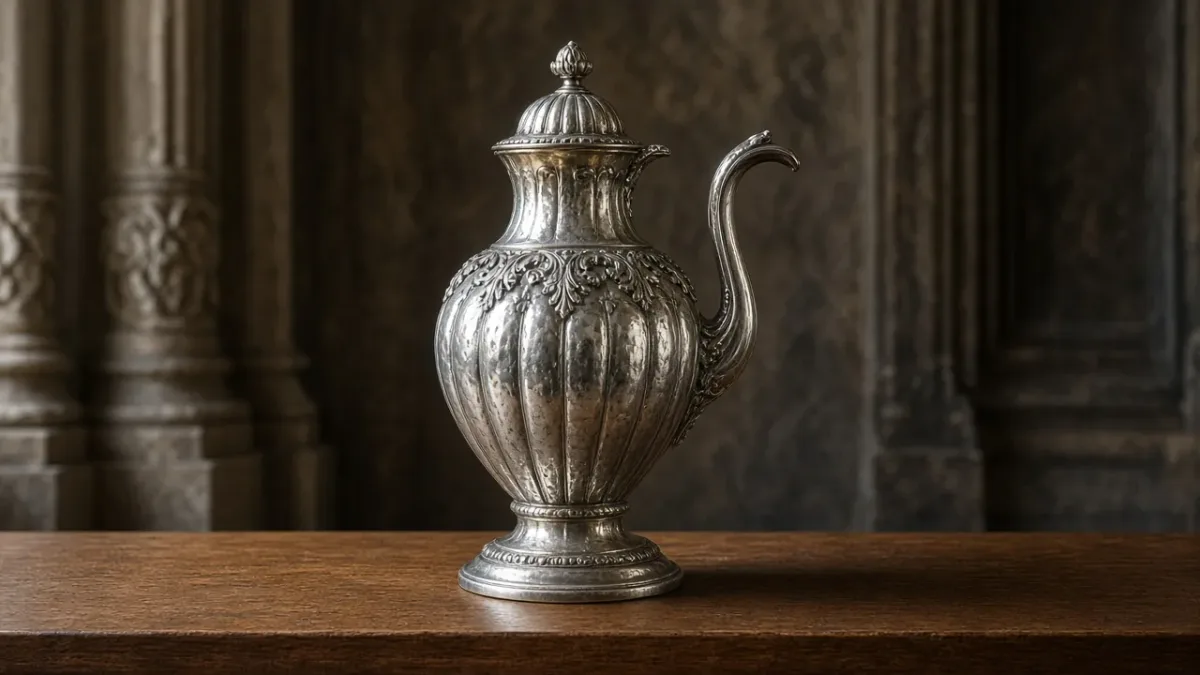
Dating Florentine Silver by Grand-Ducal Assay and Workshop Marks
Date Florentine silver by Grand-Ducal assay marks of 1832–1872, the Arte della Seta lion punch, and later FI workshop numbers used after 1934.
Florence marked silver under a guild system long before Italy had a national punch. Collectors still meet that history as a sequence of local guarantees: the oval passant lion of the Arte della Seta, a Grand-Ducal legal-title mark used from 1832 to 1872, then, after unification, the optional Kingdom punches and the numbered FI lozenges of the twentieth century. Dating Florentine silver means reading those punches against construction, not treating every Florentine lily on a body as an assay mark.
The civic giglio appears often as engraving or as a monogram device. It is a city emblem. It is not, by itself, proof of a date or a standard. For the later national framework of 800 and 925, see the Italian silver hallmarks guide. Naples and Venice used different city signs and different fineness habits; those systems are mapped in the notes on Neapolitan silver hallmarks and Venetian silver.
Guild control and the Arte della Seta
Goldsmiths and silversmiths in medieval and early modern Florence were enrolled in the Arte di Por Santa Maria, later called the Arte della Seta after the silk merchants who came to dominate the corporation. The guild’s house stood from 1377 in via di Capaccio, near the palagio di Parte Guelfa. Statutes covered not only silk but the battilori who beat gold and silver into thread, and the goldsmiths who shared the same corporate roof.
Grand Duke Pietro Leopoldo of Habsburg-Lorraine suppressed the Florentine Arti in 1770. Assay practice did not vanish with the corporation. The standard reference corpus, Dora Liscia Bemporad’s Argenti fiorentini dal XV al XIX secolo. Tipologia e marchi (Florence, S.P.E.S., 1992–1993), reconstructs marking rules from fourteenth-century statutes through the Lorraine Grand Duchy and prints plates of the punches. Volume I includes her essay on Florentine marking legislation. Any workshop name offered in a sale note should be checked against that corpus, or against an ICCD catalogue record that cites it, before it is treated as certain.
The oval passant lion, 1762–1781
A monstrance of 1781, catalogued by the Istituto Centrale per il Catalogo e la Documentazione (ICCD) and now at Pistoia, carries three punches under the foot. Cataloguers identify the guarantee as the leone passante in campo ovale of the Arte della Seta di Firenze, in use from 1762 to 1781 (Argenti fiorentini, I, p. 344, no. 17). The letters ZB match Zanobi Biagioni (ibid., I, p. 396, no. 155 a); on this object the same punch is read as likely the assayer rather than the maker. A third punch, perhaps CC, remains unread.
The date band is useful because it straddles the guild’s formal end. A passant-lion guarantee on an otherwise late-Rococo or early-Neoclassical piece can still be Florentine work of the 1760s–80s. It is not a Medici court mark, and it is not the later Grand-Ducal title punch of the 1830s.
Zanobi Biagioni is independently documented as a Florentine silversmith active 1758–1803. A pear-shaped coffee pot of about 1770, sold at Cambi, is cast, chased and raised, 32 cm high, 1,330 g, and published in Liscia Bemporad, volume 3, p. 685. The body carries a crossed-L monogram that encloses a Florentine lily. That lily is engraved decoration. The dating rests on the published punch and on the form, not on the civic flower.
Grand-Ducal title mark, 1832–1872
After the Lorraine restoration, Florence used a legal-title guarantee that ICCD cataloguers treat as diagnostic for 1832–1872. An oval cruet tray in the Florentine cathedral complex is dated to that window by the presence of the mark; style then narrows the piece to the first half of the span, about 1832–1849. The rim uses palmettes set in ogival arches, a decorative habit that Florentine goldsmiths took from Empire models. ICCD notes the role of plate commissioned from Martin-Guillaume Biennais by Elisa Bonaparte Baciocchi, Grand Duchess of Tuscany, and later restored under the Lorraine court.
Specialist hallmark literature (ASCAS / silvercollection.it) records the Florence punch of this period as a guarantee for 792/1000. That is a local standard, not sterling and not the later national 800. Do not “upgrade” a Grand-Ducal piece to 925 because a modern listing prefers that number. If the punch is worn, say so. Do not invent a 792 reading from a half-struck outline.
A parade plate of 1851 in the same ICCD series, with a palmette rim and a dedicatory wreath, carries an unidentified maker’s punch: the letter S beneath a star. Named attribution stops there. The date is on the object; the workshop is not.
Pre-unitarian Italian silver of this quality is scarce in the market. That scarcity is exactly why later workshops copied older punch shapes.
After 1872: facultative assay and the FI numbers
The law of 2 May 1872 ended the pre-unitarian offices and made official inspection optional. Most Italian silversmiths then struck only an unofficial 800 and, sometimes, a personal mark. Shapes of that 800 vary. A lone 800 on a Florentine object after 1872 is not a Grand-Ducal guarantee.
Law 5 February 1934, n. 305, imposed a uniform maker’s lozenge: a registration number, the Fascist fascio, and a two-letter province code, paired with an oval 800 or 925. After 1944 the fascio was removed from the same lozenge. Law 30 January 1968, n. 46, and D.P.R. 30 December 1970, n. 1496, replaced it with a polygonal punch: a star at left, the number, and the province. Allowed finenesses are 925, 835 and 800 in an oval. Florence is FI.
Two Florentine registrations appear often enough to be worth learning:
- FI 114: F.lli Peruzzi, Ponte Vecchio. The firm was founded in 1880 by Giuseppe Peruzzi; a Boston branch operated from 1910 to 1973. The number is among the older Florence registrations.
- FI 283: Brandimarte s.r.l., registered 1 April 1968. Brandimarte Guscelli (1930–1994) opened the workshop in 1955 in San Frediano. ICCD records on later ecclesiastical cruets note a letter mark and a head of St John the Baptist beside the official punches. The house is known for hand-hammered table silver, not for eighteenth-century forms.
A lozenge or star-and-number punch with FI dates the maker’s registration, not the style of the body. Revival candlesticks of 1970 can look “Empire.” Read the official mark first.
What the silver looks like
Liturgical plate is the backbone of documented Florentine survival: chalices, monstrances, cruets, holy-water buckets. Domestic forms that reach the market include coffee pots, candlesticks, trays and later table services. Eighteenth-century work is often raised and chased, with acanthus, ribbed pear bodies and applied spouts. Early nineteenth-century work flattens toward Empire: smooth grounds, palmette borders, engraved arms. A nineteenth-century chalice by the Scheggi brothers in the Museo Nazionale del Bargello is a dated example of that later liturgical production.
Construction tells more than a single crisp punch on a replaced cover. Look at the solder colour at foot and handle, the gauge of the sheet, and wear on thumbpieces and footrims. A lid that does not share the body’s punch set is a repair until proven otherwise. Electroplated copper with a later 800 stamp is a different object from raised silver of 792 or 800.
Florentine hardstone work of the same centuries is a separate craft. The Galleria dei Lavori, founded by Ferdinando I de’ Medici in 1588 and later the Opificio delle Pietre Dure, produced ebony cabinets and gilt-bronze mounts under Giovanni Battista Foggini (1652–1725). The Stipo dell’Elettore Palatino (1709) at Palazzo Pitti is that workshop, not a silver table service. For the hardstone side of the same court, see Florentine pietra dura.
The Tesoro dei Granduchi is not a survey of local plate
The Tesoro dei Granduchi at Palazzo Pitti, formerly the Museo degli Argenti, occupies the Medici summer apartment, frescoed in 1637 for the marriage of Ferdinando II and Vittoria della Rovere. The Medici treasure on view is mainly vases in hardstones, rock crystal, amber and ivory. The silver displayed there comes largely from the so-called Tesoro di Salisburgo, the collections of the prince-bishops of Salzburg brought to Florence by Ferdinando III of Lorraine. Visitors who expect a wall of punzoned Florentine coffee pots will not find one. Use the museum for court context. Use Liscia Bemporad and the ICCD records for marks.
Workshops that still make silver in the Oltrarno and on the Ponte Vecchio sit in the same streets as the furniture and mosaic trades. The Florence antiques walking guide maps those districts; it is not a substitute for a punch photograph.
Forgeries and pseudo-hallmarks
From the mid-twentieth century, some Italian factories added pre-unitarian-looking punches beside legal 800 and lozenge marks, as historicist decoration. ASCAS documents the practice above all on Lombardo-Veneto and Papal shapes; a Florentine case is also recorded. Fernando Genazzani of Florence, 71 FI, working 1935–1944, struck a facsimile of the Papal crossed keys on a wax jack that also bears his Fascist-period lozenge. In the published example the modern mark had been hidden under a label.
The fraud, when it occurs, is usually the later removal of the official lozenge, so that a 1950s object is offered as Grand-Ducal or Papal silver. Style, weight and the exact outline of the old-looking punch have to agree. A clean 1832–1872 guarantee on a body whose chasing is machine-even and whose solder is bright white deserves more photography, not a higher date.
How to read a piece
1. Photograph every punch in raking light. Record outline shape, not only the letters you hope to see.
2. Separate guarantee, assayer or saggiatore, and maker. On the 1781 monstrance those are three different punches.
3. Place the object in a regime: oval passant lion (1762–1781); Grand-Ducal legal title (1832–1872, 792/1000 in the specialist literature); unofficial 800 after 1872; lozenge with FI from 1934; star-and-number FI from 1968–70.
4. Check construction: seams, gauge, wear, replaced lids and feet.
5. Do not treat an engraved lily as a hallmark.
6. Name a workshop only when the punch matches a published Florentine corpus (Liscia Bemporad for the earlier centuries; the national registers for FI numbers).
Common mistakes: reading any Italian 800 as Grand-Ducal; dating only by silhouette; confusing a Brandimarte hammered jug of the 1960s with eighteenth-century raising; assuming the Tesoro dei Granduchi collection is local plate.
FAQ
What fineness is “typical” Florentine silver?
For the 1832–1872 guarantee, specialist mark surveys give 792/1000. After 1872 the usual trade standard is 800; 925 appears under the 1934 and later national rules. Always read the punch on the object.
Is the Florentine lily an assay mark?
No. The giglio is a civic emblem used in engraving and in some decorative monograms. The documented eighteenth-century guarantee is the oval passant lion of the Arte della Seta.
What does FI mean on a lozenge or star punch?
Firenze. The number is the maker’s registration in that province. FI 114 is Peruzzi; FI 283 is Brandimarte. The number dates the registration system, not the historical style of the form.
Why do so few Medici table services survive?
Much court plate was melted in successive fiscal and political crises. What the Tesoro dei Granduchi shows as “silver” is, by the museum’s own account, largely the Salzburg treasure of Ferdinando III, not a Medici dining service.
How do I tell a Grand-Ducal piece from a 1930s revival?
The 1934 lozenge (and the later star-and-number punch) should be present on legal twentieth-century work. A revival body without those marks, or with them erased, needs a specialist’s eye on the older-looking punches.
Conclusion
Florentine silver is dated by the punch regime in force when the piece was assayed, then by construction. Learn the oval passant lion of 1762–1781, the Grand-Ducal title mark of 1832–1872, and the FI numbers of 1934 and 1968–70. Attribute makers only when initials or registration numbers match a published Florentine corpus and the object agrees in date and making. The lily on the body is decoration until a guarantee punch says otherwise.